


Reverse osmosis systems depend on sufficient pressure to push water through a semipermeable membrane. When inlet pressure is weak, production slows, rejection performance may decline, and wastewater can increase. This is where a Ro Booster Pump becomes useful. It raises feed pressure before water reaches the membrane, helping the system operate within its recommended range.
In practical installations, the difference can be visible. A storage tank may fill more quickly. The filtered water stream may become steadier. The membrane can also reject dissolved salts more effectively when pressure remains stable. However, pressure alone is not the complete answer. Feedwater temperature, membrane condition, clogged prefilters, and incoming water quality all influence performance. A pump cannot repair a damaged membrane.
Correct sizing matters. An experienced installer checks the source pressure, required flow rate, membrane capacity, and electrical supply before selecting equipment. Pressure switches, automatic shutoff controls, and low-pressure protection can improve safety and reliability. Regular monitoring is still necessary. A pressure gauge, conductivity meter, and filter inspection provide useful evidence over time.
The answer is not always yes. Some systems already receive adequate pressure. In those cases, adding a pump may increase noise, energy use, or unnecessary stress on components. I have seen troubleshooting focus on the pump when a blocked prefilter was the real problem. That mistake is easy to make. A careful diagnosis creates better results than simply adding pressure. This guide explains when a Ro Booster Pump is beneficial, how it supports membrane performance, and which practical details deserve closer attention.
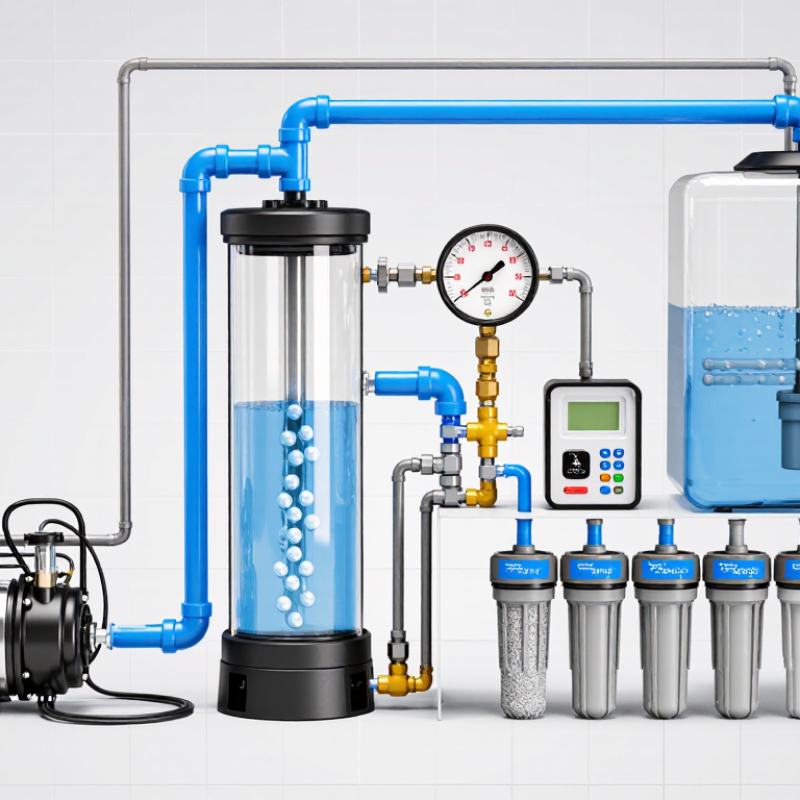
Why Use an RO Booster Pump for Reverse Osmosis?
Reverse osmosis depends on pressure, not just membrane quality. Household systems commonly need about 40–80 psi to operate effectively. Below that range, water production can slow sharply, while dissolved-solids rejection may decline. A booster pump raises and stabilizes feed pressure before water reaches the membrane. This matters in upper-floor apartments, rural homes, and properties with aging pipes.
Pressure requirements change with the water source. The World Health Organization reports typical operating pressures of about 15–25 bar for brackish-water RO and 55–80 bar for seawater RO in its technical guidance, Desalination for Safe Drinking-water Supply. Those pressures are far beyond ordinary domestic plumbing. Residential units use smaller membranes and lower flows, but they still need consistent pressure. The U.S. Environmental Protection Agency also identifies pressure and recovery as important factors in point-of-use RO performance. More pressure is not automatically better. Excessive pressure can increase leaks, noise, and membrane stress. I have found that unstable pressure is often mistaken for a faulty membrane.
Tips: Measure pressure at the membrane inlet, not only at the household tap. Check the gauge while water flows. A static reading can mislead. Use the membrane’s rated pressure, and allow room for seasonal changes. Booster pumps should include an automatic shutoff and a pressure switch. A small pressure tank can reduce frequent cycling, although its settings need careful adjustment.

Reverse osmosis depends on pressure to push water through its semipermeable membrane. When household pressure falls below about 40 psi, production can become painfully slow. A booster pump raises feed pressure, often toward the membrane’s practical working range of 60–80 psi. This creates a stronger driving force across the membrane. The result is usually faster permeate flow and steadier performance during peak household use.
Pressure is not magic. In field checks, a pressure gauge should be installed before the membrane, not guessed from faucet flow. The U.S. EPA WaterSense Specification for Point-of-Use Reverse Osmosis Systems reports that conventional systems may discharge around five gallons of wastewater for every gallon treated. Efficient systems must stay at or below 2.3 gallons under the specification. Better pressure can support efficiency, but only when the membrane and flow restrictor are correctly matched. NSF/ANSI 58 testing also emphasizes controlled operating conditions.
A pump can compensate for a weak supply line, a high building elevation, or cold seasonal water. It cannot repair a blocked prefilter. Nor can it fix an incorrectly sized membrane. That part is easy to overlook. A practical setup uses a pressure switch, automatic shutoff, check valve, and a clearly visible gauge. Excessive pressure may stress fittings and shorten membrane life. For this reason, I would test inlet pressure first, replace exhausted filters, and add the pump only when measurements justify it.
| Performance Dimension | Without a Booster Pump | With a Properly Sized Booster Pump | Practical Meaning |
|---|---|---|---|
| Feed-water pressure | Often 40–60 psi (2.8–4.1 bar), depending on the building supply | Commonly regulated to approximately 70–100 psi (4.8–6.9 bar), subject to membrane and system limits | Higher pressure improves the driving force that pushes water through the RO membrane. |
| Permeate production | May be substantially below the membrane’s rated capacity when pressure is low | Often approaches the membrane’s rated production when temperature and water quality are suitable | A pump can reduce filling time, but actual output also depends on temperature, salinity, fouling, and flow restrictions. |
| Production consistency | Output can vary significantly during peak household demand | More stable pressure and flow during normal operating conditions | The pump helps compensate for low or fluctuating inlet pressure. |
| Water recovery | Residential systems commonly recover about 15%–25% of feed water as permeate | Recovery may improve when the system is correctly adjusted, but it is not determined by pressure alone | Flow restrictor settings, membrane design, and feed-water chemistry must remain within specification. |
| Waste-water ratio | Often around 3–5 parts concentrate to 1 part purified water in conventional residential systems | May be reduced in a properly configured system, commonly toward approximately 2–3 parts to 1 | Reducing waste requires correct hydraulic adjustment; excessive pressure can damage components or reduce membrane life. |
| Membrane rejection | Can decline when pressure is too low, especially with high dissolved-solids water | Usually supports the membrane’s intended salt-rejection performance when operating conditions are correct | Pressure supports rejection, but it does not replace proper pretreatment or a functioning membrane. |
| Typical pump control | Not applicable | Pressure switch, automatic shutoff valve, or electronic controller | Automatic controls stop the pump when the storage tank is full and help prevent unnecessary operation. |
| Energy requirement | No additional pump electricity | Requires electricity, commonly through a low-voltage power supply | The trade-off is higher energy use in exchange for faster and more consistent RO production. |
| When it is most useful | Adequate when inlet pressure remains within the membrane manufacturer’s recommended range | Useful when pressure is consistently low, fluctuates, or falls below the system’s recommended operating level | Pressure should be measured under flow, not only when all household faucets are closed. |
Reference note: Values shown are typical residential RO ranges, not universal specifications. Always follow the membrane, pump, pressure-vessel, and system manufacturer’s operating limits.
Why Use an RO Booster Pump for Reverse Osmosis?
An RO booster pump improves feed pressure before water reaches the membrane. This pressure helps the membrane separate dissolved salts, metals, and other unwanted substances more effectively. Many residential systems perform best near 60–80 psi, although the correct range depends on membrane design and water temperature. When pressure drops below the system’s rated level, production slows and rejection performance may weaken. The difference can be visible: a storage tank fills overnight instead of during the afternoon.
The U.S. EPA’s WaterSense WaterSense at Work guidance reports that conventional point-of-use RO systems may discharge three to five gallons of concentrate for every gallon treated. Higher pressure can support better recovery, but a pump does not automatically eliminate wastewater. Flow restrictor settings, membrane condition, and feed-water temperature still matter. Sometimes, the pump is blamed for a problem caused by a clogged prefilter. That mistake wastes money.
A booster pump can also provide steadier performance in apartments, upper floors, or homes with fluctuating municipal pressure. NSF/ANSI 58 evaluates residential RO systems for material safety, structural integrity, and contaminant reduction claims. It does not mean every pump installation achieves the same results. Pressure should be checked with a gauge, not guessed from faucet flow. A practical setup includes a pressure switch, low-pressure protection, and correctly sized tubing. Quiet operation is useful. Excessive vibration is not. Periodic testing remains necessary, because higher pressure cannot correct a damaged membrane or poor maintenance.
A booster pump helps maintain the pressure required by an RO membrane. Higher and more stable feed pressure generally improves permeate production and supports better membrane separation, especially when incoming water pressure is low.
Chart note: The comparison uses 60 psi as a normalized reference point. Actual permeate flow varies with water temperature, membrane condition, feed-water chemistry, and osmotic pressure.
An RO booster pump stabilizes feed pressure when municipal supply is weak or inconsistent. Higher pressure can improve membrane production and reduce rejection of dissolved contaminants. It also helps during morning demand, when a kitchen tap may deliver only a thin stream. The pump is not a cure-all. A clogged prefilter will still restrict flow.
Pressure is the key selection factor. Check the membrane’s recommended operating range, then measure pressure while water is running. Static pressure can look healthy but collapse under demand. Flow matters too. Select a pump that meets the required gallons per minute without excessive pressure. Oversizing may increase noise, leakage risk, and membrane stress.
The U.S. Environmental Protection Agency reports that conventional point-of-use RO systems can discharge about five gallons for every gallon treated. Better pressure control may improve this ratio, but plumbing and membrane condition remain important.
Tips: Match the pump to real measurements, not package claims. Add a low-pressure cutoff to protect the pump. Use a pressure switch compatible with the storage tank. Allow space for vibration isolation. A simple pressure gauge helps reveal seasonal changes and blocked filters. Also, recheck performance after installation. Some systems still waste water because the flow restrictor is mismatched. That detail is easy to miss. EPA WaterSense guidance also emphasizes efficiency testing, recovery, and contaminant reduction, not pressure alone. A quieter pump may be preferable, but reliability should come first.
A booster pump helps an RO membrane work when incoming pressure is weak or unstable. Many residential systems perform near 60 psi, although the membrane manufacturer sets the correct target. Low pressure can reduce flow, increase wastewater, and leave higher total dissolved solids in treated water. EPA WaterSense materials report that standard point-of-use RO systems may discharge about five gallons of water for every gallon treated. More efficient systems can approach 2.3 gallons or less. A pump may improve recovery, but it cannot fix a blocked prefilter or an incorrectly sized membrane.
Installation needs careful pressure control. Mount the pump on a rigid surface, keep tubing away from hot pipes, and confirm the flow direction before opening the supply valve. Use a pressure gauge before the membrane. This small detail exposes problems early. Electrical connections should remain dry and use appropriate ground-fault protection. A leak detector or automatic shutoff adds another layer of safety, especially beneath a kitchen sink. Local plumbing and electrical requirements still apply.
Tips: Replace sediment and carbon filters on schedule, or sooner when pressure drops sharply. Sanitize the housing during membrane service. Check product-water TDS with a calibrated meter, then compare it with feed-water TDS. CDC household water-treatment guidance stresses routine maintenance because neglected devices can lose performance and support microbial growth. Do not chase maximum pressure blindly. Excess pressure can stress fittings, increase noise, and shorten component life. A commissioning record with pressure, TDS, flow, and date makes future troubleshooting easier. Even experienced installers sometimes skip it. That is worth reconsidering.


For those larger-sized parts, or smaller quantity runs, we have 2 independent powder coat booths and ovens. The quality, durability and affordability of today’s powder coating finishes make this the process of choice for world-class companies.
Powder coating advantages over other forms of coating are many. Materials used in the Powder coating process can be metals and non-metals that come in a multitude of thicknesses, textures, colors, etc. Another of Powder coating’s biggest advantages over conventional coatings is its ability to create finishes in many different textures. Powder Coating Booths allow us the ability to apply these advantages to large products.
Tri-State Fabricators runs a full-service conveyor line for painting. Wet painting can provide protection or decoration to many different part styles. From start to finish, every project is easier to undergo random and point-based inspection by our skilled painting team.
Advantages to our Wet Paint Line are these lines start with product prep and ends with a thorough inspection of a high quality finished product. Our ability to complete large and small projects with a superior finish and doing so in a timely and economical fashion. This passes along the savings in production to our customers. When powder coating ins not an option, our Wet Paint Line gets the job done right the first time.
When the parts get big and heavy we roll-out our custom paint racks and oversize booth. By utilizing our partnerships with all the major paint brands, we can match virtually any color with wet paint.
The advantages of having access to a Wet Paint Booth are many. Large projects of many different shapes can be loaded into the booth. The Wet Paint Booth offers an environment that is much more controlled than a typical parts painting operation.
Not only are they used because of their controlled environment, but they’re are also advantageous when it comes to applying paint to parts that are needed in industries that require specialty coatings such as medical, aerospace, etc.
Our military forces have some very high standards when it comes to the finish of their vehicles and equipment. From the first pre-treatment step to final coat, it takes a great deal of knowledge and experience to protect the men and women of our armed forces. They deserve only the best, and Tri-State Fabricators provides it.
All of our processes are closely monitored by our staff and management teams. Both of which are highly trained in the processes of metal fabrication and finishing. Tri-State Fabricators’ goal is to always fully satisfy each and every customer, including the military. We will always put a 110% into what we do.
Abrasive media blasting is an excellent way to remove old paint, rust, and increase the paint/powder adhesion. Glass beads produce a much smoother and brighter finish than angular abrasives; leaving the part clean yet without any dimensional change. Chemically inert and environmentally friendly, we can recycle our beads approximately 30 times; making them a more preferred method of metal cleaning or surface finishing.
Advantages to Glass Bead Blasting are many. Glass bead blast media is used when a project is needing rough surfaces need to become smooth for applications of coatings such as paint. It is typically used to clean paint and rust from a product surface without deforming the surface it is being used on. Overall, compared to many other blasting media, Glass Bead Blasting is a very economical choice and those savings are always passed on to our customers.
Tri-State Fabricators utilize a zinc phosphate wash to clean and etch the material to ensure the best paint adhesion possible. The unique design of our 3-stage wash system does the work like a 5-stage. From Cleaning and rinsing to conversion coating and post-treatment, Our Part Washing process is a complete service and works throughout the fabrication service and the finishing service.
Along with the previously mentioned benefits, Curing is a vital chemical reaction that leaves the product finish hard and relatively safe from mild abrasion and aggressive corrosion. This process can be done in more than one way; ambient air-dry or in curing ovens at temps that exceed 240°.
From fixing paint mistakes (someone else’s of course) to simply cleaning our paint line hooks, our burn-off oven is put to good use. After a quick burn-off, a little clean up, and a fresh coat of paint, your parts will look better than new.
Why does our Burn-Off Oven work so well? Because super heating the air around parts turns the materials into ashes. From paint and powder coatings to rubber and machining oils, high temps do the job without degrading the integrity of the part.
Masking is a vital part of producing high quality products. We have die-cut masking patterns to protect machined surfaces as well as a wide range of plugs and caps to protect threaded holes and bolts. We provide permanent and temporary masking.
Masking allows the selected sections of a product to be protected from a fabrication or finishing service. This can be with both chemicals when etching and tapes, paints when only finishing just a section of the product. Masking is great in aiding the customization process of a project.
Screen printing is a photographic process that transfers artwork onto a porous nylon screen which allows colored ink to flow through the screen and be deposited on an aluminum or plastic component. We can generally have just about any design created onto a screen for your parts.
Some of the advantages of Screen Printing are, brand recognition for your business displaying on your products, assembly instructions, product warnings/hazards, etc. Tri-State Fabricators produces Screen Printing of the highest quality so you know it’s durable.
Metal Finishing is the art of treating the exterior portion of product, often metal but can also be made of other materials, so that the surface is clean and free of any debris. Then the process of applying coats or either paint of powder coat takes place. This coating process improves the quality of the product in both appearance and resistance to wear and corrosion.
Tri-State Fabricators, Inc., understands that a project typically isn’t complete until a high-quality finish has been added to your product. This is why our painting and powder coating teams continuously inspect the products throughout the Metal Finishing process.

