Why Is a PCB Conveyor Important for SMT Assembly?
A PCB does not pause for a better handoff. It moves from printer to placement machine, then through reflow, while operators watch for skew, jams, and missing boards. A Pcb Conveyor helps keep that movement controlled. It links separate SMT stations, supports steady line flow, and gives operators access points for inspection or manual intervention. Small details matter: rail width, transfer height, board support, and stop accuracy can affect the next process.
The International Federation of Robotics reported 4,281,585 industrial robots operating worldwide in 2023, up 10% from the previous year. That figure describes industrial automation broadly, not SMT conveyors specifically. Still, it signals the direction of modern production: connected equipment depends on predictable material handling. IPC’s assembly standards also reinforce the need for controlled, repeatable processes, though a conveyor alone cannot guarantee product quality.
One practical rule captures the point: “A smooth SMT line begins with a reliable board handoff.” This is an editorial process principle, not a verified quotation from a named conveyor specialist. That distinction matters. Real production results depend on the full line, including machine setup, maintenance, and operator training. Conveyors can look simple. Their impact is not. A poorly matched unit may create bottlenecks that are easy to overlook until boards begin queuing between machines.
What a PCB Conveyor Does in SMT Assembly
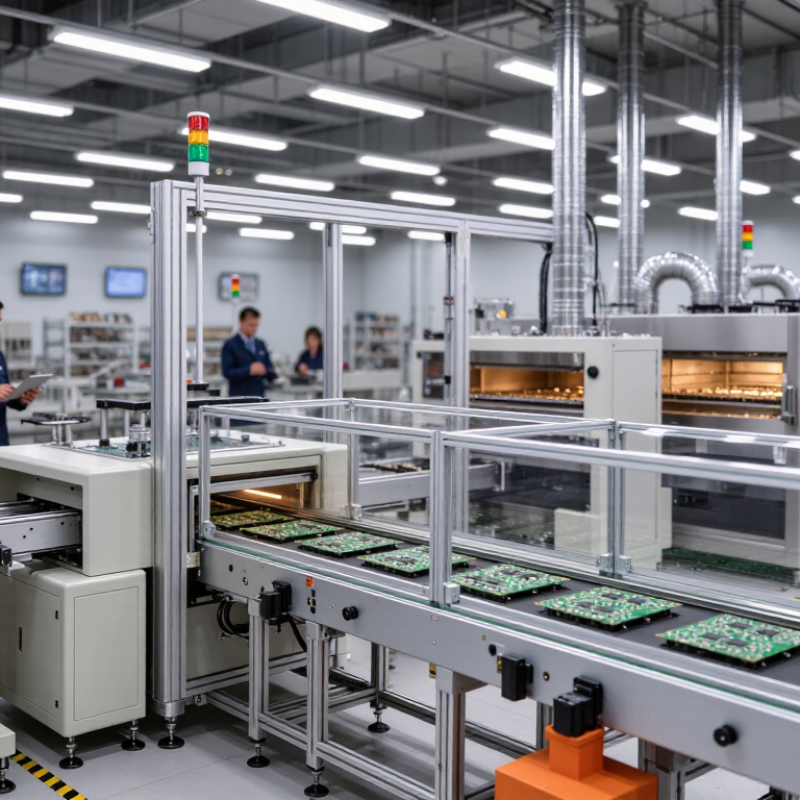
A PCB conveyor moves boards between SMT machines while keeping their travel controlled. At a typical handoff, side rails support the panel, and a sensor confirms its position before the next machine accepts it. The conveyor can stop a board briefly, maintain spacing, and coordinate transfer signals with a printer, placement machine, or inspection unit. That pause matters. Without it, boards may collide, arrive out of sequence, or stop where an operator cannot easily access them. Adjustable rails accommodate different panel sizes, but they need careful setup to prevent skew or edge contact.
Conveyors also make the line easier to monitor. An operator can spot a growing queue, notice repeated stops, and check whether a downstream machine is slowing production. Some units include buffers that hold boards during short interruptions; they cannot fix a lasting bottleneck. Small details count. A loose rail setting or mismatched transfer height can cause scratches, misalignment, or recurring jams, even when the machines work properly. Conveyor settings need checking after product changes and maintenance. It is tempting to treat this equipment as a simple bridge. That view misses its role in timing, board handling, and making line problems visible.
How Boards Move Through the SMT Production Line
A PCB conveyor is the line’s moving path, carrying each panel between printing, inspection, component placement, and reflow. Guide rails hold the board edges while sensors confirm its position. At a transfer point, a poorly aligned panel can pause the next machine or arrive skewed. Small details matter.
The International Federation of Robotics’ World Robotics 2024 report recorded 541,302 industrial robot installations worldwide in 2023. That figure reflects the scale of automated production, where steady material flow matters as much as machine speed. In SMT, conveyor speed and buffer settings help prevent one station from starving while another waits. Operators also adjust rail width for different board sizes and check that clamps do not touch components. Watch the handoff.
A practical setup needs more than a fast belt. It needs repeatable stops, compatible transfer heights, and gentle handling that limits board flex. After a line changeover, a test panel can reveal jams or uneven spacing before production resumes. Yet settings that work for one board may fail on a heavier panel. I have seen line plans look tidy on paper, but the real transfer points deserve another look. The conveyor is easy to overlook until a board stops moving.
How Conveyor Systems Support Accurate, Consistent Processing
A PCB conveyor does more than move boards between machines. It helps keep each board centered, supported, and ready for the next process. At the printer, placement machine, reflow oven, and inspection station, small differences in transfer height or speed can disturb alignment. A stable rail setting and repeatable handoff reduce those avoidable variations. They do not guarantee a defect-free board.
The MHI 2023 Annual Industry Report found that 87% of respondents expected to increase supply-chain technology investment over the following two years. This is broad industry data, not an SMT-specific performance measure, but it reflects growing attention to automation and controlled material flow. In an SMT line, conveyor sensors can confirm board presence, while adjustable width and controlled speed help manage different panel sizes and process intervals.
Operators should still verify rail width, board support, and transfer timing when product changes. Small gaps matter. A conveyor cannot correct poor stencil printing or a miscalibrated placement head; it can only provide a more consistent path between them.
And settings that work on one panel may need adjustment on another. That practical limitation is easy to overlook.
Common PCB Conveyor Types and Their Key Features
Why Is a PCB Conveyor Important for SMT Assembly?
Common PCB Conveyor Types and Their Key Features
PCB conveyors move boards between printing, placement, reflow, and inspection stations. The right type keeps boards aligned and reduces manual handling. A standard link conveyor uses adjustable rails and a motorized belt or chain. Operators can set its width for different board sizes. Inspection conveyors add a stop position, allowing staff to check solder joints under consistent lighting. Small details matter.
Buffer conveyors temporarily hold boards when adjacent machines run at different speeds. Their magazine-style lanes can store several panels, but they need careful capacity planning. Too little buffer space can interrupt production; too much occupies valuable floor area. Cooling conveyors let boards stabilize after reflow, while turn conveyors change board direction in compact layouts. Check transfer height, edge clearance, and control compatibility before choosing. A conveyor that fits one board may not fit the next.
Grand View Research estimated the global surface mount technology market at USD 5.17 billion in 2023 and projected 7.9% annual growth from 2024 to 2030. This market estimate signals sustained investment in SMT production, not a guaranteed conveyor-performance figure. In practice, reliable handoff matters more than headline speed. A useful specification lists board dimensions, line speed, stop accuracy, and required buffer time. Rushing those checks is an easy mistake.
Why PCB Conveyors Matter in SMT Assembly
PCB conveyors move boards between SMT machines and help maintain a continuous production flow. Buffer conveyors can temporarily accumulate boards, inspection conveyors provide access for visual checks, and turn conveyors change board direction. These are typical primary functions; actual capabilities depend on the conveyor’s configuration.
Factors for Choosing a Conveyor for an SMT Line
Why Is a PCB Conveyor Important for SMT Assembly?
Choosing a conveyor means matching it to the boards and the full SMT line, not just its advertised speed. Check board dimensions, thickness, weight, edge clearance, and whether narrow panels stay stable across transfers. Confirm that conveyor width and height adjust to the other machines, and that control signals support smooth handoffs. A small height mismatch can catch a panel edge. It happens.
Consider line balance, too. A fast conveyor cannot compensate for a slower printer or placement machine; it may simply create queues. Deloitte and MAPI’s 2023 Smart Manufacturing and Operations Survey reported that manufacturers expected smart-manufacturing initiatives to increase output by about 12%. That figure covers broader investments, not conveyors alone, but it highlights the value of well-integrated equipment. Ask suppliers for measured transfer times, accumulation behavior, ESD provisions, and changeover details. Then test with your heaviest and most delicate boards. One overlooked constraint can spoil an otherwise sound selection.
Tips: Verify the conveyor with real panels, including the smallest board and the widest assembly. Check rail adjustment, sensor placement, and access for cleaning. Record jams and handoff delays during a production trial; the first test may not reveal every issue.





