


Why Choose a Female Android Smartwatch for Global Sourcing?

Why Choose a Female Android Smartwatch for Global Sourcing?

The Female Android Smartwatch market is moving beyond step counting. Buyers now expect health insights, elegant design, reliable connectivity, and practical daily comfort. A slim watch on a smaller wrist must still provide a readable display, responsive controls, and dependable battery life. These details influence returns more than attractive product photos.

Industry data supports this opportunity. IDC reported approximately 537.6 million wearable devices shipped worldwide in 2024, representing double-digit annual growth. Grand View Research also valued the global smartwatch market at more than US$30 billion in 2023. Its forecast points toward strong expansion through 2030. These figures include several wearable categories, not only women-focused products. That limitation matters. It reminds sourcing teams to avoid overstating market potential.

Jitesh Ubrani, Research Manager at IDC, has described wearables as “a diverse market with many different use cases and form factors.” His observation is highly relevant to the Female Android Smartwatch segment. Global buyers can compare case sizes, strap materials, localization, app compatibility, and after-sales support. Android compatibility also creates broader supplier options than closed operating systems. However, “Android compatible” does not guarantee a smooth user experience. Firmware quality, Bluetooth stability, health-sensor accuracy, and privacy controls require verification before large orders.

A practical sourcing review should inspect real samples. Test the watch beside a phone. Check charging after repeated use. Examine the strap after sweat and washing. Small weaknesses become expensive across thousands of units. The strongest supplier is not always the lowest bidder. It is the partner that documents performance, communicates limitations, and improves the product when testing exposes uncomfortable truths.
Why Choose a Female Android Smartwatch for Global Sourcing?

Definition and Core Features of Female Android Smartwatches

Why Choose a Female Android Smartwatch for Global Sourcing?

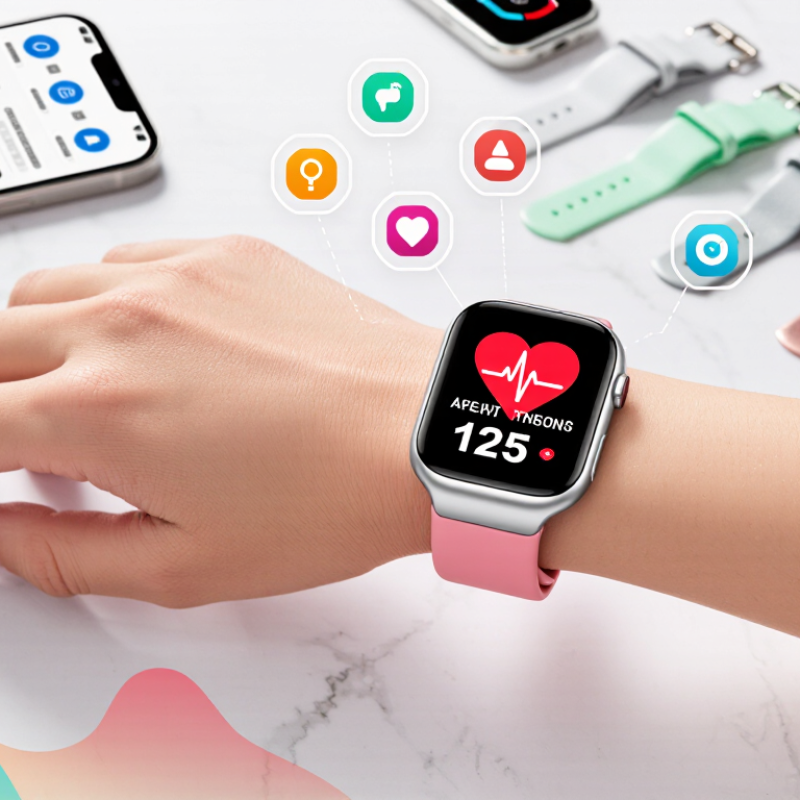
A female Android smartwatch is a wearable device designed around smaller wrists, daily styling, and Android phone compatibility. It usually combines health sensors, notifications, activity tracking, GPS, and wireless connectivity in a compact case. The “female” label can be useful for fit and design, but it may also oversimplify real users. Wrist sizes and preferences vary widely.

Core features should include heart-rate monitoring, sleep analysis, step counting, message alerts, and reliable Bluetooth pairing. Some models add menstrual-cycle tracking, blood-oxygen estimates, stress indicators, and emergency contacts. These functions support wellness decisions, not medical diagnosis. According to Grand View Research, the global smartwatch market is projected to grow strongly through 2030. Counterpoint Research also reported a 7% decline in global smartwatch shipments during 2024. This suggests that practical differentiation matters more than decorative design. Battery life, sensor accuracy, screen brightness, water resistance, and application compatibility deserve careful testing. A smaller case is not automatically better. It may sacrifice battery capacity.

Tips: Request samples in several case sizes. Test pairing with different Android versions. Check sensor consistency during walking and sleep. Review privacy controls before bulk sourcing. Avoid relying only on product specifications; hands-on testing often reveals charging problems, loose straps, or uncomfortable edges.

Why Choose a Female Android Smartwatch for Global Sourcing? - Definition and Core Features of Female Android Smartwatches

Feature Dimension Definition Typical Technical Data Global Sourcing Value
Product Positioning A wearable smart device designed with a compact profile, practical health functions, and styling preferences commonly associated with female users. Usually includes a smaller case, lighter construction, interchangeable straps, notification functions, and wellness monitoring. Supports differentiated product positioning while serving customers who prefer comfortable, fashion-oriented wearable technology.
Android Compatibility The ability to connect with Android smartphones through a dedicated mobile application and Bluetooth communication. Commonly supports Android 8.0 or later, although the exact minimum version depends on the operating system and companion application. Buyers should verify supported Android versions, application availability, pairing stability, notification access, and regional software restrictions.
Display The screen used to show time, notifications, health information, menus, and watch faces. Typical formats include 1.2–1.8-inch displays with resolutions of approximately 360 × 360 to 466 × 466 pixels. AMOLED offers strong contrast and deep black levels. Screen size, brightness, touch sensitivity, and readability affect perceived quality, outdoor usability, packaging claims, and return rates.
Case Size and Weight The physical dimensions and mass of the watch body, excluding or separately identifying the strap. Compact models commonly measure about 36–44 mm across and weigh approximately 25–45 g without the strap. Smaller and lighter designs can improve wrist comfort. Specifications should be reported accurately for product listings and size-sensitive customers.
Battery Capacity and Runtime The stored electrical capacity and expected operating period between charges. Many compact smartwatches use rechargeable lithium-polymer batteries in the approximate range of 200–400 mAh, with about 3–10 days of use depending on features and settings. Runtime should be tested under defined conditions, including display brightness, Bluetooth use, health tracking, GPS use, and notification frequency.
Health Monitoring Sensor-based tracking of selected wellness indicators for personal reference rather than medical diagnosis. Common functions include heart-rate monitoring, blood-oxygen estimation, sleep tracking, step counting, calorie estimation, and menstrual-cycle recording. Health-related claims require careful wording. Buyers should request validation information, data-privacy details, and regional regulatory guidance before marketing.
Sensors Electronic components that detect movement, optical signals, orientation, or environmental conditions. Frequently used components include an optical heart-rate sensor, accelerometer, gyroscope, and ambient-light sensor. Some models also include a barometer or geomagnetic sensor. The sensor list helps compare functions, power consumption, tracking performance, and the level of software integration offered by different suppliers.
Sports and Activity Modes Preconfigured software profiles that record activity data according to different exercise types. Entry and mid-range products often offer approximately 20–100 activity modes, such as walking, running, cycling, swimming, yoga, and strength training. The number of modes alone does not guarantee accuracy. Sourcing evaluations should focus on usable metrics, interface quality, and consistency of recorded data.
Location Tracking The use of satellite positioning to record outdoor routes, distance, pace, or location. Some watches provide built-in GNSS/GPS; others use the paired smartphone for location data. Built-in positioning generally increases power consumption and hardware cost. This distinction should be clearly stated in specifications because independent GPS operation can significantly affect product value and customer expectations.
Water Resistance The rated ability of the device to resist water exposure under specified test conditions. Common ratings include IP67, IP68, or 5 ATM. IP ratings and ATM ratings are different systems and should not be treated as identical protection claims. Suppliers should provide test documentation and clear usage limitations. Water resistance may be reduced by aging, impact, repairs, or chemical exposure.
Connectivity The wireless methods used to communicate with smartphones, networks, accessories, or positioning systems. Bluetooth Low Energy is standard for phone pairing. Some models additionally support Wi-Fi, NFC, or cellular connectivity, depending on the product configuration. Connectivity influences compatibility, certification needs, battery life, regional availability, and the total landed cost of the product.
Communication Functions Features that allow users to receive information or interact with a paired smartphone. Typical functions include call and message notifications, calendar reminders, music controls, weather updates, alarms, and remote camera control. Calling requires a microphone and speaker. Function availability can vary by Android version, application permissions, language, and phone manufacturer settings, so compatibility testing is essential.
Materials and Strap System The materials used for the case, screen cover, buttons, and wristband, together with the method used to replace the strap. Common choices include aluminum alloy or polymer cases, tempered glass or mineral glass, and silicone, fluoroelastomer, leather, or textile straps. Standard quick-release straps improve interchangeability. Material selection affects durability, skin comfort, weight, appearance, cost, and the ability to offer seasonal or customized strap collections.
Charging System The method used to replenish the internal rechargeable battery. Magnetic two-pin or wireless charging cradles are common. Charging time is often approximately 1.5–3 hours, depending on battery capacity and charger output. A complete sourcing review should include charger specifications, connector durability, replacement availability, electrical safety, and packaging configuration.
Languages and Localization The languages supported by the watch interface, companion application, notifications, manuals, and packaging. International products may support several major languages, but the supported list can differ between the device firmware and mobile application. Localization reduces customer-service issues and supports multi-market distribution. Buyers should request language screenshots and conduct regional acceptance testing.
Privacy and Data Handling The practices used to collect, store, transmit, and manage personal, health, and location-related information. Relevant areas include account registration, cloud synchronization, permission controls, encryption, data deletion, and the location of data storage. Privacy documentation and data-processing arrangements should be reviewed before selling in markets with applicable privacy or consumer-protection requirements.
Compliance and Documentation The technical and legal documentation needed to place an electronic wearable product on a target market. Depending on the destination, documentation may involve radio compliance, electromagnetic compatibility, battery transport information, chemical restrictions, user manuals, and recycling marks. Complete documentation helps reduce customs delays, marketplace removals, warranty disputes, and compliance risks during global distribution.
Customization Potential The extent to which the product can be adapted for a buyer’s target market without changing the core hardware platform. Potential options include case colors, strap materials, watch-face designs, packaging, logo placement, manuals, firmware language, and application branding. Customization can improve market fit, but buyers should confirm minimum order quantities, tooling charges, lead times, software ownership, and quality-control procedures.

Note: Technical specifications are typical market ranges rather than guarantees. Final values should be confirmed through supplier datasheets, product samples, laboratory reports, and destination-market compliance checks.


How Female Android Smartwatches Differ from General Smartwatches

Why Choose a Female Android Smartwatch for Global Sourcing?

Female Android smartwatches differ from general models through fit, health functions, and daily usability. A 38–42 mm case often suits smaller wrists better. A thinner profile also reduces sleeve friction during work. Fit matters. In procurement testing, a watch that shifts during walking can produce inconsistent heart-rate readings. Counterpoint Research reported continued growth in global smartwatch shipments in 2024, showing strong demand for specialized wearable devices.

Health features require careful evaluation. Female-focused models may include menstrual-cycle tracking, skin-temperature trends, sleep analysis, and pregnancy-related record options. These functions should support personal monitoring, not replace medical advice. The 2024 McKinsey Future of Wellness survey found that consumers increasingly prioritize health management and personalized wellness tools. However, data accuracy varies across sensors and skin conditions. That weakness deserves attention.

Android compatibility is another sourcing difference. Buyers should test Bluetooth stability, notification timing, charging speed, and app language support across several Android versions. A smaller watch may also need a more efficient battery because its internal space is limited. According to IDC’s Worldwide Quarterly Wearable Device Tracker, wearable shipments remain a major consumer-electronics category, but shipment volume alone cannot prove product quality. Suppliers should provide battery-cycle results, water-resistance evidence, privacy documentation, and regional after-sales procedures. A polished sample can still hide uncomfortable straps or confusing health settings. Test the ordinary details.

Key Sourcing Criteria for Global Buyers

Why Choose a Female Android Smartwatch for Global Sourcing?

For global buyers, “female” should mean flexible design, not a narrow stereotype. Start with fit: offer 38–42 mm cases, adjustable straps, lightweight materials, and clear screens for smaller wrists. Counterpoint Research reported that global smartwatch shipments declined by 7% in 2024. This signals intense price pressure. A distinctive fit can protect value better than decoration alone.

Android compatibility requires practical testing. Check pairing across several Android versions, Bluetooth stability, notification accuracy, language support, and battery performance under real use.

IDC reported 537.6 million wearable devices shipped worldwide in 2024, with annual growth of 11.7%. The market is large, but inconsistent software can quickly create returns.

Test the companion application in weak-network conditions. It may fail there. That detail matters.

Sourcing teams should request documented testing for battery safety, skin-contact materials, charging reliability, and water resistance. Relevant evidence may include IEC 62368-1 safety evaluation, ISO 10993 material assessment, and laboratory test reports from qualified facilities.

Health features should be described as wellness functions unless legally cleared for medical use. Require sample inspections, aging tests, spare-part plans, and transparent MOQ terms.

Counterpoint and IDC measure different product categories, so their figures should not be compared blindly. That is an easy mistake, even for experienced buyers.

Suppliers should also explain data protection, firmware updates, and regional support before contract approval.

Compatibility, Certification, and Supply Chain Considerations

Why Choose a Female Android Smartwatch for Global Sourcing?

A female-focused Android smartwatch needs more than a smaller case. It should support adjustable straps, clear notification controls, and reliable health sensors across different wrist sizes. Android compatibility must be tested by operating-system version, Bluetooth profile, screen size, and phone manufacturer. Bluetooth SIG reported that more than 5 billion Bluetooth devices shipped globally in 2023. Compatibility gaps can therefore become expensive at scale. Supplier reviews should include real phones, not only laboratory simulators. That assumption is risky.

Certification requirements change by destination. For the European market, suppliers may need CE conformity under the Radio Equipment Directive, plus RoHS and REACH evidence. US distribution commonly requires FCC authorization for radio functions. Battery transport also requires UN 38.3 testing, while IEC 62133-2 can support rechargeable-cell safety evaluation. These documents should match the exact model, battery, firmware, and manufacturing site. A certificate copied from an older sample is not enough.

Supply-chain planning deserves equal attention. IDC’s Worldwide Quarterly Wearable Device Tracker reported 520.1 million wearable devices shipped in 2023, showing strong but competitive demand. Buyers should confirm component availability, firmware ownership, inspection procedures, and replacement-unit capacity before negotiating volume. I have seen attractive samples fail after regional firmware changes. Keep a pilot batch. Female users may also notice strap irritation or charging problems faster than factory testers. This remains an imperfect testing area.

Why Choose a Female Android Smartwatch for Global Sourcing?

In addition to Android compatibility, global buyers should evaluate enclosure protection, radio approvals, chemical restrictions, battery safety, strap materials, and supplier documentation. The chart compares common IP protection levels used when specifying compact smartwatches.

IP ratings are defined under IEC 60529. The first digit indicates protection against solid particles, while the second digit indicates protection against water. IP67 and IP68 are commonly considered for active lifestyle products, but the exact testing depth and duration for IPX8 must be confirmed in the supplier’s test report. For global sourcing, also request evidence for applicable radio regulations such as CE/RED, FCC, UKCA, RCM, or ISED, together with RoHS, REACH, battery, and charger documentation.

Choosing the Right Manufacturing Partner and Product Model

Why Choose a Female Android Smartwatch for Global Sourcing?

Choosing the right manufacturing partner matters more than selecting an attractive product sample. A reliable supplier should provide factory records, quality procedures, and traceable component information. Request recent audit reports, production photos, and test results before negotiating volume. Do not rely on polished presentations alone.

The manufacturing partner should understand smaller case dimensions and varied wrist sizes. A 38–42 mm case may improve comfort, but it can limit battery space. That trade-off needs honest testing. Check screen readability, button reach, strap flexibility, charging stability, and sensor performance during daily movement. Ask for samples from different production batches. One sample proves very little.

Android compatibility also requires careful verification. Confirm supported operating systems, notification behavior, language coverage, and application security controls. The supplier should explain how personal data is handled and how software updates are managed. Regional requirements may involve electrical safety, radio testing, labeling, privacy, and recycling obligations. Certificates should match the actual product model and destination market. Generic documents are a warning sign.

A capable partner will support pilot production, inspection checkpoints, spare parts, and clear defect thresholds. Discuss response times in writing. Small mistakes still happen, even with experienced factories. That is why independent pre-shipment inspection can protect both budget and reputation. Some buyers focus too heavily on appearance. In practice, stable charging and accurate delivery dates often matter more.

Powder Coat Booths

For those larger-sized parts, or smaller quantity runs, we have 2 independent powder coat booths and ovens. The quality, durability and affordability of today’s powder coating finishes make this the process of choice for world-class companies.

Powder coating advantages over other forms of coating are many. Materials used in the Powder coating process can be metals and non-metals that come in a multitude of thicknesses, textures, colors, etc. Another of Powder coating’s biggest advantages over conventional coatings is its ability to create finishes in many different textures. Powder Coating Booths allow us the ability to apply these advantages to large products.

Wet Paint Line

Tri-State Fabricators runs a full-service conveyor line for painting. Wet painting can provide protection or decoration to many different part styles. From start to finish, every project is easier to undergo random and point-based inspection by our skilled painting team.

Advantages to our Wet Paint Line are these lines start with product prep and ends with a thorough inspection of a high quality finished product. Our ability to complete large and small projects with a superior finish and doing so in a timely and economical fashion. This passes along the savings in production to our customers. When powder coating ins not an option, our Wet Paint Line gets the job done right the first time.

Wet Paint Booths

When the parts get big and heavy we roll-out our custom paint racks and oversize booth. By utilizing our partnerships with all the major paint brands, we can match virtually any color with wet paint.

The advantages of having access to a Wet Paint Booth are many. Large projects of many different shapes can be loaded into the booth. The Wet Paint Booth offers an environment that is much more controlled than a typical parts painting operation.

Not only are they used because of their controlled environment, but they’re are also advantageous when it comes to applying paint to parts that are needed in industries that require specialty coatings such as medical, aerospace, etc.

Military CARC

Our military forces have some very high standards when it comes to the finish of their vehicles and equipment. From the first pre-treatment step to final coat, it takes a great deal of knowledge and experience to protect the men and women of our armed forces. They deserve only the best, and Tri-State Fabricators provides it.

All of our processes are closely monitored by our staff and management teams. Both of which are highly trained in the processes of metal fabrication and finishing. Tri-State Fabricators’ goal is to always fully satisfy each and every customer, including the military. We will always put a 110% into what we do.

Glass-Bead Blasting

Abrasive media blasting is an excellent way to remove old paint, rust, and increase the paint/powder adhesion. Glass beads produce a much smoother and brighter finish than angular abrasives; leaving the part clean yet without any dimensional change. Chemically inert and environmentally friendly, we can recycle our beads approximately 30 times; making them a more preferred method of metal cleaning or surface finishing.

Advantages to Glass Bead Blasting are many. Glass bead blast media is used when a project is needing rough surfaces need to become smooth for applications of coatings such as paint. It is typically used to clean paint and rust from a product surface without deforming the surface it is being used on. Overall, compared to many other blasting media, Glass Bead Blasting is a very economical choice and those savings are always passed on to our customers.

Part Washing

Tri-State Fabricators utilize a zinc phosphate wash to clean and etch the material to ensure the best paint adhesion possible. The unique design of our 3-stage wash system does the work like a 5-stage. From Cleaning and rinsing to conversion coating and post-treatment, Our Part Washing process is a complete service and works throughout the fabrication service and the finishing service.

Along with the previously mentioned benefits, Curing is a vital chemical reaction that leaves the product finish hard and relatively safe from mild abrasion and aggressive corrosion. This process can be done in more than one way; ambient air-dry or in curing ovens at temps that exceed 240°.

Burn-Off Oven

From fixing paint mistakes (someone else’s of course) to simply cleaning our paint line hooks, our burn-off oven is put to good use. After a quick burn-off, a little clean up, and a fresh coat of paint, your parts will look better than new.

Why does our Burn-Off Oven work so well? Because super heating the air around parts turns the materials into ashes. From paint and powder coatings to rubber and machining oils, high temps do the job without degrading the integrity of the part.

Masking

Masking is a vital part of producing high quality products. We have die-cut masking patterns to protect machined surfaces as well as a wide range of plugs and caps to protect threaded holes and bolts. We provide permanent and temporary masking.

Masking allows the selected sections of a product to be protected from a fabrication or finishing service. This can be with both chemicals when etching and tapes, paints when only finishing just a section of the product. Masking is great in aiding the customization process of a project.

Screen Printing

Screen printing is a photographic process that transfers artwork onto a porous nylon screen which allows colored ink to flow through the screen and be deposited on an aluminum or plastic component. We can generally have just about any design created onto a screen for your parts.

Some of the advantages of Screen Printing are, brand recognition for your business displaying on your products, assembly instructions, product warnings/hazards, etc. Tri-State Fabricators produces Screen Printing of the highest quality so you know it’s durable.

Metal Finishing

Metal Finishing is the art of treating the exterior portion of product, often metal but can also be made of other materials, so that the surface is clean and free of any debris. Then the process of applying coats or either paint of powder coat takes place. This coating process improves the quality of the product in both appearance and resistance to wear and corrosion.

Tri-State Fabricators, Inc., understands that a project typically isn’t complete until a high-quality finish has been added to your product. This is why our painting and powder coating teams continuously inspect the products throughout the Metal Finishing process.
