


Why Choose UPVC Door Hinges for Your Project?

Choosing Upvc Door Hinges is a practical decision about fit, durability, and everyday performance. A door may look correctly installed, yet still scrape the threshold or leave an uneven gap. The hinges help control its movement and maintain alignment as the door opens and closes. Small parts matter. For installers and project buyers, the right choice depends on door weight, hinge adjustment range, fixing method, and exposure to moisture. These details should be checked against the door manufacturer’s specifications, not guessed from appearance alone.

The U.S. Department of Energy’s Energy Saver guidance estimates that heat gain and loss through windows account for about 25–30% of residential heating and cooling energy use. That figure concerns windows, not UPVC door hinges. It does, however, underline why building-envelope details deserve careful attention. A well-adjusted hinge can help a door sit evenly against its frame, but it cannot guarantee lower energy use or correct a poor seal. Standards such as EN 1935 also offer a framework for assessing hinge performance, including durability and corrosion resistance. Check the product documentation for the applicable classification and test conditions. There is no universal hinge for every door. That is easy to overlook. A careful specification, followed by a real fit check, is usually more reliable than choosing by price or appearance alone.
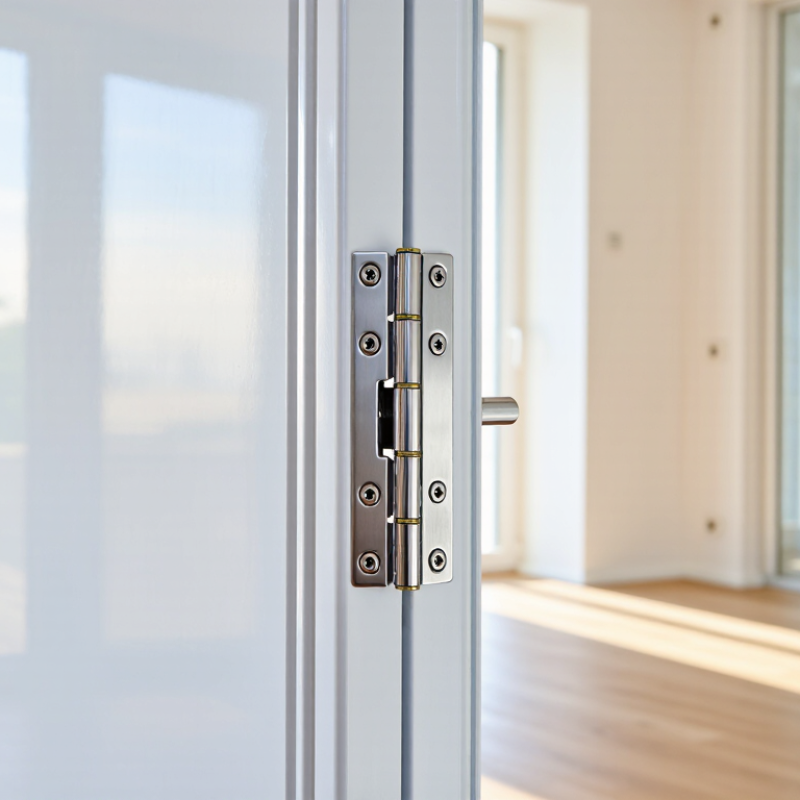
Why Choose UPVC Door Hinges for Your Project?

Understanding UPVC Door Hinges and Their Role

UPVC door hinges connect the sash to the frame and carry the door’s weight through every opening and closing cycle. They also help keep the sash aligned, so the lock engages cleanly and the door seals against weatherstripping. Small parts, important work.

Many hinges for UPVC doors offer adjustment in more than one direction. This can help correct a door that drops slightly or rubs the frame, though adjustment ranges vary by design. Check the hinge type, door weight, fixing points, and any reinforcement inside the profile before choosing a replacement. A hinge that looks similar may not fit or support the same load. That detail is easy to miss.

Good installation matters just as much as selection. Screws should engage sound material, and the sash should be supported while hinges are fitted or adjusted. Afterward, open and close the door slowly, checking for rubbing, uneven gaps, and a latch that catches. Do not force an adjustment to hide a deeper problem, such as loose fixings or a distorted frame. Hinges can improve alignment, but they cannot correct every fault. Regular checks help catch wear early.


Materials and Design Features of UPVC Door Hinges

UPVC door hinges are designed to support a door while keeping its edges aligned with the frame. The hinge body is commonly made from corrosion-resistant metal, such as stainless steel or coated steel, while pins and adjustment parts may use different metals. Materials vary by design. A smooth finish helps resist moisture, but appearance alone says little about long-term performance.

Look closely at the hinge’s load rating, fixing points, and adjustment range. A reinforced UPVC door can place considerable weight on its hinges, so screws need to reach suitable reinforcement rather than rely only on the outer plastic skin. Small adjustment screws let an installer correct sagging or uneven gaps. That matters when a door rubs near the threshold or lets in a cold draught. Check the manufacturer’s fitting instructions. Details differ.

Some hinges have covers that conceal fixings and give the door a cleaner look. Others prioritize quick access for adjustment. A neat cover is useful, but it can make inspection less convenient. I would not judge a hinge by finish alone; screw quality and accurate fitting matter just as much. Even a well-made hinge can become loose if the frame or fixing points are unsuitable.

Why Choose UPVC Door Hinges? Material Density at a Glance

Approximate density helps illustrate how hinge materials differ, but it does not determine strength or durability on its own. UPVC door hinges often combine a polymer frame with metal components; the best choice depends on load, corrosion exposure, and design.

Benefits for Durability, Security, and Weather Resistance

uPVC doors face rain, grit, temperature swings, and repeated opening. Their hinges carry the door’s weight while keeping the sash aligned against the frame. That alignment matters: a small drop can create rubbing, uneven seals, and an easier point of entry. A properly specified hinge helps maintain a close, consistent fit. Fit matters, too.

Durability can be assessed against EN 1935, the European standard for single-axis hinges. Its highest durability class covers 200,000 test cycles, a useful benchmark for frequently used doors. This is a test classification, not a guarantee that every hinge reaches it. Ask for the product’s tested class and load capacity, then match both to the door’s size and weight. More metal is not automatically better.

Weather resistance depends on the hinge material, protective finish, and maintenance. EN 1670 rates corrosion resistance; Grade 4 corresponds to 240 hours of salt-spray testing. That helps compare tested finishes, though real exposure varies with coastal air, standing water, and cleaning habits. For security, choose hinges that resist lifting and use fixings anchored into suitable door reinforcement. A strong hinge with weak screws can still fail. Check alignment after installation; small adjustments are easy to overlook.

Why Choose UPVC Door Hinges for Your Project? — Benefits for Durability, Security, and Weather Resistance

Project factor Potential benefit What to check when specifying Practical project consideration
Durability A hinge designed for the door’s weight and frequency of use can support reliable everyday operation. Confirm the manufacturer’s rated door weight, recommended number of hinges, material, and adjustment range. Door size, glazing weight, installation quality, and usage all affect service life; ratings vary by product.
Security Suitable hinge construction and secure fixing can help keep the door correctly supported and aligned. Check fixing requirements, hinge-side protection where needed, compatibility with the door profile, and applicable security test evidence. Hinges are one part of door security; the frame, locks, glazing, and installation also matter.
Weather resistance Corrosion-resistant materials or finishes can help hinges withstand exposure to moisture and outdoor conditions. Identify the hinge material and finish, and check whether the product is suitable for the project’s exposure conditions. Performance depends on material, finish, environment, and maintenance; coastal or highly exposed locations may need extra attention.
Door alignment Adjustable hinges can make it easier to correct door position during installation or routine servicing. Review the adjustment directions and range, access to adjustment points, and installation instructions. Correct adjustment helps the door close properly; it does not replace sound installation or a suitable frame.
Compatibility A hinge made for the specific uPVC door profile can provide a more suitable fit and fixing arrangement. Verify the profile, hinge position, fixing method, door configuration, and replacement-hinge dimensions. Hinges are not universally interchangeable; confirm compatibility before ordering or installation.
Maintenance Periodic inspection and care can help identify loose fixings, wear, or changes in door alignment. Follow the product’s cleaning, lubrication, and adjustment instructions; use only compatible products. Maintenance needs vary by hinge design and environment. Avoid assuming that every hinge is maintenance-free.

Note: Hinge capacity, materials, security features, and weather performance vary by product. Check current technical documentation and installation guidance for the specific door and project.

How to Choose Hinges for Your Door and Project

Choosing hinges starts with the door, not the catalogue. Record the leaf’s height, width, mass, opening direction, and expected daily use. Then check each hinge’s stated load capacity and whether the uPVC profile requires reinforcement. Small details matter. Confirm adjustment range, screw length, and clearance between the sash and frame. A hinge that fits the door but clashes with the frame is no good.

Use test evidence, not appearance alone. BS EN 1935:2002 classifies single-axis hinges by durability, door mass, and corrosion resistance. Its endurance classes extend to 200,000 test cycles. Treat that figure cautiously: it is a laboratory benchmark, not a promise of years in service. For coastal or frequently washed entrances, compare corrosion classifications as well as cycle figures. One easy-to-miss issue is profile reinforcement; even a high-rated hinge may loosen if its screws cannot grip securely. Ask for the hinge’s test classification and installation instructions, then check them against the actual door assembly.

Installation, Adjustment, and Routine Maintenance

A well-fitted UPVC door hinge should let the door move smoothly without rubbing the frame. During installation, support the door’s weight before removing or fitting a hinge. Align each hinge carefully, and use fixings suited to the hinge and door construction. Uneven gaps can point to poor alignment, even when the screws feel tight. Small changes matter.

Adjustment methods vary by hinge design, so check its instructions before turning any screws. Make small changes, then open and close the door to assess the result. Check that the latch engages and the seal contacts the frame evenly. A stiff hinge is not always a lubrication problem; misalignment can feel similar. Do not force the adjustment screw. Keep it gentle.

For routine maintenance, wipe hinges with a soft, damp cloth and dry them afterward. Check periodically for loose screws, visible wear, or movement around the fixing points. Tighten loose screws carefully, but avoid overtightening, which can damage the fixing or surrounding material. Lubricate only the points specified by the hinge instructions, using a suitable product. If the door continues to bind after careful adjustment, inspect its alignment rather than repeatedly turning the hinge screws.

Powder Coat Booths

For those larger-sized parts, or smaller quantity runs, we have 2 independent powder coat booths and ovens. The quality, durability and affordability of today’s powder coating finishes make this the process of choice for world-class companies.

Powder coating advantages over other forms of coating are many. Materials used in the Powder coating process can be metals and non-metals that come in a multitude of thicknesses, textures, colors, etc. Another of Powder coating’s biggest advantages over conventional coatings is its ability to create finishes in many different textures. Powder Coating Booths allow us the ability to apply these advantages to large products.

Wet Paint Line

Tri-State Fabricators runs a full-service conveyor line for painting. Wet painting can provide protection or decoration to many different part styles. From start to finish, every project is easier to undergo random and point-based inspection by our skilled painting team.

Advantages to our Wet Paint Line are these lines start with product prep and ends with a thorough inspection of a high quality finished product. Our ability to complete large and small projects with a superior finish and doing so in a timely and economical fashion. This passes along the savings in production to our customers. When powder coating ins not an option, our Wet Paint Line gets the job done right the first time.

Wet Paint Booths

When the parts get big and heavy we roll-out our custom paint racks and oversize booth. By utilizing our partnerships with all the major paint brands, we can match virtually any color with wet paint.

The advantages of having access to a Wet Paint Booth are many. Large projects of many different shapes can be loaded into the booth. The Wet Paint Booth offers an environment that is much more controlled than a typical parts painting operation.

Not only are they used because of their controlled environment, but they’re are also advantageous when it comes to applying paint to parts that are needed in industries that require specialty coatings such as medical, aerospace, etc.

Military CARC

Our military forces have some very high standards when it comes to the finish of their vehicles and equipment. From the first pre-treatment step to final coat, it takes a great deal of knowledge and experience to protect the men and women of our armed forces. They deserve only the best, and Tri-State Fabricators provides it.

All of our processes are closely monitored by our staff and management teams. Both of which are highly trained in the processes of metal fabrication and finishing. Tri-State Fabricators’ goal is to always fully satisfy each and every customer, including the military. We will always put a 110% into what we do.

Glass-Bead Blasting

Abrasive media blasting is an excellent way to remove old paint, rust, and increase the paint/powder adhesion. Glass beads produce a much smoother and brighter finish than angular abrasives; leaving the part clean yet without any dimensional change. Chemically inert and environmentally friendly, we can recycle our beads approximately 30 times; making them a more preferred method of metal cleaning or surface finishing.

Advantages to Glass Bead Blasting are many. Glass bead blast media is used when a project is needing rough surfaces need to become smooth for applications of coatings such as paint. It is typically used to clean paint and rust from a product surface without deforming the surface it is being used on. Overall, compared to many other blasting media, Glass Bead Blasting is a very economical choice and those savings are always passed on to our customers.

Part Washing

Tri-State Fabricators utilize a zinc phosphate wash to clean and etch the material to ensure the best paint adhesion possible. The unique design of our 3-stage wash system does the work like a 5-stage. From Cleaning and rinsing to conversion coating and post-treatment, Our Part Washing process is a complete service and works throughout the fabrication service and the finishing service.

Along with the previously mentioned benefits, Curing is a vital chemical reaction that leaves the product finish hard and relatively safe from mild abrasion and aggressive corrosion. This process can be done in more than one way; ambient air-dry or in curing ovens at temps that exceed 240°.

Burn-Off Oven

From fixing paint mistakes (someone else’s of course) to simply cleaning our paint line hooks, our burn-off oven is put to good use. After a quick burn-off, a little clean up, and a fresh coat of paint, your parts will look better than new.

Why does our Burn-Off Oven work so well? Because super heating the air around parts turns the materials into ashes. From paint and powder coatings to rubber and machining oils, high temps do the job without degrading the integrity of the part.

Masking

Masking is a vital part of producing high quality products. We have die-cut masking patterns to protect machined surfaces as well as a wide range of plugs and caps to protect threaded holes and bolts. We provide permanent and temporary masking.

Masking allows the selected sections of a product to be protected from a fabrication or finishing service. This can be with both chemicals when etching and tapes, paints when only finishing just a section of the product. Masking is great in aiding the customization process of a project.

Screen Printing

Screen printing is a photographic process that transfers artwork onto a porous nylon screen which allows colored ink to flow through the screen and be deposited on an aluminum or plastic component. We can generally have just about any design created onto a screen for your parts.

Some of the advantages of Screen Printing are, brand recognition for your business displaying on your products, assembly instructions, product warnings/hazards, etc. Tri-State Fabricators produces Screen Printing of the highest quality so you know it’s durable.

Metal Finishing

Metal Finishing is the art of treating the exterior portion of product, often metal but can also be made of other materials, so that the surface is clean and free of any debris. Then the process of applying coats or either paint of powder coat takes place. This coating process improves the quality of the product in both appearance and resistance to wear and corrosion.

Tri-State Fabricators, Inc., understands that a project typically isn’t complete until a high-quality finish has been added to your product. This is why our painting and powder coating teams continuously inspect the products throughout the Metal Finishing process.
