Why Choose a Silicone Whisk Set for Your Kitchen?
A whisk seems like a small choice until it scrapes a nonstick pan or leaves stubborn pockets of flour in cake batter. A Silicone Whisk Set offers flexible, coated heads for stirring sauces, folding ingredients, and mixing in cookware with delicate surfaces. Still, “silicone” alone does not prove a tool is durable or suitable for every cooking task. Handle strength, head attachment, heat guidance, and clear care instructions matter too.
The broader market offers useful context, though it cannot predict the quality of any single whisk. Fortune Business Insights estimated the global kitchenware market at USD 40.87 billion in 2023 and projected it could reach USD 63.70 billion by 2032. That report covers many kitchen products, not silicone whisks specifically. It signals consumer interest in kitchen tools, but product-level evidence should guide a purchase.
In this guide, we’ll look at how whisk shape, flexibility, and construction affect everyday use. A narrow whisk can reach into a mug; a balloon shape moves more air through cream. The difference is tangible. We’ll also consider cleaning, storage, and the manufacturer’s temperature instructions, rather than assuming every silicone head performs alike. One caveat: hands-on comfort varies, and a glossy product photo cannot show whether a handle feels secure when mixing thick batter. Choose for the cooking you actually do, not for a crowded set.
What Defines a Silicone Whisk Set?
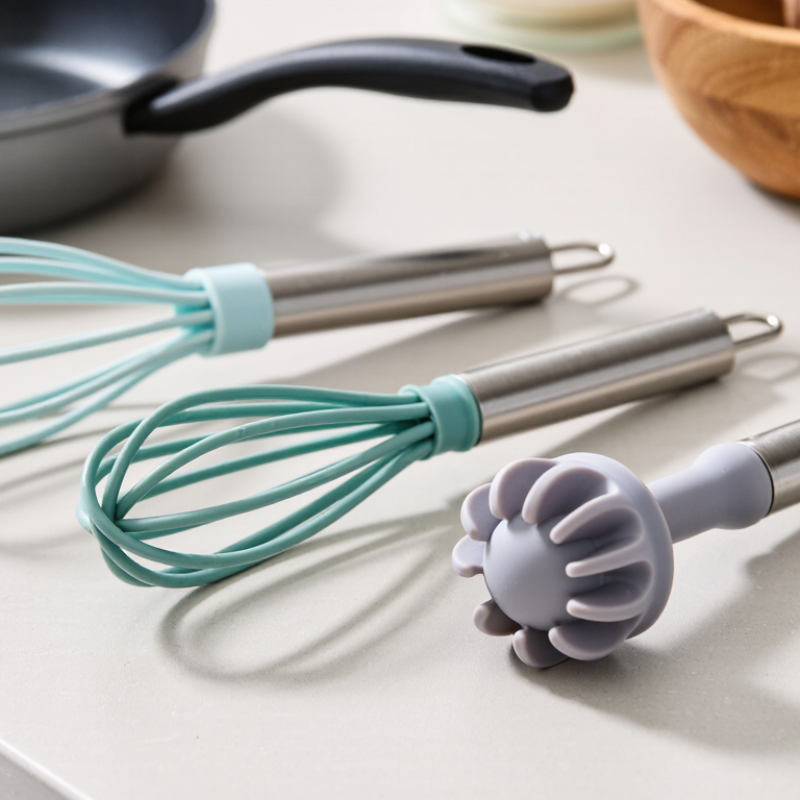
A silicone whisk set usually includes several whisk sizes, often a balloon whisk for cream and a smaller whisk for sauces or cups. Its defining feature is a silicone-coated head, commonly built around a stainless-steel wire core. Some models use a molded, one-piece head instead. That detail matters. A coated wire whisk may flex more, while a molded head can feel firmer in thick batter. Handles should offer a steady grip, even with wet fingers, and the stated heat limit should suit your cooking habits.
“Silicone” alone does not define quality. Check whether the product lists food-contact suitability, temperature limits, and care instructions. NSF/ANSI 51 sets requirements for materials used in food equipment, including evaluation for food-contact use; it is a useful reference, not automatic proof that every whisk is certified. Fortune Business Insights estimated the global kitchen utensils market at USD 30.03 billion in 2023. That market figure signals broad demand, not the performance of any particular set. A whisk that looks soft may still scratch a delicate pan if its coating is damaged. I would inspect the wire joins and handle connection, too. Small flaws show up during daily use.
How Does Silicone Perform in Everyday Cooking?
In everyday cooking, a silicone whisk is useful for more than protecting a nonstick pan. Its coated wires glide across the surface without the sharp scraping sound of metal. That matters when whisking eggs in a shallow skillet or stirring a sauce in a coated saucepan. Cleanup is usually simple, too: rinse the head soon after use, especially after mixing sticky honey or melted chocolate. Small detail. It saves effort later.
Silicone handles warm ingredients well, but heat tolerance varies by product. Check the maker’s stated temperature limit, and do not leave a whisk resting against a hot pan or flame. For pancake batter, vinaigrette, and scrambled eggs, a flexible head can reach the curved edges of a bowl or pan. The wires may feel softer than stainless steel, though, so thick dough or stubborn lumps can take more effort. A whisk is not a spatula; scraping every last bit from a bowl may still require another tool.
A silicone set can be practical if its pieces suit the tasks you actually do. More pieces do not automatically mean better cooking. Inspect the joins between the handle and whisk head, where food can collect if the design has gaps. After washing, let the whisk dry fully before storing it. Oily or strongly scented mixtures may leave a lingering smell, particularly if cleaning is rushed. Silicone is convenient, not indestructible, and an occasional close look for cracks or loose wires is sensible.
Which Whisk Shapes Suit Different Kitchen Tasks?
A silicone whisk set is useful when one tool cannot handle every bowl. The silicone coating helps protect many nonstick surfaces from scratches, though the whisk should still match the cookware’s heat limits. Shape matters more than a crowded utensil drawer. Small jobs matter.
A balloon whisk has widely spaced wires that trap air, making it a good choice for whipping cream or beating egg whites. Its rounded head also blends pancake batter in a deep bowl, but it can struggle in narrow cups. A French whisk is slimmer, with tighter wires. It reaches into corners and mixes custards, gravies, and vinaigrettes with better control. For a small mug or a single egg, a mini whisk feels less clumsy.
A flat whisk works well in shallow pans. Its shape slides across the base, helping loosen flour lumps in a sauce without scraping the surface. I still reach for the wrong shape sometimes; a balloon whisk in a small saucepan can feel like stirring with a tiny umbrella. A smaller whisk set can be easier to store, but check that each head fits your usual bowls. No shape fixes a rushed pour or an overfilled mixing bowl.
Why Choose a Silicone Whisk Set for Your Kitchen?
Whisk shape affects how well it suits different kitchen tasks. The chart compares common whisk shapes using illustrative suitability ratings from 1 (less suited) to 5 (well suited); ratings reflect each shape’s typical design, not laboratory test results.
Quick guide: Balloon whisks are shaped to incorporate air into mixtures, while flat whisks are useful for stirring sauces in shallow pans. French whisks suit general mixing, mini whisks work well for small portions, and ball whisks are handy for reaching around the sides of containers.
What Features Matter When Choosing a Set?
A silicone whisk set earns its place through useful differences, not sheer piece count. Check the wire shape and spacing: narrow, flexible loops reach into the corners of a small saucepan, while a balloon whisk moves more air into cream or egg whites. Check the wires. A stainless-steel core helps the whisk keep its shape, while the silicone coating protects many nonstick surfaces from scratches. Still, a soft coating may feel less precise when mixing a very thick batter. Grip matters. Look for a handle that feels secure with damp hands and does not become awkward during longer mixing.
Heat tolerance and cleaning details deserve a close look. Compare the stated temperature limit with the way you cook; a whisk used near a hot pan needs a suitable rating, not a guess. If the set includes several sizes, consider where each will be used: a compact whisk suits dressings, while a larger one handles a mixing bowl. More pieces are not always better. One small whisk may stay unused in the drawer. Inspect the seams where silicone meets the handle, since food can collect in gaps and make cleaning slower. Dishwasher-safe claims vary, so check care instructions before buying. A hanging loop is convenient, but only if your kitchen has space for it.
How Should Silicone Whisks Be Cleaned and Stored?
A silicone whisk set is useful for everyday mixing, but careful cleaning keeps its heads fresh and flexible. Rinse each whisk soon after use, especially after beating eggs or stirring thick batter. Dried food can cling around the wires and handle joint. Warm water, a little dish soap, and a soft sponge usually remove residue without scratching the surface. Pay attention to the narrow spaces between wires. Rinse well. No need to scrub hard.
Check the care instructions before using a dishwasher; some whisks are dishwasher-safe, while others may have handles or fittings that are not. Let each whisk dry completely before putting it away. Trapped moisture in a crowded drawer is easy to overlook. I sometimes leave utensils beside the sink too long, and that is not ideal.
Store dry whisks in a utensil holder or hang them from a hook, with enough room to keep the silicone head from bending under heavier tools. Avoid sharp edges and tight stacking. Every so often, inspect the head and its connection to the handle for cracks, looseness, or a lingering odor. Replace a damaged whisk rather than keep using it.





