Why Choose Rolling Tool Carts for Your Business?

Why Choose Rolling Tool Carts for Your Business?

A busy workshop rarely loses time through one dramatic failure. Small delays accumulate. A technician walks across the floor for one wrench, then returns for fasteners. Rolling Tool Carts reduce these interruptions by bringing organized tools directly to the workstation. Their value is practical, not decorative. When drawers, trays, and side panels have defined locations, employees can identify missing equipment faster and restore tools consistently.

The U.S. Bureau of Labor Statistics recorded approximately 2.6 million nonfatal workplace injuries and illnesses in private industry during 2023. The Occupational Safety and Health Administration also emphasizes safer material handling, clear work areas, and reduced ergonomic strain. A properly selected cart can support these goals by limiting unnecessary carrying and keeping heavy tools near waist height. It cannot remove every hazard. Poor loading, damaged casters, or blocked aisles can create new risks.

Real improvement requires observation. Measure walking distances, tool-search time, and workstation congestion before purchasing. Check each cart’s rated capacity, drawer extension, wheel quality, brake design, and corrosion resistance. A cart that looks impressive may fail in a humid maintenance room. That mistake is easy to make. Grand View Research and other tool-storage market analyses show continuing demand for organized, mobile storage, yet market growth does not guarantee operational value for every company. Rolling Tool Carts work best when matched to actual tasks, floor conditions, and employee habits. Their strongest benefit may be simple: fewer searches, cleaner stations, and a more repeatable daily workflow.
Why Choose Rolling Tool Carts for Your Business?

Business Tool Storage Needs and the Role of Rolling Carts

Why Choose Rolling Tool Carts for Your Business?

Business tool storage is not only about keeping equipment off the floor. It also affects workflow, safety, and maintenance time. A rolling tool cart places frequently used tools beside the workstation. Technicians can move drills, sockets, fasteners, and measuring devices without repeated trips across the facility. In my experience, this simple change reduces interruptions during repairs. Clear drawers also make missing tools easier to notice.

A suitable cart should match the working environment. Check its load rating, drawer depth, wheel quality, and locking system before purchase. Lockable casters help keep the cart stable during precise tasks. Full-extension drawers improve access to tools at the back. In busy workshops, steel construction usually handles daily impacts better than lightweight materials. However, heavy carts can become difficult to push across uneven floors.

Small details matter.

Tool storage should follow actual work habits, not an imagined perfect routine. One team may need shallow drawers for hand tools. Another may require deeper compartments for power equipment and spare parts. Labels, foam inserts, and simple color coding can reduce searching time. They also support consistent tool returns between shifts. Yet organization can fail when storage rules are too complicated. I have seen carefully labeled carts become cluttered again within weeks. Regular checks and honest feedback are necessary. A cart should support the team’s movement, not restrict it.

Why Choose Rolling Tool Carts for Your Business?

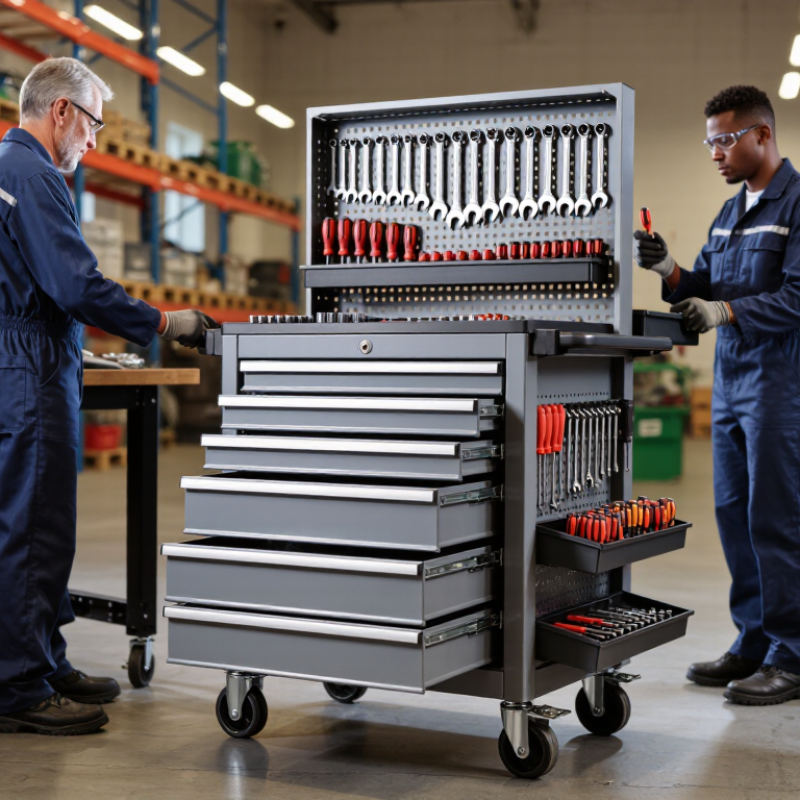
Rolling tool carts combine organized storage with workplace mobility. Typical industrial carts are designed around compact footprints, ergonomic working heights, and substantial load capacities, helping teams keep frequently used tools close to the point of work while reducing unnecessary carrying and movement.

Key Features That Define a Reliable Rolling Tool Cart

A reliable rolling tool cart begins with stability, not appearance.

In daily workshop use, wide casters, a low center of gravity, and a strong frame reduce tipping on uneven floors. Locking drawers should open smoothly and stay closed during movement. Small details matter. A loose drawer can damage tools and slow urgent repairs.

The U.S. Bureau of Labor Statistics reported that overexertion, bodily reaction, and repetitive motion remain major causes of private-industry injuries involving days away from work.

The 2023 Liberty Mutual Workplace Safety Index also estimated billions in annual costs from serious workplace injuries.

These findings support choosing carts that reduce carrying distance and awkward handling. A cart with height-adjustable shelves, non-slip liners, and handles that fit the user can make repeated tasks less demanding. Measure the route first. A cart that cannot pass a doorway is a poor investment.

Load capacity requires honest planning.

Check the rated capacity for each drawer, shelf, and caster, rather than trusting the total headline number. Steel construction offers durability, but excessive weight reduces maneuverability. Corrosion-resistant finishes help in humid workshops, while replaceable casters extend service life.

In my experience, users often overlook wheel quality. That is a mistake. Yet no cart solves poor organization alone; labeling, routine inspections, and sensible weight distribution still matter.

How Mobility Improves Workplace Efficiency and Organization

Why Choose Rolling Tool Carts for Your Business?

Mobility can change how a workplace uses every minute. A rolling tool cart keeps frequently used equipment near the task. Workers avoid repeated trips across the workshop, warehouse, or service area. That saved movement can improve focus and reduce unnecessary fatigue. A cart also creates a defined home for each tool. Drawers, trays, and side panels make missing equipment easier to notice. In a busy repair room, this order matters. However, mobility is not magic. An overloaded cart may roll poorly, block walkways, or create safety concerns. Choose strong wheels, a stable frame, and brakes that hold firmly.

Tips: Group tools by task, not only by size. Place heavy items in lower drawers. Label spaces clearly. Check wheels and handles weekly. Keep aisles open, even during urgent work. A five-minute reset can prevent tomorrow’s confusion.

Good organization also supports reliable work records. When tools remain in consistent locations, staff can identify shortages faster. Shared carts help teams prepare stations with fewer delays. They can also support cleaner handovers between shifts. Still, a perfect layout rarely appears immediately. Observe how people move, then adjust drawer placement and cart positions. One overlooked detail may be the height of a handle, the turning space, or poor lighting near the storage area. Test the setup during normal work, not only during a quiet inspection.

Comparing Rolling Tool Carts with Fixed Storage Solutions

Why Choose Rolling Tool Carts for Your Business?

Comparing rolling tool carts with fixed storage solutions starts with workflow. Fixed cabinets keep tools secure, but they make every task dependent on walking back and forth. A rolling cart moves with the technician, carrying sockets, gauges, fasteners, and paperwork to the work area. In a busy maintenance shop, that small change can remove repeated trips between a bench and a machine.

The U.S. Bureau of Labor Statistics reported 946,250 days-away-from-work cases involving sprains, strains, and tears in 2022. A cart cannot prevent every injury, but it can reduce unnecessary reaching, lifting, and carrying. NIOSH ergonomic guidance also emphasizes keeping frequently used materials within easy reach. Adjustable drawers and a stable worktop support that practice better than distant fixed shelving. Keep heavy items low. It matters.

Fixed storage still has value. It offers high capacity, clear inventory zones, and strong control for rarely used equipment. However, it may create bottlenecks when several employees need the same tools. The 2023 State of Manufacturing Report from Deloitte identified operational efficiency and workforce productivity as continuing priorities for manufacturers. Mobile storage supports both, though not perfectly. Crowded aisles, poor wheel maintenance, or overloaded drawers can create new problems. In real workshops, managers should test one cart during a normal shift, measure travel time, and ask technicians what slows them down. The first layout may be wrong. That is useful evidence, not failure.


Factors to Consider When Selecting a Cart for Your Business

Choosing rolling tool carts can improve workflow, but the right cart depends on daily demands.

Start by listing the tools, materials, and equipment your team moves most often. Measure their combined weight, not just the largest item. A cart with a high load rating should still roll smoothly under pressure. Check wheel diameter, wheel material, and locking performance. Larger wheels handle uneven floors better. Swivel casters help tight turns, while fixed wheels improve straight movement. Test the handle height with actual users. A comfortable grip prevents awkward leaning during long shifts. Small details matter.

Storage design deserves equal attention.

Shallow drawers keep fasteners visible, while deeper compartments hold drills or protective gear. Look for latches that stay closed when the cart crosses a threshold. Steel may suit demanding workshops, but lighter materials can reduce pushing effort. Consider corrosion resistance if the cart works near moisture, dust, or cleaning chemicals. Review the footprint beside benches, doors, and emergency routes. In practice, many teams choose a cart that is too large. That decision can create more obstruction than storage value. Leave room for movement.

Tips:

Load the heaviest items on the lowest shelf. Push the cart through your actual workspace before purchase. Check noise levels on hard flooring. Ask operators to test it for one full shift. Record common faults during the first month. This feedback may reveal that drawer depth, not capacity, is the real problem. Also inspect welds, fasteners, and wheel mounts regularly. A reliable cart is maintained, not merely purchased.

Powder Coat Booths

For those larger-sized parts, or smaller quantity runs, we have 2 independent powder coat booths and ovens. The quality, durability and affordability of today’s powder coating finishes make this the process of choice for world-class companies.

Powder coating advantages over other forms of coating are many. Materials used in the Powder coating process can be metals and non-metals that come in a multitude of thicknesses, textures, colors, etc. Another of Powder coating’s biggest advantages over conventional coatings is its ability to create finishes in many different textures. Powder Coating Booths allow us the ability to apply these advantages to large products.

Wet Paint Line

Tri-State Fabricators runs a full-service conveyor line for painting. Wet painting can provide protection or decoration to many different part styles. From start to finish, every project is easier to undergo random and point-based inspection by our skilled painting team.

Advantages to our Wet Paint Line are these lines start with product prep and ends with a thorough inspection of a high quality finished product. Our ability to complete large and small projects with a superior finish and doing so in a timely and economical fashion. This passes along the savings in production to our customers. When powder coating ins not an option, our Wet Paint Line gets the job done right the first time.

Wet Paint Booths

When the parts get big and heavy we roll-out our custom paint racks and oversize booth. By utilizing our partnerships with all the major paint brands, we can match virtually any color with wet paint.

The advantages of having access to a Wet Paint Booth are many. Large projects of many different shapes can be loaded into the booth. The Wet Paint Booth offers an environment that is much more controlled than a typical parts painting operation.

Not only are they used because of their controlled environment, but they’re are also advantageous when it comes to applying paint to parts that are needed in industries that require specialty coatings such as medical, aerospace, etc.

Military CARC

Our military forces have some very high standards when it comes to the finish of their vehicles and equipment. From the first pre-treatment step to final coat, it takes a great deal of knowledge and experience to protect the men and women of our armed forces. They deserve only the best, and Tri-State Fabricators provides it.

All of our processes are closely monitored by our staff and management teams. Both of which are highly trained in the processes of metal fabrication and finishing. Tri-State Fabricators’ goal is to always fully satisfy each and every customer, including the military. We will always put a 110% into what we do.

Glass-Bead Blasting

Abrasive media blasting is an excellent way to remove old paint, rust, and increase the paint/powder adhesion. Glass beads produce a much smoother and brighter finish than angular abrasives; leaving the part clean yet without any dimensional change. Chemically inert and environmentally friendly, we can recycle our beads approximately 30 times; making them a more preferred method of metal cleaning or surface finishing.

Advantages to Glass Bead Blasting are many. Glass bead blast media is used when a project is needing rough surfaces need to become smooth for applications of coatings such as paint. It is typically used to clean paint and rust from a product surface without deforming the surface it is being used on. Overall, compared to many other blasting media, Glass Bead Blasting is a very economical choice and those savings are always passed on to our customers.

Part Washing

Tri-State Fabricators utilize a zinc phosphate wash to clean and etch the material to ensure the best paint adhesion possible. The unique design of our 3-stage wash system does the work like a 5-stage. From Cleaning and rinsing to conversion coating and post-treatment, Our Part Washing process is a complete service and works throughout the fabrication service and the finishing service.

Along with the previously mentioned benefits, Curing is a vital chemical reaction that leaves the product finish hard and relatively safe from mild abrasion and aggressive corrosion. This process can be done in more than one way; ambient air-dry or in curing ovens at temps that exceed 240°.

Burn-Off Oven

From fixing paint mistakes (someone else’s of course) to simply cleaning our paint line hooks, our burn-off oven is put to good use. After a quick burn-off, a little clean up, and a fresh coat of paint, your parts will look better than new.

Why does our Burn-Off Oven work so well? Because super heating the air around parts turns the materials into ashes. From paint and powder coatings to rubber and machining oils, high temps do the job without degrading the integrity of the part.

Masking

Masking is a vital part of producing high quality products. We have die-cut masking patterns to protect machined surfaces as well as a wide range of plugs and caps to protect threaded holes and bolts. We provide permanent and temporary masking.

Masking allows the selected sections of a product to be protected from a fabrication or finishing service. This can be with both chemicals when etching and tapes, paints when only finishing just a section of the product. Masking is great in aiding the customization process of a project.

Screen Printing

Screen printing is a photographic process that transfers artwork onto a porous nylon screen which allows colored ink to flow through the screen and be deposited on an aluminum or plastic component. We can generally have just about any design created onto a screen for your parts.

Some of the advantages of Screen Printing are, brand recognition for your business displaying on your products, assembly instructions, product warnings/hazards, etc. Tri-State Fabricators produces Screen Printing of the highest quality so you know it’s durable.

Metal Finishing

Metal Finishing is the art of treating the exterior portion of product, often metal but can also be made of other materials, so that the surface is clean and free of any debris. Then the process of applying coats or either paint of powder coat takes place. This coating process improves the quality of the product in both appearance and resistance to wear and corrosion.

Tri-State Fabricators, Inc., understands that a project typically isn’t complete until a high-quality finish has been added to your product. This is why our painting and powder coating teams continuously inspect the products throughout the Metal Finishing process.



