


Why Choose Neodymium Magnets for Your Business?

A Neodymium Magnet can deliver strong holding force from a compact footprint. That matters when a motor must fit inside a tight housing, or a sensor needs a small, dependable magnetic component. For businesses, the decision is not only about strength. Operating temperature, corrosion protection, coating, shape, and supply continuity all affect performance and total cost.

The U.S. Geological Survey’s Mineral Commodity Summaries 2025 reports estimated global rare-earth mine production of 390,000 metric tons in 2024, including 270,000 metric tons in China. These figures describe rare-earth output, not magnet production, but they show why buyers should examine sourcing and supplier resilience. The U.S. Department of Energy’s 2023 Critical Materials Assessment also identifies rare earth elements used in permanent magnets as important materials for clean-energy technologies. The practical takeaway is clear: specify the grade and working conditions, not just the magnet’s advertised pull force. A magnet exposed to heat or moisture may need different properties or protective treatment. Small specification errors can become costly.

For procurement teams, compare tested performance, dimensional tolerances, coating options, and traceable documentation. Ask suppliers how they verify magnetic properties and manage batch variation. Then test samples in the actual assembly. A lab result is useful, but it cannot capture every vibration, temperature cycle, or installation constraint. Even a well-chosen magnet can disappoint when the design overlooks those details.
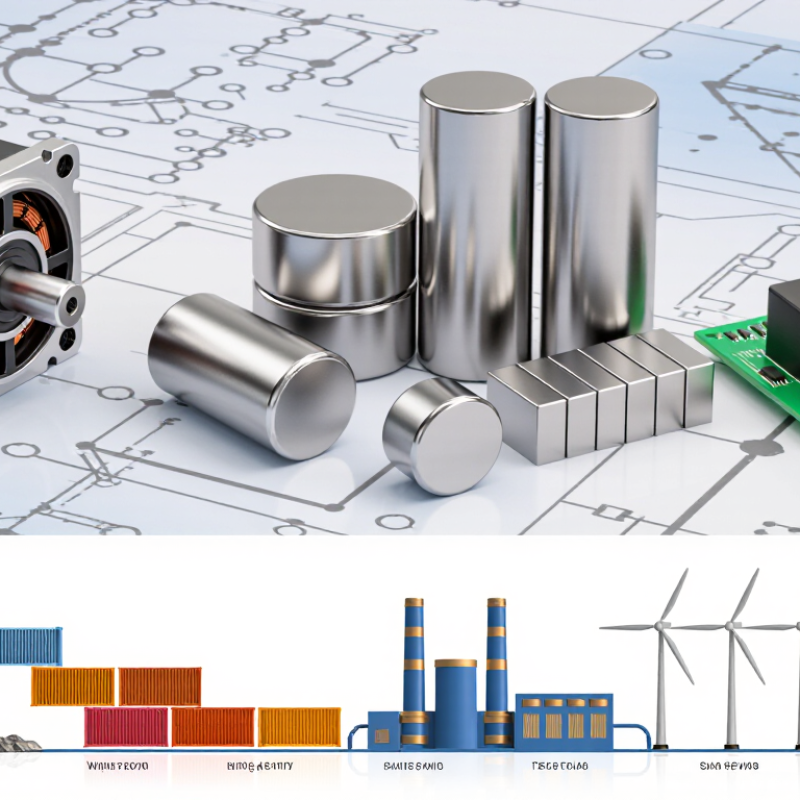
Why Choose Neodymium Magnets for Your Business?

What Neodymium Magnets Are and How They Work

Neodymium magnets are permanent magnets made mainly from neodymium, iron, and boron. Their key magnetic phase, Nd₂Fe₁₄B, has a crystal structure that strongly favors magnetization in one direction. During manufacture, the material is magnetized so many tiny magnetic regions align. The result is a powerful, compact field that can hold steel parts or drive a motor. Simple, but not magic.

The USGS Mineral Commodity Summaries 2024 estimated 2023 global rare-earth mine production at 350,000 metric tons of rare-earth-oxide equivalent, including 240,000 metric tons from China. This measures mined material, not magnet output; the distinction matters when assessing supply.

For business use, check the magnet’s grade, dimensions, temperature rating, and coating. A strong magnet can lose performance when heated, and uncoated material can corrode. “Strong” alone is not a specification.

Tips: Match the magnet to the actual job. Test it near the real air gap and working temperature, not just on a clean steel bench. Keep a little margin. It is easy to overlook assembly forces, too; two magnets can snap together before a technician has time to react.


Key Properties That Set Neodymium Magnets Apart

Neodymium magnets deliver high magnetic strength in a relatively small package. For businesses, this can free up space in motors, sensors, fixtures, and compact closures. A magnet only a few millimetres wide may hold a steel component firmly, depending on its grade, shape, and working gap. Small part. Strong pull.

Their magnetic performance is often described by energy product, while resistance to demagnetisation depends on the grade and operating conditions. Temperature matters. A magnet that performs well in a cool assembly may lose strength if exposed to excessive heat; the exact limit varies by grade. Neodymium magnets are also brittle, so a hard impact can chip or crack them. They are not miniature steel springs.

Corrosion resistance deserves attention during material selection. Many neodymium magnets use protective coatings, but a damaged coating or humid environment can still create problems. In a real product, test the magnet with its housing, adhesive, and nearby metals—not in isolation. Measure holding force across the actual gap, too. That detail is easy to overlook. The strongest available grade is not always the best choice; cost, temperature, coating, and assembly method all shape long-term performance. A prototype can reveal issues that a specification sheet cannot.

Business Applications Across Industries

Why Choose Neodymium Magnets for Your Business?

Business Applications Across Industries

Neodymium magnets offer strong holding power in a compact size, making them useful where space is limited. In manufacturing, they can secure small components in fixtures or help separate ferrous material from product streams. A magnetic fixture can reduce slipping during assembly, though its performance depends on contact area and surface condition. Details matter.

In retail displays, compact magnets can hold removable signs and product panels without bulky brackets. Medical equipment makers may use them in carefully engineered assemblies, while designers of sensors and motors rely on their magnetic properties for precise operation. These applications require suitable coatings and controlled installation, especially where moisture or repeated impacts are present. A small air gap can reduce holding force more than expected. That can surprise teams.

Neodymium magnets are not automatically the right choice for every job. Heat, corrosion, brittle edges, and nearby electronics may affect material selection or placement. Teams should test prototypes under real operating conditions, including vibration and cleaning routines. Specifications help, but a quick bench test may miss long-term wear. Choosing the right grade, shape, and mounting method can make a compact magnet dependable in daily use.

Operational and Cost Benefits for Businesses

For many businesses, neodymium magnets provide strong holding force in a compact footprint. This can save space in fixtures, sensor housings, closures, and production tooling. Smaller assemblies may need fewer brackets or fasteners, which can reduce handling and installation time. In repetitive production, small savings add up. But results depend on the design and working conditions.

Tips: Test a sample in the real setup. Check air gaps, load direction, temperature, coating, and repeated impact before ordering in volume. Pull-force figures alone can mislead.

A well-matched magnet may simplify assembly and reduce maintenance on moving parts. Compare its purchase price with labor, replacement frequency, and the cost of surrounding components. The cheapest option may not stay cheapest. Neodymium magnets can be brittle, and heat or corrosion may affect performance. A protective housing and suitable coating can help, but they add cost and space. I would validate the design with a short production trial; calculations rarely capture every vibration or alignment issue. That extra check takes time, yet it can prevent costly changes later.

A higher energy product can help designers meet magnetic performance targets with less magnet volume, potentially saving space and weight in equipment. Actual purchase and operating costs depend on the magnet grade, design, coating, and working conditions.

Values show typical material ranges; exact specifications vary by grade and manufacturer. MGOe = mega-gauss-oersteds.

Factors to Consider When Selecting Neodymium Magnets

Why Choose Neodymium Magnets for Your Business?

Factors to Consider When Selecting Neodymium Magnets

Choosing a neodymium magnet starts with the job, not the grade label. Define the required holding force, air gap, contact surface, and available space. A magnet tested against thick steel may perform differently on a painted panel or a thin bracket. Fit matters. The U.S. Geological Survey’s Mineral Commodity Summaries 2024 estimated global rare-earth mine production at 350,000 metric tons in 2023, with 240,000 tons from China. That concentration makes supplier continuity, traceability, and lead times practical selection criteria, not paperwork details.

Temperature and corrosion protection deserve equal attention. Standard neodymium grades can lose performance when operating temperatures exceed their specified limits; the exact threshold depends on grade and magnet shape. Heat changes everything. Match the coating—such as nickel, zinc, or epoxy—to humidity, abrasion, and chemical exposure. For a damp assembly, an attractive price may not compensate for a coating that wears through. Ask for force data under your actual gap and temperature conditions, plus dimensional tolerances and batch documentation. The International Energy Agency’s Global Critical Minerals Outlook 2024 also highlights concentrated rare-earth processing, reinforcing the value of checking supply options early. A spreadsheet helps, but it can still miss the messy details of installation.

Why Choose Neodymium Magnets for Your Business? — Factors to Consider When Selecting Neodymium Magnets
Selection Factor What to Check Practical Guidance Business Consideration
Magnetic grade Grade designations such as N35, N42, and N52 indicate different magnetic performance levels. Higher grades generally provide a greater maximum energy product, but the appropriate grade depends on the magnet’s size, geometry, operating conditions, and required holding force. Compare the performance required with the cost and availability of each grade; the highest grade is not automatically the best choice.
Maximum energy product Often expressed in megagauss-oersteds (MGOe); common sintered neodymium grades span roughly 33–53 MGOe. Use the manufacturer’s specification for the exact grade and product. Energy product alone does not determine the holding force of a finished assembly. Useful for comparing magnetic material performance, but validate the completed design under real operating conditions.
Operating temperature Check the specified maximum operating temperature and the temperature-dependent loss of magnetic output. Standard grades may have maximum operating limits around 80°C, while some temperature-rated grades support higher limits. Actual limits vary by grade and design. Include ambient heat, process heat, duty cycle, and safety margins in the specification. Excessive heat can cause irreversible loss of magnetization.
Shape and dimensions Common forms include discs, blocks, rings, and custom shapes; dimensions affect the magnetic field and available force. Specify length, width, thickness or diameter, tolerances, magnetization direction, and any holes or countersinks. Confirm that the magnet fits the assembly and can be manufactured, handled, and installed consistently.
Holding force and air gap Request force data for the intended contact material, surface finish, orientation, and gap. Published pull-force values are commonly measured against a thick, flat steel plate under controlled conditions. Paint, coatings, roughness, thin steel, and air gaps can reduce force. Test the complete assembly rather than relying only on a catalog pull-force figure. Add an appropriate design safety factor.
Corrosion protection Neodymium-iron-boron magnets can corrode if exposed to moisture or damaging environments. Common coatings include nickel-copper-nickel, zinc, epoxy, and other protective finishes. No coating is suitable for every environment. Match the coating to humidity, chemicals, abrasion, and cleaning requirements; inspect for coating damage during service.
Coating and assembly compatibility Consider coating thickness, surface contact, adhesive type, and the materials surrounding the magnet. Coatings can affect fit and bonding. Brittle magnets may chip or crack under impact or excessive clamping pressure. Use suitable fixtures and assembly methods, and verify that the chosen adhesive and coating are compatible with operating conditions.
Mechanical handling and safety Assess attraction to nearby ferromagnetic objects, pinch points, impact risk, and the quantity and size of magnets being handled. Strong magnets can snap together unexpectedly, chip, or damage sensitive equipment. Keep them away from devices that may be affected by strong magnetic fields. Establish safe storage, separation, handling, and installation procedures for staff and equipment.
Quality and documentation Request material grade, dimensional tolerances, coating details, magnetization direction, and inspection information. Check that specifications describe the finished magnet and that test conditions are clear and repeatable. Consistent documentation supports incoming inspection, production control, and replacement-part matching.
Total cost and supply planning Compare unit cost, tooling or custom-shape costs, lead time, minimum order quantities, and replacement availability. Evaluate the cost of the magnet as part of the complete assembly, including installation and potential maintenance. Balance performance with dependable supply and lifecycle requirements rather than selecting on unit price alone.
Specification note Temperature limits, force values, tolerances, and coating performance vary by grade, geometry, manufacturer, and test method. Confirm all critical values against the supplier’s current technical data and validate them in the intended application.

Powder Coat Booths

For those larger-sized parts, or smaller quantity runs, we have 2 independent powder coat booths and ovens. The quality, durability and affordability of today’s powder coating finishes make this the process of choice for world-class companies.

Powder coating advantages over other forms of coating are many. Materials used in the Powder coating process can be metals and non-metals that come in a multitude of thicknesses, textures, colors, etc. Another of Powder coating’s biggest advantages over conventional coatings is its ability to create finishes in many different textures. Powder Coating Booths allow us the ability to apply these advantages to large products.

Wet Paint Line

Tri-State Fabricators runs a full-service conveyor line for painting. Wet painting can provide protection or decoration to many different part styles. From start to finish, every project is easier to undergo random and point-based inspection by our skilled painting team.

Advantages to our Wet Paint Line are these lines start with product prep and ends with a thorough inspection of a high quality finished product. Our ability to complete large and small projects with a superior finish and doing so in a timely and economical fashion. This passes along the savings in production to our customers. When powder coating ins not an option, our Wet Paint Line gets the job done right the first time.

Wet Paint Booths

When the parts get big and heavy we roll-out our custom paint racks and oversize booth. By utilizing our partnerships with all the major paint brands, we can match virtually any color with wet paint.

The advantages of having access to a Wet Paint Booth are many. Large projects of many different shapes can be loaded into the booth. The Wet Paint Booth offers an environment that is much more controlled than a typical parts painting operation.

Not only are they used because of their controlled environment, but they’re are also advantageous when it comes to applying paint to parts that are needed in industries that require specialty coatings such as medical, aerospace, etc.

Military CARC

Our military forces have some very high standards when it comes to the finish of their vehicles and equipment. From the first pre-treatment step to final coat, it takes a great deal of knowledge and experience to protect the men and women of our armed forces. They deserve only the best, and Tri-State Fabricators provides it.

All of our processes are closely monitored by our staff and management teams. Both of which are highly trained in the processes of metal fabrication and finishing. Tri-State Fabricators’ goal is to always fully satisfy each and every customer, including the military. We will always put a 110% into what we do.

Glass-Bead Blasting

Abrasive media blasting is an excellent way to remove old paint, rust, and increase the paint/powder adhesion. Glass beads produce a much smoother and brighter finish than angular abrasives; leaving the part clean yet without any dimensional change. Chemically inert and environmentally friendly, we can recycle our beads approximately 30 times; making them a more preferred method of metal cleaning or surface finishing.

Advantages to Glass Bead Blasting are many. Glass bead blast media is used when a project is needing rough surfaces need to become smooth for applications of coatings such as paint. It is typically used to clean paint and rust from a product surface without deforming the surface it is being used on. Overall, compared to many other blasting media, Glass Bead Blasting is a very economical choice and those savings are always passed on to our customers.

Part Washing

Tri-State Fabricators utilize a zinc phosphate wash to clean and etch the material to ensure the best paint adhesion possible. The unique design of our 3-stage wash system does the work like a 5-stage. From Cleaning and rinsing to conversion coating and post-treatment, Our Part Washing process is a complete service and works throughout the fabrication service and the finishing service.

Along with the previously mentioned benefits, Curing is a vital chemical reaction that leaves the product finish hard and relatively safe from mild abrasion and aggressive corrosion. This process can be done in more than one way; ambient air-dry or in curing ovens at temps that exceed 240°.

Burn-Off Oven

From fixing paint mistakes (someone else’s of course) to simply cleaning our paint line hooks, our burn-off oven is put to good use. After a quick burn-off, a little clean up, and a fresh coat of paint, your parts will look better than new.

Why does our Burn-Off Oven work so well? Because super heating the air around parts turns the materials into ashes. From paint and powder coatings to rubber and machining oils, high temps do the job without degrading the integrity of the part.

Masking

Masking is a vital part of producing high quality products. We have die-cut masking patterns to protect machined surfaces as well as a wide range of plugs and caps to protect threaded holes and bolts. We provide permanent and temporary masking.

Masking allows the selected sections of a product to be protected from a fabrication or finishing service. This can be with both chemicals when etching and tapes, paints when only finishing just a section of the product. Masking is great in aiding the customization process of a project.

Screen Printing

Screen printing is a photographic process that transfers artwork onto a porous nylon screen which allows colored ink to flow through the screen and be deposited on an aluminum or plastic component. We can generally have just about any design created onto a screen for your parts.

Some of the advantages of Screen Printing are, brand recognition for your business displaying on your products, assembly instructions, product warnings/hazards, etc. Tri-State Fabricators produces Screen Printing of the highest quality so you know it’s durable.

Metal Finishing

Metal Finishing is the art of treating the exterior portion of product, often metal but can also be made of other materials, so that the surface is clean and free of any debris. Then the process of applying coats or either paint of powder coat takes place. This coating process improves the quality of the product in both appearance and resistance to wear and corrosion.

Tri-State Fabricators, Inc., understands that a project typically isn’t complete until a high-quality finish has been added to your product. This is why our painting and powder coating teams continuously inspect the products throughout the Metal Finishing process.
