


Why Choose Microfluidic Chips for Your Business?

Microfluidic Chips are changing how businesses design diagnostics, drug research, and analytical instruments. A tiny cartridge can guide fluids through channels thinner than a human hair. It can reduce sample volume, shorten testing time, and support repeatable automation. These advantages matter when laboratories face rising reagent costs and pressure for faster decisions.

George M. Whitesides, a leading microfluidics researcher, defined the field clearly: “Microfluidics is the science and technology of systems that process or manipulate small amounts of fluids.” His explanation highlights the core business value. Precise fluid control can turn a complex laboratory workflow into a compact, scalable platform. For product teams, this may mean smaller instruments, lower waste, and easier integration with optical or electronic sensors.

Market evidence supports this momentum, though estimates are not identical. Grand View Research valued the global microfluidics market at approximately USD 28.35 billion in 2023. Its report projects a 13.2% compound annual growth rate from 2024 to 2030. Some estimates disagree. That difference deserves attention before investment decisions are made. Still, the direction is difficult to ignore. Companies choosing Microfluidic Chips should assess manufacturing yield, material compatibility, calibration, and user training. A chip may look elegant on a prototype bench. Production can be less forgiving. The strongest business case combines measurable throughput gains with documented validation, reliable supply chains, and realistic total ownership costs.
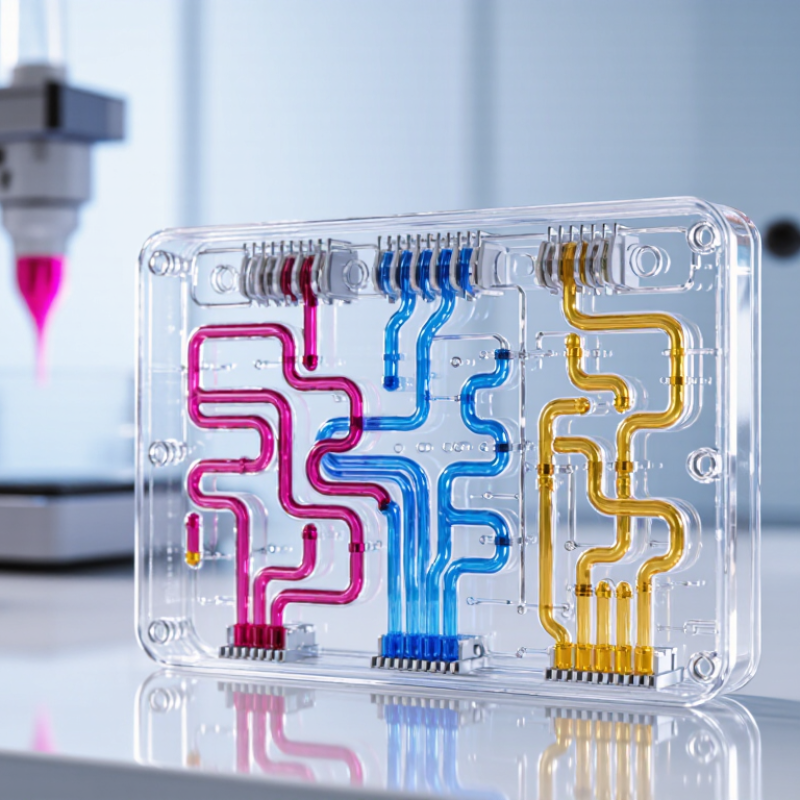
Why Choose Microfluidic Chips for Your Business?

What Are Microfluidic Chips and How Do They Work?

Microfluidic chips are small devices that guide liquids through channels thinner than a human hair. They usually contain inlets, chambers, valves, mixers, and detection areas. A typical chip can handle tiny samples, sometimes only a few microliters. Pumps or pressure differences move the liquid through the channels. Because the flow is usually laminar, streams travel side by side instead of turbulently mixing. Mixing often depends on diffusion or carefully designed channel patterns. Sensors then measure color, electrical signals, fluorescence, or other changes.

For a business, this design can reduce reagent use, shorten testing time, and support compact instruments. A clinic may process a sample near the point of care. A laboratory may run several controlled reactions on one disposable chip. In practice, results depend on channel geometry, surface treatment, temperature, and operator training. Chips are not magic. Bubble formation, blocked channels, or uneven sample loading can damage reliability. I have seen how a simple handling error can matter more than an advanced sensor. Validation under real working conditions remains essential.

Tips: Start with one measurable workflow, not a broad promise. Test real samples early. Record flow rates, storage conditions, and failure causes. Build quality checks into every batch. A slightly slower chip with stable results may create more business value than a faster design that requires constant troubleshooting.


Why Choose Microfluidic Chips for Your Business?

Microfluidic chips control very small liquid volumes through channels that are typically tens to hundreds of micrometres wide. This miniaturization can reduce reagent consumption, support parallel testing, and shorten processing time.

The chart shows representative liquid-volume ranges used in common laboratory formats. Lower working volumes can reduce material costs and waste, while integrated channels, valves, droplets, and sensors help automate repeatable workflows.

Values are representative engineering ranges: 96-well assays commonly use approximately 100–300 μL, microfluidic chambers about 1–10 μL, and droplet-based microfluidics about 1–100 nL. Actual volumes vary by assay design.

Which Business Applications Benefit from Microfluidic Chips?

Microfluidic chips support business applications that depend on small samples, rapid testing, and controlled fluid movement. Their narrow channels can handle blood, saliva, water, or chemical solutions with minimal waste. This matters when materials are expensive or difficult to collect.

Clinical laboratories can use these chips for diagnostic screening and cell analysis. A compact device may combine sample preparation, reaction, and detection in one workflow. Results can arrive faster than with several separate instruments. However, accuracy still depends on calibration, operator training, and proper sample handling. Small volumes leave little room for error.

Pharmaceutical research teams benefit from microfluidic chips when studying drug responses or forming microscopic particles. Researchers can adjust flow rates and observe changes under repeatable conditions. Food and environmental companies can also test contamination indicators in water, ingredients, or production areas. These applications may reduce transport time and simplify on-site checks. Not every process needs a chip. Sometimes, conventional equipment remains more reliable for large batches.

In practical projects, integration often creates the hardest challenge. A chip may perform well in controlled trials but struggle with messy real samples. That gap deserves attention. Businesses should compare recovery rates, maintenance needs, regulatory requirements, and total operating costs before scaling. A promising prototype is not automatically a dependable product.

What Advantages Do Microfluidic Chips Offer Businesses?

Microfluidic chips give businesses precise control over very small liquid volumes. Their channels can be thinner than a human hair. This precision reduces reagent waste and lowers handling costs. A compact chip may perform mixing, separation, and detection in one workflow. In practical testing, engineers can watch droplets move through clear channels. That visibility helps reveal leaks, bubbles, and uneven flow before production.

Businesses in diagnostics, pharmaceutical research, food testing, and environmental analysis can benefit from faster processing. Multiple channels can run samples at the same time. This improves throughput without requiring a large laboratory footprint. Smaller instruments also reduce bench space and routine maintenance. However, speed is not guaranteed. Reliable results still require calibration, controlled temperatures, and trained operators. Each assay needs independent verification.

Microfluidic systems can support safer workflows by limiting sample volumes and reducing manual transfers. They also create consistent testing conditions, which strengthens data quality. From an operations perspective, standard chips may simplify training and inventory planning. Yet surface adsorption, clogging, and material compatibility can affect performance. These problems are easy to underestimate. Businesses should test real samples, not only ideal laboratory fluids. A limited pilot may expose weaknesses that impressive early results conceal.

Why Choose Microfluidic Chips for Your Business? - What Advantages Do Microfluidic Chips Offer Businesses?
Business Dimension Conventional Laboratory Approach Microfluidic Chip Capability Potential Business Value
Sample and Reagent Volume Many laboratory workflows operate at microliter to milliliter volumes. nL–µL scale
Microchannels can handle very small liquid volumes, depending on the chip design and application.
Lower consumption of costly reagents, reduced waste, and lower per-test material costs.
Processing Speed Separate preparation, reaction, washing, and detection steps can increase total processing time. Small dimensions shorten diffusion distances and support rapid mixing, heat transfer, and reaction control. Shorter turnaround times can improve service capacity and support faster operational decisions.
Parallel Processing Parallelization often requires multiple vessels, instruments, or manual handling steps. Multiple channels, chambers, or droplets can be integrated on one chip for simultaneous processing. Higher test capacity within a compact footprint and better suitability for screening and quality-control workflows.
Automation Potential Pipetting, transfers, and repeated washing may require substantial manual intervention. Chips can be connected to pumps, valves, sensors, imaging systems, and software-controlled workflows. More consistent operation, fewer handling errors, and improved scalability of routine processes.
Footprint and Portability Benchtop workflows may require several instruments and dedicated laboratory space. Fluid handling, reaction chambers, and detection interfaces can be combined in a compact cartridge or device. Lower space requirements and easier deployment in decentralized, field, or point-of-use environments.
Reproducibility Results may be affected by manual pipetting, vessel-to-vessel variation, and operator technique. Precisely fabricated channels and controlled flow conditions can provide repeatable fluid handling when properly validated. Greater process consistency and easier standardization across operators or production sites.
Integration of Functions Sample preparation, reaction, separation, and detection are often performed in separate stages. Filtration, mixing, amplification, cell handling, separation, and detection may be integrated into a single workflow. Fewer transfer steps, reduced contamination opportunities, and simpler product or service workflows.
Heat and Mass Transfer Larger volumes generally require more time to heat, cool, or equilibrate uniformly. High surface-area-to-volume ratios support rapid thermal response and efficient molecular transport. Improved control of temperature-sensitive processes and potential reductions in cycle time.
Sample Requirements Some assays require relatively large sample quantities to complete multiple preparation steps. Small-volume processing can support applications where samples are scarce, expensive, or difficult to obtain. Greater feasibility for limited clinical, environmental, research, or product-development samples.
Scalability Capacity increases may require additional instruments, operators, and laboratory space. Scaling can be achieved through parallelization, multiplexing, cartridge production, or automated instrument integration. A flexible route from prototype testing to higher-throughput commercial operations.
Data Generation and Monitoring Measurements may be collected at discrete stages using separate instruments. Optical, electrochemical, pressure, flow, and temperature sensors can be integrated with the fluidic workflow. More continuous process monitoring, improved traceability, and stronger support for data-driven quality control.
Implementation Considerations Existing laboratory procedures and equipment may be familiar to staff and easier to adapt incrementally. Initial development may require specialized chip design, surface treatment, fluid control, validation, and manufacturing processes. The strongest return is usually achieved when the application benefits from low volumes, automation, integration, rapid processing, or high testing density.
Note: Actual performance depends on chip material, channel geometry, assay chemistry, flow-control method, detection technology, sample type, and manufacturing quality. The capabilities shown are general characteristics of microfluidic systems rather than guaranteed specifications for every chip.

How Do Microfluidic Chips Improve Efficiency and Scalability?

Why Choose Microfluidic Chips for Your Business?

How Do Microfluidic Chips Improve Efficiency and Scalability?

Microfluidic chips move tiny liquid volumes through precisely designed channels. This reduces reagent use, shortens reaction times, and limits manual handling. In practical laboratory workflows, parallel channels can process several samples at once. A technician may load one compact device instead of managing many separate tubes. That change can reduce transfer errors and free valuable bench space. Small volumes matter.

Scalability comes from repeating a validated channel design across larger chip formats. Automated pumps, sensors, and imaging systems can support consistent operation with less direct intervention. However, scaling is not always effortless. Viscosity changes, blocked channels, and uneven flow may appear during expansion. A method that works with ten samples may need redesign before handling hundreds. Careful calibration and documented quality checks remain essential for reliable results.

Tips: Start with a small pilot and record flow rates, loading time, and failed runs. Test real sample types, not only clean laboratory solutions. Keep spare chips available during early trials. Review cleaning and waste procedures before increasing throughput. The cheapest device is not always the most efficient choice. Teams should also question whether automation adds value for their current volume. Sometimes, a simpler setup performs better.

What Factors Should Businesses Consider Before Adoption?

Why Choose Microfluidic Chips for Your Business?

Microfluidic chips can reduce sample volumes, shorten testing cycles, and support more consistent results. However, adoption should begin with business needs, not technology excitement. Before investing, assess your target applications, daily sample volume, required sensitivity, and acceptable turnaround time. A chip that works well for research may not suit production testing. The answer is not always yes.

Consider total ownership costs. Include chip materials, instruments, calibration, software, staff training, waste handling, and maintenance. Check whether existing laboratory equipment can support the new workflow. Compatibility matters. Businesses should also review supplier documentation, quality controls, validation methods, and technical support. Reliable evidence is more valuable than attractive performance claims. Small pilot tests can reveal clogging, inconsistent flow, or difficult sample preparation before full deployment.

Tips: Define measurable goals before testing. Compare chip performance with your current method. Record hands-on time, failure rates, cleaning needs, and operator feedback. Ask independent technical experts to review the data. Do not ignore training.

Scalability deserves careful attention. A prototype may process ten samples daily, while commercial operations may require hundreds. Confirm whether the system can maintain accuracy at higher throughput. Review data integration, traceability, and environmental conditions. Regulatory expectations may also influence validation and recordkeeping. Some teams underestimate these requirements. That can delay launch. A practical adoption plan should include staged testing, documented acceptance criteria, and a realistic budget for unexpected redesigns.

Powder Coat Booths

For those larger-sized parts, or smaller quantity runs, we have 2 independent powder coat booths and ovens. The quality, durability and affordability of today’s powder coating finishes make this the process of choice for world-class companies.

Powder coating advantages over other forms of coating are many. Materials used in the Powder coating process can be metals and non-metals that come in a multitude of thicknesses, textures, colors, etc. Another of Powder coating’s biggest advantages over conventional coatings is its ability to create finishes in many different textures. Powder Coating Booths allow us the ability to apply these advantages to large products.

Wet Paint Line

Tri-State Fabricators runs a full-service conveyor line for painting. Wet painting can provide protection or decoration to many different part styles. From start to finish, every project is easier to undergo random and point-based inspection by our skilled painting team.

Advantages to our Wet Paint Line are these lines start with product prep and ends with a thorough inspection of a high quality finished product. Our ability to complete large and small projects with a superior finish and doing so in a timely and economical fashion. This passes along the savings in production to our customers. When powder coating ins not an option, our Wet Paint Line gets the job done right the first time.

Wet Paint Booths

When the parts get big and heavy we roll-out our custom paint racks and oversize booth. By utilizing our partnerships with all the major paint brands, we can match virtually any color with wet paint.

The advantages of having access to a Wet Paint Booth are many. Large projects of many different shapes can be loaded into the booth. The Wet Paint Booth offers an environment that is much more controlled than a typical parts painting operation.

Not only are they used because of their controlled environment, but they’re are also advantageous when it comes to applying paint to parts that are needed in industries that require specialty coatings such as medical, aerospace, etc.

Military CARC

Our military forces have some very high standards when it comes to the finish of their vehicles and equipment. From the first pre-treatment step to final coat, it takes a great deal of knowledge and experience to protect the men and women of our armed forces. They deserve only the best, and Tri-State Fabricators provides it.

All of our processes are closely monitored by our staff and management teams. Both of which are highly trained in the processes of metal fabrication and finishing. Tri-State Fabricators’ goal is to always fully satisfy each and every customer, including the military. We will always put a 110% into what we do.

Glass-Bead Blasting

Abrasive media blasting is an excellent way to remove old paint, rust, and increase the paint/powder adhesion. Glass beads produce a much smoother and brighter finish than angular abrasives; leaving the part clean yet without any dimensional change. Chemically inert and environmentally friendly, we can recycle our beads approximately 30 times; making them a more preferred method of metal cleaning or surface finishing.

Advantages to Glass Bead Blasting are many. Glass bead blast media is used when a project is needing rough surfaces need to become smooth for applications of coatings such as paint. It is typically used to clean paint and rust from a product surface without deforming the surface it is being used on. Overall, compared to many other blasting media, Glass Bead Blasting is a very economical choice and those savings are always passed on to our customers.

Part Washing

Tri-State Fabricators utilize a zinc phosphate wash to clean and etch the material to ensure the best paint adhesion possible. The unique design of our 3-stage wash system does the work like a 5-stage. From Cleaning and rinsing to conversion coating and post-treatment, Our Part Washing process is a complete service and works throughout the fabrication service and the finishing service.

Along with the previously mentioned benefits, Curing is a vital chemical reaction that leaves the product finish hard and relatively safe from mild abrasion and aggressive corrosion. This process can be done in more than one way; ambient air-dry or in curing ovens at temps that exceed 240°.

Burn-Off Oven

From fixing paint mistakes (someone else’s of course) to simply cleaning our paint line hooks, our burn-off oven is put to good use. After a quick burn-off, a little clean up, and a fresh coat of paint, your parts will look better than new.

Why does our Burn-Off Oven work so well? Because super heating the air around parts turns the materials into ashes. From paint and powder coatings to rubber and machining oils, high temps do the job without degrading the integrity of the part.

Masking

Masking is a vital part of producing high quality products. We have die-cut masking patterns to protect machined surfaces as well as a wide range of plugs and caps to protect threaded holes and bolts. We provide permanent and temporary masking.

Masking allows the selected sections of a product to be protected from a fabrication or finishing service. This can be with both chemicals when etching and tapes, paints when only finishing just a section of the product. Masking is great in aiding the customization process of a project.

Screen Printing

Screen printing is a photographic process that transfers artwork onto a porous nylon screen which allows colored ink to flow through the screen and be deposited on an aluminum or plastic component. We can generally have just about any design created onto a screen for your parts.

Some of the advantages of Screen Printing are, brand recognition for your business displaying on your products, assembly instructions, product warnings/hazards, etc. Tri-State Fabricators produces Screen Printing of the highest quality so you know it’s durable.

Metal Finishing

Metal Finishing is the art of treating the exterior portion of product, often metal but can also be made of other materials, so that the surface is clean and free of any debris. Then the process of applying coats or either paint of powder coat takes place. This coating process improves the quality of the product in both appearance and resistance to wear and corrosion.

Tri-State Fabricators, Inc., understands that a project typically isn’t complete until a high-quality finish has been added to your product. This is why our painting and powder coating teams continuously inspect the products throughout the Metal Finishing process.
