Why Choose a Gas Generator Set for Your Business?
A Gas Generator Set can help a business keep essential operations running when the utility supply is interrupted or unreliable. For a factory, that may mean keeping a production line moving. For a hotel, it can mean maintaining lighting, refrigeration, and critical building systems. The right choice depends on more than rated output. Fuel availability, operating hours, site conditions, maintenance access, and noise limits all deserve careful review.
A useful principle is: “Reliable backup begins with matching the generator to the real load, not the hoped-for load.” This is an original illustrative quotation, not a verified statement from a named industry expert. It captures a practical point, but a qualified power-systems professional should validate the sizing and installation assumptions for each site.
Look beyond the purchase price. Compare fuel costs, service intervals, expected runtime, emissions performance, and the availability of trained technicians. Ask how the unit responds to sudden load changes, such as a compressor starting while other equipment is running. Small details matter. A poorly planned fuel connection or cramped service clearance can complicate routine maintenance.
Gas supply may also vary by location and operating conditions. That deserves honest assessment. This guide examines where a Gas Generator Set can fit, what trade-offs businesses should weigh, and which questions to ask before selecting equipment. The aim is not to promise uninterrupted power. It is to help decision-makers make a better-informed choice.
What Is a Gas Generator Set? Components, Fuel Supply, and Power Output
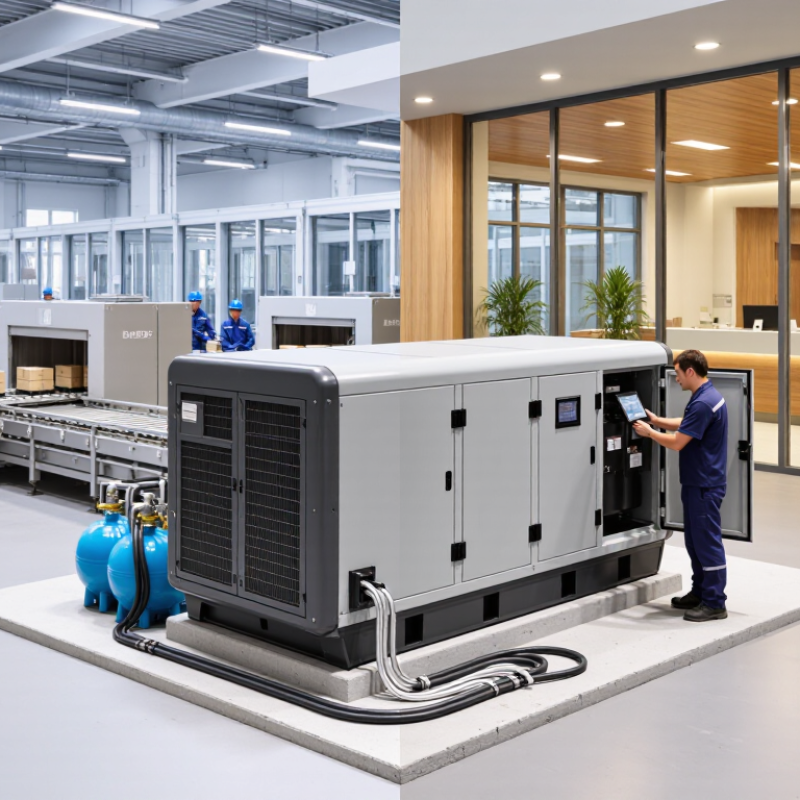
A gas generator set converts fuel energy into electricity through a coordinated set of components. A gas engine drives an alternator, while a control panel monitors voltage, frequency, temperature, and alarms. Cooling equipment removes engine heat, and the exhaust system carries combustion gases away from the installation area. Small details matter. A blocked air intake or poor ventilation can affect performance and equipment life.
Fuel usually arrives through a natural-gas pipeline or a properly designed LPG supply system. The engine needs suitable pressure and a steady flow, so a regulator and correctly sized piping are important. A technician should check the available supply against the generator’s demand, especially when other appliances share the line. Fuel quality and site conditions can also influence operation. The setup is not always as simple as connecting a pipe.
Power output is commonly listed in kilowatts or kilovolt-amperes. These figures describe different electrical properties, and the usable capacity depends on power factor, operating conditions, and the loads being served. Motors, pumps, and compressors may draw extra current during startup. A nameplate rating can therefore look more generous than the real-world capacity. Match the set to both steady demand and starting loads, and leave room for reasonable load changes.
How Gas Sets Produce Electricity: Natural Gas Made 43% of U.S. Power in 2023 (EIA)
In 2023, natural gas generated about 43% of U.S. electricity, according to the Energy Information Administration. That figure describes the national power mix, not the performance of any individual generator. A gas set burns fuel in an engine or turbine, turning a shaft connected to an electrical generator. Inside it, electromagnetic induction converts that motion into electricity. The process is familiar, but its efficiency depends on equipment condition, load, and maintenance.
For a business, a gas set can supply backup power during an outage or support a steady on-site load, if designed for that duty. Picture a refrigeration unit restarting after a brief grid interruption: the generator must match its starting demand, not just its normal running load. Small details matter. Fuel pressure and pipeline availability can affect operation, so a site assessment should include both. Natural gas combustion also produces carbon dioxide, and emissions vary with equipment and operating conditions. A reliable plan needs routine testing, ventilation, and a clear understanding of which loads are essential. The national 43% share is useful context, but it cannot tell a business whether a gas set suits its own site.
Efficiency and Emissions: DOE Reports 60–80% Total Efficiency for CHP Systems
Why Choose a Gas Generator Set for Your Business?
A gas generator set can do more than produce electricity when configured for combined heat and power (CHP). It can also capture engine heat for water, space heating, or industrial processes. The U.S. Department of Energy reports that CHP systems can reach 60–80% total efficiency, compared with roughly 50% for separate heat and power generation. That matters. But the upper range depends on recovering and using the heat, not simply installing a generator.
For a facility with steady hot-water demand, recovered heat can reduce fuel otherwise burned by a boiler. Picture a generator room beside a production line: exhaust heat is routed through a heat-recovery unit, while jacket water serves a wash process. The DOE’s Combined Heat and Power Basics explains this efficiency advantage through the combined use of electricity and useful thermal energy. The U.S. Environmental Protection Agency’s Catalog of CHP Technologies also details how engine performance and emissions vary by equipment type and operating conditions.
Efficiency is not automatic. Heat demand may fall on mild days, and a system sized too large can run inefficiently at part load. Gas combustion still produces emissions, including nitrogen oxides and carbon dioxide; actual levels depend on the engine, controls, maintenance, and fuel. A site assessment should compare hourly electricity and heat needs, not just annual bills. It is easy to focus on the impressive efficiency range. The less tidy question is whether your business can use the recovered heat every day.
Why Choose a Gas Generator Set for Your Business? — Efficiency and Emissions: DOE Reports 60–80% Total Efficiency for CHP Systems
Sources: U.S. Department of Energy, Combined Heat and Power (CHP) Basics; U.S. Environmental Protection Agency, greenhouse-gas emission factors for natural gas. Values are general references, not a performance guarantee for a specific installation.
Business Case: Compare Fuel Costs, Reliability, and Maintenance Requirements
A gas generator set can make sense when a business needs backup power without storing large volumes of fuel onsite. But fuel price alone does not decide the case. The U.S. Energy Information Administration reported an average industrial natural gas price of $3.27 per thousand cubic feet in 2023; its average retail diesel price was $4.21 per gallon. These are different units, not a direct cost comparison. Calculate cost per kilowatt-hour using local tariffs, generator heat rate, delivery fees, and expected runtime. Small assumptions matter.
Reliability depends on more than the engine. Uptime Institute’s 2024 Annual Outage Analysis identifies power problems as a leading cause of serious outages, making tested backup capacity important. A gas unit avoids onsite refueling, but it still relies on an available gas supply and adequate pressure. During an extended utility disruption, that dependency deserves a hard look. Not a footnote.
Maintenance costs also vary by duty cycle. Gas engines need scheduled oil, filter, ignition-system, and coolant checks; diesel units require fuel-system care and attention to stored fuel quality. Both need regular exercise under load, inspection, and service records. Compare the service plan against actual operating hours, not just the calendar. One overlooked detail: a lightly used generator can still fail when its battery, controls, or fuel connection is neglected. The spreadsheet will not catch that.
How to Size a Gas Generator: Match kW Demand, Starting Loads, and Runtime
Sizing a gas generator starts with a clear load list, not the largest number on an old invoice. Record each essential appliance, its running kilowatts, and how many hours it operates. Walk the site. A refrigeration unit, well pump, and office lighting may run together, while other equipment stays off. Add only the loads that must operate at the same time, then allow a practical margin for growth.
Starting loads need separate attention. Motors and compressors can briefly draw much more power than they use while running. Check equipment nameplates or manufacturer data for starting current, especially for pumps, air conditioners, and workshop machines. If several motors may start together, the generator must handle that combined surge. A qualified installer can review the load sequence and power factor; a simple kW total can miss both. The first estimate is rarely perfect.
Runtime depends on more than generator size. Estimate the hours needed during an outage, then confirm the gas supply can deliver enough fuel at the required pressure and flow. Natural gas availability may differ by site, and propane storage needs its own capacity check. Heat, altitude, and installation conditions can also reduce output. Compare the site’s measured demand with the generator’s rated capacity before choosing a unit.





