Why Choose an Expansion Screw for Your Project?
Fasteners rarely get attention until one fails. A loose bracket, a spinning screw, or a cracked edge can turn a small installation into a costly repair. An Expansion Screw can provide a dependable mechanical hold in suitable concrete or masonry, where tightening the fastener presses its sleeve against the drilled hole. The fit matters. So do the base material, hole diameter, embedment depth, and installation torque.
The market context is substantial. Grand View Research estimated the global construction fasteners market at about $89.9 billion in 2022 and projected continued growth through 2030. That figure covers many fastening products, not expansion screws alone, but it reflects how much building work depends on reliable connections. The U.S. Census Bureau also reported roughly $1.98 trillion in U.S. construction spending for 2023. Behind those figures are ordinary details: a handrail fixed to a concrete stair, or a steel bracket secured to a masonry wall.
Anchorage researcher Dr. Rolf Eligehausen’s published work offers a useful principle, paraphrased here: “Anchor performance depends on the fastener, the base material, and the installation working together.” A screw cannot compensate for weak substrate or poor drilling. That sounds simple. It is not. Choosing the right Expansion Screw means checking the product’s technical data against the actual load and site conditions, rather than relying on appearance or habit.
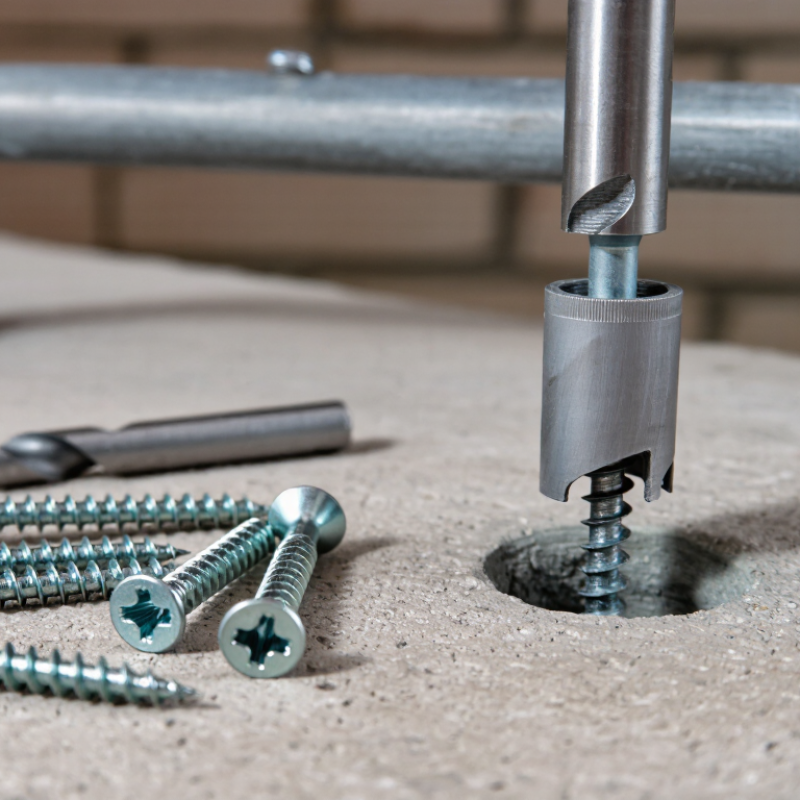
An expansion screw is a fastener designed to hold in a drilled hole, often in concrete, brick, or masonry. In common systems, the screw works with an expansion sleeve or anchor body. As the screw tightens, a cone or plug pushes the sleeve outward against the hole walls. This pressure creates a mechanical grip instead of relying only on threads biting into the material. Designs vary, so the term does not describe one universal shape. Fit matters. A suitable fastener can secure items such as brackets, rails, or equipment, but its capacity depends on both the anchor and the material around it.
Before installation, identify the base material and expected load. Concrete, hollow brick, and soft block do not behave alike. Drill the specified diameter and depth, then clear dust from the hole; debris can interfere with proper seating. Keep the anchor away from edges and cracks unless its instructions allow otherwise. Use the recommended tightening method, since overtightening may damage threads or weaken the grip. Not every wall. It is easy to blame the fastener when a crumbly surface is the real weakness. A test fit may feel reassuring, but it cannot replace a rated load limit or installation guidance.
An expansion screw anchors by turning rotational force into outward pressure inside a drilled hole. As the screw advances, its expansion section presses against the hole wall. That contact creates friction and helps resist pullout and movement. The base material matters. A screw set in sound concrete behaves differently from one installed in hollow block, cracked masonry, or weak mortar.
NRMCA’s Concrete in Practice 35 explains that concrete strength is commonly specified at 3,000 psi or higher and assessed using standard cylinder tests. That value describes a test specimen, not necessarily the concrete around a particular hole. Surface damage, voids, and nearby edges can reduce dependable holding capacity. Small details matter. Match the fastener’s approved substrate and embedment requirements to the project, and clear drilling dust before installation.
ACI 355.2 evaluates post-installed mechanical anchors through qualification tests in cracked and uncracked concrete, among other conditions. Such testing helps engineers compare anchor performance; it does not guarantee every field installation. Tightening torque, hole diameter, embedment depth, and edge distance all affect the result. It sounds simple. In practice, a slightly oversized hole or uneven tightening can change how the expansion sleeve engages. When loads are critical, use published design data and have the connection checked by a qualified professional.
Why Choose an Expansion Screw for Your Project?
Common Types and Materials of Expansion Screws
Expansion screws grip when tightening forces a sleeve, clip, or cone against the drilled hole. Sleeve anchors suit solid concrete and some masonry, while wedge anchors provide strong expansion in concrete. Drop-in anchors sit flush inside concrete and accept threaded bolts, making them useful for overhead fixtures or removable equipment. Choose based on the base material, load direction, and whether the concrete is cracked. The wrong anchor can loosen, even when the screw itself looks robust.
Common materials include zinc-plated carbon steel, hot-dip galvanized steel, and stainless steel. The International Zinc Association reports that roughly 60% of zinc use goes to galvanizing steel, which helps resist corrosion. For damp or outdoor locations, stainless steel may be a better choice; however, grade and exposure still matter. ICC-ES AC193 evaluation reports provide product-specific load capacities and installation conditions for mechanical anchors in concrete. Check the report, rather than relying on a generic load figure. It is easy to overlook hole cleaning, but dust can affect the anchor’s grip.
Tips: Match the anchor to the substrate, then drill the specified diameter and depth. Brush and clear the hole. Tighten to the stated torque with a calibrated wrench; overtightening may damage the anchor or concrete. One detail worth reconsidering: a larger screw is not automatically a safer choice.
Expansion screws are commonly used to fix items to concrete and solid masonry. As the screw tightens, its sleeve expands against the drilled hole, creating a firm mechanical grip. Typical applications include mounting handrails, shelving brackets, light equipment, and sign supports. On site, the surface matters. A sound concrete wall behaves differently from crumbly brick.
They are useful where an adhesive fixing may be impractical or where a removable connection is preferred. For example, a bracket in a garage might need a secure fixing that can still be serviced later. Small details matter: the hole diameter, drilling depth, and screw torque should match the fastener’s specifications. Dust left inside the hole can reduce reliable contact. A careful fit helps.
Expansion screws are not right for every material or load. Hollow blocks, cracked masonry, and thin edges may need a different fixing designed for those conditions.
Not every wall.
Check the substrate, expected load, and distance from edges before installation; for heavy or safety-critical fixtures, use qualified advice. Outdoor use also calls for suitable corrosion resistance. The choice is not always obvious, and guessing can leave a fitting loose.
An expansion screw can secure fixtures to solid concrete or masonry by pressing against the sides of a drilled hole. Choose one suited to the wall material, fixture weight, and expected load. Check the screw’s stated size and required hole diameter; these details must match. For hollow walls or crumbly surfaces, a different fixing may be needed. A strong fastener cannot fix weak material.
Mark the hole, then drill straight to the specified depth using the recommended bit size. Wear eye protection, and clear dust from the hole so the screw can seat properly. Insert the fastener and tighten it gradually with the correct tool. Stop when the fixture feels secure; overtightening can damage the material or fastener. Check that the fixture sits flat and does not shift. Small details matter. I would still recheck the load guidance, especially for overhead fixtures.
Tips: Measure twice before drilling. Keep the drill perpendicular to the surface, and avoid enlarging the hole by rocking the bit. If the screw spins or the wall cracks, stop and reassess the hole and substrate. Guessing here can make a poor fixing worse.



For those larger-sized parts, or smaller quantity runs, we have 2 independent powder coat booths and ovens. The quality, durability and affordability of today’s powder coating finishes make this the process of choice for world-class companies.
Powder coating advantages over other forms of coating are many. Materials used in the Powder coating process can be metals and non-metals that come in a multitude of thicknesses, textures, colors, etc. Another of Powder coating’s biggest advantages over conventional coatings is its ability to create finishes in many different textures. Powder Coating Booths allow us the ability to apply these advantages to large products.
Tri-State Fabricators runs a full-service conveyor line for painting. Wet painting can provide protection or decoration to many different part styles. From start to finish, every project is easier to undergo random and point-based inspection by our skilled painting team.
Advantages to our Wet Paint Line are these lines start with product prep and ends with a thorough inspection of a high quality finished product. Our ability to complete large and small projects with a superior finish and doing so in a timely and economical fashion. This passes along the savings in production to our customers. When powder coating ins not an option, our Wet Paint Line gets the job done right the first time.
When the parts get big and heavy we roll-out our custom paint racks and oversize booth. By utilizing our partnerships with all the major paint brands, we can match virtually any color with wet paint.
The advantages of having access to a Wet Paint Booth are many. Large projects of many different shapes can be loaded into the booth. The Wet Paint Booth offers an environment that is much more controlled than a typical parts painting operation.
Not only are they used because of their controlled environment, but they’re are also advantageous when it comes to applying paint to parts that are needed in industries that require specialty coatings such as medical, aerospace, etc.
Our military forces have some very high standards when it comes to the finish of their vehicles and equipment. From the first pre-treatment step to final coat, it takes a great deal of knowledge and experience to protect the men and women of our armed forces. They deserve only the best, and Tri-State Fabricators provides it.
All of our processes are closely monitored by our staff and management teams. Both of which are highly trained in the processes of metal fabrication and finishing. Tri-State Fabricators’ goal is to always fully satisfy each and every customer, including the military. We will always put a 110% into what we do.
Abrasive media blasting is an excellent way to remove old paint, rust, and increase the paint/powder adhesion. Glass beads produce a much smoother and brighter finish than angular abrasives; leaving the part clean yet without any dimensional change. Chemically inert and environmentally friendly, we can recycle our beads approximately 30 times; making them a more preferred method of metal cleaning or surface finishing.
Advantages to Glass Bead Blasting are many. Glass bead blast media is used when a project is needing rough surfaces need to become smooth for applications of coatings such as paint. It is typically used to clean paint and rust from a product surface without deforming the surface it is being used on. Overall, compared to many other blasting media, Glass Bead Blasting is a very economical choice and those savings are always passed on to our customers.
Tri-State Fabricators utilize a zinc phosphate wash to clean and etch the material to ensure the best paint adhesion possible. The unique design of our 3-stage wash system does the work like a 5-stage. From Cleaning and rinsing to conversion coating and post-treatment, Our Part Washing process is a complete service and works throughout the fabrication service and the finishing service.
Along with the previously mentioned benefits, Curing is a vital chemical reaction that leaves the product finish hard and relatively safe from mild abrasion and aggressive corrosion. This process can be done in more than one way; ambient air-dry or in curing ovens at temps that exceed 240°.
From fixing paint mistakes (someone else’s of course) to simply cleaning our paint line hooks, our burn-off oven is put to good use. After a quick burn-off, a little clean up, and a fresh coat of paint, your parts will look better than new.
Why does our Burn-Off Oven work so well? Because super heating the air around parts turns the materials into ashes. From paint and powder coatings to rubber and machining oils, high temps do the job without degrading the integrity of the part.
Masking is a vital part of producing high quality products. We have die-cut masking patterns to protect machined surfaces as well as a wide range of plugs and caps to protect threaded holes and bolts. We provide permanent and temporary masking.
Masking allows the selected sections of a product to be protected from a fabrication or finishing service. This can be with both chemicals when etching and tapes, paints when only finishing just a section of the product. Masking is great in aiding the customization process of a project.
Screen printing is a photographic process that transfers artwork onto a porous nylon screen which allows colored ink to flow through the screen and be deposited on an aluminum or plastic component. We can generally have just about any design created onto a screen for your parts.
Some of the advantages of Screen Printing are, brand recognition for your business displaying on your products, assembly instructions, product warnings/hazards, etc. Tri-State Fabricators produces Screen Printing of the highest quality so you know it’s durable.
Metal Finishing is the art of treating the exterior portion of product, often metal but can also be made of other materials, so that the surface is clean and free of any debris. Then the process of applying coats or either paint of powder coat takes place. This coating process improves the quality of the product in both appearance and resistance to wear and corrosion.
Tri-State Fabricators, Inc., understands that a project typically isn’t complete until a high-quality finish has been added to your product. This is why our painting and powder coating teams continuously inspect the products throughout the Metal Finishing process.


