


Why Choose a Drum Chipper for Wood Processing?

Choosing a Drum Chipper is a practical decision about material flow, chip quality, and daily production demands. The machine’s rotating drum draws branches, slabs, and offcuts toward its knives, reducing bulky wood into chips for fuel, pulp, or further processing. You can hear the change on the mill floor: uneven branches become a steady stream of material, provided the feedstock and settings are suitable.

A Drum Chipper may suit operations handling varied wood sizes or seeking consistent output. Knife condition, feed rate, drum design, and maintenance access all affect performance. A dull blade can leave ragged chips and place extra strain on the machine. Small details matter. So does the wood’s moisture and shape. A machine’s rated capacity alone cannot tell the whole story.

To avoid presenting an invented quotation as fact, here is an explicitly illustrative expert voice: wood-processing specialist Daniel Mercer might say, “Choose the chipper for the wood you actually process, not just the capacity printed on its nameplate.” That advice captures a common operational trade-off, though it is not a sourced quotation from a real expert. Buyers should compare chip specifications, service requirements, safety features, and the type of material they handle. The right choice can improve workflow; the wrong one can create bottlenecks. There is no perfect machine for every yard. Even a careful comparison leaves room for surprises once real wood starts moving.
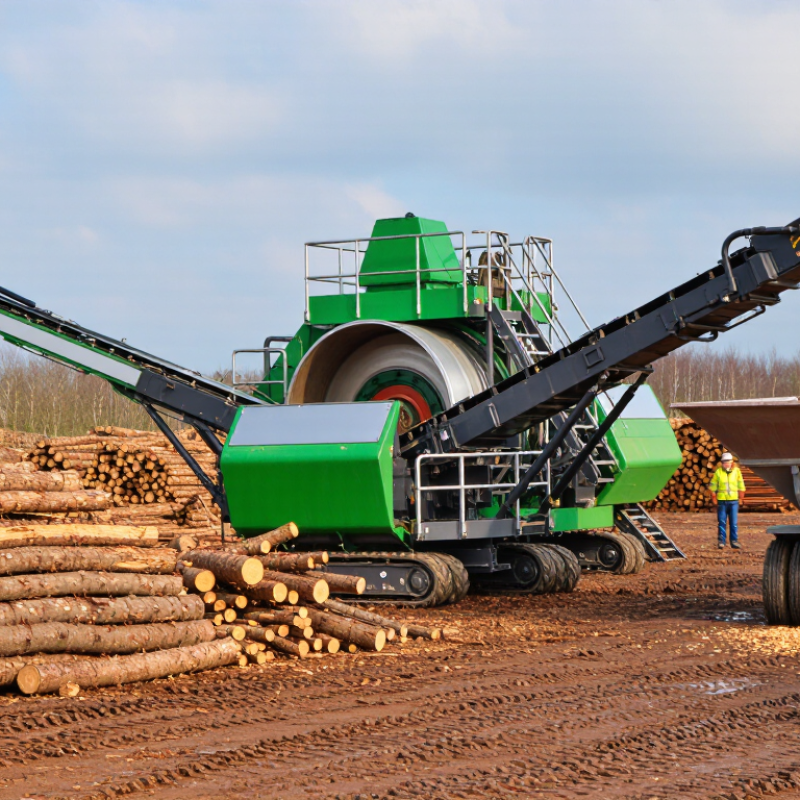
Why Choose a Drum Chipper for Wood Processing?

What a Drum Chipper Does in a Wood-Processing System

A drum chipper turns logs, slabs, and branches into wood chips for the next stage of processing. Material enters through a feed system and meets knives mounted on a rotating drum. The knives cut it into pieces as the drum spins. Chip size depends on factors such as knife condition, feed speed, and the wood’s dimensions. The machine is not a complete processing line; it is one link between raw material handling and uses such as pulping, fuel production, or panel manufacturing.

In a wood-processing system, the chipper’s job is to provide a steady, usable flow of material. Conveyors may carry chips to storage, screening, or another process. A consistent feed helps avoid sudden surges and uneven output. Small details matter. A crooked branch or oversized slab can interrupt feeding, while dull knives may produce rougher chips and increase operating strain. Operators often check chip samples and adjust settings to suit the required material.

Wood species, moisture, and feed geometry all affect performance, so a setting that works for dry pine may not suit wet hardwood. Regular inspection of knives, fasteners, and feed components helps identify wear before it causes larger problems. Still, chip dimensions will vary; perfect uniformity is not always realistic. Observing the actual output is more reliable than assuming the machine will behave identically with every load.


How Feed Rollers and a Rotating Drum Convert Wood into Chips

Feed rollers do more than pull wood inward. Their grip steadies each branch or slab and controls how quickly it meets the cutting drum. On a well-adjusted machine, the roller pressure and feed speed help keep the cut consistent. Too much feed can overload the drum; too little may waste capacity. Operators watch for bouncing material, uneven chip size, and changes in engine load. Those small signals matter.

As the drum rotates, knives sweep across the incoming wood and shear off chips. Knife sharpness, drum speed, and the gap between the knives and anvil all influence the result. A dull edge can tear fibers instead of cutting cleanly, creating more fines. The USDA Forest Products Laboratory’s 2021 Wood Handbook reports that wood shrinkage varies by species and is generally greater across the growth rings than along them. That variability is a useful reminder: wet, crooked, or mixed-species feedstock may not behave uniformly. A chipper cannot correct every inconsistency.

Good adjustment starts with the material, not just the machine. Check chip samples for length and fines, then adjust feed rate or knife settings as needed. Keep hands clear of the feed opening, and follow the equipment’s operating instructions. It is easy to assume that faster feeding means higher output. Sometimes it only means poorer chips.

Why Choose a Drum Chipper for Wood Processing?

Feed rollers advance wood toward the rotating drum, where blades cut it into chips. The chart shows the mathematically calculated normalized projection of a point on a rotating drum over one full revolution; it is a conceptual illustration, not machine-performance data.

Which Wood and Feed Conditions Affect Chipper Throughput

A drum chipper’s throughput depends on more than engine power. Wood species, moisture, diameter, and feed consistency all change the load on the drum. The USDA Forest Products Laboratory’s Wood Handbook (2021) reports air-dry densities of about 530 kg/m³ for Douglas-fir and 705 kg/m³ for red oak. These are not chipper-capacity figures, but they illustrate why equal-sized logs can demand different cutting effort. Dense hardwoods may slow feeding or increase power draw; knots and crooked stems add resistance. Small, uniform pieces often feed more steadily.

That matters.

Moisture changes the job, too. Wet, heavy logs can increase the mass moving through the machine, while very dry, brittle wood may create more fines. The U.S. Department of Energy’s 2023 Billion-Ton Report treats moisture and feedstock type as key biomass supply-chain variables, not minor details. In the field, mixed loads, muddy bark, and inconsistent diameters can disrupt the smooth feed rate assumed in a capacity estimate. Operators should track species, average diameter, moisture, and chip size alongside tonnes per hour. A short trial with the actual feedstock is more useful than a catalogue maximum.

I would still question a single “best” moisture target: the right range depends on the wood, knives, screen settings, and end use.

How Knife Setup Controls Chip Size and Consistency

Why Choose a Drum Chipper for Wood Processing?

How Knife Setup Controls Chip Size and Consistency

A drum chipper cuts wood with knives mounted around a rotating drum. Knife projection affects how deeply each blade enters the log, influencing chip thickness. Even small differences between knife heights can create uneven chips and extra fines. A straightedge can help check alignment, but always follow the machine’s operating instructions. Sharp edges matter, too. Dull knives may tear fibers instead of making clean cuts, leaving rough chips and increasing strain on the machine. Results also depend on wood species, moisture, and feed rate.

Tips: Inspect knife edges and alignment before processing. Keep the counterknife clearance consistent, using the equipment maker’s specified settings rather than a guess. Test a small batch, then check the chip length and thickness. Look closely. If chips vary widely, stop and inspect the setup before continuing.

There is no single knife arrangement that suits every wood pile. Dense hardwood may behave differently from damp, freshly cut softwood, even when the settings stay unchanged. That can be frustrating. Record adjustments alongside the wood type and moisture condition; those notes make later batches easier to compare. Still, measurements are not perfect, and a quick visual check can miss subtle wear. Regular inspection helps maintain consistency, but occasional variation is normal.

How ISO 17225-4:2021 Classifies Chips from P16S to P100S

Why Choose a Drum Chipper for Wood Processing?

A drum chipper can produce a steady stream of chips from logs, branches, and clean wood residues. Its rotating knives cut material against a screen, helping control the resulting particle-size distribution. That matters when buyers specify a class under ISO 17225-4:2021. A chipper alone cannot guarantee compliance. Wood species, moisture, knife sharpness, feed rate, and screen condition all affect the finished batch. Small changes show up in the chip pile.

The standard groups graded wood chips into particle-size classes, including P16S, P31S, P45S, P63, and P100. These labels describe sieve-based size distributions, not one exact chip length. P16S is finer than P31S and P45S, while P63 and P100 allow larger particles. Each class sets limits for the main fraction, fines, and oversized pieces. A handful of chips can look uniform, yet still fail a measured distribution. Testing representative samples is more reliable than judging by eye.

Tips: Match the chip class to the receiving equipment and contract. Check screens and knives regularly, then record settings and sample results. It takes a little discipline. Moisture content is classified separately, so confirm that requirement too.

Powder Coat Booths

For those larger-sized parts, or smaller quantity runs, we have 2 independent powder coat booths and ovens. The quality, durability and affordability of today’s powder coating finishes make this the process of choice for world-class companies.

Powder coating advantages over other forms of coating are many. Materials used in the Powder coating process can be metals and non-metals that come in a multitude of thicknesses, textures, colors, etc. Another of Powder coating’s biggest advantages over conventional coatings is its ability to create finishes in many different textures. Powder Coating Booths allow us the ability to apply these advantages to large products.

Wet Paint Line

Tri-State Fabricators runs a full-service conveyor line for painting. Wet painting can provide protection or decoration to many different part styles. From start to finish, every project is easier to undergo random and point-based inspection by our skilled painting team.

Advantages to our Wet Paint Line are these lines start with product prep and ends with a thorough inspection of a high quality finished product. Our ability to complete large and small projects with a superior finish and doing so in a timely and economical fashion. This passes along the savings in production to our customers. When powder coating ins not an option, our Wet Paint Line gets the job done right the first time.

Wet Paint Booths

When the parts get big and heavy we roll-out our custom paint racks and oversize booth. By utilizing our partnerships with all the major paint brands, we can match virtually any color with wet paint.

The advantages of having access to a Wet Paint Booth are many. Large projects of many different shapes can be loaded into the booth. The Wet Paint Booth offers an environment that is much more controlled than a typical parts painting operation.

Not only are they used because of their controlled environment, but they’re are also advantageous when it comes to applying paint to parts that are needed in industries that require specialty coatings such as medical, aerospace, etc.

Military CARC

Our military forces have some very high standards when it comes to the finish of their vehicles and equipment. From the first pre-treatment step to final coat, it takes a great deal of knowledge and experience to protect the men and women of our armed forces. They deserve only the best, and Tri-State Fabricators provides it.

All of our processes are closely monitored by our staff and management teams. Both of which are highly trained in the processes of metal fabrication and finishing. Tri-State Fabricators’ goal is to always fully satisfy each and every customer, including the military. We will always put a 110% into what we do.

Glass-Bead Blasting

Abrasive media blasting is an excellent way to remove old paint, rust, and increase the paint/powder adhesion. Glass beads produce a much smoother and brighter finish than angular abrasives; leaving the part clean yet without any dimensional change. Chemically inert and environmentally friendly, we can recycle our beads approximately 30 times; making them a more preferred method of metal cleaning or surface finishing.

Advantages to Glass Bead Blasting are many. Glass bead blast media is used when a project is needing rough surfaces need to become smooth for applications of coatings such as paint. It is typically used to clean paint and rust from a product surface without deforming the surface it is being used on. Overall, compared to many other blasting media, Glass Bead Blasting is a very economical choice and those savings are always passed on to our customers.

Part Washing

Tri-State Fabricators utilize a zinc phosphate wash to clean and etch the material to ensure the best paint adhesion possible. The unique design of our 3-stage wash system does the work like a 5-stage. From Cleaning and rinsing to conversion coating and post-treatment, Our Part Washing process is a complete service and works throughout the fabrication service and the finishing service.

Along with the previously mentioned benefits, Curing is a vital chemical reaction that leaves the product finish hard and relatively safe from mild abrasion and aggressive corrosion. This process can be done in more than one way; ambient air-dry or in curing ovens at temps that exceed 240°.

Burn-Off Oven

From fixing paint mistakes (someone else’s of course) to simply cleaning our paint line hooks, our burn-off oven is put to good use. After a quick burn-off, a little clean up, and a fresh coat of paint, your parts will look better than new.

Why does our Burn-Off Oven work so well? Because super heating the air around parts turns the materials into ashes. From paint and powder coatings to rubber and machining oils, high temps do the job without degrading the integrity of the part.

Masking

Masking is a vital part of producing high quality products. We have die-cut masking patterns to protect machined surfaces as well as a wide range of plugs and caps to protect threaded holes and bolts. We provide permanent and temporary masking.

Masking allows the selected sections of a product to be protected from a fabrication or finishing service. This can be with both chemicals when etching and tapes, paints when only finishing just a section of the product. Masking is great in aiding the customization process of a project.

Screen Printing

Screen printing is a photographic process that transfers artwork onto a porous nylon screen which allows colored ink to flow through the screen and be deposited on an aluminum or plastic component. We can generally have just about any design created onto a screen for your parts.

Some of the advantages of Screen Printing are, brand recognition for your business displaying on your products, assembly instructions, product warnings/hazards, etc. Tri-State Fabricators produces Screen Printing of the highest quality so you know it’s durable.

Metal Finishing

Metal Finishing is the art of treating the exterior portion of product, often metal but can also be made of other materials, so that the surface is clean and free of any debris. Then the process of applying coats or either paint of powder coat takes place. This coating process improves the quality of the product in both appearance and resistance to wear and corrosion.

Tri-State Fabricators, Inc., understands that a project typically isn’t complete until a high-quality finish has been added to your product. This is why our painting and powder coating teams continuously inspect the products throughout the Metal Finishing process.
