Why Choose a Threaded Linear Shaft for Your Application?
A Threaded Linear Shaft can simplify mounting in machines where alignment, repeatable travel, and limited space matter. Its threaded ends can secure brackets, stops, or couplings without separate adapters. In a compact packaging line, that may mean fewer parts around a guide rail and easier access for maintenance. Small details matter.
Before choosing one, define what the shaft must do. Will it guide a carriage, support a load, or transmit motion through a threaded interface? These functions are not interchangeable. Check the thread form, shaft diameter, unsupported length, load direction, operating speed, and required accuracy. A shaft that fits the drawing may still deflect under load. That is easy to overlook.
A transparent expert attribution matters, so this draft does not present a fictional quotation as a real industry statement. Instead, here is a practical design principle: “Match the shaft to the load, motion, and mounting method—not just the nominal diameter.” Treat it as a reminder, not a substitute for engineering review. If you need a named expert’s verified quotation, provide a source or approved expert name.
Selection also depends on the operating environment. Dust, moisture, temperature changes, and lubrication access can affect service life. Compare material, finish, tolerance, and installation requirements with the machine’s actual conditions. Then confirm the choice with supplier specifications or a qualified design engineer. A little caution helps. No shaft solves every problem.
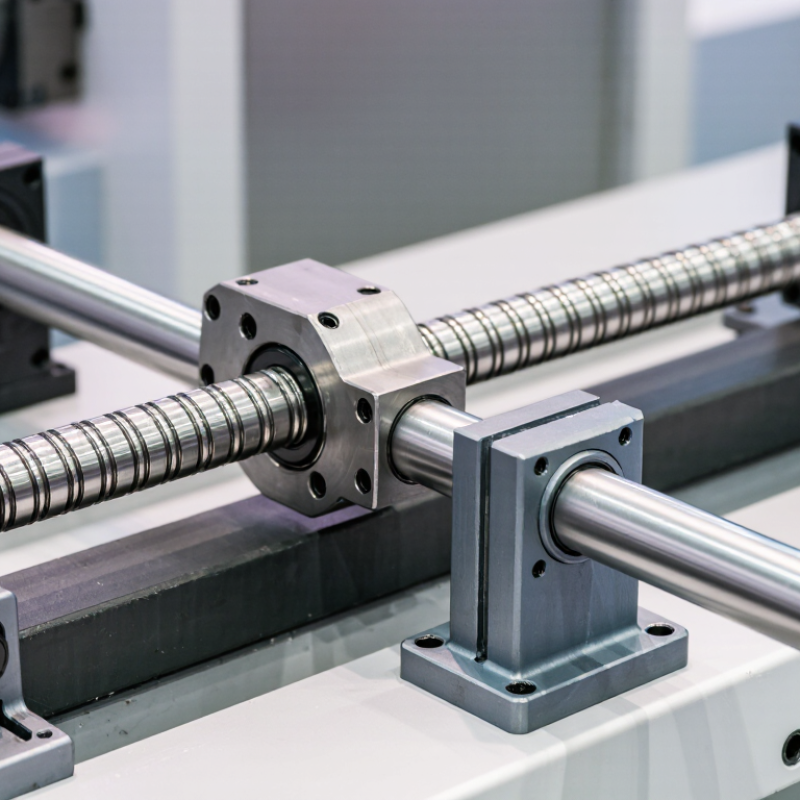
What a Threaded Linear Shaft Is and How It Works
A threaded linear shaft is a straight metal component with helical threads along some or all of its length. Those threads engage a compatible nut, turning rotary motion into controlled linear travel. When the shaft rotates, the nut moves along it; when the nut is restrained from rotating, the shaft can instead move through it. The exact motion depends on how the assembly is mounted.
Small details matter. Thread pitch determines how far the nut travels per shaft revolution, while thread fit affects smoothness and looseness. For example, a coarse pitch can move a carriage farther with each turn, while a finer pitch allows smaller adjustments. The shaft’s straightness, surface finish, and support spacing also influence how steadily it moves under load. A shaft that bends or is poorly aligned may cause uneven travel or extra wear.
In an application, the shaft may transmit force and guide motion, but it should not automatically be treated as a precision guide rail. Separate rails or bearings may be needed to control side loads. This is easy to underestimate. Check the load, travel speed, operating environment, and mounting layout before choosing a design. The right arrangement depends on the machine, not just the thread.
Key Design Features of a Threaded Linear Shaft
A threaded linear shaft must do more than support a moving part. Its core diameter affects stiffness, while thread pitch determines how far a nut travels with each rotation. A finer pitch can improve positioning control, but it may reduce travel speed. Check the expected load, stroke, and operating speed together. One number rarely tells the whole story.
Material and surface finish shape service life. Hardened steel can resist wear under repeated motion, while corrosion-resistant materials may suit damp or washdown areas. The choice depends on load and surroundings. Look closely at straightness and thread consistency, too. A shaft that looks smooth may still bind if its axis is misaligned. That detail is easy to overlook.
The shaft ends need careful design. Bearing seats, shoulders, and couplings should match the assembly, with enough clearance to avoid rubbing. Add suitable lubrication where the motion and environment allow it. Dust and chips can collect in the thread valleys, so guards may help in exposed equipment. Calculations provide a useful starting point, but real assemblies can reveal vibration or uneven wear. Measure the actual setup before finalizing tolerances. A small test can prevent a costly redesign.
Benefits Compared with Smooth Linear Shafts
A threaded linear shaft can simplify mounting when a machine needs a firm, adjustable connection. Its threads let a technician secure brackets, end supports, or stops with nuts, rather than relying only on clamps or custom adapters. During assembly, a small adjustment can bring two supports into line. That saves time. It can also make replacement easier when the shaft must be removed for maintenance.
Compared with a smooth shaft, the threaded version offers more options for axial positioning and fastening, especially in compact equipment with limited space. But the threads are not automatically an advantage along the bearing travel surface. Rolling or sliding elements generally need a smooth, accurately finished section; contact with thread crests may cause vibration, wear, or uneven motion. Keep the bearing path smooth where the design allows, and check thread size, shaft material, load, and alignment before specifying a part. Details matter.
There is a trade-off. Threads can create stress concentrations, and exposed grooves may collect dust or lubricant residue. In a clean, lightly loaded assembly, this may be manageable; in a high-speed or dirty environment, it deserves closer review. I would not choose a threaded shaft just because installation looks simpler. Measure the actual mounting space and travel first.
Applications That Require Threaded Linear Motion
Why Choose a Threaded Linear Shaft for Your Application?
Applications That Require Threaded Linear Motion
Threaded linear shafts suit applications where rotation must produce controlled, repeatable travel. A matching nut moves along the shaft as it turns, making this arrangement useful for positioning stages, adjustable fixtures, compact lifts, and machine stops. Picture a sensor mount advancing a few millimeters at a time, or a worktable rising to a set height. The motion is straightforward, but the shaft needs support, and the nut usually needs guidance to prevent unwanted rotation. Small details matter.
Tips: Check the required travel, load, speed, and duty cycle before selecting a thread. A finer lead can improve positioning resolution, but may move the load more slowly. Consider backlash if the mechanism must reverse direction accurately. Also check lubrication and exposure to dust; these can affect wear and smooth operation.
For light-duty adjustment, a threaded shaft can offer a simple, compact mechanism. In higher-load or frequent-motion systems, verify alignment and support conditions rather than relying on shaft strength alone. It is easy to assume a smaller pitch always means better accuracy. Not necessarily. Nut clearance, mounting stiffness, and operating conditions also influence repeatability. Test the assembly under realistic loads before finalizing the design.
Factors for Selecting a Threaded Linear Shaft
Why Choose a Threaded Linear Shaft for Your Application?
Factors for Selecting a Threaded Linear Shaft
Start with the load, unsupported length, and movement speed. A shaft that looks adequately sized can still bend under load, especially when its support points are far apart. Check the manufacturer’s deflection data against your actual mounting arrangement. Fit matters. Also consider whether the threaded section carries the load or only secures the shaft; confusing these jobs can lead to premature wear. A common shop-floor oversight is measuring the shaft diameter but not checking straightness and end-thread dimensions.
Specify tolerances, not just a nominal size. ISO 286-1:2010 gives an IT7 tolerance width of 18 micrometres for diameters from 10 to 18 millimetres, illustrating how small dimensional differences can affect a sliding fit. For metric threads, ISO 965-1:2013 defines tolerance systems; 6g external and 6H internal classes are commonly specified. Match the thread class to the mating component and assembly method. Consider material and surface protection too: a humid washdown area needs different corrosion resistance from a dry indoor machine. There is no universal best choice. Recheck the drawing against real loads and mounting clearances; that step is easy to rush.





