Why Choose a Static Pile Driver?
Choosing a Static Pile Driver can make sense when a project needs controlled pile installation with less noise and vibration than conventional impact driving. The machine presses piles into the ground using hydraulic force, often supported by reaction force from previously installed piles or a designed counterweight system. That is useful. Near occupied buildings, hospitals, or sensitive equipment, reducing vibration can help limit disturbance, though site measurements and engineering review still matter.
The method also offers steady control over installation speed and pile alignment. Operators can monitor resistance as each pile advances, giving the project team practical information about changing ground conditions. A quieter site may also improve communication between crews. Small details count. Still, a static pile driver is not a universal solution. Dense obstructions, unsuitable soil, restricted access, pile dimensions, and reaction capacity can affect feasibility and production. Equipment availability and setup time deserve attention, too. A careful assessment should compare the proposed system with geotechnical data, structural requirements, and nearby building conditions before equipment is selected.
This guide explains where static piling may offer value, what to evaluate before mobilization, and which limitations deserve honest consideration. The aim is not to promise a perfect installation. It is to help project teams ask better questions, verify assumptions, and choose a piling approach suited to the ground, structure, and working environment.
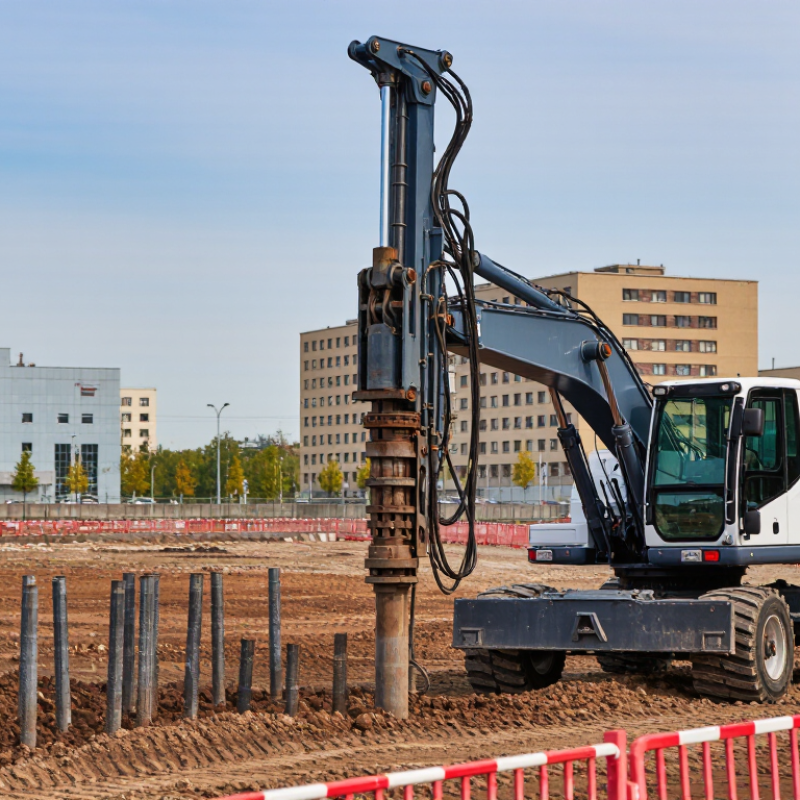
Static Pile Driving Defined: Hydraulic Press-In Installation Without Impact Blows
A static pile driver installs piles by pressing them into the ground with hydraulic force, rather than striking them with a hammer. Clamps grip the pile, and hydraulic cylinders apply steady downward pressure. The machine usually gains reaction force from previously installed piles or a separate counterweight system. No hammer blows.
This press-in method can reduce impact noise and ground vibration, which may help near occupied buildings, utilities, or vibration-sensitive equipment. Operators can monitor pressure as each pile advances. A sudden change may signal a harder soil layer or an obstruction, though pressure readings alone do not identify the cause. Site investigation still matters.
Static installation is not effortless or suitable everywhere. Dense ground, buried obstacles, restricted access, and the available reaction system can affect progress. The equipment also needs careful setup and alignment; a small tilt can create problems as the pile goes deeper. It is not magic, though. For a project team, the real choice comes from matching soil conditions, pile design, and nearby constraints to the installation method.
How the Press-In Cycle Works: Force, Pile Alignment, and Ground Reaction
A static pile driver advances a pile by pressing it into the ground, rather than relying on repeated impact. Hydraulic clamps grip the pile, and cylinders apply controlled downward force. Each press-in cycle moves the pile a short distance, then the machine resets its grip for the next stroke. The pace can feel slow. That control helps reduce vibration and noise near occupied buildings.
As resistance increases, operators watch pressure readings and check the pile’s vertical or planned angle. A small lean at the start can become harder to correct deeper down. A spirit level, survey equipment, and clear visual checks help catch drift early. Small movements matter.
The press needs a reaction force to push against. Depending on the equipment and setup, that reaction may come from previously installed piles or added weight. The ground beneath the reaction system also matters; weak or uneven support can affect stability. During a stroke, changing pressure may signal denser soil, an obstruction, or a shift in alignment. Operators should pause and investigate, not simply force the pile onward. Soil conditions rarely behave perfectly, and readings need interpretation. A careful field record of pressure, depth, and alignment gives the next shift useful context.
Equipment Selection: Match Rated Pressing Force to Pile and Soil Design Loads
Why Choose a Static Pile Driver?
Equipment Selection: Match Rated Pressing Force to Pile and Soil Design Loads
Choose a static pile driver by comparing its rated pressing force with the force expected during installation—not just the pile’s structural capacity. The design load describes what the pile must support; pressing force describes what the equipment must overcome in the ground. FHWA’s 2016 GEC-12, Design and Construction of Driven Pile Foundations, explains how subsurface conditions and construction verification inform pile resistance. Use the site investigation and installation plan together. A clay layer, dense sand, or buried obstruction can change required force sharply over a short distance.
For example, if a project’s installation analysis predicts a peak force of 950 kN, a machine rated at 1,200 kN may offer useful capacity headroom. This is an illustrative comparison, not a universal safety factor. Confirm the rating at the intended operating configuration, and check reaction mass, clamps, pile dimensions, and access. A high force rating alone proves little. Actual ground behavior can be stubborn.
Tips: Ask the geotechnical engineer for predicted installation forces and their assumptions. Compare those estimates with trial-pile or monitoring data when available. FHWA GEC-12 describes load testing and construction verification as tools for checking design assumptions. If field readings exceed predictions, pause and reassess rather than simply pressing harder. A neat calculation can still miss a local soil change.
Why Choose a Static Pile Driver? - Equipment Selection: Match Rated Pressing Force to Pile and Soil Design Loads
| Indicative Pile Type and Size | Example Soil Profile | Pile Axial Design Load | Estimated Maximum Installation Pressing Resistance | Illustrative Minimum Rated Pressing Force | Selection Check |
| Precast reinforced-concrete square pile, 250 × 250 mm | Soft to medium-stiff clay, without a hard bearing layer near the toe | 400 kN | 450–600 kN | 800 kN | Confirm the pile section can safely withstand the expected jacking force. |
| Precast reinforced-concrete square pile, 300 × 300 mm | Firm clay or medium-dense sand | 600 kN | 700–900 kN | 1,200 kN | Check the full soil profile and the required termination or set criteria. |
| Precast reinforced-concrete square pile, 350 × 350 mm | Stiff clay or dense sand | 800 kN | 1,000–1,300 kN | 1,600 kN | Allow for local hard layers and possible increases in penetration resistance. |
| Precast reinforced-concrete square pile, 400 × 400 mm | Very stiff clay or dense sand over a competent stratum | 1,000 kN | 1,400–1,800 kN | 2,000 kN | Verify pile structural capacity, joint capacity, and press equipment limits. |
| Precast reinforced-concrete square pile, 500 × 500 mm | Dense sand or a profile with a shallow hard stratum | 1,500 kN | 2,100–2,700 kN | 3,000 kN | Use project-specific geotechnical assessment to confirm the upper-bound force. |
Important: These values are illustrative screening examples, not design recommendations. Pile axial design load and installation pressing resistance are different quantities; rated pressing force should be selected from predicted installation resistance, with an appropriate project-specific reserve. Confirm the selection using geotechnical data, trial piles or load testing where required, pile structural limits, and the equipment supplier’s specifications.
Noise Benchmarks: GB 12523 Limits Construction-Site Noise to 70/55 dB(A)
Why Choose a Static Pile Driver?
GB 12523 sets familiar construction-site boundary benchmarks of 70 dB(A) by day and 55 dB(A) at night. Applicable limits and measurement conditions should be checked for each project. A static pile driver presses piles into the ground instead of repeatedly striking them. That can reduce sharp impact noise near homes, schools, and busy streets. It is not silent. Hydraulic pumps, generators, pile handling, and soil conditions also affect sound levels.
A practical noise check starts at the site boundary, not beside the machine. Record readings during representative operating cycles, and note the time, equipment activity, and nearby traffic. Compare the results with the applicable daytime or nighttime limit. A single low reading can be misleading if the machine was idle or background noise changed. I would not treat one quiet measurement as proof of ongoing compliance.
Static installation may help a project manage noise, but equipment choice alone cannot guarantee a result. Pump placement, maintenance, work sequencing, and distance from sensitive buildings all matter. Even small changes in setup can alter what neighbors hear. That part is easy to underestimate.
Why Choose a Static Pile Driver? — Noise Benchmarks
GB 12523-2011 sets construction-site boundary noise limits of 70 dB(A) during the day and 55 dB(A) at night.
Static pile driving presses piles into the ground without repeated impact-hammer blows, which can help reduce impulsive noise. Actual noise varies with equipment, ground conditions, and nearby activity; compliance should be checked through boundary monitoring.





