A child’s first ride often begins with two feet on the ground, a careful push, and a quick glance toward a nearby adult. A Stable Balance Bike can make these early moments feel more manageable by giving young riders a simple way to practice steering and balance. Its value is not just in the word “stable.” Fit, frame design, tire grip, and a child’s confidence all affect how the bike feels. Small details matter.
A well-sized bike should let a child sit comfortably and place both feet flat on the ground. The handlebars should be easy to reach, without forcing a hunched posture. On a smooth, open path, children can walk the bike forward, then gradually try longer glides as they feel ready. Keep a properly fitted helmet on, stay close, and check the bike for loose parts or worn tires before rides. These habits cannot remove every wobble. They can make practice more thoughtful.
Stability is not a promise that a child will learn quickly, or that every model suits every rider. Some children prefer to walk their bike for days; others want to glide at once. That’s normal. A parent may even find that a bike that looks steady in a shop feels awkward on uneven ground. Choosing carefully means looking beyond product claims and considering the child’s height, comfort, riding surface, and willingness to try. The best start is often a modest one: a familiar place, short practice sessions, and room to build confidence at the child’s pace.
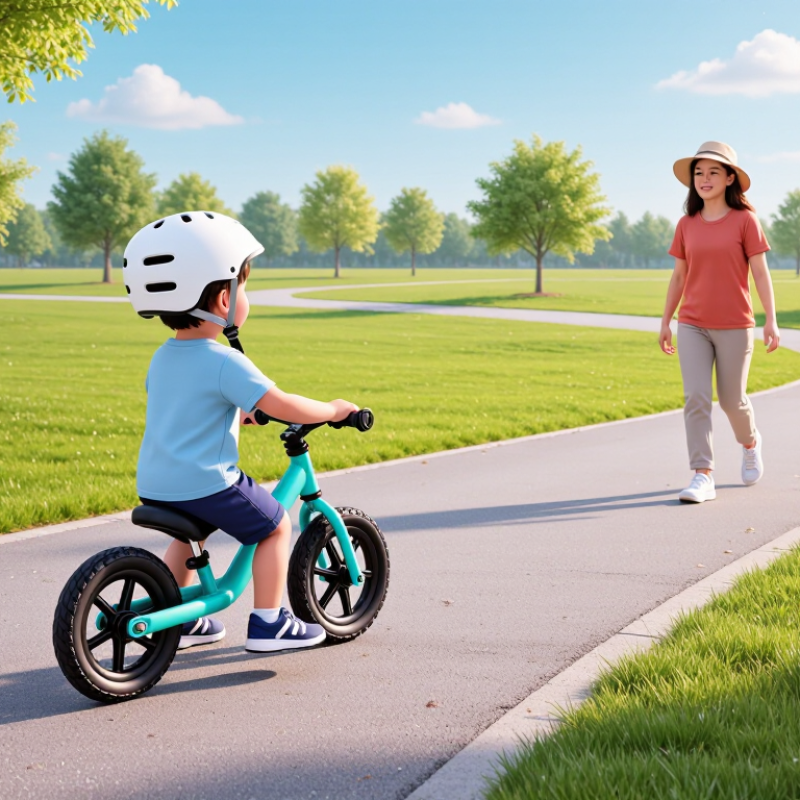
A stable balance bike starts with fit, not extra weight. A low saddle lets a child plant both feet flat, bend the knees, and catch a wobble quickly. A low center of gravity can make the frame feel less tippy, while a sensible wheelbase helps it track steadily. Too-long frames, however, may be harder for small riders to steer. Fit matters.
Tires should meet the ground evenly and grip firm paths without feeling sluggish. Check that the handlebar turns smoothly and does not swing sharply with a light touch. ASTM F963-23 sets toy safety requirements, but it does not give balance bikes a universal stability score. That distinction matters. The U.S. Consumer Product Safety Commission’s Toy-Related Deaths and Injuries, Calendar Year 2023 report estimated 231,700 toy-related emergency-room injuries among children under 15; this broad figure is not specific to balance bikes. It supports careful checks, not claims that one design feature prevents injuries. On a level surface, watch how the bike responds when your child walks it slowly and turns. A loose grip or uneven tire can change the feel. I would not judge stability from a product photo alone. Height, surface, and a child’s confidence all matter.
What Makes a Balance Bike Stable? A low center of mass, a child-sized fit, and predictable steering can help a young rider stay in control. The chart shows how the sideways component of gravity increases as a bike leans. It is a simplified physics illustration—not a product test or a direct measure of bike stability.
Key Design Features That Support Balance
A stable balance bike starts with a frame that fits the child, not just a sturdy-looking shape. A low step-through frame lets small legs get on and off without awkward climbing. The seat should adjust so both feet rest flat on the ground, with knees slightly bent. That contact gives a child a simple way to pause, push, and recover. Small detail. A seat set too high can make even a well-built bike feel uncertain.
Weight and geometry matter, too. A lightweight frame is easier for a child to steer back after a wobble, while a sensible wheelbase helps the bike track steadily. Handlebars should be easy to grip and turn, with rounded ends and enough room for little hands. Tires need dependable grip on the surfaces where the bike will be used. Wider tires are not automatically safer; tread and pressure also affect how they roll. A hands-on fit check can reveal things that measurements alone may miss.
A comfortable riding position supports practice without forcing it. The child should be able to look ahead, push with alternating feet, and briefly lift both feet when ready. A padded seat may help on longer outings, but it cannot correct a poor fit. Brakes can be useful once a child can reach and operate them, though beginners may first rely on their feet to slow down. Adult supervision still matters, especially on slopes or uneven pavement. Even a stable bike can tip.
A stable balance bike gives a child a calmer place to practise steering, gliding, and stopping. When both feet can reach the ground, a wobble feels less like a fall and more like useful feedback. The child can push off, lift their feet for a moment, then plant them again. Small wins matter. A low, predictable frame may help keep attention on direction and balance rather than fear. It does not teach every skill at once.
Practice still matters most. The World Health Organization’s 2019 guidelines recommend at least 180 minutes of varied physical activity each day for children aged three to four, including 60 minutes of moderate-to-vigorous activity. A short ride on a clear, level path can fit naturally into active play. An adult can walk nearby, point out a gentle turn, and let the child choose when to coast. Not magic. A bike that is too tall or heavy can still feel awkward, and a stable design cannot replace supervision or a well-fitted helmet. Some children need time before they want to lift their feet. That hesitation is worth respecting; progress may look like one smooth push today, not a long glide. (WHO, Guidelines on Physical Activity, Sedentary Behaviour and Sleep for Children under 5 Years of Age, 2019.)
Why Choose a Stable Balance Bike for Kids?
Safety and Fit Considerations for Young Riders
A stable balance bike should feel manageable, not oversized or difficult to steer. When seated, a child should be able to place both feet flat on the ground with slightly bent knees. This lets them stop without reaching or tipping sideways. Check that the handlebars are within comfortable reach and do not force the child to lean forward. A low, easy-to-mount frame can also make getting on and off less awkward. Small details matter.
For safety, choose a bike with secure grips, smooth edges, and brakes the child can reach and use, if fitted. Check the tires, fasteners, and seat adjustment before each ride. A properly fitted helmet and closed-toe shoes offer useful protection. Start on level ground away from traffic, steep slopes, and loose gravel. Keep practice sessions short, especially when the child is tired.
Tips: Adjust the seat so both feet touch the ground. Let your child walk the bike before trying to glide. Watch how they stop and turn. If they seem tense, lower the seat or choose a quieter practice area. Fit guides help, but children vary, and a quick test ride can reveal issues a measurement misses.

Start with fit, not appearance. Your child should sit on the saddle with both feet flat on the ground and knees slightly bent. This lets them steady the bike without stretching or tipping onto their toes. Check the handlebar reach, too. Small hands should grip comfortably, with relaxed shoulders. A bike that is too large can feel wobbly, even when its frame is well designed.
Next, consider weight, tires, and steering. A lightweight frame is easier for a child to lift after a fall or guide around a tight turn. Tires should suit the surfaces your child will ride: wider air-filled tires can soften bumps, while solid tires need less upkeep. Neither option guarantees stability. Look for smooth steering and a frame that feels balanced when the bike is upright. A low step-through can also make getting on and off less awkward. Test the fit in person when possible. Small details matter.
Do not assume that extra-wide tires automatically make a bike safer. Stability depends on fit, control, and practice together. A properly sized helmet should sit level and snug, and early rides belong on a flat, traffic-free area. Keep the first sessions short. Children vary; some need time before they feel comfortable gliding. Check the saddle height again as they grow, because even a few centimeters can change how confidently they plant their feet.


For those larger-sized parts, or smaller quantity runs, we have 2 independent powder coat booths and ovens. The quality, durability and affordability of today’s powder coating finishes make this the process of choice for world-class companies.
Powder coating advantages over other forms of coating are many. Materials used in the Powder coating process can be metals and non-metals that come in a multitude of thicknesses, textures, colors, etc. Another of Powder coating’s biggest advantages over conventional coatings is its ability to create finishes in many different textures. Powder Coating Booths allow us the ability to apply these advantages to large products.
Tri-State Fabricators runs a full-service conveyor line for painting. Wet painting can provide protection or decoration to many different part styles. From start to finish, every project is easier to undergo random and point-based inspection by our skilled painting team.
Advantages to our Wet Paint Line are these lines start with product prep and ends with a thorough inspection of a high quality finished product. Our ability to complete large and small projects with a superior finish and doing so in a timely and economical fashion. This passes along the savings in production to our customers. When powder coating ins not an option, our Wet Paint Line gets the job done right the first time.
When the parts get big and heavy we roll-out our custom paint racks and oversize booth. By utilizing our partnerships with all the major paint brands, we can match virtually any color with wet paint.
The advantages of having access to a Wet Paint Booth are many. Large projects of many different shapes can be loaded into the booth. The Wet Paint Booth offers an environment that is much more controlled than a typical parts painting operation.
Not only are they used because of their controlled environment, but they’re are also advantageous when it comes to applying paint to parts that are needed in industries that require specialty coatings such as medical, aerospace, etc.
Our military forces have some very high standards when it comes to the finish of their vehicles and equipment. From the first pre-treatment step to final coat, it takes a great deal of knowledge and experience to protect the men and women of our armed forces. They deserve only the best, and Tri-State Fabricators provides it.
All of our processes are closely monitored by our staff and management teams. Both of which are highly trained in the processes of metal fabrication and finishing. Tri-State Fabricators’ goal is to always fully satisfy each and every customer, including the military. We will always put a 110% into what we do.
Abrasive media blasting is an excellent way to remove old paint, rust, and increase the paint/powder adhesion. Glass beads produce a much smoother and brighter finish than angular abrasives; leaving the part clean yet without any dimensional change. Chemically inert and environmentally friendly, we can recycle our beads approximately 30 times; making them a more preferred method of metal cleaning or surface finishing.
Advantages to Glass Bead Blasting are many. Glass bead blast media is used when a project is needing rough surfaces need to become smooth for applications of coatings such as paint. It is typically used to clean paint and rust from a product surface without deforming the surface it is being used on. Overall, compared to many other blasting media, Glass Bead Blasting is a very economical choice and those savings are always passed on to our customers.
Tri-State Fabricators utilize a zinc phosphate wash to clean and etch the material to ensure the best paint adhesion possible. The unique design of our 3-stage wash system does the work like a 5-stage. From Cleaning and rinsing to conversion coating and post-treatment, Our Part Washing process is a complete service and works throughout the fabrication service and the finishing service.
Along with the previously mentioned benefits, Curing is a vital chemical reaction that leaves the product finish hard and relatively safe from mild abrasion and aggressive corrosion. This process can be done in more than one way; ambient air-dry or in curing ovens at temps that exceed 240°.
From fixing paint mistakes (someone else’s of course) to simply cleaning our paint line hooks, our burn-off oven is put to good use. After a quick burn-off, a little clean up, and a fresh coat of paint, your parts will look better than new.
Why does our Burn-Off Oven work so well? Because super heating the air around parts turns the materials into ashes. From paint and powder coatings to rubber and machining oils, high temps do the job without degrading the integrity of the part.
Masking is a vital part of producing high quality products. We have die-cut masking patterns to protect machined surfaces as well as a wide range of plugs and caps to protect threaded holes and bolts. We provide permanent and temporary masking.
Masking allows the selected sections of a product to be protected from a fabrication or finishing service. This can be with both chemicals when etching and tapes, paints when only finishing just a section of the product. Masking is great in aiding the customization process of a project.
Screen printing is a photographic process that transfers artwork onto a porous nylon screen which allows colored ink to flow through the screen and be deposited on an aluminum or plastic component. We can generally have just about any design created onto a screen for your parts.
Some of the advantages of Screen Printing are, brand recognition for your business displaying on your products, assembly instructions, product warnings/hazards, etc. Tri-State Fabricators produces Screen Printing of the highest quality so you know it’s durable.
Metal Finishing is the art of treating the exterior portion of product, often metal but can also be made of other materials, so that the surface is clean and free of any debris. Then the process of applying coats or either paint of powder coat takes place. This coating process improves the quality of the product in both appearance and resistance to wear and corrosion.
Tri-State Fabricators, Inc., understands that a project typically isn’t complete until a high-quality finish has been added to your product. This is why our painting and powder coating teams continuously inspect the products throughout the Metal Finishing process.




