


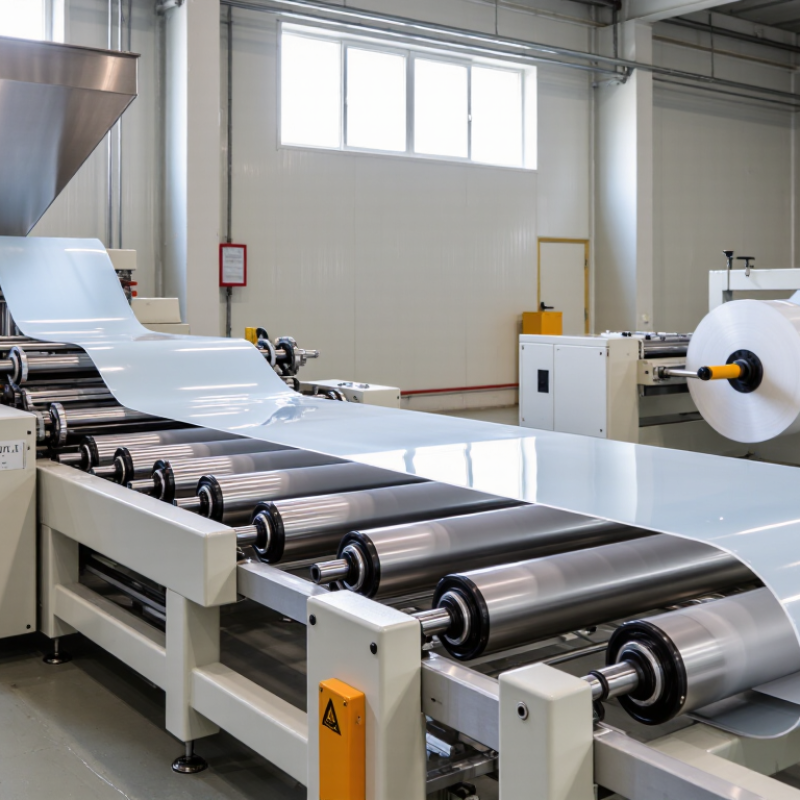
A Ps Sheet Extrusion Line turns polystyrene resin into continuous sheets for packaging, stationery, and thermoforming. Its appeal is practical: manufacturers can control sheet thickness, width, and surface finish in one connected process. The line typically includes material feeding, a heated screw and barrel, a flat die, cooling rolls, and cutting or winding equipment. Each stage affects the final sheet. Small changes in temperature or roll pressure can show up as uneven thickness, cloudy areas, or edge variation. Details matter.
Why choose this equipment? It can support repeatable production when the resin grade, machine settings, and product requirements are properly matched. For a buyer, the useful questions are concrete: What thickness range is needed? How stable is output during a long run? Are the controls clear to operators? What maintenance access is available around the die and rolls? A supplier’s stated capacity is only part of the picture. Ask how it was measured and under what conditions. A fast line is not automatically a good fit.
The choice deserves reflection. A line that suits one sheet product may waste energy or require adjustments for another. Review sample sheets, technical specifications, service support, and expected material use before committing. Even a promising configuration can need tuning after installation. That is normal, but it should be planned for. This guide explores the practical advantages and trade-offs, helping readers assess whether a Ps Sheet Extrusion Line fits their production goals.
Why Choose a PS Sheet Extrusion Line?
PS Sheet Extrusion Lines Turn Polystyrene Pellets into Continuous Sheets
Polystyrene pellets enter a hopper and feed into a heated barrel. A rotating screw moves, melts, and mixes the material before pushing it through a flat die. The die spreads the melt into a continuous sheet. Cooling rolls then help stabilize its thickness and surface. The sheet can be wound or cut to suit the next production step. It is a straightforward sequence, but steady output depends on careful adjustment.
Good process control matters. Operators watch melt temperature, screw speed, roll gap, and sheet edges. Small changes can affect thickness or cause waviness across the width. A line may run smoothly while producing uneven edges, so checking samples matters as much as watching the controls. I would not assume one setting works for every pellet grade or sheet thickness; trial runs often reveal details that the setup sheet misses.
Tips: Check thickness at the center and both edges. Keep notes when changing temperature or roll settings. Look for bubbles, dull patches, or curled edges before increasing line speed. These signs can point to material or cooling issues.
| Production Dimension | Typical Range or Configuration | How It Supports Sheet Production |
|---|---|---|
| Raw Material | General-purpose polystyrene (GPPS), high-impact polystyrene (HIPS), or a blend, supplied as pellets | Pellets are fed, melted, and homogenized before being formed into a continuous sheet. |
| Sheet Thickness | Approximately 0.2–6 mm, depending on the product and line setup | Adjustable thickness supports applications ranging from thin packaging sheet to thicker formed products. |
| Useful Sheet Width | Common configurations range from about 600–1,500 mm | A flat die and downstream rolls form a sheet across the selected working width. |
| Extruder Screw Diameter | Often around 65–120 mm on production lines; size varies with output requirements | The screw conveys, melts, and mixes the pellets to deliver a consistent melt to the die. |
| Typical Output | Approximately 100–500 kg/h for many production configurations | Actual throughput depends on screw design, material grade, sheet dimensions, and operating conditions. |
| Line Speed | Commonly about 5–30 m/min, depending on thickness and cooling capacity | Coordinated haul-off speed helps maintain consistent sheet thickness and stable winding or stacking. |
| Melt Processing Temperature | Often within roughly 180–240°C; the suitable profile depends on resin grade and equipment | Controlled barrel and die temperatures help melt the polymer while limiting overheating and flow variation. |
| Sheet Forming | Flat die followed by a multi-roll calender or polishing stack | The die distributes the melt across the width, while the rolls set thickness, surface finish, and flatness. |
| Cooling and Calibration | Temperature-controlled rolls, commonly operated with chilled-water circuits | Roll cooling stabilizes the sheet and helps it retain its dimensions as it leaves the forming section. |
| Trim and Edge Control | Edge trimming can be integrated with suitable scrap collection and handling | Trimming produces a more uniform usable width; clean scrap may be managed according to material and process requirements. |
| Downstream Handling | Haul-off, cutting, stacking, or roll winding, selected for the sheet format | Continuous handling keeps the sheet moving from the calender to the required finished length or package. |
| Typical Applications | Thermoforming sheet, packaging components, display materials, and general-purpose sheet products | Finished applications depend on the selected PS grade, sheet thickness, forming process, and product specifications. |
Ranges are indicative industry values, not guaranteed specifications. Confirm the material grade, target sheet dimensions, and required output with the equipment supplier.

A PS sheet extrusion line can turn a modest material density into predictable, lightweight panels. The British Plastics Federation’s polystyrene technical profile gives a typical density of 1.04–1.06 g/cm³. That range makes sheet-weight estimates practical. A one-square-metre sheet, one millimetre thick, weighs about 1.04–1.06 kilograms before trimming. At 0.5 millimetres, it is roughly half that. Light enough for many display, packaging, and interior applications. Not the lightest plastic, though: polypropylene is generally less dense, so the best choice depends on stiffness and end use.
For an extrusion line, density helps estimate output mass, but it does not set sheet weight alone. Thickness variation, width, and edge trim matter on the factory floor. MatWeb’s generic polystyrene property records also show why a single number should not represent every grade. Resin formulation and test conditions can shift results. Check the specific grade, then confirm density using ASTM D792, the displacement method for plastics. A simple calculation is useful, but it can create false confidence if the finished sheet’s gauge is uneven. A sample measurement can catch that. The line still needs careful temperature and haul-off control; density is a starting point, not a process guarantee.
Sheet quality begins in the die. In a PS sheet extrusion line, the die gap and melt flow help set the sheet’s thickness across its width. If flow is uneven, one edge may emerge thicker than the other. Operators can check samples with a thickness gauge and adjust process settings before the variation grows.
Small changes matter.
Cooling control shapes the sheet after it leaves the die. A steady, well-balanced cooling process helps reduce curl and maintain flatness as the material firms. If one side cools faster, internal stress can affect how the sheet lies or cuts later.
The surface also needs attention. Clean rollers, stable contact, and controlled temperatures help prevent marks, haze, or uneven gloss. Not every line responds exactly as expected; material temperature and production speed can shift the result. That takes monitoring, not guesswork.
A practical setup records thickness readings, cooling conditions, and visible surface defects during production. Some adjustments may improve one feature while affecting another, so the settings deserve review rather than blind repetition.
Why Choose a PS Sheet Extrusion Line?
Polystyrene’s glass-transition temperature is commonly near 100°C, though the exact value varies with resin grade and formulation. Below this range, the sheet is relatively rigid. As it passes through the transition, it becomes more flexible and sensitive to heat. That matters. Glass-transition temperature is not the extrusion melt setting; the polymer must be heated well beyond it to flow through the die.
On a sheet line, temperature control shapes the sheet’s behavior after extrusion, too. As hot material leaves the die and cools across the rolls, it passes back through the transition range. Uneven cooling can contribute to internal stress, curl, or changes in dimensions. Watch the edges. A slight thickness difference may cool at a different rate from the center, leaving a visible effect after trimming or forming.
A well-adjusted line helps keep output steady through coordinated control of melt temperature, die flow, roll temperature, and haul-off speed. Operators can check sheet thickness across its width and look for waviness as the material cools. In practice, production is rarely as tidy as a chart suggests; a small change in feed or room conditions may call for another adjustment. That is worth remembering when choosing equipment: stable control matters more than treating 100°C as a magic number.
Approximate glass-transition temperature ranges for common plastics (°C)
Polystyrene (PS) typically has a glass-transition temperature near 100°C. This transition is not a melting point or a recommended extrusion setting; actual processing temperatures depend on the material grade, equipment, and product requirements.
A PS sheet extrusion line produces polystyrene sheets for packaging, display panels, and thermoforming. The right setup can help maintain consistent thickness across a roll or cut sheet. That matters when a package must fit a mold without thin corners, or when a display panel needs a clean, even surface. Operators monitor temperature, screw speed, and cooling conditions because small changes can affect sheet finish and forming behavior.
Applications differ. Packaging converters may value predictable forming and trimming, while display makers often focus on surface appearance and stiffness. Thermoforming shops need sheets that heat evenly and hold useful detail after forming. A practical line should match the intended sheet width, thickness range, and production volume, rather than chase one headline output figure. Samples and trial runs can reveal issues that specifications alone miss. They take time.
Clear or colored sheets may suit different visual needs, but the final choice depends on the product design and processing conditions. Even with careful control, occasional variation can occur; reviewing sheet samples and process records helps identify where adjustments are needed. A line is only part of the result. Material handling and operator checks matter, too.


For those larger-sized parts, or smaller quantity runs, we have 2 independent powder coat booths and ovens. The quality, durability and affordability of today’s powder coating finishes make this the process of choice for world-class companies.
Powder coating advantages over other forms of coating are many. Materials used in the Powder coating process can be metals and non-metals that come in a multitude of thicknesses, textures, colors, etc. Another of Powder coating’s biggest advantages over conventional coatings is its ability to create finishes in many different textures. Powder Coating Booths allow us the ability to apply these advantages to large products.
Tri-State Fabricators runs a full-service conveyor line for painting. Wet painting can provide protection or decoration to many different part styles. From start to finish, every project is easier to undergo random and point-based inspection by our skilled painting team.
Advantages to our Wet Paint Line are these lines start with product prep and ends with a thorough inspection of a high quality finished product. Our ability to complete large and small projects with a superior finish and doing so in a timely and economical fashion. This passes along the savings in production to our customers. When powder coating ins not an option, our Wet Paint Line gets the job done right the first time.
When the parts get big and heavy we roll-out our custom paint racks and oversize booth. By utilizing our partnerships with all the major paint brands, we can match virtually any color with wet paint.
The advantages of having access to a Wet Paint Booth are many. Large projects of many different shapes can be loaded into the booth. The Wet Paint Booth offers an environment that is much more controlled than a typical parts painting operation.
Not only are they used because of their controlled environment, but they’re are also advantageous when it comes to applying paint to parts that are needed in industries that require specialty coatings such as medical, aerospace, etc.
Our military forces have some very high standards when it comes to the finish of their vehicles and equipment. From the first pre-treatment step to final coat, it takes a great deal of knowledge and experience to protect the men and women of our armed forces. They deserve only the best, and Tri-State Fabricators provides it.
All of our processes are closely monitored by our staff and management teams. Both of which are highly trained in the processes of metal fabrication and finishing. Tri-State Fabricators’ goal is to always fully satisfy each and every customer, including the military. We will always put a 110% into what we do.
Abrasive media blasting is an excellent way to remove old paint, rust, and increase the paint/powder adhesion. Glass beads produce a much smoother and brighter finish than angular abrasives; leaving the part clean yet without any dimensional change. Chemically inert and environmentally friendly, we can recycle our beads approximately 30 times; making them a more preferred method of metal cleaning or surface finishing.
Advantages to Glass Bead Blasting are many. Glass bead blast media is used when a project is needing rough surfaces need to become smooth for applications of coatings such as paint. It is typically used to clean paint and rust from a product surface without deforming the surface it is being used on. Overall, compared to many other blasting media, Glass Bead Blasting is a very economical choice and those savings are always passed on to our customers.
Tri-State Fabricators utilize a zinc phosphate wash to clean and etch the material to ensure the best paint adhesion possible. The unique design of our 3-stage wash system does the work like a 5-stage. From Cleaning and rinsing to conversion coating and post-treatment, Our Part Washing process is a complete service and works throughout the fabrication service and the finishing service.
Along with the previously mentioned benefits, Curing is a vital chemical reaction that leaves the product finish hard and relatively safe from mild abrasion and aggressive corrosion. This process can be done in more than one way; ambient air-dry or in curing ovens at temps that exceed 240°.
From fixing paint mistakes (someone else’s of course) to simply cleaning our paint line hooks, our burn-off oven is put to good use. After a quick burn-off, a little clean up, and a fresh coat of paint, your parts will look better than new.
Why does our Burn-Off Oven work so well? Because super heating the air around parts turns the materials into ashes. From paint and powder coatings to rubber and machining oils, high temps do the job without degrading the integrity of the part.
Masking is a vital part of producing high quality products. We have die-cut masking patterns to protect machined surfaces as well as a wide range of plugs and caps to protect threaded holes and bolts. We provide permanent and temporary masking.
Masking allows the selected sections of a product to be protected from a fabrication or finishing service. This can be with both chemicals when etching and tapes, paints when only finishing just a section of the product. Masking is great in aiding the customization process of a project.
Screen printing is a photographic process that transfers artwork onto a porous nylon screen which allows colored ink to flow through the screen and be deposited on an aluminum or plastic component. We can generally have just about any design created onto a screen for your parts.
Some of the advantages of Screen Printing are, brand recognition for your business displaying on your products, assembly instructions, product warnings/hazards, etc. Tri-State Fabricators produces Screen Printing of the highest quality so you know it’s durable.
Metal Finishing is the art of treating the exterior portion of product, often metal but can also be made of other materials, so that the surface is clean and free of any debris. Then the process of applying coats or either paint of powder coat takes place. This coating process improves the quality of the product in both appearance and resistance to wear and corrosion.
Tri-State Fabricators, Inc., understands that a project typically isn’t complete until a high-quality finish has been added to your product. This is why our painting and powder coating teams continuously inspect the products throughout the Metal Finishing process.

