


Water that collects behind a retaining wall, beneath a landscaped area, or beside a paved path can weaken ground and create ongoing maintenance problems. A Plastic blind drain offers a practical way to collect and redirect subsurface water through a concealed drainage route. Its perforated structure allows water to enter while surrounding soil is kept out by a suitable filter layer. In the field, details matter: a drain placed beside compacted backfill may perform differently from one installed in loose, silty soil.
The right choice depends on site conditions, not just the product name. Consider expected water flow, soil type, installation depth, outlet location, and the load above the drain. Check the manufacturer’s specifications, and confirm that the filter fabric suits the soil; an unsuitable wrap can clog over time. A dependable outlet is essential. Without one, collected water has nowhere useful to go.
Plastic systems are often light to handle and resistant to corrosion, which can simplify transport and installation. Still, they are not a cure-all. Poor grading, crushed sections, or careless backfilling can reduce performance. Small mistakes matter. Before choosing a system, compare its capacity and dimensions with the project plan, and seek qualified drainage advice when site conditions are uncertain. This guide explores where a plastic blind drain can be useful, what to assess before installation, and which limitations deserve a closer look. A little caution now can prevent a wet surprise later.
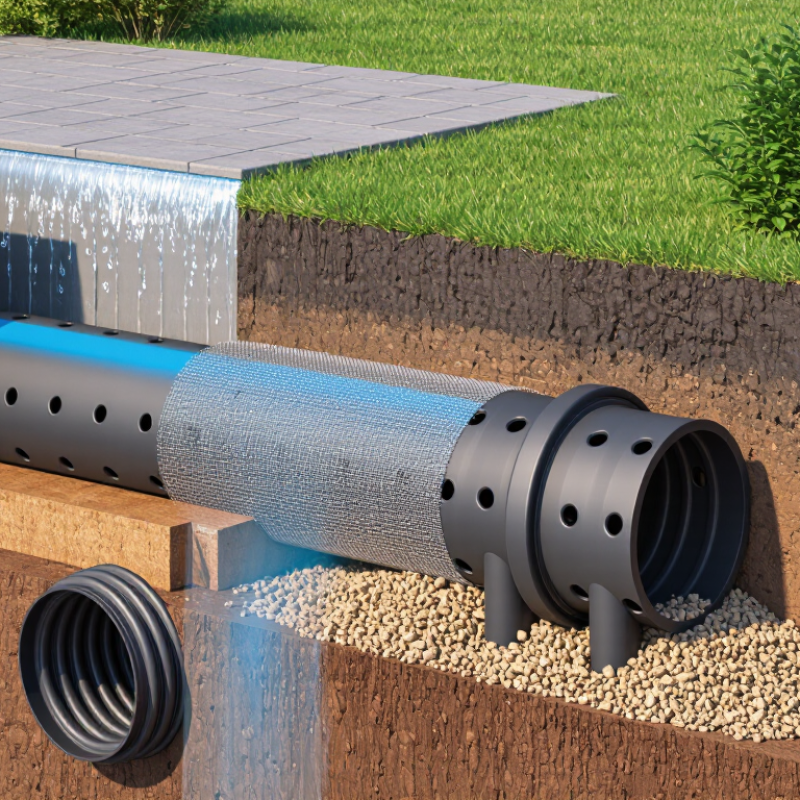
A plastic blind drain is a buried drainage unit with three working parts: a permeable geotextile, a hollow plastic core, and a route for water to discharge. The fabric faces the surrounding soil. It screens out particles while allowing water through; the core provides a low-resistance path along the drain. Not merely a wrap. If soil clogs the fabric, water entry slows. If the core is crushed or poorly connected, collected water has nowhere useful to go.
The Federal Highway Administration’s Geosynthetic Design and Construction Guidelines (NHI-07-092, 2008) treats filtration and drainage as separate design checks. It identifies apparent opening size and permittivity as key geotextile properties. ASTM D4751 measures opening size; ASTM D4491 measures permittivity. These test results help match a fabric to the soil and expected flow, rather than choosing by appearance alone. In practice, check the soil gradation, groundwater level, and outlet elevation before installation. A small gravel trench may look simple, but fine silt can change the design. That assumption is easy to make—and sometimes wrong. Keep the core’s flow path continuous, protect the fabric from tears during backfilling, and confirm the outlet remains clear after grading.

A plastic blind drain can help move collected water away from a wet area, but placement should follow site evidence, not guesswork. Start with soil texture and infiltration observations. Clay-rich soil may hold water around a trench, while coarse sand can drain quickly but allow fine particles to migrate. A simple test pit can reveal layered soils, though one pit may not represent the whole site.
That estimate may be wrong.
Check groundwater levels at different times, especially after heavy rain or seasonal snowmelt. A single dry-weather reading can miss the highest water table. Survey ground and outlet elevations to establish the hydraulic gradient: water needs a continuous downhill route, without low spots that trap sediment. Confirm the drain assembly’s flow path, filter fabric, and aggregate requirements before setting trench depth. Poor outlet conditions can undermine an otherwise well-placed drain.
Tips: Mark utility lines, record elevations, and inspect the proposed outlet. If groundwater is near the trench base, seek a site-specific drainage assessment before excavation. Don’t assume.
Why Choose a Plastic Blind Drain for Your Project?
How ASTM D4716 Measures In-Plane Flow Capacity Under Load
A plastic blind drain gives water a defined path through its core while the surrounding soil presses against it. But a high flow figure alone does not prove that the drain will perform well in a project. The test conditions matter.
ASTM D4716 measures water flow within a geosynthetic, parallel to its plane, under a specified compressive load and hydraulic gradient. In a typical test, a specimen sits between boundaries, water passes through it, and the flow rate per unit width is recorded. The applied load simulates pressure from soil or other materials. The result helps engineers compare products under stated conditions. It is not a universal field-flow guarantee.
When reviewing data, check the normal stress, gradient, specimen thickness, and test duration. These details shape the result. A drain tested at a light load may not retain the same capacity beneath deep fill. That matters. Also consider long-term compression, filter fabric, soil compatibility, and possible clogging. ASTM D4716 provides a useful measure, but it cannot recreate every site condition. I would treat the reported capacity as one design input, then ask whether the test setup resembles the project’s actual pressures and drainage path. A small mismatch can change the decision.
| Item | Definition or value | Why it matters for a plastic blind drain |
|---|---|---|
| Test method | ASTM D4716/D4716M: in-plane flow rate per unit width and hydraulic transmissivity of a geosynthetic under a constant head. | Provides a standardized way to assess water flow within a drainage product’s plane while it is subjected to specified test conditions. |
| In-plane flow | Water moving parallel to the plane of the geosynthetic, rather than through its thickness. | This is the drainage direction used by a blind drain to collect and convey water toward an outlet. |
| Normal compressive stress | Pressure applied perpendicular to the specimen during testing; the selected stress is a test condition, not a single universal value. | A useful evaluation checks flow under stresses representative of the project, because compression can reduce drainage channels. |
| Hydraulic gradient, i | The hydraulic head loss divided by the flow length; it is dimensionless. | Flow results should be compared at stated gradients, since the driving head affects measured flow. |
| Flow rate per unit width, q | q = Q/W, where Q is measured flow rate and W is specimen width. SI units: m²/s. | Normalizing by specimen width supports comparison between test specimens of different widths. |
| Hydraulic transmissivity, θ | θ = q/i for the reported test conditions. SI units: m²/s. | Expresses the in-plane flow capacity relative to the hydraulic gradient; it is condition-dependent and should be reported with the test conditions. |
| Unit conversion | 1 L/min per m of width = 1.667 × 10⁻⁵ m²/s. | Helps convert commonly used flow-per-width units to SI units for consistent reporting. |
| Calculation example | If Q = 0.60 L/min through a 0.30 m-wide specimen, then q = 2.0 L/min per m = 3.33 × 10⁻⁵ m²/s. At i = 0.10, θ = 3.33 × 10⁻⁴ m²/s. | Illustrates the calculations only. These values are not product test results or a performance claim. |
| Project comparison | Compare reported flow or transmissivity at matching normal stress, hydraulic gradient, and other stated test conditions. | A higher result under comparable conditions can indicate greater measured in-plane flow capacity, but it does not by itself establish long-term field performance. |
Note: ASTM D4716 results describe performance under the specified laboratory conditions. For design, review the complete test report and assess site-specific load, drainage length, hydraulic conditions, installation, and long-term behavior.
A plastic blind drain relies on its geotextile wrap to admit water while limiting soil movement into the drainage core. ASTM D4491 measures geotextile permittivity: the rate of water flow through a fabric under a specified head, relative to its thickness. The result is typically reported in inverse seconds. It offers a useful comparison, but it is not a direct measure of how a drain will perform in every soil.
A higher permittivity may indicate greater capacity for flow across the fabric. Still, soil gradation, hydraulic pressure, and the risk of clogging matter too. A high number can look reassuring. I would not choose a filter by that figure alone. Check the test report, fabric construction, and the soil’s particle-size distribution together. On a site with fine, silty soil, for example, a geotextile that passes water readily may still be poorly matched if particles accumulate at its surface.
ASTM D4491 data helps narrow options, not replace project-specific judgment. Compare values tested using the same method and review the manufacturer’s reported test conditions. Then consider installation: folds, punctures, or crushed drain cores can restrict flow regardless of the laboratory result. It is easy to treat one number as certainty. It isn’t. A qualified geotechnical professional can assess whether the proposed filter suits the soil and expected water conditions.
A plastic blind drain works only when water has a clear route out. Its outlet deserves as much attention as the buried pipe. Choose an exit point that remains above standing water and can discharge safely away from foundations or slopes. A steady fall helps water move by gravity, but the required gradient depends on site conditions and the drainage layout. Avoid sharp bends and crushed sections near the outlet. Small details matter.
During installation, keep the pipe aligned and support it evenly with suitable drainage aggregate. Wrap or surround it with a compatible filter layer where soil could migrate into the openings. Check that the outlet is visible and accessible before covering the trench. It is easy to rush this step. I would also photograph the pipe route and outlet location; later, those details can save time when digging or inspecting.
Clogging checks should be simple and regular, especially after heavy rain or nearby soil work. Look for reduced flow, muddy discharge, standing water, or debris at the outlet. A clean outlet does not prove the full drain is clear, so compare its flow with previous checks. If water backs up, inspect accessible points before flushing or digging; forceful cleaning may damage plastic pipe or its filter. Small maintenance records help reveal changes early.
How outlet design, installation, and clogging checks protect drain performance
Larger outlets can pass more water in this idealized comparison, but actual drainage depends on the full system. Keep the outlet unobstructed, install the drain to the specified grade, and check for sediment or debris regularly. Values are theoretical estimates using the orifice equation with a 0.6 discharge coefficient and 50 mm water head; they are not field-test results.


For those larger-sized parts, or smaller quantity runs, we have 2 independent powder coat booths and ovens. The quality, durability and affordability of today’s powder coating finishes make this the process of choice for world-class companies.
Powder coating advantages over other forms of coating are many. Materials used in the Powder coating process can be metals and non-metals that come in a multitude of thicknesses, textures, colors, etc. Another of Powder coating’s biggest advantages over conventional coatings is its ability to create finishes in many different textures. Powder Coating Booths allow us the ability to apply these advantages to large products.
Tri-State Fabricators runs a full-service conveyor line for painting. Wet painting can provide protection or decoration to many different part styles. From start to finish, every project is easier to undergo random and point-based inspection by our skilled painting team.
Advantages to our Wet Paint Line are these lines start with product prep and ends with a thorough inspection of a high quality finished product. Our ability to complete large and small projects with a superior finish and doing so in a timely and economical fashion. This passes along the savings in production to our customers. When powder coating ins not an option, our Wet Paint Line gets the job done right the first time.
When the parts get big and heavy we roll-out our custom paint racks and oversize booth. By utilizing our partnerships with all the major paint brands, we can match virtually any color with wet paint.
The advantages of having access to a Wet Paint Booth are many. Large projects of many different shapes can be loaded into the booth. The Wet Paint Booth offers an environment that is much more controlled than a typical parts painting operation.
Not only are they used because of their controlled environment, but they’re are also advantageous when it comes to applying paint to parts that are needed in industries that require specialty coatings such as medical, aerospace, etc.
Our military forces have some very high standards when it comes to the finish of their vehicles and equipment. From the first pre-treatment step to final coat, it takes a great deal of knowledge and experience to protect the men and women of our armed forces. They deserve only the best, and Tri-State Fabricators provides it.
All of our processes are closely monitored by our staff and management teams. Both of which are highly trained in the processes of metal fabrication and finishing. Tri-State Fabricators’ goal is to always fully satisfy each and every customer, including the military. We will always put a 110% into what we do.
Abrasive media blasting is an excellent way to remove old paint, rust, and increase the paint/powder adhesion. Glass beads produce a much smoother and brighter finish than angular abrasives; leaving the part clean yet without any dimensional change. Chemically inert and environmentally friendly, we can recycle our beads approximately 30 times; making them a more preferred method of metal cleaning or surface finishing.
Advantages to Glass Bead Blasting are many. Glass bead blast media is used when a project is needing rough surfaces need to become smooth for applications of coatings such as paint. It is typically used to clean paint and rust from a product surface without deforming the surface it is being used on. Overall, compared to many other blasting media, Glass Bead Blasting is a very economical choice and those savings are always passed on to our customers.
Tri-State Fabricators utilize a zinc phosphate wash to clean and etch the material to ensure the best paint adhesion possible. The unique design of our 3-stage wash system does the work like a 5-stage. From Cleaning and rinsing to conversion coating and post-treatment, Our Part Washing process is a complete service and works throughout the fabrication service and the finishing service.
Along with the previously mentioned benefits, Curing is a vital chemical reaction that leaves the product finish hard and relatively safe from mild abrasion and aggressive corrosion. This process can be done in more than one way; ambient air-dry or in curing ovens at temps that exceed 240°.
From fixing paint mistakes (someone else’s of course) to simply cleaning our paint line hooks, our burn-off oven is put to good use. After a quick burn-off, a little clean up, and a fresh coat of paint, your parts will look better than new.
Why does our Burn-Off Oven work so well? Because super heating the air around parts turns the materials into ashes. From paint and powder coatings to rubber and machining oils, high temps do the job without degrading the integrity of the part.
Masking is a vital part of producing high quality products. We have die-cut masking patterns to protect machined surfaces as well as a wide range of plugs and caps to protect threaded holes and bolts. We provide permanent and temporary masking.
Masking allows the selected sections of a product to be protected from a fabrication or finishing service. This can be with both chemicals when etching and tapes, paints when only finishing just a section of the product. Masking is great in aiding the customization process of a project.
Screen printing is a photographic process that transfers artwork onto a porous nylon screen which allows colored ink to flow through the screen and be deposited on an aluminum or plastic component. We can generally have just about any design created onto a screen for your parts.
Some of the advantages of Screen Printing are, brand recognition for your business displaying on your products, assembly instructions, product warnings/hazards, etc. Tri-State Fabricators produces Screen Printing of the highest quality so you know it’s durable.
Metal Finishing is the art of treating the exterior portion of product, often metal but can also be made of other materials, so that the surface is clean and free of any debris. Then the process of applying coats or either paint of powder coat takes place. This coating process improves the quality of the product in both appearance and resistance to wear and corrosion.
Tri-State Fabricators, Inc., understands that a project typically isn’t complete until a high-quality finish has been added to your product. This is why our painting and powder coating teams continuously inspect the products throughout the Metal Finishing process.

