


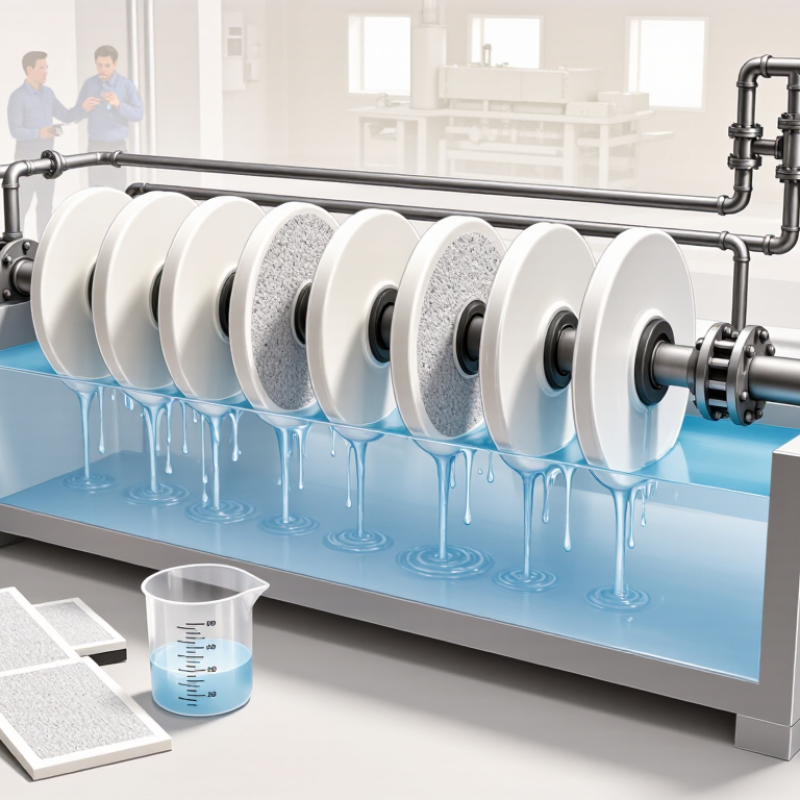
A Ceramic Vacuum Filter can be a practical choice when a process needs steady solid-liquid separation and reusable filter media. Its porous ceramic elements allow liquid to pass under vacuum while retaining solids at the surface. In operation, slurry spreads across rotating filter discs, and a cake forms as filtrate moves through the ceramic. The process is visible and measurable: operators can monitor filtrate clarity, cake thickness, and vacuum levels during a shift. Small changes in feed consistency may affect all three.
Durability is a key reason plants consider ceramic filtration. Ceramic elements can tolerate repeated washing and may provide long service life when selected and maintained correctly. They can also support lower moisture in some filter cakes, which may reduce downstream drying demands. Results depend on the material, particle size, slurry chemistry, and operating conditions. No filter is a perfect fit. Fine particles can behave unexpectedly, and blocked pores or uneven cake release may require attention. I would not choose a unit from a product sheet alone. Review actual feed data, cleaning requirements, spare-part availability, and trial results with a qualified supplier. That is the careful part. A well-matched Ceramic Vacuum Filter can improve process consistency, but its value should be confirmed against the plant’s real operating goals.
Why Choose a Ceramic Vacuum Filter?
What a Ceramic Vacuum Filter Is: Microporous Discs with 1–5 μm Pores
A ceramic vacuum filter separates liquid from solids using rigid, porous discs. Their interconnected pores typically measure 1–5 μm across. Under vacuum, liquid moves through the disc while suspended solids collect on its surface as a filter cake. The ceramic body is usually divided into small sectors, so filtrate can pass through internal channels toward a collection pipe. The disc turns through the slurry, then exposes the cake for removal. Small details matter. Pore size is not a precise particle-size cutoff: slurry chemistry, particle shape, and the developing cake all affect what passes through.
These discs are valued for their hard, stable structure and repeated use in demanding filtration cycles. A fine pore network can help produce clear filtrate, while vacuum draws liquid through without relying on disposable cloth as the main filtering surface. Still, actual results vary. A sticky cake may release unevenly, and blocked pores can reduce flow over time. Cleaning procedures and operating conditions therefore need careful testing with the real slurry, not just a sample specification. That distinction is easy to miss. In practice, the pore number describes the ceramic, not the whole separation performance.

Microporous ceramic discs have pore sizes in the 1–5 μm range.
The chart shows the stated pore-size range; it does not represent filtration efficiency or operating performance.
A ceramic vacuum filter works by drawing liquid through porous ceramic discs while solids remain on the surface. The stated vacuum range, 0.06–0.09 MPa, equals 60–90 kPa (NIST SP 811). That pressure difference pulls filtrate through the disc and helps form a mineral cake. Wills and Finch’s Mineral Processing Technology (8th edition, 2016) describes this pressure-driven separation as a core mineral-processing method.
Small changes matter. At the lower end, a dense slurry may drain slowly; toward 0.09 MPa, flow can improve, provided seals and piping prevent air leaks.
During operation, the discs rotate through slurry, emerge with a thin cake, then pass a discharge zone. The ceramic pores retain solids while filtrate travels through internal channels. Operators can watch the filtrate: a cloudy stream may signal fine particles passing through, while uneven cake thickness can point to poor slurry mixing or worn seals.
More vacuum does not always mean a drier cake. Cake structure, particle size, and feed concentration also shape moisture and throughput. That trade-off is easy to underestimate. Actual performance should be checked against plant readings, since altitude, leaks, and slurry properties can shift the effective pressure difference.
In mineral-concentrate filtration, cake moisture often matters as much as throughput. A ceramic vacuum filter can typically produce cakes containing about 8–15% moisture, depending on the material and operating conditions. That range is a practical reference, not a guarantee. Ore type, particle size, feed consistency, and cake thickness all influence the result.
Ceramic filter plates use porous surfaces to draw liquid from the concentrate while retaining solids. In operation, a well-formed cake may look firm and matte as it leaves the filtration zone, rather than glossy with free water. Lower moisture can reduce the load on dryers and make material easier to handle. Small changes matter. Even a few percentage points can affect downstream energy use.
Still, the number needs context. Two concentrates at 10% moisture may behave differently because their minerals and particle shapes differ. Operators should check moisture alongside filtration rate, cake release, and filtrate clarity. Not every feed cooperates. A finer grind or changing slurry density can shift performance, sometimes unexpectedly. Site trials and routine sampling are more reliable than treating a typical range as a fixed specification.
Ceramic vacuum filters are used where solid-liquid separation must remain steady and process water has value. In mining, they handle mineral concentrates after flotation or thickening. A porous ceramic disc draws liquid through its surface while solids form a cake. The discharged cake is often relatively dry, which can reduce the load on later handling and transport. Every percentage point matters.
In metallurgy, filters may process metal-bearing concentrates, residues, or other fine solids. Particle size and slurry behavior affect performance, so a filter that works well on one feed may struggle with another. Operators need to monitor cake thickness, filtrate clarity, and vacuum stability. A clean-looking filtrate is useful, but it does not tell the whole story.
Chemical plants use ceramic vacuum filters for selected process slurries, including some corrosive or abrasive streams. Ceramic surfaces can resist wear, yet chemical compatibility still depends on the actual solution, temperature, and cleaning method. The details matter. Before choosing equipment, teams should test representative slurry and confirm maintenance needs. Ceramic filtration can save water and energy in suitable conditions, but it is not an automatic fit for every plant. Some operating assumptions deserve a second look.
Selection starts with the feed, not the equipment brochure. Check the particle-size distribution and note how many fines the slurry contains. Fine particles may block pores or slow cake formation. Small details matter. Also record solids concentration, temperature, and changes between shifts. A trial with representative process slurry is more useful than a clean-water test, which may overstate performance.
Judge throughput by dry solids per hour, not filtrate flow alone. Track cake thickness, moisture, and cycle time across several runs. A quick initial flow can still leave a wet cake that is hard to handle. There is no single number that tells the whole story. Include normal feed fluctuations in testing.
Cleaning and maintenance affect performance over time. Ask how the elements are cleaned, how often cleaning is needed, and which methods suit the process. Backwashing may help; chemical cleaning should only use compatible procedures. Inspect seals, plates, and scraper parts regularly. Keep simple logs of vacuum pressure, filtrate clarity, and cycle times. Trends can reveal problems early, though records are easy to neglect during a busy shift.


For those larger-sized parts, or smaller quantity runs, we have 2 independent powder coat booths and ovens. The quality, durability and affordability of today’s powder coating finishes make this the process of choice for world-class companies.
Powder coating advantages over other forms of coating are many. Materials used in the Powder coating process can be metals and non-metals that come in a multitude of thicknesses, textures, colors, etc. Another of Powder coating’s biggest advantages over conventional coatings is its ability to create finishes in many different textures. Powder Coating Booths allow us the ability to apply these advantages to large products.
Tri-State Fabricators runs a full-service conveyor line for painting. Wet painting can provide protection or decoration to many different part styles. From start to finish, every project is easier to undergo random and point-based inspection by our skilled painting team.
Advantages to our Wet Paint Line are these lines start with product prep and ends with a thorough inspection of a high quality finished product. Our ability to complete large and small projects with a superior finish and doing so in a timely and economical fashion. This passes along the savings in production to our customers. When powder coating ins not an option, our Wet Paint Line gets the job done right the first time.
When the parts get big and heavy we roll-out our custom paint racks and oversize booth. By utilizing our partnerships with all the major paint brands, we can match virtually any color with wet paint.
The advantages of having access to a Wet Paint Booth are many. Large projects of many different shapes can be loaded into the booth. The Wet Paint Booth offers an environment that is much more controlled than a typical parts painting operation.
Not only are they used because of their controlled environment, but they’re are also advantageous when it comes to applying paint to parts that are needed in industries that require specialty coatings such as medical, aerospace, etc.
Our military forces have some very high standards when it comes to the finish of their vehicles and equipment. From the first pre-treatment step to final coat, it takes a great deal of knowledge and experience to protect the men and women of our armed forces. They deserve only the best, and Tri-State Fabricators provides it.
All of our processes are closely monitored by our staff and management teams. Both of which are highly trained in the processes of metal fabrication and finishing. Tri-State Fabricators’ goal is to always fully satisfy each and every customer, including the military. We will always put a 110% into what we do.
Abrasive media blasting is an excellent way to remove old paint, rust, and increase the paint/powder adhesion. Glass beads produce a much smoother and brighter finish than angular abrasives; leaving the part clean yet without any dimensional change. Chemically inert and environmentally friendly, we can recycle our beads approximately 30 times; making them a more preferred method of metal cleaning or surface finishing.
Advantages to Glass Bead Blasting are many. Glass bead blast media is used when a project is needing rough surfaces need to become smooth for applications of coatings such as paint. It is typically used to clean paint and rust from a product surface without deforming the surface it is being used on. Overall, compared to many other blasting media, Glass Bead Blasting is a very economical choice and those savings are always passed on to our customers.
Tri-State Fabricators utilize a zinc phosphate wash to clean and etch the material to ensure the best paint adhesion possible. The unique design of our 3-stage wash system does the work like a 5-stage. From Cleaning and rinsing to conversion coating and post-treatment, Our Part Washing process is a complete service and works throughout the fabrication service and the finishing service.
Along with the previously mentioned benefits, Curing is a vital chemical reaction that leaves the product finish hard and relatively safe from mild abrasion and aggressive corrosion. This process can be done in more than one way; ambient air-dry or in curing ovens at temps that exceed 240°.
From fixing paint mistakes (someone else’s of course) to simply cleaning our paint line hooks, our burn-off oven is put to good use. After a quick burn-off, a little clean up, and a fresh coat of paint, your parts will look better than new.
Why does our Burn-Off Oven work so well? Because super heating the air around parts turns the materials into ashes. From paint and powder coatings to rubber and machining oils, high temps do the job without degrading the integrity of the part.
Masking is a vital part of producing high quality products. We have die-cut masking patterns to protect machined surfaces as well as a wide range of plugs and caps to protect threaded holes and bolts. We provide permanent and temporary masking.
Masking allows the selected sections of a product to be protected from a fabrication or finishing service. This can be with both chemicals when etching and tapes, paints when only finishing just a section of the product. Masking is great in aiding the customization process of a project.
Screen printing is a photographic process that transfers artwork onto a porous nylon screen which allows colored ink to flow through the screen and be deposited on an aluminum or plastic component. We can generally have just about any design created onto a screen for your parts.
Some of the advantages of Screen Printing are, brand recognition for your business displaying on your products, assembly instructions, product warnings/hazards, etc. Tri-State Fabricators produces Screen Printing of the highest quality so you know it’s durable.
Metal Finishing is the art of treating the exterior portion of product, often metal but can also be made of other materials, so that the surface is clean and free of any debris. Then the process of applying coats or either paint of powder coat takes place. This coating process improves the quality of the product in both appearance and resistance to wear and corrosion.
Tri-State Fabricators, Inc., understands that a project typically isn’t complete until a high-quality finish has been added to your product. This is why our painting and powder coating teams continuously inspect the products throughout the Metal Finishing process.

