


Why Choose a Ball Bearing Cnc Machine?
A Ball Bearing Cnc Machine offers a practical balance between accuracy, speed, and repeatable production. Its spindle bearings support smooth rotation during drilling, milling, and precision boring. This matters when a bearing seat must remain round within tight tolerances. Even a small vibration can create chatter marks, heat, and costly scrap.
John Saunders, founder of Saunders Machine Works and a respected CNC educator, often shares a simple principle: “The best way to learn is by doing.” That idea applies directly to machine selection. Operators should inspect real test cuts, measure finished parts, and study performance under load. A polished brochure cannot replace a steel component measured after machining.
The right Ball Bearing Cnc Machine can reduce setup time and improve surface consistency. It may also handle repeated production with less manual correction. Picture a workshop producing bearing housings every morning. Consistent spindle movement helps each bore match the previous one. That consistency builds trust with customers.
Still, the machine is not a miracle. Poor tooling, incorrect feeds, or weak maintenance can defeat excellent hardware. Bearings need proper lubrication, clean coolant, and scheduled inspection. This is where many buyers underestimate ownership.
A careful buyer should compare spindle runout, bearing type, rigidity, service support, and control features. Ask for measured results, not impressive claims. Sometimes, a simpler machine is wiser. High speed alone does not guarantee better parts.
This guide examines why a Ball Bearing Cnc Machine may suit demanding workshops. It also considers its limitations, operating costs, and learning curve. Reliable results come from both engineering and disciplined human practice.
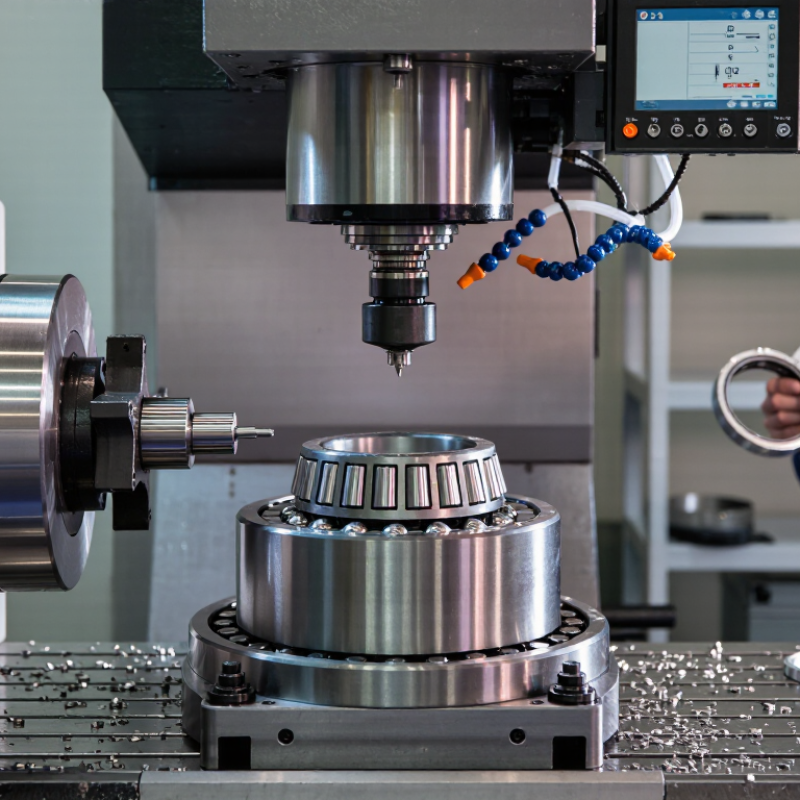
Why Choose a Ball Bearing CNC Machine?
A ball-bearing CNC machine uses hardened steel balls to support moving components with low rolling friction. In many designs, recirculating balls run inside linear guide blocks and ball screws. The screw converts motor rotation into controlled table movement. Preloaded bearings reduce play between mating surfaces. That matters when cutting small holes or repeating narrow contours.
The label can mislead. Not every bearing system delivers equal precision. Rail alignment, preload, lubrication, and machine stiffness also influence results. A practical check is simple: command a short axis move, then measure return position with a dial indicator. Heat, chips, and poor lubrication can still create errors. Small details matter.
According to Grand View Research, the global CNC machine market was valued at about 83.3 billion dollars in 2023. Its report links continued growth with automated, high-precision production. That demand explains the interest in low-friction motion systems. The U.S. Department of Energy reports that motor-driven equipment uses roughly 70% of industrial electricity. Efficient mechanical transmission can therefore support lower operating waste, although savings depend on the complete machine design.
Ball bearings also improve smoothness at moderate and high speeds. They can reduce vibration caused by uneven sliding contact. However, excessive preload increases friction and heat. More precision is not always better. A properly matched bearing system usually performs better than an aggressively tightened one.
| System or Dimension | What It Is | How It Works | Typical Data or Range | Practical Benefit |
|---|---|---|---|---|
| Ball screw drive | A threaded shaft and nut containing recirculating steel balls. | The balls roll between the screw and nut, converting motor rotation into controlled linear movement with very low sliding friction. | Common lead: approximately 5–20 mm per revolution; many precision systems use preloaded nuts to reduce backlash. | Improves positioning consistency, efficiency, and repeatability compared with a basic sliding screw. |
| Linear ball-bearing guides | Guide blocks and rails that use recirculating balls to support and constrain an axis. | Rows of balls roll along hardened raceways while the guide block carries the table, gantry, or spindle assembly. | Typical rail sizes for compact machines: approximately 15–30 mm; larger machines may use larger rails and multiple blocks. | Provides smooth travel, high stiffness, and better resistance to side loads. |
| Drive motor and coupling | The motor-and-coupling assembly that rotates each ball screw. | A stepper or servo motor receives commands from the CNC controller and turns the screw by a calculated number of revolutions. | Typical positioning systems use stepper motors for lower-cost machines and servo motors where higher speed, feedback, and dynamic performance are required. | Controls axis speed and position while allowing coordinated multi-axis movement. |
| Encoder feedback | A position sensor used mainly with closed-loop servo systems. | The encoder reports actual motor or axis position to the controller, which corrects detected position error. | Feedback resolution varies by encoder and control system; it should not be confused with guaranteed machine accuracy. | Helps detect following errors, missed motion, and load-related position deviations. |
| Work envelope | The usable X, Y, and Z travel available for a workpiece. | The controller coordinates linear-axis movement within the machine’s programmed travel limits. | Compact machines commonly provide roughly 300–600 mm of X travel, 200–400 mm of Y travel, and 100–250 mm of Z travel. | Defines the maximum practical part size and influences fixture and tooling choices. |
| Positioning accuracy | How closely an axis reaches a commanded coordinate. | Accuracy depends on screw lead error, thermal expansion, guide alignment, calibration, structural rigidity, and control resolution. | A general small-machine range is approximately ±0.02–0.10 mm; published values must be checked under defined test conditions. | Supports dimensional control when the machine is properly calibrated and operated. |
| Repeatability | The ability to return to the same position repeatedly. | Preloaded rolling elements reduce clearance, while the controller repeats the programmed motion path. | Typical advertised values for compact precision machines may be around ±0.01–0.05 mm, depending on test method and setup. | Useful for repeated batches, drilling patterns, engraving, and multi-operation machining. |
| Rapid traverse speed | The maximum programmed axis speed when the machine is not cutting. | The controller accelerates the motor while staying within limits imposed by screw lead, motor torque, guide load, and machine rigidity. | Compact ball-screw machines commonly operate at approximately 3–15 m/min in rapid motion. | Reduces non-cutting time while maintaining controlled axis movement. |
| Spindle speed | The rotational speed of the cutting tool or workholding spindle. | The CNC controller sets spindle revolutions per minute according to the tool, material, diameter, and programmed cutting conditions. | Light-duty machines often use approximately 6,000–24,000 rpm; suitable speed depends on the application. | Enables cutting of materials such as plastics, wood, aluminum, and selected steels when the machine is appropriately designed. |
| Backlash control | Measures and methods used to limit lost motion when an axis reverses direction. | Preloaded ball nuts, proper bearing support, accurate alignment, and controller compensation reduce reversal error. | Well-adjusted systems aim for very low backlash, but the actual value must be measured on the completed machine. | Improves circular interpolation, corner accuracy, hole location, and surface quality. |
| Lubrication requirement | Oil or grease applied to ball screws, guideways, and bearings. | Lubricant separates rolling surfaces, reduces wear, and helps protect raceways from contamination. | Maintenance intervals vary with duty cycle, contamination, lubricant type, and manufacturer instructions. | Extends component life and helps preserve smooth, accurate motion. |
| CNC control process | The electronic system that interprets programmed toolpaths. | G-code commands are converted into coordinated axis pulses or servo commands; interpolation synchronizes X, Y, Z, and other axes. | Common functions include feed-rate control, spindle-speed control, work offsets, tool compensation, and limit protection. | Automates repeatable machining operations and allows complex geometries to be produced consistently. |

A ball screw converts motor rotation into precise linear movement. Hardened steel balls roll between the screw and nut, replacing much of the sliding friction found in traditional lead screws. That difference matters. Less friction means lower drive torque, reduced heat, and more usable motor power at the cutting tool.
Under suitable conditions, a quality ball screw can deliver more than 90% mechanical efficiency. Its performance depends on preload, lubrication, alignment, load, and operating speed. A lightly loaded, correctly aligned axis may transfer motion with impressive smoothness. Poor alignment can quickly waste that advantage. The number is useful, but it is not magic.
In practical CNC work, technicians check backlash with a dial indicator and watch motor current during rapid moves. A rising current may reveal contamination, excessive preload, or lubrication problems. I have seen a clean-looking assembly produce rough motion because its mounting faces were slightly out of square. That detail is easy to miss. Regular inspection still matters, even with efficient components.
Ball bearing CNC systems also improve repeatability during frequent direction changes. The rolling contact reduces stick-slip behavior, helping the machine approach programmed positions more consistently. Yet higher efficiency does not automatically create better parts. Rigidity, thermal control, cutting strategy, and operator setup remain equally important. A ball screw saves energy only when the entire axis is installed and maintained with care.
Why Choose a Ball Bearing CNC Machine?
How Preload Controls Backlash and Micron-Level Positioning Accuracy
A ball bearing CNC machine relies on controlled preload to reduce unwanted movement between mating components. In a preloaded ball screw, the balls contact opposing raceways with slight force. This removes clearance before cutting begins. Less clearance means less backlash when the axis reverses direction.
The result is clearer motion at the tool tip. A command for 10 microns can produce a more predictable response, especially during contour changes. In practical machine checks, backlash should be measured in both travel directions. A dial indicator, laser system, or high-resolution linear scale can reveal errors that software may hide. Small changes matter.
Preload is not simply “more is better.” Excessive force increases friction, motor load, and bearing temperature. Heat can expand the screw and shift the measured position by several microns. I have seen machines perform accurately during a cold test, then drift after extended operation. That trade-off is easy to underestimate. Correct setup requires torque checks, temperature monitoring, lubrication control, and verification at working speed.
Ball bearing systems also support smooth acceleration and repeatable positioning when paired with rigid guides and stable control settings. However, preload cannot repair a weak frame, poor alignment, or thermal distortion. The machine must be evaluated as a complete system. Precision is a process, not a single specification.
How Preload Controls Backlash and Micron-Level Positioning Accuracy
Increasing ball screw preload reduces clearance between the balls and raceways, which lowers backlash and improves bidirectional positioning accuracy. The values shown are representative engineering ranges for precision CNC ball screws; actual results vary with screw diameter, manufacturing accuracy, load, temperature, lubrication, and machine structure.
Why Choose a Ball Bearing CNC Machine?
How Spindle Bearings Achieve High Speed Through dN Values Above 1 Million
A ball bearing CNC machine supports fast, accurate spindle rotation with limited friction. In spindle engineering, the dN value equals bearing bore diameter in millimeters multiplied by rotational speed. A value above one million signals serious high-speed capability. For example, a 70 mm bore running at 15,000 rpm reaches a dN of 1,050,000. That speed can improve surface quality and reduce cycle times. However, dN alone does not guarantee reliable machining. Heat, lubrication, preload, cage design, and shaft accuracy also control performance.
A precision ball bearing must manage centrifugal forces while maintaining stable contact between balls and raceways. Proper preload reduces vibration, but excessive preload creates heat quickly. Oil-air lubrication can remove heat more effectively than heavy grease in demanding applications. The calculation is simple. The machine is not. A clean bearing environment matters, too. Even small contamination can damage raceways and shorten service life. Engineers should confirm temperature rise during real cutting, not only during an unloaded spindle test. That point is easy to overlook.
Tips: Check the manufacturer’s dN rating against your actual bore size and target rpm. Monitor spindle temperature, vibration, and noise during production. Allow warm-up time before heavy cutting. Review preload and lubrication settings when changing tools or operating speeds. A high dN value looks impressive, but stable thermal behavior is the result that matters.
Why Choose a Ball Bearing CNC Machine?
A ball bearing CNC machine can reduce friction between moving components. That benefit sounds simple, but ISO 230-2 testing reveals the fuller picture. The standard evaluates positioning accuracy, repeatability, backlash, and bidirectional movement across an axis. It also records results at multiple locations and travel directions. A machine may reach one excellent position, then drift elsewhere. That difference matters when cutting a 0.02 mm feature.
ISO 230-2:2014 does not provide one universal pass-or-fail tolerance. Instead, it defines measurement methods and reporting terms. NIST Technical Note 1297 also stresses that measurement uncertainty must be included. Therefore, a test report without temperature, probe, feed rate, and setup details is incomplete. Thermal stability deserves special attention. A spindle warming by only a few degrees can shift tool position. Ball bearings may run smoothly, yet heat can still move the machine structure. The assumption is attractive, but sometimes wrong.
Tips: Test after a controlled warm-up. Record room temperature, spindle speed, axis direction, and tool position. Compare the first and last readings. A clean graph can still hide a weak setup. In shop-floor checks, operators should inspect bearing noise, vibration, and lubrication condition. These practical observations support ISO 230-2 data, rather than replacing it. The 2023 International Federation of Robotics report recorded 553,052 industrial robot installations worldwide in 2022, showing how strongly automation depends on predictable motion. CNC accuracy deserves the same evidence-based discipline.


For those larger-sized parts, or smaller quantity runs, we have 2 independent powder coat booths and ovens. The quality, durability and affordability of today’s powder coating finishes make this the process of choice for world-class companies.
Powder coating advantages over other forms of coating are many. Materials used in the Powder coating process can be metals and non-metals that come in a multitude of thicknesses, textures, colors, etc. Another of Powder coating’s biggest advantages over conventional coatings is its ability to create finishes in many different textures. Powder Coating Booths allow us the ability to apply these advantages to large products.
Tri-State Fabricators runs a full-service conveyor line for painting. Wet painting can provide protection or decoration to many different part styles. From start to finish, every project is easier to undergo random and point-based inspection by our skilled painting team.
Advantages to our Wet Paint Line are these lines start with product prep and ends with a thorough inspection of a high quality finished product. Our ability to complete large and small projects with a superior finish and doing so in a timely and economical fashion. This passes along the savings in production to our customers. When powder coating ins not an option, our Wet Paint Line gets the job done right the first time.
When the parts get big and heavy we roll-out our custom paint racks and oversize booth. By utilizing our partnerships with all the major paint brands, we can match virtually any color with wet paint.
The advantages of having access to a Wet Paint Booth are many. Large projects of many different shapes can be loaded into the booth. The Wet Paint Booth offers an environment that is much more controlled than a typical parts painting operation.
Not only are they used because of their controlled environment, but they’re are also advantageous when it comes to applying paint to parts that are needed in industries that require specialty coatings such as medical, aerospace, etc.
Our military forces have some very high standards when it comes to the finish of their vehicles and equipment. From the first pre-treatment step to final coat, it takes a great deal of knowledge and experience to protect the men and women of our armed forces. They deserve only the best, and Tri-State Fabricators provides it.
All of our processes are closely monitored by our staff and management teams. Both of which are highly trained in the processes of metal fabrication and finishing. Tri-State Fabricators’ goal is to always fully satisfy each and every customer, including the military. We will always put a 110% into what we do.
Abrasive media blasting is an excellent way to remove old paint, rust, and increase the paint/powder adhesion. Glass beads produce a much smoother and brighter finish than angular abrasives; leaving the part clean yet without any dimensional change. Chemically inert and environmentally friendly, we can recycle our beads approximately 30 times; making them a more preferred method of metal cleaning or surface finishing.
Advantages to Glass Bead Blasting are many. Glass bead blast media is used when a project is needing rough surfaces need to become smooth for applications of coatings such as paint. It is typically used to clean paint and rust from a product surface without deforming the surface it is being used on. Overall, compared to many other blasting media, Glass Bead Blasting is a very economical choice and those savings are always passed on to our customers.
Tri-State Fabricators utilize a zinc phosphate wash to clean and etch the material to ensure the best paint adhesion possible. The unique design of our 3-stage wash system does the work like a 5-stage. From Cleaning and rinsing to conversion coating and post-treatment, Our Part Washing process is a complete service and works throughout the fabrication service and the finishing service.
Along with the previously mentioned benefits, Curing is a vital chemical reaction that leaves the product finish hard and relatively safe from mild abrasion and aggressive corrosion. This process can be done in more than one way; ambient air-dry or in curing ovens at temps that exceed 240°.
From fixing paint mistakes (someone else’s of course) to simply cleaning our paint line hooks, our burn-off oven is put to good use. After a quick burn-off, a little clean up, and a fresh coat of paint, your parts will look better than new.
Why does our Burn-Off Oven work so well? Because super heating the air around parts turns the materials into ashes. From paint and powder coatings to rubber and machining oils, high temps do the job without degrading the integrity of the part.
Masking is a vital part of producing high quality products. We have die-cut masking patterns to protect machined surfaces as well as a wide range of plugs and caps to protect threaded holes and bolts. We provide permanent and temporary masking.
Masking allows the selected sections of a product to be protected from a fabrication or finishing service. This can be with both chemicals when etching and tapes, paints when only finishing just a section of the product. Masking is great in aiding the customization process of a project.
Screen printing is a photographic process that transfers artwork onto a porous nylon screen which allows colored ink to flow through the screen and be deposited on an aluminum or plastic component. We can generally have just about any design created onto a screen for your parts.
Some of the advantages of Screen Printing are, brand recognition for your business displaying on your products, assembly instructions, product warnings/hazards, etc. Tri-State Fabricators produces Screen Printing of the highest quality so you know it’s durable.
Metal Finishing is the art of treating the exterior portion of product, often metal but can also be made of other materials, so that the surface is clean and free of any debris. Then the process of applying coats or either paint of powder coat takes place. This coating process improves the quality of the product in both appearance and resistance to wear and corrosion.
Tri-State Fabricators, Inc., understands that a project typically isn’t complete until a high-quality finish has been added to your product. This is why our painting and powder coating teams continuously inspect the products throughout the Metal Finishing process.

