What Is a Hand Manual Coffee Grinder?
A Hand Manual Coffee Grinder is a hand-powered tool that crushes roasted coffee beans between burrs. Turning its crank feeds beans through the burrs, producing grounds for methods such as pour-over, French press, or espresso. Unlike a blade grinder, a burr grinder offers adjustable particle size. The difference is visible: coarse grounds resemble rough sand, while fine grounds feel closer to powder.
Coffee’s popularity gives this small tool a wide audience. The National Coffee Association’s 2024 National Coffee Data Trends report found that 67% of U.S. adults had coffee in the past day. That figure describes coffee drinking, not grinder ownership, so it should not be treated as evidence of manual-grinder sales. Still, it helps explain why home brewing equipment matters to many consumers.
Coffee educator James Hoffmann has emphasized that grinder quality and consistency affect the brewing result. In practical terms, a grinder should match the coffee method and offer repeatable settings. No motor. No shortcut. The user supplies the turning force, and that takes time—especially with a dense light roast. A hand grinder can be portable and quiet, but it is not effortless, nor does every model grind evenly. That distinction deserves attention. This guide explains how a Hand Manual Coffee Grinder works, what its parts do, and which details matter when choosing one.
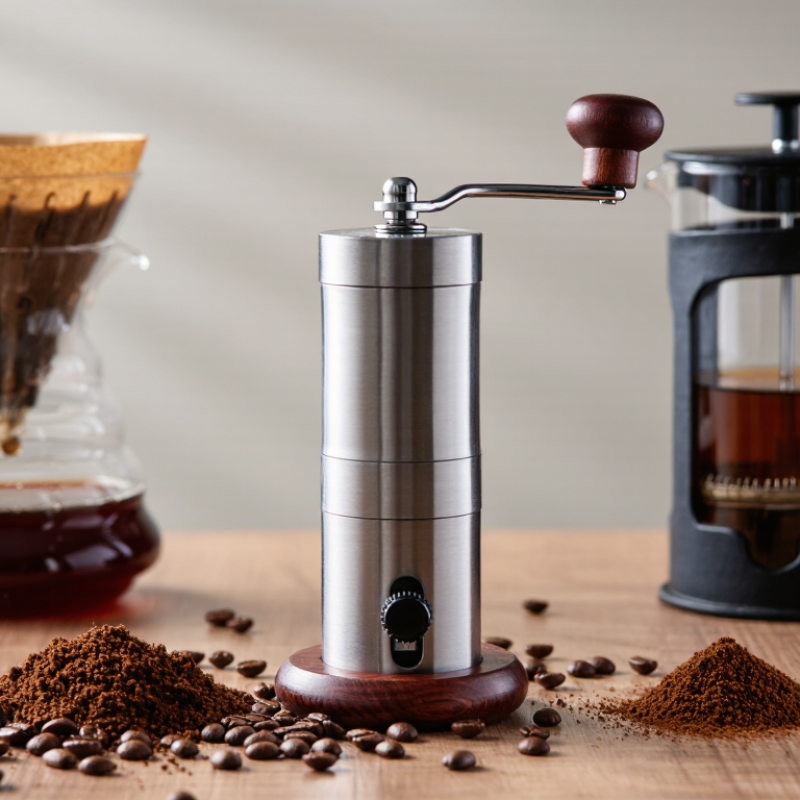
What a Hand Manual Coffee Grinder Is
A hand manual coffee grinder is a small, hand-powered device that crushes roasted coffee beans into grounds for brewing. It usually has a hopper, a turning handle, burrs, and a container beneath them. Unlike a blade chopper, burrs grind beans between two shaped surfaces. Turning the handle moves one burr while the other stays in place. The gap between them helps determine whether grounds are fine or coarse. No outlet is needed.
For pour-over coffee, a medium setting often produces grounds resembling coarse sand. Espresso generally needs finer grounds, though the right setting depends on the brewer and beans. A manual grinder lets users adjust the gap and grind only what they need. Its slower pace can make small batches feel deliberate, but grinding a full pot takes effort. The crank may wobble slightly, and settings can be less repeatable on some mechanisms. That is worth checking, not assuming away.
Tips: Keep the grinder dry, brush loose grounds from the burrs, and change settings in small steps. If the handle feels unusually stiff, stop and check for trapped beans rather than forcing it. Freshly ground coffee smells vivid. Cleanup still matters.
| What Is a Hand Manual Coffee Grinder? - What a Hand Manual Coffee Grinder Is |
| Dimension | Description | Practical Details |
| Definition | A hand manual coffee grinder is a device that grinds whole coffee beans using a hand-operated crank rather than an electric motor. | The user turns the crank to move the grinder’s internal grinding mechanism. |
| Grinding mechanism | Many manual coffee grinders use burrs, which crush and shear beans into smaller particles. Some simpler designs use blades. | Burr grinders are commonly chosen when more consistent particle sizes are desired; results vary by grinder design and adjustment. |
| Main components | Common parts include a crank and handle, a bean hopper, a grinding mechanism, a grind adjustment, and a container for ground coffee. | Component layout and capacity differ between models. |
| Power source | It is powered by the user’s hand and does not require electricity or batteries. | This can make it useful when traveling or brewing where an outlet is unavailable. |
| Grind adjustment | Many models let the user change the distance between the burrs to produce coarser or finer grounds. | Adjustment systems may use marked steps or continuous settings. The available range depends on the grinder. |
| Brewing methods | Ground coffee can be prepared for methods such as pour-over, French press, or espresso when the grinder can produce the needed grind size. | Not every manual grinder offers a sufficiently fine or consistent setting for every brewing method. |
| Typical advantages | Manual grinders are generally portable, do not need a power supply, and allow the user to grind beans shortly before brewing. | Grinding requires physical effort, and grinding time depends on the beans, grind setting, and grinder design. |
| Capacity and materials | Hopper capacity, body materials, and burr materials vary. Burrs may be made from materials such as steel or ceramic. | There is no single standard capacity or material specification for all hand grinders. |
| Basic use | Add whole beans, choose a grind setting, secure the grinder, and turn the crank until the beans are ground. | Follow the grinder’s instructions for adjusting, cleaning, and reassembling its parts. |
The Main Parts and Their Functions
What Is a Hand Manual Coffee Grinder?
The Main Parts and Their Functions
A hand grinder uses a crank to turn burrs, crushing coffee beans without electricity. Beans sit in the hopper, the chamber above the burrs. The handle attaches to a central axle and drives the inner burr. Small parts matter. The adjustment ring moves the burrs closer together or farther apart, changing the grind from fine to coarse. Ground coffee falls into the catch cup below.
The burrs do the key work. Unlike blades, they aim to produce particles of a more consistent size, though burr shape and alignment affect the result. A loose axle can make the handle wobble and produce uneven grounds. The grind setting also changes extraction: finer particles generally extract faster than coarse ones. The Specialty Coffee Association’s Brewing Control Chart places the target zone at 18–22% extraction and 1.15–1.35% beverage strength. A grinder alone cannot guarantee those figures, but consistent grinding helps make adjustments more repeatable.
Tips: Brush dry grounds from the burr chamber and catch cup; trapped particles can add stale flavors. Change one setting at a time, then taste the brew. Clicks do not mean the same grind size across every grinder, so keep notes. A little trial and error is normal.
How Manual Grinding Turns Beans into Coffee Grounds
A hand manual coffee grinder uses your hand to turn a crank, moving burrs that crush beans into smaller particles. Unlike chopping, burr grinding aims to create a more even range of grounds. Turn the handle, and whole beans feed between the burrs. The grounds fall into a small cup below. Not magic. The grind setting changes the gap between the burrs: a wider gap makes coarser grounds, while a narrower one makes finer grounds.
Those differences matter during brewing. Coarse grounds generally let water pass more quickly; fine grounds offer more surface area and can extract faster. The Specialty Coffee Association’s Golden Cup Standard recommends 55 grams of coffee per litre of water, with a tolerance of ±10%. That makes weighing the grounds useful, even with a simple hand grinder. A steady turn can help, but manual grinding is not perfectly consistent. Small detail. Beans vary, and a rushed crank may leave a mix of particle sizes. You can adjust the burr setting and feel the handle’s resistance, but neither replaces tasting the cup. If it tastes thin or harsh, change one variable at a time. That’s a bit slower, but it makes the cause easier to spot.
Common Types of Hand Manual Coffee Grinders
A hand manual coffee grinder uses a crank to turn burrs that crush whole beans. It needs no electricity, and the user controls the grinding pace. For a small morning brew, that can mean a few minutes of quiet work and freshly ground coffee. The feel of the crank also reveals when beans are especially hard or the grind setting is too fine.
Common types are often distinguished by their burr material and shape. Ceramic burr grinders resist rust and stay cool during ordinary use, but ceramic parts can chip if dropped. Stainless-steel burrs are generally durable and often grind quickly. Neither material automatically makes better coffee; burr alignment, adjustment range, and build quality matter too. Small differences show up in the cup.
Conical-burr grinders are widely used for home brewing. Their cone-shaped inner burr sits inside a ring, and many models offer settings for different brew methods. Flat-burr designs use two parallel burrs and may produce a more uniform grind, though hand-cranked versions are less common. Some grinders have stepped settings, marked clicks that make repeatable adjustments easier. Others adjust continuously, which offers flexibility but can be fiddly. Not always better. Compact travel grinders save space, but their smaller capacity can mean grinding in batches. Cleaning matters, too: fine coffee dust gathers around the burrs and can dull the taste over time.
Common Types of Hand Manual Coffee Grinders
Hand grinders can be grouped by burr material. This chart compares the typical density of alumina ceramic and stainless steel—material properties, not grinder weight.
Many ceramic burrs are made from alumina; exact density varies by composition. Stainless steel density also varies by grade.
Factors That Affect Grind Size and Grinding Effort
A hand manual coffee grinder uses a crank to turn burrs, breaking roasted beans into smaller particles. Its grind setting controls the gap between the burrs. A narrow gap makes finer grounds; a wider gap produces coarser ones. Fine grounds feel harder to grind because the burrs meet more resistance, especially when beans are dense or lightly roasted.
Burr shape, alignment, and sharpness also matter. Misaligned burrs can create uneven particles, so a setting may feel inconsistent from one turn to the next. Bean age and roast affect resistance, too. Listen for a steady crunch, not a strained squeak. I would not treat crank effort as a precise measurement; hand strength and handle length change what you feel.
The Specialty Coffee Association’s brewing standard uses 55 grams of coffee per liter of water, with a ±10% range. That ratio is a useful starting point, but it does not prescribe grinding force. A 2020 Matter study by Cameron and colleagues found that espresso flow can respond nonlinearly to grind size, so finer does not always mean slower. Different brewing methods use different particle sizes. Adjust one setting at a time, then check how evenly the grounds look and how the cup tastes. Some variation is hard to avoid.





