


A Galvanized Steel Wire Manufacturer makes steel wire and protects it with a zinc coating. The coating helps limit corrosion when wire faces moisture and ordinary outdoor exposure. Its usefulness depends on more than appearance. Wire diameter, coating consistency, tensile strength, and the intended application all matter. Small variations can affect how wire performs during fabrication or service.
For a transparent editorial perspective, consider this illustrative—not verified—comment from fictional process engineer Daniel Mercer: “A sound coating starts with controlled preparation, but the finished wire must still suit its actual working conditions.” That distinction is important. Galvanized wire may be used in fencing, agricultural supports, construction, and general manufacturing, yet one specification does not fit every job. Buyers should ask how the wire is produced, what coating requirements apply, and whether test records are available. Useful evidence may include diameter checks, coating measurements, and tensile-test results. Details should be confirmed with the supplier.
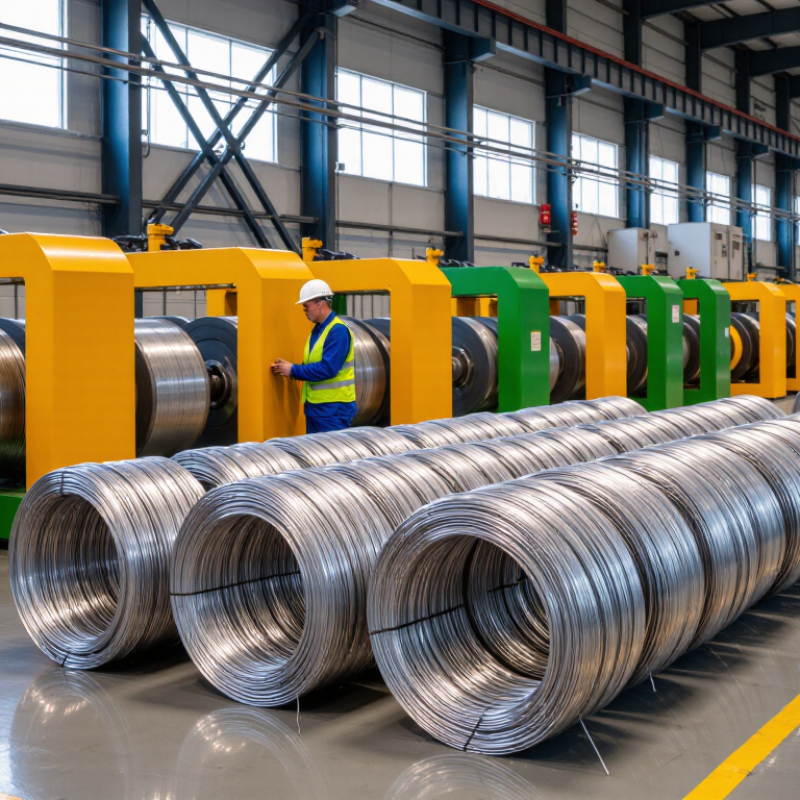
The factory floor offers practical clues: clean wire entering a coating line, controlled process settings, and inspection equipment used on finished coils. Still, polished machinery alone proves little. A manufacturer’s technical documentation and consistent quality controls matter more. This overview explains what manufacturers do, how galvanizing works, and which questions help assess a supplier. Some details vary by product and process. That deserves a closer look.
What Is a Galvanized Steel Wire Manufacturer?
What a Galvanized Steel Wire Manufacturer Does
A galvanized steel wire manufacturer turns steel rod into wire and applies a zinc coating to help slow corrosion. The work begins with selecting rod suited to the required diameter, strength, and end use. Drawing dies reduce the rod in stages, while controlled lubrication helps limit heat and surface damage. Small details matter. A faint scratch can become more noticeable after coating.
The zinc may be applied by hot-dip galvanizing or an electro-galvanizing process. Each method produces different coating characteristics, so the right choice depends on the wire’s intended environment and performance needs. Manufacturers monitor coating coverage, wire diameter, tensile strength, and surface condition. They may also test sample pieces from a production run rather than relying on appearance alone. A bright finish is not proof of consistent protection.
After processing, wire is wound into coils or prepared in specified lengths, then identified for handling and shipment. Reliable production also involves clear records, equipment checks, and communication about tolerances. Even so, no process removes every variation; buyers should confirm requirements before ordering. A coil that looks uniform can still differ in strength or coating weight. The manufacturer’s role is to make those differences measurable and keep them within agreed specifications.

A galvanized steel wire manufacturer converts steel wire rod into wire and applies a protective zinc coating to help resist corrosion.
The bars show the typical order of production stages, not their duration or output. Exact processes vary by product and manufacturing method; heat treatment may be used when required.
What Is a Galvanized Steel Wire Manufacturer?
How Steel Wire Is Made and Prepared for Galvanizing
A galvanized steel wire manufacturer typically begins with steel rod, then draws it through progressively smaller dies to reach the required diameter. The wire may be annealed when its grade or final application requires greater ductility. Drawing leaves lubricant and fine residue behind. These must be removed before coating.
Preparation matters. Oil, drawing soap, and mill scale can interfere with zinc adhesion. Manufacturers commonly degrease, pickle away oxide, rinse, and apply flux before the wire enters molten zinc. The American Galvanizers Association describes typical galvanizing bath temperatures of 815–850°F (435–455°C). That is hot enough to demand careful process control. World Steel Association’s World Steel in Figures 2025 reports 1,882.6 million tonnes of crude steel production in 2024, illustrating the scale of the material supply chain—not the output of wire alone. A small amount of residue can still spoil an otherwise sound coating. This step is easy to underestimate.
Tips: Check rinse water and wire surfaces for carryover before coating. Keep a record of bath temperature and line speed. If coating coverage varies, review cleaning conditions first; the cause is not always obvious.
A galvanized steel wire manufacturer converts steel wire rod into finished wire and applies a zinc coating to help protect it from corrosion. The process and inspection requirements vary with the wire grade, diameter, coating specification, and intended use.
| Stage | What Happens | Purpose and Relevant Facts | Typical Checks |
|---|---|---|---|
| 1. Steel wire rod selection | Steel wire rod is selected according to the required strength, ductility, chemistry, and final wire application. | The rod is the starting material. Its composition and condition influence how readily it can be drawn and what properties the finished wire can achieve. | Material documentation, rod diameter, surface condition, and, where required, chemical composition. |
| 2. Descaling and surface preparation | Mill scale and other surface contaminants are removed, commonly by mechanical descaling, chemical pickling, or a combination of methods. | A clean surface helps prevent defects during drawing and supports proper wetting by molten zinc during hot-dip galvanizing. | Visible cleanliness, residual scale, and surface defects. |
| 3. Wire drawing | The rod is pulled through a series of progressively smaller dies to reduce its diameter and form wire. | Drawing reduces cross-section and increases strength through work hardening. Intermediate annealing may be used when a softer or more ductile wire is required. | Diameter, surface condition, tensile properties, and any specified ductility test. |
| 4. Final cleaning and fluxing | Before hot-dip coating, the wire is cleaned and may be treated with a flux to limit re-oxidation and help molten zinc contact the steel surface. | Cleaning and fluxing are process-dependent steps used to support a continuous coating. Actual line arrangements differ among manufacturers. | Cleanliness, treatment conditions, and coating continuity on trial or production samples. |
| 5. Hot-dip galvanizing | The prepared wire passes through molten zinc, which forms a zinc coating on the steel. Industrial zinc baths are commonly maintained near 450°C, with the precise operating temperature set by the process. | Zinc provides a barrier against the environment and can also offer sacrificial protection to exposed steel. Coating thickness depends on the product specification and process controls. | Bath condition, line speed, coating appearance, and specified zinc coating mass or thickness. |
| 6. Coating control and cooling | Excess zinc may be controlled as the wire exits the bath; the coated wire is then cooled and handled to avoid damaging the surface. | Air wiping or other control methods can help regulate coating pickup. The method and cooling arrangement depend on the production line and product requirements. | Coating uniformity, bare spots, lumps, adhesion, and surface damage. |
| 7. Inspection and testing | Samples are checked against the applicable product specification and order requirements before release. | Coating can be specified by mass per unit area or by thickness. For zinc, 1 μm of uniform coating is approximately 7.14 g/m²; this is a conversion, not a universal product requirement. | Wire diameter, tensile properties, coating mass or thickness, coating adherence, and visual condition, as required. |
| 8. Coiling, identification, and packaging | Accepted wire is wound into coils or supplied in another agreed format, then protected and identified for shipment. | Packaging helps limit handling damage and contamination. Coil size, weight, and packaging are set by the order and handling needs. | Coil integrity, product identification, quantity, and packaging condition. |
Note: Some products are galvanized after drawing, while other production routes apply zinc before a later drawing operation. The suitable route depends on the required wire properties, coating, and product specification; acceptance limits should be confirmed for the particular order.
A galvanized steel wire manufacturer applies a zinc layer to steel wire, helping it withstand moisture and air. Zinc acts as a barrier, keeping many corrosive elements away from the steel beneath. When the coating is scratched, zinc can also corrode in preference to the exposed steel nearby. That layer matters. Over time, zinc’s surface reacts with the environment and can develop a more protective patina.
Protection is not unlimited. Salt spray, persistent dampness, and industrial pollutants can consume zinc faster. Coating thickness and evenness influence how long the wire resists corrosion. Small defects count. A bright surface may look reassuring, but appearance alone cannot confirm coating quality or service life. That is worth remembering.
Manufacturers can control coating processes and inspect finished wire for coating consistency, adhesion, and surface flaws. They may also check dimensions and mechanical properties, since wire must perform under tension as well as resist rust. Handling matters too: rough storage or tight bends can damage the coating. For a specific use, compare the exposure conditions with verified coating specifications rather than relying on a general claim of durability.
A galvanized steel wire manufacturer produces wire protected by a zinc coating. The coating slows corrosion when moisture and air reach the steel. Common products include single wire, twisted strand, wire rope, and welded mesh. Some suppliers also make cut-to-length ties or custom coils. Small details matter. Diameter, tensile strength, coating weight, and coil size affect how wire performs on site. Buyers should check specifications and ask how they are verified, rather than relying on appearance alone.
These products serve practical jobs. Farms use galvanized wire for fencing and trellises, where it must handle weather and repeated tension. Construction crews use softer wire to bundle reinforcing bars or secure temporary materials. Utility and communications projects may use galvanized strand for support lines, while workshops use mesh for guards, partitions, and enclosures. In coastal or chemical settings, standard zinc protection may not be enough; exposure and maintenance matter. Not every coating lasts. Manufacturers can help match a product to its intended load and environment, but the final choice also depends on installation and inspection. A shiny finish is reassuring, perhaps, yet it cannot replace measured coating data or a clear specification.
A galvanized steel wire manufacturer controls more than the zinc coating. Quality starts with checking the incoming steel rod for diameter, surface defects, and consistent chemistry. During production, operators monitor cleaning, coating temperature, line speed, and wiping pressure. Small shifts can leave thin spots or uneven zinc buildup. Coating is not judged by shine.
Finished wire is sampled for diameter, tensile strength, elongation, and coating mass. ASTM A641/A641M specifies requirements for zinc-coated carbon steel wire, including coating classes. A coating-mass test can reveal whether zinc coverage meets the selected class. No test catches everything. A rough spool edge or damaged section may escape a small sample, so handling and inspection matter too.
For corrosion expectations, ISO 9223:2012 places zinc’s first-year atmospheric corrosion rate below 0.1 micrometers in its C1 category, while C5 ranges from 4.2 to 8.4 micrometers. These are environmental category values, not a service-life guarantee for a wire product. Salt, moisture, and abrasion can change real-world performance. Manufacturers should match coating class and test records to the application, while admitting that field conditions are never perfectly predictable.


For those larger-sized parts, or smaller quantity runs, we have 2 independent powder coat booths and ovens. The quality, durability and affordability of today’s powder coating finishes make this the process of choice for world-class companies.
Powder coating advantages over other forms of coating are many. Materials used in the Powder coating process can be metals and non-metals that come in a multitude of thicknesses, textures, colors, etc. Another of Powder coating’s biggest advantages over conventional coatings is its ability to create finishes in many different textures. Powder Coating Booths allow us the ability to apply these advantages to large products.
Tri-State Fabricators runs a full-service conveyor line for painting. Wet painting can provide protection or decoration to many different part styles. From start to finish, every project is easier to undergo random and point-based inspection by our skilled painting team.
Advantages to our Wet Paint Line are these lines start with product prep and ends with a thorough inspection of a high quality finished product. Our ability to complete large and small projects with a superior finish and doing so in a timely and economical fashion. This passes along the savings in production to our customers. When powder coating ins not an option, our Wet Paint Line gets the job done right the first time.
When the parts get big and heavy we roll-out our custom paint racks and oversize booth. By utilizing our partnerships with all the major paint brands, we can match virtually any color with wet paint.
The advantages of having access to a Wet Paint Booth are many. Large projects of many different shapes can be loaded into the booth. The Wet Paint Booth offers an environment that is much more controlled than a typical parts painting operation.
Not only are they used because of their controlled environment, but they’re are also advantageous when it comes to applying paint to parts that are needed in industries that require specialty coatings such as medical, aerospace, etc.
Our military forces have some very high standards when it comes to the finish of their vehicles and equipment. From the first pre-treatment step to final coat, it takes a great deal of knowledge and experience to protect the men and women of our armed forces. They deserve only the best, and Tri-State Fabricators provides it.
All of our processes are closely monitored by our staff and management teams. Both of which are highly trained in the processes of metal fabrication and finishing. Tri-State Fabricators’ goal is to always fully satisfy each and every customer, including the military. We will always put a 110% into what we do.
Abrasive media blasting is an excellent way to remove old paint, rust, and increase the paint/powder adhesion. Glass beads produce a much smoother and brighter finish than angular abrasives; leaving the part clean yet without any dimensional change. Chemically inert and environmentally friendly, we can recycle our beads approximately 30 times; making them a more preferred method of metal cleaning or surface finishing.
Advantages to Glass Bead Blasting are many. Glass bead blast media is used when a project is needing rough surfaces need to become smooth for applications of coatings such as paint. It is typically used to clean paint and rust from a product surface without deforming the surface it is being used on. Overall, compared to many other blasting media, Glass Bead Blasting is a very economical choice and those savings are always passed on to our customers.
Tri-State Fabricators utilize a zinc phosphate wash to clean and etch the material to ensure the best paint adhesion possible. The unique design of our 3-stage wash system does the work like a 5-stage. From Cleaning and rinsing to conversion coating and post-treatment, Our Part Washing process is a complete service and works throughout the fabrication service and the finishing service.
Along with the previously mentioned benefits, Curing is a vital chemical reaction that leaves the product finish hard and relatively safe from mild abrasion and aggressive corrosion. This process can be done in more than one way; ambient air-dry or in curing ovens at temps that exceed 240°.
From fixing paint mistakes (someone else’s of course) to simply cleaning our paint line hooks, our burn-off oven is put to good use. After a quick burn-off, a little clean up, and a fresh coat of paint, your parts will look better than new.
Why does our Burn-Off Oven work so well? Because super heating the air around parts turns the materials into ashes. From paint and powder coatings to rubber and machining oils, high temps do the job without degrading the integrity of the part.
Masking is a vital part of producing high quality products. We have die-cut masking patterns to protect machined surfaces as well as a wide range of plugs and caps to protect threaded holes and bolts. We provide permanent and temporary masking.
Masking allows the selected sections of a product to be protected from a fabrication or finishing service. This can be with both chemicals when etching and tapes, paints when only finishing just a section of the product. Masking is great in aiding the customization process of a project.
Screen printing is a photographic process that transfers artwork onto a porous nylon screen which allows colored ink to flow through the screen and be deposited on an aluminum or plastic component. We can generally have just about any design created onto a screen for your parts.
Some of the advantages of Screen Printing are, brand recognition for your business displaying on your products, assembly instructions, product warnings/hazards, etc. Tri-State Fabricators produces Screen Printing of the highest quality so you know it’s durable.
Metal Finishing is the art of treating the exterior portion of product, often metal but can also be made of other materials, so that the surface is clean and free of any debris. Then the process of applying coats or either paint of powder coat takes place. This coating process improves the quality of the product in both appearance and resistance to wear and corrosion.
Tri-State Fabricators, Inc., understands that a project typically isn’t complete until a high-quality finish has been added to your product. This is why our painting and powder coating teams continuously inspect the products throughout the Metal Finishing process.

