


Dtf Transfer Sheets are a practical part of direct-to-film garment printing. They carry printed artwork on a thin PET film before heat application. Unlike ordinary transfer paper, these sheets work with specialized water-based inks and hot-melt adhesive powder. The result can be a bright, detailed design on cotton, polyester, blends, and many other compatible fabrics.
In a typical workflow, the artwork is printed in reverse onto the film. Adhesive powder is then applied to the wet ink and cured with controlled heat. A heat press transfers the finished image onto a shirt or textile. Pressure, temperature, and pressing time matter. Even a small mistake can cause peeling, dull colors, or uneven edges. The film may feel simple, but it requires careful handling.
Good DTF Transfer Sheets should match the printer, ink, powder, and fabric being used. Checking manufacturer specifications is more reliable than trusting appearance alone. A clean print does not guarantee a durable transfer. Fabric texture, washing conditions, and curing quality also influence performance. Testing a small sample is wise. It may seem slower, but it can prevent wasted garments and materials. There is no universal setting for every project. Real results often require adjustment, and that is where beginners sometimes learn the most. Understanding these materials helps users choose suitable sheets and build a more consistent production process.
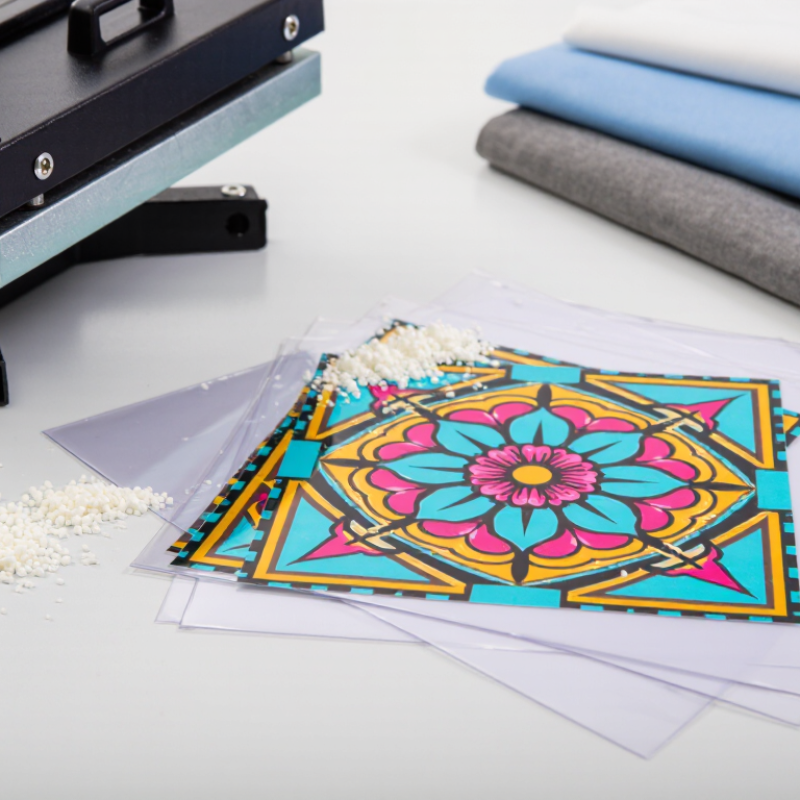
DTF transfer sheets are thin PET films used to move printed designs onto fabric. DTF means direct to film. The artwork is printed with textile pigment ink, coated with hot-melt adhesive powder, and cured before pressing. Unlike ordinary transfer paper, the design sits on a flexible adhesive layer. It can produce sharp edges, bright colors, and detailed images on cotton, polyester, blends, and some treated materials.
In practical use, I check the sheet’s print side before placing it on the garment. A small test press helps reveal problems with temperature, pressure, or peeling time. The fabric should be flat, clean, and free from moisture. After pressing, the design may feel slightly raised. That texture is normal, although an overly thick print can feel heavy. I have found that rushing the curing stage often causes weak edges after washing. That detail is easy to overlook.
Tips: Store sheets in a dry, dust-free place. Keep the printed surface protected. Follow the film supplier’s recommended settings, then adjust carefully for fabric thickness. Press a small sample first. Wash the finished garment inside out with mild detergent. Avoid harsh heat during drying. Results can vary. Even experienced users need occasional testing.

What Are DTF Transfer Sheets?
Key Materials and Structure of DTF Transfer Sheets
DTF transfer sheets are thin films used to carry printed designs onto textiles. Their main material is usually polyethylene terephthalate, or PET. PET provides dimensional stability during printing and heat pressing. It should remain flat, even under moderate heat.
The printable surface contains a specialized coating. This layer controls ink absorption and helps keep small details sharp. A balanced coating prevents excessive spreading, muddy edges, and uneven color density. Some films have a matte surface, while others look glossy. The finish can influence handling and visual results.
After printing, a hot-melt adhesive powder is applied to the wet ink. The powder forms a bonding layer when heated. Strictly speaking, the powder is not always part of the sheet itself. It becomes part of the transfer structure during production. The finished stack includes PET film, cured ink, and adhesive.
During testing, operators should check coating uniformity, film thickness, powder coverage, and release behavior. Small defects matter. A weak release layer may leave residue or damage fine lettering. Excessive adhesive can create a rough hand feel. I have found that storage conditions also deserve more attention than expected. Humidity can affect powder flow, while heat may change film performance. Not every sheet behaves identically, even when its specifications appear similar.
| Layer or Data Dimension | Typical Material or Specification | Primary Function | Important Characteristics |
|---|---|---|---|
| Base Film | Polyethylene terephthalate (PET), commonly 50–100 micrometers thick | Provides dimensional stability and supports the printed image during handling and heat pressing | Clear, flexible, heat-resistant, and sufficiently smooth for uniform coating and printing |
| Release Coating | Silicone-based or other controlled-release surface treatment | Allows the cured transfer to separate from the PET film and bond to the fabric | Release behavior may be hot-peel, warm-peel, or cold-peel depending on the sheet design |
| Ink-Receiving Coating | Microporous or polymer-modified coating formulated for water-based textile-transfer inks | Controls ink absorption, dot formation, color density, and image sharpness | Must provide good wetting, rapid ink control, and compatibility with both color and white ink |
| Printed Color Layer | Water-based pigment ink, typically using cyan, magenta, yellow, and black (CMYK) | Creates the visible artwork and reproduces color gradients, fine details, and photographic elements | Printed as a reversed image so that it appears correctly after transfer to the textile |
| White Ink Layer | White water-based pigment ink printed behind the color image | Improves opacity and color brightness, especially on dark or colored fabrics | Layer thickness and curing must be controlled to reduce cracking, poor adhesion, or uneven coverage |
| Hot-Melt Adhesive Powder | Thermoplastic polyurethane (TPU) or comparable textile adhesive powder; particle sizes commonly range from about 80–200 micrometers | Forms the adhesive layer that bonds the printed design to the textile during heat pressing | Requires even coating and complete melting; excess powder should be removed before curing |
| Overall Sheet Format | Rolls or cut sheets; common working widths include approximately 30–60 cm | Supports individual transfers, gang sheets, and continuous production workflows | The selected format should match the printer, powder applicator, curing unit, and heat press |
| Surface Finish | Common finishes include matte, glossy, and lightly textured surfaces | Influences the visual appearance of the transfer before and after application | Finish can affect glare, hand feel, release performance, and the apparent color of the design |
| Typical Heat-Press Range | Approximately 130–160°C for about 10–20 seconds, depending on the transfer system and fabric | Melts the adhesive powder and enables bonding to the textile surface | The exact temperature, pressure, and dwell time must follow the material supplier’s tested instructions |
| Compatible Textile Types | Cotton, polyester, cotton–polyester blends, and selected coated or synthetic fabrics | Provides a versatile decoration method for apparel, bags, uniforms, and other textile products | Compatibility varies by adhesive formulation; always test adhesion, wash durability, stretch, and color migration |
Note: Specifications are typical industry ranges rather than universal requirements. Actual performance depends on the PET sheet construction, ink system, adhesive powder, curing conditions, fabric composition, and heat-press settings.
DTF transfer sheets begin with a clear PET film, printed in reverse with water-based textile ink. The image must be mirrored, or the final design will face the wrong direction. A white ink layer usually supports bright colors on dark garments. Industry reports show why this method is growing. Grand View Research valued the global digital textile printing market at several billion dollars in recent years, with strong projected growth through 2030. Smithers also identifies direct-to-film processes as an important part of modern garment decoration.
After printing, hot-melt adhesive powder is spread across the wet design. Excess powder is removed carefully. The coated film then enters a curing stage, often around 120–160°C, depending on the powder and equipment. Heat activates the adhesive without destroying fine details. Operators inspect edges, color density, and powder coverage under bright light. Small gaps can cause peeling later. The process looks simple. It is not always forgiving. Humidity, curing time, and storage can change the result, which makes production records important.
Tips: Keep transfer sheets flat, dry, and away from dust. Test one print before a large run. Use the fabric supplier’s recommended heat and pressure settings. A practical mistake is trusting temperature alone; actual platen pressure and fabric thickness matter too. Some designs still need adjustment after testing, and that is part of responsible quality control.
What Are DTF Transfer Sheets?
How to Apply DTF Transfers to Garments
DTF transfer sheets carry printed artwork on coated PET film. The design is printed with textile ink, covered with hot-melt powder, and cured before pressing. This method works on cotton, polyester, blends, and darker fabrics. Textile Exchange’s Materials Market Report 2024 states that polyester represented about 57% of global fiber production in 2023. Therefore, testing synthetic garments is essential, because heat can change their texture or color.
Place the garment on a firm, heat-resistant press surface. Pre-press it for five seconds to remove moisture and wrinkles. Position the transfer with the printed side facing the fabric. Press according to the film supplier’s temperature, pressure, and time instructions. Many workflows use medium pressure near 150–165°C for 10–15 seconds, but this is not universal. Peel hot, warm, or cold only as directed. My early tests sometimes failed because I trusted temperature alone. Pressure and fabric moisture mattered more than expected. Let the garment cool before checking small edges.
Tips: Test one spare garment first. Use a lint roller before pressing. Avoid seams, zippers, and thick collars. After peeling, cover the design with parchment or finishing film and press briefly again when recommended. AATCC TM61 uses controlled laundering to compare colorfastness, but home washing is less predictable. Wash printed garments inside out, below 40°C, and avoid direct ironing. Some transfers feel slightly raised after curing. That texture can soften with washing, though not every result is perfect.
This chart shows a practical starting timeline for applying a direct-to-film transfer: pre-press the garment briefly to remove moisture and wrinkles, heat press the transfer, allow it to cool for a cold peel when required, and finish with a short post-press. Exact temperature, pressure, peel method, and dwell time vary by film, adhesive powder, fabric, and transfer supplier, so always verify the product instructions before production.
What Are DTF Transfer Sheets?
DTF transfer sheets carry printed artwork from a film surface onto fabric. The process uses pigment ink, adhesive powder, and controlled heat. A heat press bonds the design to the garment. Fine lines and bright colors usually remain clear. Small orders are also practical.
Compatible Fabrics, Benefits, and Limitations
DTF transfers work well on cotton, polyester, and many blended fabrics. They can also suit some nylon materials, but nylon requires careful temperature testing. Fabric coatings, water resistance, and uneven textures can weaken adhesion. Always test a small swatch first. It saves material and reveals problems early.
The main benefit is flexibility. You can decorate dark garments without cutting separate layers of vinyl. Detailed artwork is possible, including small lettering and gradients. The finish may feel slightly raised or rubbery. On stretchy fabric, thick designs can crack when pulled repeatedly. High heat and harsh washing can shorten durability. Use moderate washing temperatures and avoid aggressive drying when possible. It is tempting to call DTF universal, but that claim is too broad. Results depend on ink coverage, powder distribution, pressing pressure, and fabric preparation. Even experienced operators sometimes see lifting at corners. That deserves investigation, not guesswork.


For those larger-sized parts, or smaller quantity runs, we have 2 independent powder coat booths and ovens. The quality, durability and affordability of today’s powder coating finishes make this the process of choice for world-class companies.
Powder coating advantages over other forms of coating are many. Materials used in the Powder coating process can be metals and non-metals that come in a multitude of thicknesses, textures, colors, etc. Another of Powder coating’s biggest advantages over conventional coatings is its ability to create finishes in many different textures. Powder Coating Booths allow us the ability to apply these advantages to large products.
Tri-State Fabricators runs a full-service conveyor line for painting. Wet painting can provide protection or decoration to many different part styles. From start to finish, every project is easier to undergo random and point-based inspection by our skilled painting team.
Advantages to our Wet Paint Line are these lines start with product prep and ends with a thorough inspection of a high quality finished product. Our ability to complete large and small projects with a superior finish and doing so in a timely and economical fashion. This passes along the savings in production to our customers. When powder coating ins not an option, our Wet Paint Line gets the job done right the first time.
When the parts get big and heavy we roll-out our custom paint racks and oversize booth. By utilizing our partnerships with all the major paint brands, we can match virtually any color with wet paint.
The advantages of having access to a Wet Paint Booth are many. Large projects of many different shapes can be loaded into the booth. The Wet Paint Booth offers an environment that is much more controlled than a typical parts painting operation.
Not only are they used because of their controlled environment, but they’re are also advantageous when it comes to applying paint to parts that are needed in industries that require specialty coatings such as medical, aerospace, etc.
Our military forces have some very high standards when it comes to the finish of their vehicles and equipment. From the first pre-treatment step to final coat, it takes a great deal of knowledge and experience to protect the men and women of our armed forces. They deserve only the best, and Tri-State Fabricators provides it.
All of our processes are closely monitored by our staff and management teams. Both of which are highly trained in the processes of metal fabrication and finishing. Tri-State Fabricators’ goal is to always fully satisfy each and every customer, including the military. We will always put a 110% into what we do.
Abrasive media blasting is an excellent way to remove old paint, rust, and increase the paint/powder adhesion. Glass beads produce a much smoother and brighter finish than angular abrasives; leaving the part clean yet without any dimensional change. Chemically inert and environmentally friendly, we can recycle our beads approximately 30 times; making them a more preferred method of metal cleaning or surface finishing.
Advantages to Glass Bead Blasting are many. Glass bead blast media is used when a project is needing rough surfaces need to become smooth for applications of coatings such as paint. It is typically used to clean paint and rust from a product surface without deforming the surface it is being used on. Overall, compared to many other blasting media, Glass Bead Blasting is a very economical choice and those savings are always passed on to our customers.
Tri-State Fabricators utilize a zinc phosphate wash to clean and etch the material to ensure the best paint adhesion possible. The unique design of our 3-stage wash system does the work like a 5-stage. From Cleaning and rinsing to conversion coating and post-treatment, Our Part Washing process is a complete service and works throughout the fabrication service and the finishing service.
Along with the previously mentioned benefits, Curing is a vital chemical reaction that leaves the product finish hard and relatively safe from mild abrasion and aggressive corrosion. This process can be done in more than one way; ambient air-dry or in curing ovens at temps that exceed 240°.
From fixing paint mistakes (someone else’s of course) to simply cleaning our paint line hooks, our burn-off oven is put to good use. After a quick burn-off, a little clean up, and a fresh coat of paint, your parts will look better than new.
Why does our Burn-Off Oven work so well? Because super heating the air around parts turns the materials into ashes. From paint and powder coatings to rubber and machining oils, high temps do the job without degrading the integrity of the part.
Masking is a vital part of producing high quality products. We have die-cut masking patterns to protect machined surfaces as well as a wide range of plugs and caps to protect threaded holes and bolts. We provide permanent and temporary masking.
Masking allows the selected sections of a product to be protected from a fabrication or finishing service. This can be with both chemicals when etching and tapes, paints when only finishing just a section of the product. Masking is great in aiding the customization process of a project.
Screen printing is a photographic process that transfers artwork onto a porous nylon screen which allows colored ink to flow through the screen and be deposited on an aluminum or plastic component. We can generally have just about any design created onto a screen for your parts.
Some of the advantages of Screen Printing are, brand recognition for your business displaying on your products, assembly instructions, product warnings/hazards, etc. Tri-State Fabricators produces Screen Printing of the highest quality so you know it’s durable.
Metal Finishing is the art of treating the exterior portion of product, often metal but can also be made of other materials, so that the surface is clean and free of any debris. Then the process of applying coats or either paint of powder coat takes place. This coating process improves the quality of the product in both appearance and resistance to wear and corrosion.
Tri-State Fabricators, Inc., understands that a project typically isn’t complete until a high-quality finish has been added to your product. This is why our painting and powder coating teams continuously inspect the products throughout the Metal Finishing process.

