


Warehouse Forklift Tires shape more than ride comfort. They affect traction, floor wear, turning stability, and how confidently a loaded truck moves through a tight aisle. A tire that performs well on smooth concrete may struggle where dust, damp patches, or dock plates interrupt the route. The right choice depends on the truck, load, floor, operating hours, and maintenance plan.
“Choose a tire for the floor and workload, not just the truck.” — [Verified warehouse tire expert’s name and source needed]
That practical rule guides this look at Warehouse Forklift Tires for different warehouse needs. Cushion tires can suit clean, smooth indoor floors and compact turning areas. Pneumatic and solid pneumatic options may be considered where surfaces are rougher or routes extend outdoors. Polyurethane tires can fit certain electric pallet trucks and demanding indoor applications, but they are not a universal answer. Specifications vary by equipment and duty cycle.
Before comparing options, check the forklift manufacturer’s requirements, tire dimensions, load rating, and operating conditions. Look closely for uneven wear, embedded debris, and damage around the tread or sidewall. Small clues matter. A polished concrete aisle, a dusty loading bay, and a sharp turn near racking can each change tire performance. This guide compares common tire types, their trade-offs, and the details buyers should verify. One limitation deserves attention: no category name alone guarantees a good fit. The actual floor and work pattern decide more than a product label.
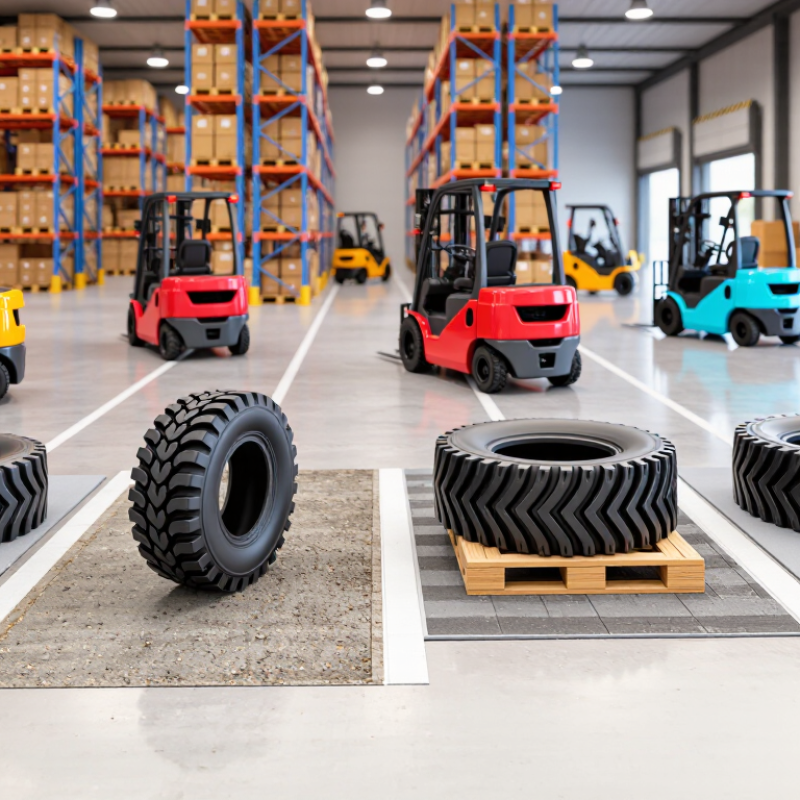
Warehouse forklift tires are usually chosen by floor conditions, load weight, and how tightly the truck must turn. Cushion tires are made from solid rubber and fit compactly around the wheel. Their small turning radius suits smooth indoor floors and narrow aisles. They can feel firm over floor joints, though, and are not made for rough outdoor travel.
Pneumatic tires resemble those used on road vehicles. Air-filled versions absorb bumps well, making them useful on uneven yards or mixed indoor-outdoor routes. They need pressure checks and can puncture. Solid pneumatic tires keep a similar profile but replace air with solid material, reducing puncture concerns. The trade-off is a harsher ride. That matters.
Polyurethane tires are common on certain electric warehouse trucks, especially pallet jacks and reach trucks. They roll efficiently on smooth concrete and can support frequent maneuvering. Their performance depends on the wheel design and load, so they are not a universal fit. A clean floor helps, but tiny metal fragments can still cause wear. There is no perfect tire. Even a suitable type may wear unevenly if the truck repeatedly turns in one direction or carries loads beyond its rating. Check the equipment specifications and inspect tires for chunking, flat spots, or exposed damage.

Forklift tires are working components, not just cushions under a load. Their material and construction affect traction, heat, ride comfort, and floor wear. Solid rubber tires resist punctures and suit smooth indoor floors, but they transmit more vibration through the truck. Pneumatic tires absorb bumps better, though their air-filled construction needs pressure checks and can be damaged by debris. Polyurethane tires roll efficiently on clean, level surfaces, but may offer less cushioning on uneven concrete.
The differences show up in small details. A hard tire can chatter over expansion joints; a softer compound may grip better but wear faster during tight turns. There is no perfect choice. OSHA’s powered industrial truck safety materials estimate about 85 forklift-related fatalities and 34,900 serious injuries annually in the United States, underscoring why tire condition and stable handling deserve attention. Tire selection cannot prevent every incident, but damaged tread, uneven wear, or incorrect pressure can make control less predictable. Check the tire type against the floor, load, travel distance, and turning frequency. Then inspect it regularly. Real warehouse floors are rarely as smooth as a specification sheet suggests.
Forklift tires should match the floor as well as the load. Smooth, sealed concrete usually suits cushion tires, which offer a compact turning profile for indoor work. On rough yards or cracked loading bays, pneumatic tires absorb more impact and maintain better contact across uneven ground. Solid pneumatic tires resist punctures, but their firmer ride can transfer more vibration to the truck and operator. Small details matter.
Look beyond the floor surface. Dust, metal shavings, moisture, and tight turning zones can change how a tire wears or grips. A heavy pallet carried over expansion joints may need a different setup from light stock moved along clean aisles. Check the forklift’s specifications, rated load, and working hours before choosing; tire fit and capacity are not interchangeable. Not always. Even a clean floor can become slick near wash areas, while a rough-looking floor may be manageable at low speed. Measure wear regularly and watch for flat spots, cuts, or unusual vibration. A short trial in the actual work area can reveal problems that a catalog cannot. I would not treat one tire type as a universal answer.
Choosing forklift tires starts with the load, not the floor. Check the truck’s data plate and the tire’s rated capacity, including the effect of attachments and load position. A heavier load can shift weight onto the front axle. The tire must suit that demand, with the truck manufacturer’s specifications as the reference. Don’t guess from appearance. OSHA’s Powered Industrial Truck guidance cites estimates of 85 forklift-related fatalities and 34,900 serious injuries each year in the United States. Those figures are estimates, not a tire-specific risk count, but they show why stable handling matters.
Next, match traction and maneuverability to the actual route. Solid cushion tires suit smooth indoor floors and tight aisles; pneumatic tires can handle rougher surfaces, though they need room and suitable floor clearance. On polished concrete, dust, water, or small oil patches can change grip. Small details matter. Walk the route and look for sharp turns, dock plates, floor joints, and debris before choosing. A tire that turns neatly in an empty aisle may feel different with a full pallet aboard. That’s easy to overlook.
Compare the tread, compound, and required maintenance, then test under normal operating conditions if possible. Non-marking tires may protect light-colored floors, but they are not automatically the best choice for every surface. Record uneven wear and pressure changes where applicable. The data sheet helps; it cannot describe every patch of floor. OSHA’s powered-industrial-truck guidance is a useful safety reference, while the truck and tire specifications should guide the final fit.
Forklift tires are the only contact between a loaded truck and the warehouse floor. Before each shift, check for cuts, missing chunks, cracks, embedded debris, and uneven wear. Look closely at the tire edges and the floor around the wheels. Small defects matter. On pneumatic tires, use a gauge and follow the truck manufacturer’s pressure specification; a visual check can miss underinflation. For solid tires, watch the wear line and replace tires that reach it.
OSHA estimates that powered industrial trucks are involved in about 85 fatal accidents and 34,900 serious injuries each year. These figures cover trucks overall, not tire-related incidents. Still, damaged or poorly maintained tires can affect traction, stability, and stopping. OSHA’s 29 CFR 1910.178(q)(7) requires unsafe trucks to be removed from service until restored to safe operating condition. Do not guess.
Keep inspection notes with the truck’s maintenance records. Record the tire’s location, defect, and action taken, so recurring wear does not disappear into a vague “fixed” entry. Check for floor hazards too: a loose metal strap can cut a tire, while oil may reduce grip. If wear appears uneven, ask qualified maintenance staff to check alignment, load conditions, and wheel components. A rushed glance can feel adequate. It isn’t.


For those larger-sized parts, or smaller quantity runs, we have 2 independent powder coat booths and ovens. The quality, durability and affordability of today’s powder coating finishes make this the process of choice for world-class companies.
Powder coating advantages over other forms of coating are many. Materials used in the Powder coating process can be metals and non-metals that come in a multitude of thicknesses, textures, colors, etc. Another of Powder coating’s biggest advantages over conventional coatings is its ability to create finishes in many different textures. Powder Coating Booths allow us the ability to apply these advantages to large products.
Tri-State Fabricators runs a full-service conveyor line for painting. Wet painting can provide protection or decoration to many different part styles. From start to finish, every project is easier to undergo random and point-based inspection by our skilled painting team.
Advantages to our Wet Paint Line are these lines start with product prep and ends with a thorough inspection of a high quality finished product. Our ability to complete large and small projects with a superior finish and doing so in a timely and economical fashion. This passes along the savings in production to our customers. When powder coating ins not an option, our Wet Paint Line gets the job done right the first time.
When the parts get big and heavy we roll-out our custom paint racks and oversize booth. By utilizing our partnerships with all the major paint brands, we can match virtually any color with wet paint.
The advantages of having access to a Wet Paint Booth are many. Large projects of many different shapes can be loaded into the booth. The Wet Paint Booth offers an environment that is much more controlled than a typical parts painting operation.
Not only are they used because of their controlled environment, but they’re are also advantageous when it comes to applying paint to parts that are needed in industries that require specialty coatings such as medical, aerospace, etc.
Our military forces have some very high standards when it comes to the finish of their vehicles and equipment. From the first pre-treatment step to final coat, it takes a great deal of knowledge and experience to protect the men and women of our armed forces. They deserve only the best, and Tri-State Fabricators provides it.
All of our processes are closely monitored by our staff and management teams. Both of which are highly trained in the processes of metal fabrication and finishing. Tri-State Fabricators’ goal is to always fully satisfy each and every customer, including the military. We will always put a 110% into what we do.
Abrasive media blasting is an excellent way to remove old paint, rust, and increase the paint/powder adhesion. Glass beads produce a much smoother and brighter finish than angular abrasives; leaving the part clean yet without any dimensional change. Chemically inert and environmentally friendly, we can recycle our beads approximately 30 times; making them a more preferred method of metal cleaning or surface finishing.
Advantages to Glass Bead Blasting are many. Glass bead blast media is used when a project is needing rough surfaces need to become smooth for applications of coatings such as paint. It is typically used to clean paint and rust from a product surface without deforming the surface it is being used on. Overall, compared to many other blasting media, Glass Bead Blasting is a very economical choice and those savings are always passed on to our customers.
Tri-State Fabricators utilize a zinc phosphate wash to clean and etch the material to ensure the best paint adhesion possible. The unique design of our 3-stage wash system does the work like a 5-stage. From Cleaning and rinsing to conversion coating and post-treatment, Our Part Washing process is a complete service and works throughout the fabrication service and the finishing service.
Along with the previously mentioned benefits, Curing is a vital chemical reaction that leaves the product finish hard and relatively safe from mild abrasion and aggressive corrosion. This process can be done in more than one way; ambient air-dry or in curing ovens at temps that exceed 240°.
From fixing paint mistakes (someone else’s of course) to simply cleaning our paint line hooks, our burn-off oven is put to good use. After a quick burn-off, a little clean up, and a fresh coat of paint, your parts will look better than new.
Why does our Burn-Off Oven work so well? Because super heating the air around parts turns the materials into ashes. From paint and powder coatings to rubber and machining oils, high temps do the job without degrading the integrity of the part.
Masking is a vital part of producing high quality products. We have die-cut masking patterns to protect machined surfaces as well as a wide range of plugs and caps to protect threaded holes and bolts. We provide permanent and temporary masking.
Masking allows the selected sections of a product to be protected from a fabrication or finishing service. This can be with both chemicals when etching and tapes, paints when only finishing just a section of the product. Masking is great in aiding the customization process of a project.
Screen printing is a photographic process that transfers artwork onto a porous nylon screen which allows colored ink to flow through the screen and be deposited on an aluminum or plastic component. We can generally have just about any design created onto a screen for your parts.
Some of the advantages of Screen Printing are, brand recognition for your business displaying on your products, assembly instructions, product warnings/hazards, etc. Tri-State Fabricators produces Screen Printing of the highest quality so you know it’s durable.
Metal Finishing is the art of treating the exterior portion of product, often metal but can also be made of other materials, so that the surface is clean and free of any debris. Then the process of applying coats or either paint of powder coat takes place. This coating process improves the quality of the product in both appearance and resistance to wear and corrosion.
Tri-State Fabricators, Inc., understands that a project typically isn’t complete until a high-quality finish has been added to your product. This is why our painting and powder coating teams continuously inspect the products throughout the Metal Finishing process.

