


What Is the Vacuum Brazing Process and How Does It Work?

The Vacuum Brazing Process joins metal components by heating them with a filler alloy inside a vacuum furnace. Unlike welding, it melts the filler, not the base materials. The liquid filler flows into a close-fitting joint through capillary action, then solidifies as the assembly cools. Small details matter.

A typical cycle begins with clean parts, carefully positioned with the filler alloy. After loading, the furnace removes much of the air and follows a controlled heating schedule. As the temperature rises, the filler melts and spreads along the joint surfaces. Cooling then forms the bond. Flux is usually unnecessary, though suitable materials and clean surfaces remain essential. That sounds simple.

The outcome depends on more than furnace temperature. Joint clearance, alloy choice, part geometry, and heating uniformity all affect how the filler flows. In practice, the process can be less forgiving than a neat diagram suggests: small gaps or uneven heating may produce incomplete joints. Vacuum level and cycle settings also vary with the materials and equipment, so established procedures and inspection matter. This overview explains how each stage works, what influences joint quality, and where careful process control makes a practical difference.
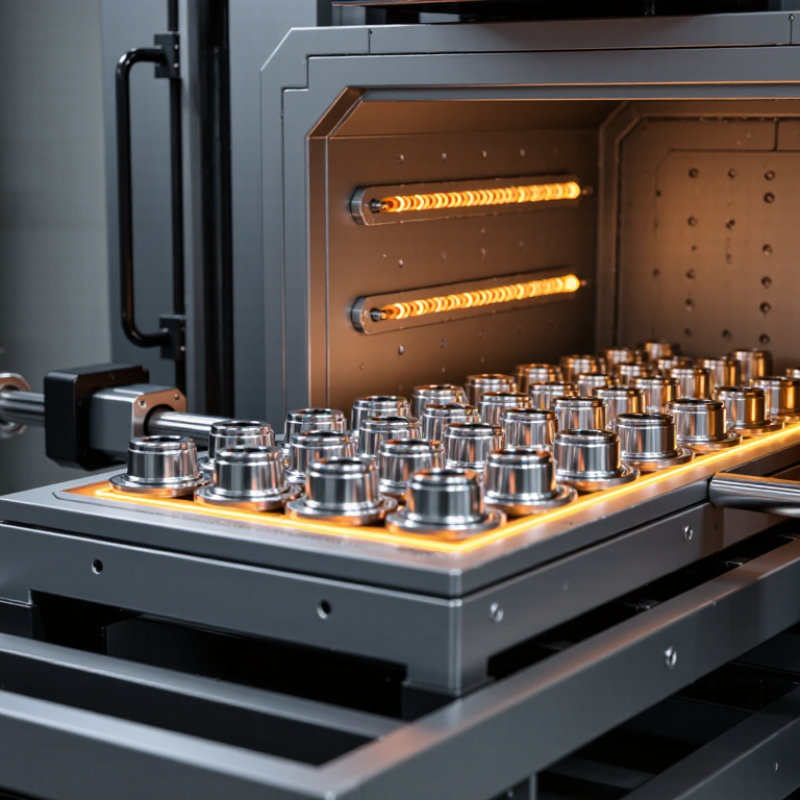
What Is the Vacuum Brazing Process and How Does It Work?

Vacuum Brazing Fundamentals: Filler Metals Melt Above 450°C

Vacuum brazing joins closely fitted metal parts by heating them in a low-pressure furnace. The filler metal melts and flows into the narrow joint, while the base metals remain solid. The key threshold is 450°C. The American Welding Society’s A3.0M/A3.0 terminology standard defines brazing by a filler metal liquidus above this temperature. That boundary matters.

The actual cycle depends on the filler alloy and the parts being joined. Operators heat the assembly until the filler melts, wets the surfaces, and fills the joint by capillary action. A vacuum helps limit oxidation, which can otherwise obstruct flow and weaken bonding. ASM Handbook, Volume 6A, describes vacuum brazing as a process suited to clean, flux-free joints in controlled furnace conditions. But 450°C is not a furnace setting. It is a classification threshold, and treating it like a recipe would be a mistake.

For example, a thin stainless-steel assembly may need a carefully controlled ramp to avoid distortion, while thicker parts heat more slowly. Joint clearance matters too: an overly wide gap can interrupt filler flow. The AWS threshold gives engineers a shared definition; it does not guarantee a sound joint. That part takes testing.

What Is the Vacuum Brazing Process and How Does It Work? - Vacuum Brazing Fundamentals: Filler Metals Melt Above 450°C

Process Dimension What Happens Typical Details and Considerations
Brazing principle A filler metal melts and flows into a closely fitted joint while the base components remain solid. In the commonly used definition, brazing filler metal has a liquidus temperature above 450°C (840°F). Capillary action helps draw the molten filler through the joint clearance.
Joint preparation Parts are cleaned, aligned, and assembled with filler metal placed at or near the joint. Oil, dirt, and excessive oxide can prevent wetting. Joint clearance must suit the materials, filler, and process temperature; there is no single clearance suitable for every design.
Vacuum environment The loaded assembly is heated in a sealed furnace as air and other gases are removed. Vacuum level is selected for the materials and process requirements. Industrial furnace operating pressures can vary widely; approximately 10−2 to 10−5 mbar is an illustrative range, not a universal specification.
Heating and outgassing The furnace heats the parts in controlled stages, allowing trapped gases and volatile residues to be removed before brazing. Heating schedules depend on part mass, geometry, materials, and furnace loading. Thorough cleaning helps reduce contamination and outgassing.
Brazing temperature The assembly is brought above the filler metal’s liquidus temperature so the filler can melt and wet the joint surfaces. The required temperature is determined by the selected filler and base materials. Many vacuum-brazing cycles fall roughly between 600°C and 1200°C, but some applications are outside this range.
Filler flow and joint formation Molten filler wets compatible surfaces and is drawn into the joint by capillary action, then forms a bond as it solidifies. Good results depend on surface condition, joint fit, filler compatibility, and a suitable time at temperature. The base metals are not intended to melt.
Filler metal selection The filler is chosen to suit the base metals, service environment, joint design, and furnace cycle. Common filler families include silver-, copper-, nickel-, and gold-based alloys. Their melting ranges and suitability differ; the filler must not damage or excessively interact with the base materials.
Cooling After the brazing hold, the assembly is cooled under a controlled atmosphere or vacuum according to the process specification. Cooling rate can affect distortion, residual stress, and the properties of heat-treated materials. Some furnaces use gas cooling when the load and equipment permit.
Typical advantages The process can produce clean joints without routine flux use and can braze multiple joints in one furnace cycle. Vacuum processing can limit oxidation and reduce post-braze flux removal. Outcomes depend on material chemistry, surface preparation, furnace condition, and process control.
Quality checks Completed assemblies are inspected to confirm joint integrity and dimensional requirements. Depending on the application, checks may include visual inspection, dimensional measurement, leak testing, or appropriate non-destructive testing.

Values shown are general guidance only. Actual temperatures, vacuum levels, clearances, and cycle times should be established for the specific materials, component design, and applicable process specification.


Joint Design and Filler Selection: Clearances Often Range from 0.025–0.125 mm

In vacuum brazing, joint clearance controls how molten filler metal travels between the parts. A common working range is 0.025–0.125 mm, but it is not a universal rule. The best fit depends on the base metals, filler alloy, joint shape, and heating cycle. Fit matters.

When the gap is too narrow, filler may not flow through the joint evenly. When it is too wide, capillary action weakens and larger voids can remain. For a cylindrical sleeve, for example, a small change in diameter can create a noticeable difference in clearance around the full circumference. Parts should be measured and checked for roundness, not just compared by nominal dimensions.

Filler selection and clearance should be considered together. The filler must wet the base metals and melt below their solidus temperature; its flow behavior also affects the usable gap. In practice, thermal expansion can change the fit as the assembly heats, so room-temperature measurements do not tell the whole story. Not always. A trial assembly or process coupon can reveal issues that drawings miss, though it adds time and may not perfectly represent every production part. Clean surfaces, stable fixturing, and a controlled vacuum cycle help maintain consistent joints.

Surface Preparation and Evacuation: Industrial Vacuums Reach 10⁻⁴–10⁻⁶ mbar

Before loading, technicians remove oil, oxide, and machining residue from both joint faces. A clean, lint-free wipe and a compatible cleaning method help prevent trapped contamination. Then parts are dried and assembled with a controlled, even gap. Small details matter. A fingerprint can become a source of gas during heating, while an uneven joint may leave filler metal poorly distributed. The ASM Handbook, Volume 6, describes surface condition and joint design as key factors in brazing quality; cleaning alone cannot compensate for a poor fit.

The chamber is pumped down toward 10⁻⁴–10⁻⁶ mbar before heating. This low pressure limits oxygen around the parts and supports clean wetting by the filler metal. The AWS Brazing Handbook discusses vacuum brazing as a controlled-atmosphere process, but a pressure reading is not proof of a clean chamber. Moisture and residue can continue to outgas, and a gauge may not reflect conditions near the workpiece. Technicians therefore watch the pressure trend, allow adequate pump-down time, and avoid rushing the cycle. It is an imperfect check. For repeatable results, record pressure, load arrangement, and surface-preparation steps alongside each run.

Heating and Capillary Flow: Brazing Stays Below the Base Metal’s Solidus

In vacuum brazing, the filler metal melts while the base components remain solid. That temperature window matters: AWS A3.0M/A3.0:2020 defines brazing as joining above 450°C (840°F), with the filler’s liquidus below the base metal’s solidus. The exact setting depends on the alloys and joint design. A thermocouple near a thin stainless-steel panel may read differently from one on a thick fixture. Small gaps matter.

As the filler liquefies, capillary action pulls it into the joint, much like water entering a narrow seam. Clean, closely fitted surfaces help the molten alloy spread and bond; poor fit can leave voids or starve part of the joint. Vacuum reduces oxidation during heating, but it cannot correct grease, trapped debris, or an oversized gap. It is easy to overlook that distinction. Heating too far can also erode or distort the base metal, even if it never fully melts. The AWS Brazing Handbook discusses joint clearance and filler flow as key design factors; in practice, the right clearance must be matched to the specific materials and filler alloy. That judgment is rarely perfect on the first trial.

Controlled Cooling and Inspection: Verify Joint Integrity and Dimensional Stability

After brazing, the assembly must cool under a controlled furnace cycle. Cooling too quickly can create thermal gradients between thick and thin sections, increasing stress or distortion. The right rate depends on the base metals, filler alloy, joint design, and part size. There is no single setting that suits every component. Keep the part supported as specified, and avoid opening the furnace before the load reaches its safe handling temperature.

Small details matter. A thin flange beside a heavy block may cool unevenly. Once the assembly reaches room temperature, inspect the joint for visible gaps, excess filler, or signs of incomplete flow. Visual checks are useful, but they cannot reveal every internal flaw. Depending on service requirements, dimensional checks, leak testing, or suitable nondestructive examination may be needed.

Measure critical features from defined reference points, not from a convenient edge that may itself have shifted. Compare results with the drawing tolerances, and record the inspection method, equipment, and readings. If dimensions drift, review the cooling cycle and fixture support before changing the brazing parameters. That diagnosis can be imperfect; distortion may have more than one cause. Keep the evidence.

Powder Coat Booths

For those larger-sized parts, or smaller quantity runs, we have 2 independent powder coat booths and ovens. The quality, durability and affordability of today’s powder coating finishes make this the process of choice for world-class companies.

Powder coating advantages over other forms of coating are many. Materials used in the Powder coating process can be metals and non-metals that come in a multitude of thicknesses, textures, colors, etc. Another of Powder coating’s biggest advantages over conventional coatings is its ability to create finishes in many different textures. Powder Coating Booths allow us the ability to apply these advantages to large products.

Wet Paint Line

Tri-State Fabricators runs a full-service conveyor line for painting. Wet painting can provide protection or decoration to many different part styles. From start to finish, every project is easier to undergo random and point-based inspection by our skilled painting team.

Advantages to our Wet Paint Line are these lines start with product prep and ends with a thorough inspection of a high quality finished product. Our ability to complete large and small projects with a superior finish and doing so in a timely and economical fashion. This passes along the savings in production to our customers. When powder coating ins not an option, our Wet Paint Line gets the job done right the first time.

Wet Paint Booths

When the parts get big and heavy we roll-out our custom paint racks and oversize booth. By utilizing our partnerships with all the major paint brands, we can match virtually any color with wet paint.

The advantages of having access to a Wet Paint Booth are many. Large projects of many different shapes can be loaded into the booth. The Wet Paint Booth offers an environment that is much more controlled than a typical parts painting operation.

Not only are they used because of their controlled environment, but they’re are also advantageous when it comes to applying paint to parts that are needed in industries that require specialty coatings such as medical, aerospace, etc.

Military CARC

Our military forces have some very high standards when it comes to the finish of their vehicles and equipment. From the first pre-treatment step to final coat, it takes a great deal of knowledge and experience to protect the men and women of our armed forces. They deserve only the best, and Tri-State Fabricators provides it.

All of our processes are closely monitored by our staff and management teams. Both of which are highly trained in the processes of metal fabrication and finishing. Tri-State Fabricators’ goal is to always fully satisfy each and every customer, including the military. We will always put a 110% into what we do.

Glass-Bead Blasting

Abrasive media blasting is an excellent way to remove old paint, rust, and increase the paint/powder adhesion. Glass beads produce a much smoother and brighter finish than angular abrasives; leaving the part clean yet without any dimensional change. Chemically inert and environmentally friendly, we can recycle our beads approximately 30 times; making them a more preferred method of metal cleaning or surface finishing.

Advantages to Glass Bead Blasting are many. Glass bead blast media is used when a project is needing rough surfaces need to become smooth for applications of coatings such as paint. It is typically used to clean paint and rust from a product surface without deforming the surface it is being used on. Overall, compared to many other blasting media, Glass Bead Blasting is a very economical choice and those savings are always passed on to our customers.

Part Washing

Tri-State Fabricators utilize a zinc phosphate wash to clean and etch the material to ensure the best paint adhesion possible. The unique design of our 3-stage wash system does the work like a 5-stage. From Cleaning and rinsing to conversion coating and post-treatment, Our Part Washing process is a complete service and works throughout the fabrication service and the finishing service.

Along with the previously mentioned benefits, Curing is a vital chemical reaction that leaves the product finish hard and relatively safe from mild abrasion and aggressive corrosion. This process can be done in more than one way; ambient air-dry or in curing ovens at temps that exceed 240°.

Burn-Off Oven

From fixing paint mistakes (someone else’s of course) to simply cleaning our paint line hooks, our burn-off oven is put to good use. After a quick burn-off, a little clean up, and a fresh coat of paint, your parts will look better than new.

Why does our Burn-Off Oven work so well? Because super heating the air around parts turns the materials into ashes. From paint and powder coatings to rubber and machining oils, high temps do the job without degrading the integrity of the part.

Masking

Masking is a vital part of producing high quality products. We have die-cut masking patterns to protect machined surfaces as well as a wide range of plugs and caps to protect threaded holes and bolts. We provide permanent and temporary masking.

Masking allows the selected sections of a product to be protected from a fabrication or finishing service. This can be with both chemicals when etching and tapes, paints when only finishing just a section of the product. Masking is great in aiding the customization process of a project.

Screen Printing

Screen printing is a photographic process that transfers artwork onto a porous nylon screen which allows colored ink to flow through the screen and be deposited on an aluminum or plastic component. We can generally have just about any design created onto a screen for your parts.

Some of the advantages of Screen Printing are, brand recognition for your business displaying on your products, assembly instructions, product warnings/hazards, etc. Tri-State Fabricators produces Screen Printing of the highest quality so you know it’s durable.

Metal Finishing

Metal Finishing is the art of treating the exterior portion of product, often metal but can also be made of other materials, so that the surface is clean and free of any debris. Then the process of applying coats or either paint of powder coat takes place. This coating process improves the quality of the product in both appearance and resistance to wear and corrosion.

Tri-State Fabricators, Inc., understands that a project typically isn’t complete until a high-quality finish has been added to your product. This is why our painting and powder coating teams continuously inspect the products throughout the Metal Finishing process.
