How to Understand RCCB Meaning and How It Works?
Rccb Meaning refers to the role of a residual current circuit breaker in protecting people from certain electrical faults. The device compares current flowing through the live and neutral conductors. If some current escapes its intended path, the imbalance can trigger a rapid disconnection. Click. Power stops.
Mike Holt, a well-known electrical educator, offers a useful perspective on electrical protection. The following is a paraphrased safety principle, not a verbatim quotation: “Protective devices work best when correctly selected, installed, and tested.” That distinction matters. An RCCB can reduce the risk of electric shock, but it does not replace sound wiring, suitable overcurrent protection, or inspection by a qualified professional.
This guide will explain what an RCCB does, how its internal sensing principle works, and how it differs from related protective devices. It will also clarify common terms, including rated residual operating current and test-button function. Picture a small leakage current flowing from a damaged appliance casing toward earth. The RCCB detects an imbalance and disconnects the circuit, provided the device and installation are suitable.
There are limits. An RCCB may not protect against every electrical hazard, and a test button cannot prove that the entire installation is safe. That is easy to overlook. The practical goal is understanding—not treating one breaker as a complete safety solution.
What RCCB Means and What It Protects Against
RCCB means residual current circuit breaker. It monitors the current flowing through the live and neutral wires. Under normal conditions, those currents are nearly equal. If some current escapes through a person, damaged insulation, or a damp surface, the balance changes. The RCCB detects this difference and disconnects the circuit, often within a fraction of a second. That matters. A fault may be invisible, while a wet floor or nicked cable can create a real shock risk.
An RCCB is designed to reduce the risk of electric shock and certain fires caused by leakage current. It does not usually protect against overloads or short circuits, so suitable overcurrent protection is also needed. One device cannot prevent every accident. Its effectiveness depends on correct selection, installation, and regular checks.
For example, the test button should be used as directed by the manufacturer; it checks the tripping mechanism, not the whole installation. If it fails to trip, or trips repeatedly, do not keep resetting it without finding the cause. Have a qualified electrician inspect the circuit.
It is easy to assume a breaker is “fine” because it has never tripped, but that alone proves very little.
The Main Parts of an RCCB
The Main Parts of an RCCB
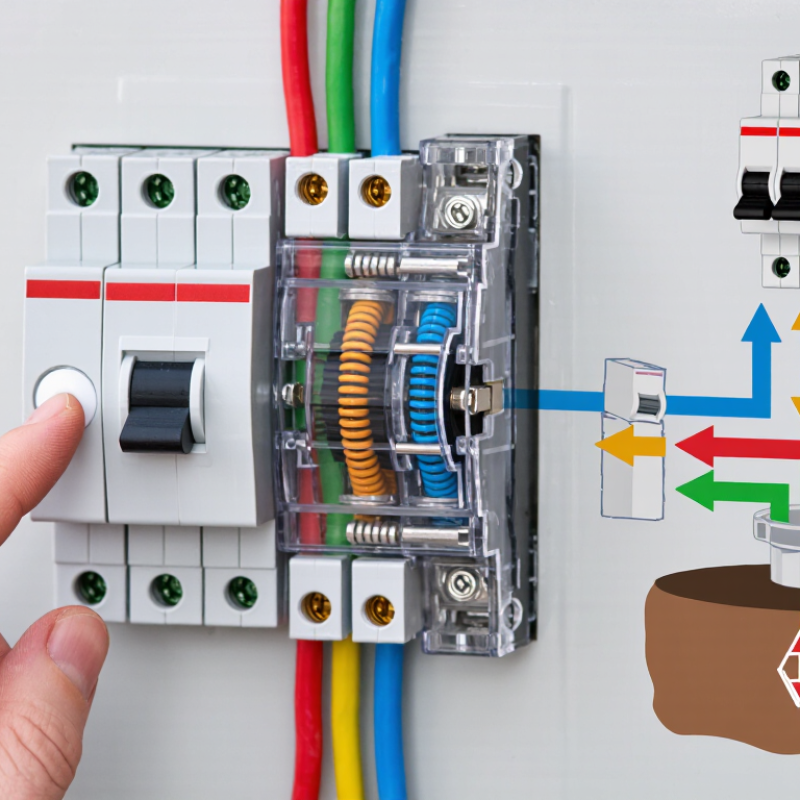
An RCCB compares the current flowing through its live and neutral conductors. Both pass through a toroidal current transformer inside the device. Under normal conditions, their magnetic effects balance. If some current leaks to earth, the balance shifts, and a trip mechanism opens the contacts. A test button and resistor let users check the mechanism; they do not replace scheduled inspection.
The detail I would not overlook is what an RCCB cannot do: it does not provide overload or short-circuit protection.
The NFPA report Home Electrical Fires estimated an annual average of 46,700 U.S. home fires involving electrical failure or malfunction from 2015 to 2019. An RCCB cannot prevent every such fire, but it can disconnect certain earth-leakage faults. IEC 61008-1 covers RCCBs without integral overcurrent protection. IEC 60364-4-41 calls for additional protection with devices rated at no more than 30 mA in specified applications. Correct selection and installation still matter.
Tips: Press the test button as directed by the manufacturer, and have a qualified electrician investigate a device that fails to trip. Never treat a successful test as proof that every circuit is protected.
How an RCCB Monitors Current Flow
An RCCB monitors the current leaving a circuit and the current returning through its neutral conductor. In normal operation, those readings should balance. Inside the device, a sensing core compares them continuously. If damaged insulation lets current escape through a person or an earthed metal casing, the return current falls short. That imbalance matters. The RCCB detects the difference and opens its contacts, disconnecting the supply. It does not usually protect against overloads or short circuits; a separate overcurrent protective device is needed.
IEC 61008-1 sets performance tests for RCCBs without integral overcurrent protection. For a standard, non-delayed device, the test requires no trip at half its rated residual current, and a trip within 300 milliseconds at that rated current. At five times the rated residual current, the maximum operating time is 40 milliseconds. These are laboratory limits, not a promise that every fault will produce the same result. Actual operation depends on the device type, fault path, and installation. The comparison is elegant, but not magic: a loose neutral or an unsuitable device can complicate protection. A qualified electrician should select and test the RCCB for the circuit.
How an RCCB Detects Leakage and Trips
An RCCB compares the current flowing through the live and neutral wires. In normal operation, those currents balance. If current escapes through damaged insulation, a damp appliance, or a person, the balance shifts. A small transformer inside the device senses this residual current and activates a trip mechanism. The contacts open, disconnecting the circuit. The change can happen before anyone notices a smell or sound.
IEC 61008-1 sets maximum disconnection times for general-type RCCBs: 300 milliseconds at rated residual current, 150 milliseconds at twice that current, and 40 milliseconds at five times the rated current. These are standard test limits, not a promise that every fault will produce the same result. An RCCB also cannot protect against every electric shock, such as contact between live and neutral. That limitation is easy to overlook.
Tip: Check the device’s test button at the interval stated by its manufacturer, and arrange professional checks if it fails to trip. Keep the panel dry and unobstructed. It is worth remembering that a successful test checks the mechanism, not the condition of every cable or appliance.
Common RCCB Types and Their Uses
RCCBs differ mainly in the residual current waveforms they can detect. Type AC responds to sinusoidal alternating current and may suit simple resistive circuits, such as basic lighting. Type A also detects pulsating direct current, making it more appropriate for circuits supplying electronic appliances, including washing machines and induction hobs. Check the appliance instructions and local wiring rules; a familiar label is not enough.
Type F is designed for certain mixed-frequency residual currents from single-phase variable-speed equipment, such as inverter-driven air conditioners. Type B detects these and smooth direct current, which can occur with some three-phase converters and electric-vehicle charging equipment. IEC 62423 covers Type F and Type B RCCBs. Type S adds a time delay, often helping coordinate an upstream device with faster downstream protection. It is not a substitute for correctly designed circuit protection. Details matter.
The scale of electrical risk gives this choice practical weight. NFPA’s Electrical Fires report estimates that U.S. fire departments responded to about 24,200 home electrical fires annually from 2015 to 2019, causing 295 deaths and 900 injuries. That report does not measure RCCB performance, but it underlines why protective devices must match the installation. An RCCB also does not provide overload or short-circuit protection; it needs suitable overcurrent protection. Real installations can be messy, and device selection should be checked against the load, manufacturer guidance, and applicable electrical standards.





