


What Is Ultra Wideband Positioning and How Does It Work?

Ultra Wideband Positioning is a modern method for locating people, tools, vehicles, and devices with remarkable precision. Unlike traditional Bluetooth proximity estimates, it measures the travel time of radio signals. A small UWB tag sends a short pulse to fixed anchors around a room. The system calculates how long each pulse takes to arrive. Tiny timing differences reveal distance. Several distance measurements then help determine the tag’s position through trilateration.

The process sounds simple. It is not always simple in practice. Walls, metal shelves, moving people, and reflected signals can disturb measurements. Careful anchor placement matters. So does clock synchronization and antenna calibration. In a warehouse, for example, anchors mounted near ceiling corners can guide workers toward a specific pallet location. In hospitals, UWB tags may help locate mobile equipment without relying on vague room-level estimates. IEEE 802.15.4z also supports improved ranging reliability and stronger protection against certain signal attacks.

Accuracy depends on the environment.

A trustworthy deployment needs testing under real conditions, not only laboratory results. Installers should measure blind spots, review battery performance, and confirm that collected location data is handled responsibly. UWB can support safer workflows and faster asset searches, but it cannot solve every tracking problem. Some systems need additional sensors, better maps, or human judgment. It is easy to oversell the technology. A realistic understanding of Ultra Wideband Positioning begins with both its impressive precision and its practical limitations.
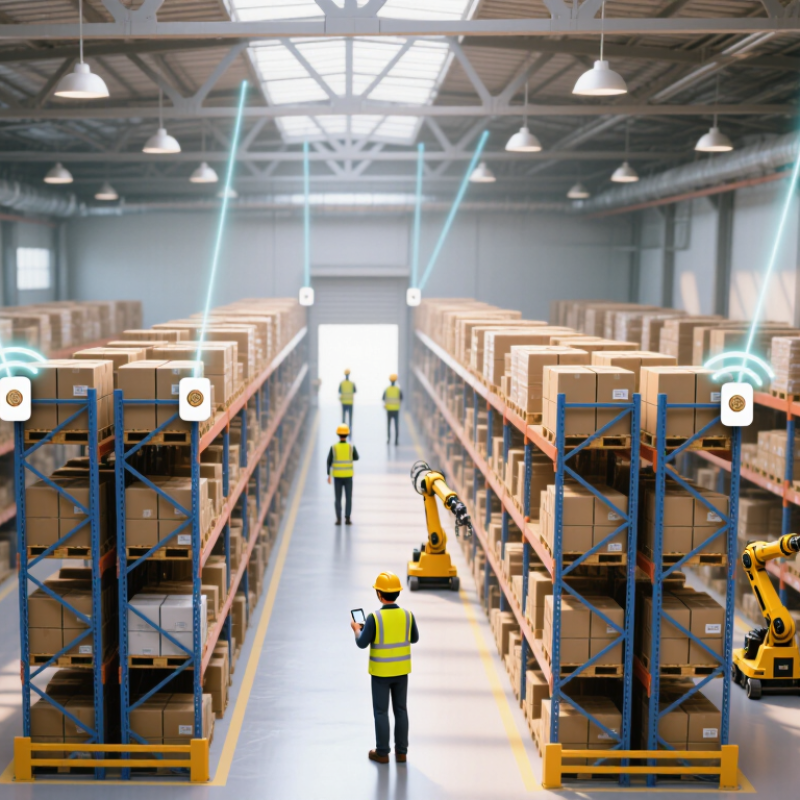
What Is Ultra Wideband Positioning and How Does It Work?

What Ultra-Wideband Positioning Is

Ultra-Wideband positioning is a radio-based method for measuring location through extremely short pulses. Unlike ordinary wireless systems, it records how long a signal takes to travel between a tag and fixed reference points. The system then converts those timing measurements into distance. A tag may sit inside a warehouse cart, on a tool, or inside a wearable device. Fixed anchors listen from different positions. Their combined readings estimate the tag’s location, often within tens of centimeters in controlled spaces.

The technology operates across a wide frequency range, commonly around 3.1 to 10.6 GHz under United States regulations. Its short pulses can separate reflections more clearly than many narrowband signals. That improves positioning near walls, machinery, and moving people. A 2023 MarketsandMarkets report estimated the ultra-wideband market at about USD 1.6 billion, with continued growth expected through 2028. Berg Insight also identified real-time location systems as a major commercial application, especially in industrial environments. These figures show strong momentum, but market growth does not guarantee perfect accuracy. Metal shelving, blocked paths, and poor anchor placement still create errors. It is not magic. A practical installation needs careful calibration, reliable clock synchronization, and regular testing. Even then, a location estimate remains an estimate, not an unquestionable fact.


How Ultra-Wideband Signals Enable Precise Ranging

What Is Ultra Wideband Positioning and How Does It Work?

How Ultra-Wideband Signals Enable Precise Ranging

Ultra-wideband positioning measures distance through extremely short radio pulses. A tag sends a pulse, and an anchor records its arrival time. The system then estimates the time of flight between both devices. Multiplying that delay by the speed of light produces a distance estimate. Timing matters. A one-nanosecond error represents roughly 30 centimeters of range.

Modern systems use two-way ranging to reduce clock differences. Devices exchange carefully timed messages and calculate the round-trip delay. IEEE 802.15.4z adds stronger ranging methods and improved resistance to manipulated measurements. FiRa Consortium technical materials commonly describe accuracy near 10 centimeters under favorable conditions. However, that figure is not a promise. Metal shelves, wet materials, crowded rooms, and reflected signals can reduce reliability. Walls interfere. Real installations need testing.

Tips: Keep anchors away from large metal surfaces. Survey each room before deployment. Use several anchors for better geometry. MarketsandMarkets projects the UWB market to grow from about USD 1.6 billion in 2023 to USD 3.3 billion by 2028. That growth reflects wider adoption, but market size does not guarantee positioning quality. Measure accuracy at different heights, walking speeds, and times of day. A small calibration error can become a visible map drift.

What Is Ultra Wideband Positioning and How Does It Work? - How Ultra-Wideband Signals Enable Precise Ranging
Data Dimension Measured or Defined Value Unit Technical Significance
Common UWB Frequency Range 3.1–10.6 GHz This is the widely cited UWB frequency range defined for unlicensed low-power operation in the United States. Permitted bands differ by region and application.
Minimum UWB Bandwidth At least 500 MHz A very wide occupied bandwidth allows the receiver to distinguish signal-arrival times more precisely than a narrowband waveform.
Alternative Fractional-Bandwidth Criterion At least 20% Fractional bandwidth Fractional bandwidth is calculated as 2 × (upper frequency − lower frequency) ÷ (upper frequency + lower frequency).
Speed of Electromagnetic Propagation 299,792,458 m/s Ranging systems use the propagation speed of radio waves to convert measured signal time into distance.
Distance Represented by 1 Nanosecond Approximately 0.30 m A one-way timing error of 1 nanosecond corresponds to about 30 centimeters of distance error in free space.
Distance Represented by 100 Picoseconds Approximately 0.03 m A 100-picosecond one-way timing interval corresponds to approximately 3 centimeters, illustrating why precise timestamping is essential.
Basic Time-of-Flight Formula Distance = Propagation Speed × Time of Flight Formula For one-way ranging, distance is calculated from the elapsed time between transmission and reception. Two-way ranging measures a round-trip interval and applies the appropriate factor.
Typical Indoor Positioning Accuracy About 10–30 cm This range is achievable in favorable indoor conditions with suitable antenna placement, calibration, line of sight, and adequate anchor geometry. Actual performance varies.
Primary Ranging Method Time of Flight or Two-Way Ranging Method A device estimates distance by measuring how long a radio signal takes to travel between a mobile tag and one or more fixed reference points.
Synchronization Requirement for Two-Way Ranging Reduced compared with one-way ranging System characteristic The exchange of timed messages can compensate for much of the clock offset between devices, although clock drift and processing delays still require calibration.
Minimum Reference Points for 2D Trilateration At least 3 Reference points Three known distances can theoretically locate a point in two dimensions. Additional reference points improve robustness and help resolve measurement errors.
Minimum Reference Points for 3D Trilateration At least 4 Reference points Four or more geometrically suitable reference points are generally required to estimate a three-dimensional position from measured ranges.
Common Positioning Techniques ToF, TDoA, AoA, and Trilateration Techniques Time of Flight measures signal travel time, Time Difference of Arrival compares arrival times, Angle of Arrival estimates direction, and trilateration combines multiple distances.
Impact of Non-Line-of-Sight Conditions Positive Range Bias Typical error behavior Walls, people, furniture, and other obstacles can delay the first detectable signal path, causing the calculated distance to appear longer than the true distance.
Key Accuracy Factors Clock Precision, Antenna Delay, Multipath, Geometry, and Calibration Factors Wide bandwidth alone does not guarantee centimeter-level positioning; system design and environmental conditions strongly influence the final result.

Key Components of an Ultra-Wideband Positioning System

What Is Ultra Wideband Positioning and How Does It Work?

Key Components of an Ultra-Wideband Positioning System

An ultra-wideband positioning system measures distance through short radio pulses. Its core includes fixed anchors, mobile tags, antennas, and processing software. Anchors sit on walls or ceilings. A tag may travel on a tool cart or helmet. Time-of-flight calculations convert signal travel into location. IEEE 802.15.4z defines enhanced ranging methods for these exchanges. NIST’s indoor-positioning research also stresses clock accuracy and controlled testing.

The radio is only one component. A local controller synchronizes anchors and filters noisy measurements. Location software then compares several distances through multilateration. A 2024 technical review of indoor positioning systems reports typical UWB accuracy near 10–30 centimeters in clear conditions. Performance drops near metal racks, thick concrete, and moving machinery. Walls interfere. Antenna placement matters.

Calibration connects laboratory performance with daily operations. Installers should record anchor height, cable delays, and reference points. A practical test might move one tag beside a doorway, beneath a shelf, and across a loading area. The system should expose confidence levels, not only coordinates. That detail helps technicians question an apparently precise result. In my experience, maintenance is underestimated; a shifted anchor can create a clean-looking but incorrect map. Battery status, firmware consistency, and timestamp drift also deserve monitoring. The weak point is often the deployment plan, not the signal.

How a Position Is Calculated from Signal Measurements

Ultra Wideband Positioning estimates location by measuring how long radio signals take to travel. The system uses fixed anchors and a mobile tag. Each anchor records a signal’s arrival time. Radio waves move extremely fast. A timing error of one nanosecond can create roughly 30 centimeters of distance error. The tag’s position comes from several measured distances, not from one signal alone.

The calculation is called multilateration. A processor compares the time differences between anchors, then draws possible distance circles around them. Where those measurements overlap, the tag is likely located. Three anchors can estimate a two-dimensional position, while four or more usually support three-dimensional tracking and better timing correction. Real systems also compensate for clock drift, antenna delays, and signal reflections. Concrete walls, metal shelves, and people can distort the path. The result may jump briefly. It is not magic, and it is not flawless.

Tips: Place anchors at different heights and avoid hiding them behind metal. Keep the geometry wide rather than grouping anchors together. Watch confidence values, not just the displayed coordinates. Test the system with a tape measure in the actual room. A clean laboratory result may weaken near machinery or crowded corridors. Filtering can smooth movement, but excessive filtering creates noticeable lag. Check both accuracy and response time.

What Is Ultra Wideband Positioning and How Does It Work?

How a Position Is Calculated from Signal Measurements

UWB positioning estimates the distance between a tag and several fixed anchors by measuring signal time of flight. The measured distances are combined through multilateration to calculate the tag position. In this example, the estimated position is approximately (4.1 m, 5.9 m) on a two-dimensional floor plan.

The comparison shows the measured ranges and the ranges expected from the calculated position. Small differences are normal because of clock uncertainty, reflections, antenna delay, and measurement noise.

Factors That Affect Ultra-Wideband Positioning Accuracy

Ultra-wideband positioning estimates location by measuring how long radio pulses take to travel between a tag and fixed anchors. Its accuracy can reach centimeters in controlled conditions. Real environments are less cooperative. Walls, metal shelves, glass, and machinery can reflect pulses. These reflections create multipath errors, making a tag appear several centimeters away.

Anchor placement strongly affects the result. Anchors should surround the working area rather than sit along one wall. Their height also matters. Mounting them too low may increase blockage from people, carts, or furniture. Poor geometric layouts can amplify small timing errors. A stable installation needs measured anchor coordinates, secure mounting, and careful calibration.

Signal quality changes with antenna direction and the user’s body. A hand covering the tag can weaken or delay the signal. Moving objects may briefly distort measurements. Clock synchronization, firmware settings, battery condition, and local radio activity also deserve attention. Field tests should include walking, turning, crouching, and stopping near obstacles. A clean laboratory result may not represent a busy warehouse. I have found that repeated tests often reveal small errors that a single demonstration hides. Even then, perfect accuracy is an unrealistic target.

Article Source:

Powder Coat Booths

For those larger-sized parts, or smaller quantity runs, we have 2 independent powder coat booths and ovens. The quality, durability and affordability of today’s powder coating finishes make this the process of choice for world-class companies.

Powder coating advantages over other forms of coating are many. Materials used in the Powder coating process can be metals and non-metals that come in a multitude of thicknesses, textures, colors, etc. Another of Powder coating’s biggest advantages over conventional coatings is its ability to create finishes in many different textures. Powder Coating Booths allow us the ability to apply these advantages to large products.

Wet Paint Line

Tri-State Fabricators runs a full-service conveyor line for painting. Wet painting can provide protection or decoration to many different part styles. From start to finish, every project is easier to undergo random and point-based inspection by our skilled painting team.

Advantages to our Wet Paint Line are these lines start with product prep and ends with a thorough inspection of a high quality finished product. Our ability to complete large and small projects with a superior finish and doing so in a timely and economical fashion. This passes along the savings in production to our customers. When powder coating ins not an option, our Wet Paint Line gets the job done right the first time.

Wet Paint Booths

When the parts get big and heavy we roll-out our custom paint racks and oversize booth. By utilizing our partnerships with all the major paint brands, we can match virtually any color with wet paint.

The advantages of having access to a Wet Paint Booth are many. Large projects of many different shapes can be loaded into the booth. The Wet Paint Booth offers an environment that is much more controlled than a typical parts painting operation.

Not only are they used because of their controlled environment, but they’re are also advantageous when it comes to applying paint to parts that are needed in industries that require specialty coatings such as medical, aerospace, etc.

Military CARC

Our military forces have some very high standards when it comes to the finish of their vehicles and equipment. From the first pre-treatment step to final coat, it takes a great deal of knowledge and experience to protect the men and women of our armed forces. They deserve only the best, and Tri-State Fabricators provides it.

All of our processes are closely monitored by our staff and management teams. Both of which are highly trained in the processes of metal fabrication and finishing. Tri-State Fabricators’ goal is to always fully satisfy each and every customer, including the military. We will always put a 110% into what we do.

Glass-Bead Blasting

Abrasive media blasting is an excellent way to remove old paint, rust, and increase the paint/powder adhesion. Glass beads produce a much smoother and brighter finish than angular abrasives; leaving the part clean yet without any dimensional change. Chemically inert and environmentally friendly, we can recycle our beads approximately 30 times; making them a more preferred method of metal cleaning or surface finishing.

Advantages to Glass Bead Blasting are many. Glass bead blast media is used when a project is needing rough surfaces need to become smooth for applications of coatings such as paint. It is typically used to clean paint and rust from a product surface without deforming the surface it is being used on. Overall, compared to many other blasting media, Glass Bead Blasting is a very economical choice and those savings are always passed on to our customers.

Part Washing

Tri-State Fabricators utilize a zinc phosphate wash to clean and etch the material to ensure the best paint adhesion possible. The unique design of our 3-stage wash system does the work like a 5-stage. From Cleaning and rinsing to conversion coating and post-treatment, Our Part Washing process is a complete service and works throughout the fabrication service and the finishing service.

Along with the previously mentioned benefits, Curing is a vital chemical reaction that leaves the product finish hard and relatively safe from mild abrasion and aggressive corrosion. This process can be done in more than one way; ambient air-dry or in curing ovens at temps that exceed 240°.

Burn-Off Oven

From fixing paint mistakes (someone else’s of course) to simply cleaning our paint line hooks, our burn-off oven is put to good use. After a quick burn-off, a little clean up, and a fresh coat of paint, your parts will look better than new.

Why does our Burn-Off Oven work so well? Because super heating the air around parts turns the materials into ashes. From paint and powder coatings to rubber and machining oils, high temps do the job without degrading the integrity of the part.

Masking

Masking is a vital part of producing high quality products. We have die-cut masking patterns to protect machined surfaces as well as a wide range of plugs and caps to protect threaded holes and bolts. We provide permanent and temporary masking.

Masking allows the selected sections of a product to be protected from a fabrication or finishing service. This can be with both chemicals when etching and tapes, paints when only finishing just a section of the product. Masking is great in aiding the customization process of a project.

Screen Printing

Screen printing is a photographic process that transfers artwork onto a porous nylon screen which allows colored ink to flow through the screen and be deposited on an aluminum or plastic component. We can generally have just about any design created onto a screen for your parts.

Some of the advantages of Screen Printing are, brand recognition for your business displaying on your products, assembly instructions, product warnings/hazards, etc. Tri-State Fabricators produces Screen Printing of the highest quality so you know it’s durable.

Metal Finishing

Metal Finishing is the art of treating the exterior portion of product, often metal but can also be made of other materials, so that the surface is clean and free of any debris. Then the process of applying coats or either paint of powder coat takes place. This coating process improves the quality of the product in both appearance and resistance to wear and corrosion.

Tri-State Fabricators, Inc., understands that a project typically isn’t complete until a high-quality finish has been added to your product. This is why our painting and powder coating teams continuously inspect the products throughout the Metal Finishing process.
