A TRV radiator valve is a small control with a noticeable effect. It helps regulate the heat entering one radiator, responding to the temperature near its sensor rather than simply following the boiler’s overall setting. Picture a sunny room: as sunlight warms the air, the valve can reduce hot-water flow through that radiator. When the room cools, it can open again. Small detail. Real comfort.
Hydronic-heating engineer and author John Siegenthaler writes about designing systems around useful, room-level control. A concise, non-verbatim summary of that principle is: “Deliver heat according to what the room needs.” That distinction matters. A TRV does not directly set an exact room temperature, and it cannot make a cold boiler produce heat. Its response also depends on placement, radiator sizing, and unobstructed airflow around the sensor. Curtains covering the valve can distort its reading. So can furniture pushed close against it.
This guide explains what happens inside Trv Radiator Valves, how their sensing element moves the valve pin, and what the numbered settings generally mean. You will also learn where a TRV can improve comfort, where it cannot help, and what to check before adjusting one. The controls are simple, but not magic. A valve may need balancing or professional attention if a radiator stays cold, heats unevenly, or makes persistent noise. Understanding those limits makes it easier to use the valve sensibly and avoid expecting one small component to solve every heating problem.
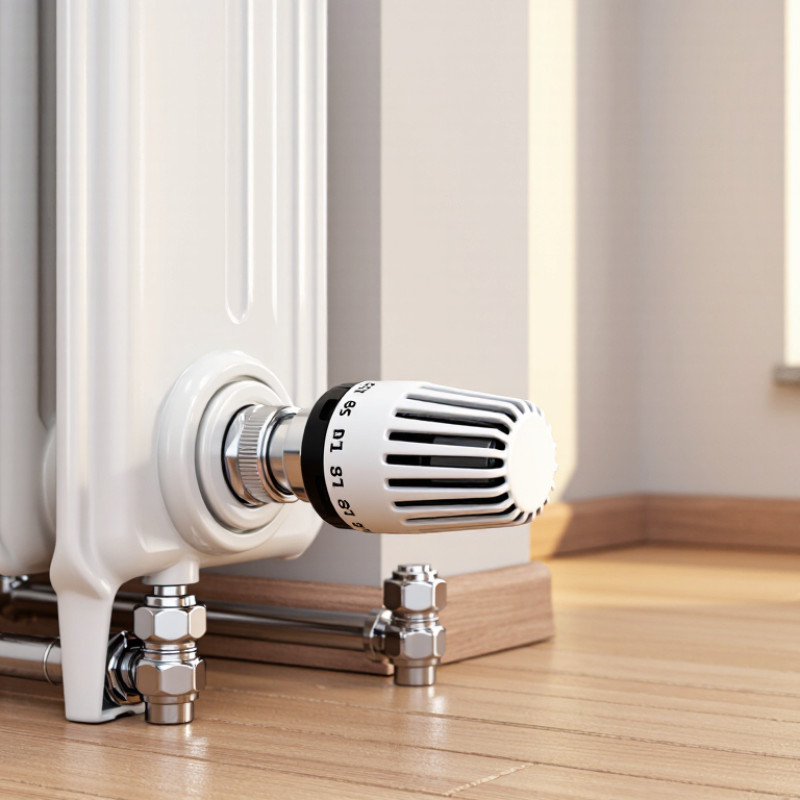
A thermostatic radiator valve, or TRV, is the adjustable control fitted to a radiator’s inlet. It usually has two parts: a valve body and a sensor head. Inside the head, wax or liquid expands as the nearby air warms. This pushes a pin into the valve and reduces hot-water flow. When the air cools, the sensor contracts and the valve opens again. No wiring is needed.
The dial responds to air around the radiator, not the whole home. A heavy curtain or sofa placed over the sensor can distort its reading. Small detail, big effect. The numbered scale is a guide, not a precise temperature display; settings vary by valve and room conditions.
In practical terms, a lower setting limits how warm that room becomes, while a higher setting allows more heat. Energy Saving Trust guidance estimates that heating accounts for roughly 55% of household energy bills in UK homes, which helps explain why room-by-room control matters.
A TRV does not create heat or control the boiler by itself. It only regulates flow through its radiator, and its response may feel slow in a cold room.
A TRV radiator valve has two main sections: the thermostatic head and the valve body. The head usually carries a numbered dial, which sets the room temperature you want. Inside it sits a temperature-sensitive element, often filled with liquid or wax. As room air warms, this element expands and presses a small pin inward. Small part, big effect.
The pin sits in the valve body, which connects to the radiator’s water inlet. When the pin moves inward, it reduces the opening and slows hot-water flow. As the room cools, the element contracts, allowing the pin to move back and more water to enter. The dial does not measure temperature like a digital thermometer; its numbers are settings, not exact readings. That distinction is easy to miss.
The head needs room air to sense changes. Heavy curtains, furniture, or a deep window ledge can trap warm air around it, causing the valve to close too soon. Some installations use a remote sensor when the head is difficult to position well. The connection nut secures the head to the valve body, but the two parts do different jobs: one senses and controls, while the other regulates water flow. The setup is simple, though placement can be less forgiving than it looks.
A thermostatic radiator valve (TRV) senses the air around its head, rather than measuring the radiator’s water temperature. Inside, a temperature-sensitive element—often filled with wax or liquid—expands as the surrounding air warms. This movement presses a small pin in the valve, reducing hot-water flow through the radiator. When the air cools, the element contracts and the pin allows more flow. The change is gradual, not instant.
Position matters. A TRV tucked behind thick curtains or crowded by furniture may sense trapped warm air and turn the radiator down too early. A cold draught can have the opposite effect. Most heads use numbered settings, not precise room-temperature readings, so the same number may feel different in different rooms. It takes time. The valve also responds with a delay, and that lag is easy to underestimate on a chilly morning.
Tips: Keep the valve head clear, and avoid covering it with fabric. Set it to a comfortable level, then wait several hours before adjusting again. If the room stays uneven, check for blocked airflow or a poorly placed valve; the dial alone may not explain the problem.
A thermostatic radiator valve (TRV) adjusts hot-water flow according to the temperature around its sensor. Inside the valve, a wax or liquid element expands as the room warms. It pushes a small pin, narrowing the valve opening and reducing heat from the radiator. When the room cools, the element contracts and allows more water through. The dial sets a target, not an exact temperature. Small movements matter.
Placement matters too. Heavy curtains or furniture can trap warm air around the sensor, making the valve close while the rest of the room stays chilly. A TRV also cannot directly control the boiler; it only regulates flow through its radiator. UK Department for Energy Security and Net Zero data identifies space heating as roughly three-fifths of domestic energy use, which makes room-by-room control relevant. But a valve alone does not guarantee savings: settings, insulation, and system balance all affect results. Even a careful setup may need adjustment after a cold evening.
A thermostatic radiator valve (TRV) senses the room air temperature and adjusts the flow of hot water through the radiator. As the room approaches the setpoint, the valve reduces its opening; when the room is warm enough, it may nearly close. This illustrative chart shows the general pattern, not a precise calibration: actual valve behavior varies by model, installation and heating system.

A thermostatic radiator valve (TRV) adjusts hot-water flow through a radiator as room temperature changes. Its sensor responds to nearby air, not the whole home. When the air warms, the valve reduces flow; when it cools, the valve opens again. Small details matter.
Placement can strongly affect readings. A TRV covered by a heavy curtain may sense trapped warmth and shut the radiator too early. Direct sunlight, a nearby lamp, or a cold draft can also distort its response. Keep the sensor exposed to room air where possible. A dial marked with numbers can imply more precision than the room actually offers.
Performance also depends on the heating system and the room itself. Poorly balanced radiators may heat unevenly, while a radiator that is too small may struggle on cold days. Furniture blocking the radiator can slow heat spreading through the space. In practice, give the valve time to respond; repeated adjustments can make the room feel less stable.
Not instantly.
Dust or a stiff valve pin may also hinder movement, so a valve that behaves oddly may need inspection rather than a lower setting.


For those larger-sized parts, or smaller quantity runs, we have 2 independent powder coat booths and ovens. The quality, durability and affordability of today’s powder coating finishes make this the process of choice for world-class companies.
Powder coating advantages over other forms of coating are many. Materials used in the Powder coating process can be metals and non-metals that come in a multitude of thicknesses, textures, colors, etc. Another of Powder coating’s biggest advantages over conventional coatings is its ability to create finishes in many different textures. Powder Coating Booths allow us the ability to apply these advantages to large products.
Tri-State Fabricators runs a full-service conveyor line for painting. Wet painting can provide protection or decoration to many different part styles. From start to finish, every project is easier to undergo random and point-based inspection by our skilled painting team.
Advantages to our Wet Paint Line are these lines start with product prep and ends with a thorough inspection of a high quality finished product. Our ability to complete large and small projects with a superior finish and doing so in a timely and economical fashion. This passes along the savings in production to our customers. When powder coating ins not an option, our Wet Paint Line gets the job done right the first time.
When the parts get big and heavy we roll-out our custom paint racks and oversize booth. By utilizing our partnerships with all the major paint brands, we can match virtually any color with wet paint.
The advantages of having access to a Wet Paint Booth are many. Large projects of many different shapes can be loaded into the booth. The Wet Paint Booth offers an environment that is much more controlled than a typical parts painting operation.
Not only are they used because of their controlled environment, but they’re are also advantageous when it comes to applying paint to parts that are needed in industries that require specialty coatings such as medical, aerospace, etc.
Our military forces have some very high standards when it comes to the finish of their vehicles and equipment. From the first pre-treatment step to final coat, it takes a great deal of knowledge and experience to protect the men and women of our armed forces. They deserve only the best, and Tri-State Fabricators provides it.
All of our processes are closely monitored by our staff and management teams. Both of which are highly trained in the processes of metal fabrication and finishing. Tri-State Fabricators’ goal is to always fully satisfy each and every customer, including the military. We will always put a 110% into what we do.
Abrasive media blasting is an excellent way to remove old paint, rust, and increase the paint/powder adhesion. Glass beads produce a much smoother and brighter finish than angular abrasives; leaving the part clean yet without any dimensional change. Chemically inert and environmentally friendly, we can recycle our beads approximately 30 times; making them a more preferred method of metal cleaning or surface finishing.
Advantages to Glass Bead Blasting are many. Glass bead blast media is used when a project is needing rough surfaces need to become smooth for applications of coatings such as paint. It is typically used to clean paint and rust from a product surface without deforming the surface it is being used on. Overall, compared to many other blasting media, Glass Bead Blasting is a very economical choice and those savings are always passed on to our customers.
Tri-State Fabricators utilize a zinc phosphate wash to clean and etch the material to ensure the best paint adhesion possible. The unique design of our 3-stage wash system does the work like a 5-stage. From Cleaning and rinsing to conversion coating and post-treatment, Our Part Washing process is a complete service and works throughout the fabrication service and the finishing service.
Along with the previously mentioned benefits, Curing is a vital chemical reaction that leaves the product finish hard and relatively safe from mild abrasion and aggressive corrosion. This process can be done in more than one way; ambient air-dry or in curing ovens at temps that exceed 240°.
From fixing paint mistakes (someone else’s of course) to simply cleaning our paint line hooks, our burn-off oven is put to good use. After a quick burn-off, a little clean up, and a fresh coat of paint, your parts will look better than new.
Why does our Burn-Off Oven work so well? Because super heating the air around parts turns the materials into ashes. From paint and powder coatings to rubber and machining oils, high temps do the job without degrading the integrity of the part.
Masking is a vital part of producing high quality products. We have die-cut masking patterns to protect machined surfaces as well as a wide range of plugs and caps to protect threaded holes and bolts. We provide permanent and temporary masking.
Masking allows the selected sections of a product to be protected from a fabrication or finishing service. This can be with both chemicals when etching and tapes, paints when only finishing just a section of the product. Masking is great in aiding the customization process of a project.
Screen printing is a photographic process that transfers artwork onto a porous nylon screen which allows colored ink to flow through the screen and be deposited on an aluminum or plastic component. We can generally have just about any design created onto a screen for your parts.
Some of the advantages of Screen Printing are, brand recognition for your business displaying on your products, assembly instructions, product warnings/hazards, etc. Tri-State Fabricators produces Screen Printing of the highest quality so you know it’s durable.
Metal Finishing is the art of treating the exterior portion of product, often metal but can also be made of other materials, so that the surface is clean and free of any debris. Then the process of applying coats or either paint of powder coat takes place. This coating process improves the quality of the product in both appearance and resistance to wear and corrosion.
Tri-State Fabricators, Inc., understands that a project typically isn’t complete until a high-quality finish has been added to your product. This is why our painting and powder coating teams continuously inspect the products throughout the Metal Finishing process.




