


7 Trolley Rail Buying Tips for Global Buyers

Trolley Rail selection can look simple on a product page, but small differences affect fit, movement, and maintenance. A rail must work with the trolley wheels, carried load, travel distance, and supporting structure. A mismatch may cause noise, uneven wear, or difficult installation.

Details matter. Buyers should confirm rail dimensions, material, surface finish, joint design, fasteners, and allowable load with the supplier. Ask for drawings and technical data, not just a brief catalog description. Where possible, compare the rail profile with the actual wheel and mounting arrangement. A clear drawing can prevent costly guesswork.

Conditions vary. Dust, moisture, temperature changes, and frequent starts can influence performance. Buyers serving different markets should also check which technical standards and documentation apply to their project. Requirements can differ by application and destination, so assumptions are risky. Even a careful checklist has limits.

This guide outlines seven practical buying considerations for global buyers, from matching the rail to its operating environment to reviewing supplier support and delivery details. It is not a substitute for engineering review when loads or layouts are complex. A sturdy-looking rail is not automatically the right one. Careful questions, verified measurements, and realistic operating details make a more dependable purchase—and sometimes reveal that the first choice needs reconsideration.
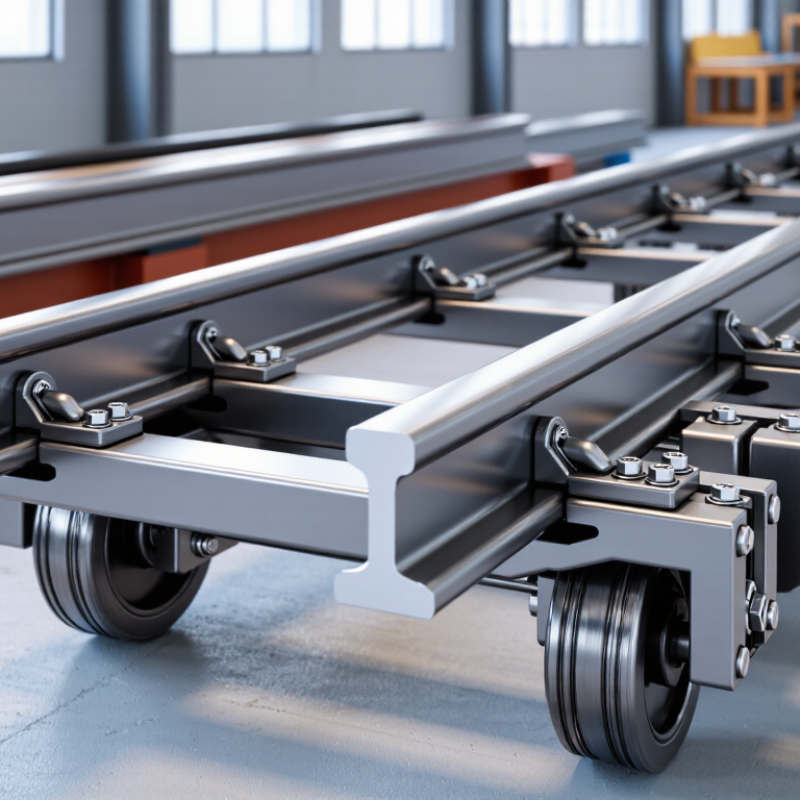
7 Trolley Rail Buying Tips for Global Buyers

Understanding Trolley Rails and Their Role in Material Handling

A trolley rail is the guided path that carries a moving load through a workshop, warehouse, or production line. It may be installed overhead or at floor level, depending on the trolley design and available space. The rail does more than keep travel on course. Its profile, joints, supports, and alignment affect rolling resistance, vibration, and how loads reach the building structure. Small details matter. A poorly aligned joint can make a loaded trolley jerk, while inadequate support spacing can cause deflection.

Choosing a rail starts with the real operating conditions: maximum load, travel distance, curves, duty cycle, and exposure to dust or moisture. Check the rail and trolley as a system, not as separate parts. A track that looks straight may still bind under load; appearance alone is not verification. Allow for inspection access, too. It is easy to overlook how difficult a hidden joint can be to examine later.

Industry reports show why material handling deserves careful planning, though they do not prove that one rail design suits every site. MHI’s 2024 Annual Industry Report found that 55% of surveyed respondents planned to spend more than $1 million on supply-chain technology over the following two years. Grand View Research estimated the global material-handling equipment market at $212.3 billion in 2023. Those figures describe a broad sector, not trolley rails specifically. For buyers, the practical takeaway is to request load ratings, installation tolerances, and maintenance guidance—and to verify that each matches the intended application.


Trolley Rail Buying Tip: Compare Material Density

Typical material density affects the rail system’s own weight and handling requirements. These are approximate values; actual density varies by alloy. Choose rails based on load capacity, profile, support spacing, environment, and installation requirements—not density alone.

Defining Load Capacity, Operating Conditions, and Rail Layout

Before choosing trolley rail, define the heaviest moving load—not just the payload. Include the hoist, trolley, lifting attachments, and any load that swings during starts or stops. Rate the complete path by its weakest rail, joint, hanger, or supporting structure. Fit matters. A clean capacity figure can still mislead if it ignores repeated duty cycles or uneven loading.

Operating conditions change the specification. Record temperature, dust, moisture, washdown, and daily travel frequency; a coating suitable for a dry warehouse may fail near corrosive cleaning chemicals. ASME B30.17 covers safety requirements for overhead and gantry cranes and monorails, making it a useful reference when reviewing equipment and operation. MHI’s 2024 Annual Industry Report found that 55% of surveyed supply-chain leaders planned to increase technology investment. That figure is not a rail-design value, but it highlights why accurate load and route data matter as facilities add automation.

Map straight runs, curves, switches, transfer points, and maintenance access before fixing the layout. Check turning radius and clearance against the actual trolley and suspended load, especially at doorways and workstations. Leave room. One easy detail to miss is where a long load sweeps around a bend; the drawing may look clear while the load clips nearby equipment. Verify rail reactions and support spacing with a qualified engineer, using site measurements rather than assumptions.

7 Trolley Rail Buying Tips for Global Buyers - Defining Load Capacity, Operating Conditions, and Rail Layout

Use these checks to prepare a rail specification and request comparable supplier quotations.
No. Buying Tip What to Define Practical Data or Check Why It Matters
1 Specify the complete load State the maximum payload, trolley weight, lifting attachment weight, and number of trolleys sharing the load. Example: a 1,000 kg payload plus a 150 kg trolley and attachment creates 1,150 kg of static suspended mass before any applicable dynamic or design allowances. Rail, hangers, joints, and supporting structure must be checked for the actual load case—not payload alone.
2 Confirm the load rating basis Request the rated capacity per trolley and per rail section, plus the assumptions used for load sharing, wheel loading, and duty. Compare the stated rating with the intended load arrangement. Have qualified engineers verify dynamic effects, impact, eccentric loading, and the supporting structure. Capacity figures are not directly comparable when suppliers use different configurations or design assumptions.
3 Describe operating conditions Identify indoor or outdoor use, ambient temperature, moisture, dust, washdown, corrosive exposure, and nearby heat sources. Specify the site’s expected temperature range and exposure conditions. Confirm that rail material, finish, wheels, bearings, and lubricant suit those conditions. Environmental conditions can affect corrosion protection, rolling resistance, lubrication, and component service life.
4 Map the rail layout Provide route length, straight sections, curves, junctions, end stops, transfer points, and any elevation changes. Mark the centerline and dimensions on a plan. For curves, confirm the minimum permitted radius against the selected trolley geometry and load. Curve compatibility and transitions affect trolley movement, wheel loading, clearance, and the ability to negotiate the route.
5 Check clearances and obstructions Measure available headroom and identify columns, pipes, lights, doors, machinery, and pedestrian or vehicle routes. Show the rail elevation, trolley envelope, suspended-load envelope, and required access or maintenance clearances on the layout drawing. Clearance checks help prevent collisions and ensure the load can travel and be serviced safely.
6 Define supports and joints Record the supporting structure, proposed hanger locations, rail joints, and any structural constraints. Have support spacing and connection details engineered for the selected rail, load cases, and building structure. Check joint alignment and provision for movement where required by the design. Rail capacity depends on the complete installed system, including supports and connections—not just the rail section.
7 Match the system to its duty and maintenance plan Describe travel frequency, operating hours, manual or powered movement, expected starts and stops, and inspection access. Request the applicable duty classification or service assumptions, compatible components, inspection guidance, and spare-part requirements. Usage intensity and maintainability affect wear, availability, and the suitability of the selected trolley and rail system.

Design note: Capacities, support spacing, curve limits, and safety factors are system-specific. Confirm final selections against applicable local regulations, engineering calculations, and the installation instructions for the chosen equipment.

Selecting Rail Profiles, Materials, and Surface Treatments

A suitable trolley rail profile depends on wheel shape, load, and travel direction. Flat rails suit flanged wheels poorly, while rounded or grooved profiles can guide matching wheels more consistently. Measure the wheel tread and flange before choosing. A mismatch may cause noise, uneven wear, or derailment under side loads. Small details matter. Check the rail’s straightness, joint design, and support spacing against the trolley’s actual operating conditions.

Carbon steel offers strength and is often practical for heavy loads in dry indoor spaces. Stainless steel can resist corrosion in damp or frequently washed areas, but its grade should suit the exposure. Aluminum weighs less and can simplify installation, though it may not handle concentrated loads as well. Match material to load, moisture, cleaning routine, and maintenance access. More strength costs weight. That trade-off is easy to underestimate when rails span long distances.

Surface treatment affects both service life and wheel contact. Paint can protect exposed steel, but thick coatings on the running surface may wear quickly or alter clearance. Galvanizing helps protect against corrosion, yet coating thickness and profile fit need review before installation. Hard coatings may improve wear resistance in specific applications, but they are not automatically the best choice. Ask for coating details and dimensional tolerances. Inspect sample sections under the intended lighting; scratches and uneven finishes can be hard to spot in a crowded workshop. Worth checking.

Checking Dimensions, Standards, and System Compatibility

7 Trolley Rail Buying Tips for Global Buyers

Checking Dimensions, Standards, and System Compatibility

A trolley rail can look standard on paper and still fail to fit on site. Check the rail gauge, profile, overall length, and support spacing against measured installation drawings. Measure twice. Include curves, switches, end stops, and clearance around beams; these details are easy to miss in a clean, straight-line plan. It is tempting to trust catalog dimensions, but small differences in wheel profile or flange width can cause binding and uneven wear.

Confirm the system’s rated load, including the trolley, suspended equipment, and any moving load. Ask how the rating is calculated and whether it applies to straight sections, curves, or the complete assembly. Standards and terminology differ across markets, so request the specific standard, test documentation, and operating limits rather than relying on a general “compliant” claim. Check that the building supports and fasteners suit the expected forces, too.

Compatibility goes beyond matching rail dimensions. Verify that trolley wheels, connectors, hangers, and track sections are designed to work together. Confirm materials and finishes suit the environment, especially where dust, moisture, or temperature changes are common. A drawing may not show every site condition. Compare supplier drawings with physical measurements, and flag any mismatch before ordering; a little uncertainty is better addressed early than after installation.

Evaluating Suppliers, Quality Controls, and International Delivery

A trolley rail purchase starts with a supplier’s ability to understand the actual installation. Share rail drawings, trolley dimensions, load requirements, and operating conditions before comparing quotations. Ask how the supplier checks dimensions and material batches, and whether inspection records can be provided. Clear answers matter. Small gaps in alignment can cause uneven movement or premature wear.

Quality controls should be specific, not just promised. Request material certificates where relevant, dimensional inspection results, and details of any load or surface tests. Agree on acceptance limits before production, then inspect a sample or arrange a pre-shipment check. Test it first. A polished catalogue is not proof of consistent manufacturing; I would not rely on one alone. Even a capable supplier can misunderstand a drawing, so confirm critical measurements in writing.

International delivery needs the same attention as production. Confirm packing protects rail ends and finished surfaces from impact and moisture, especially during long transfers. Check the shipment dimensions, delivery terms, transport schedule, and documents your receiving team needs. Ask who handles damage claims and what evidence to collect on arrival. A low freight quote can hide extra handling costs. I have to admit, delivery estimates are rarely exact, so leave room for delays and avoid scheduling installation too tightly.

Powder Coat Booths

For those larger-sized parts, or smaller quantity runs, we have 2 independent powder coat booths and ovens. The quality, durability and affordability of today’s powder coating finishes make this the process of choice for world-class companies.

Powder coating advantages over other forms of coating are many. Materials used in the Powder coating process can be metals and non-metals that come in a multitude of thicknesses, textures, colors, etc. Another of Powder coating’s biggest advantages over conventional coatings is its ability to create finishes in many different textures. Powder Coating Booths allow us the ability to apply these advantages to large products.

Wet Paint Line

Tri-State Fabricators runs a full-service conveyor line for painting. Wet painting can provide protection or decoration to many different part styles. From start to finish, every project is easier to undergo random and point-based inspection by our skilled painting team.

Advantages to our Wet Paint Line are these lines start with product prep and ends with a thorough inspection of a high quality finished product. Our ability to complete large and small projects with a superior finish and doing so in a timely and economical fashion. This passes along the savings in production to our customers. When powder coating ins not an option, our Wet Paint Line gets the job done right the first time.

Wet Paint Booths

When the parts get big and heavy we roll-out our custom paint racks and oversize booth. By utilizing our partnerships with all the major paint brands, we can match virtually any color with wet paint.

The advantages of having access to a Wet Paint Booth are many. Large projects of many different shapes can be loaded into the booth. The Wet Paint Booth offers an environment that is much more controlled than a typical parts painting operation.

Not only are they used because of their controlled environment, but they’re are also advantageous when it comes to applying paint to parts that are needed in industries that require specialty coatings such as medical, aerospace, etc.

Military CARC

Our military forces have some very high standards when it comes to the finish of their vehicles and equipment. From the first pre-treatment step to final coat, it takes a great deal of knowledge and experience to protect the men and women of our armed forces. They deserve only the best, and Tri-State Fabricators provides it.

All of our processes are closely monitored by our staff and management teams. Both of which are highly trained in the processes of metal fabrication and finishing. Tri-State Fabricators’ goal is to always fully satisfy each and every customer, including the military. We will always put a 110% into what we do.

Glass-Bead Blasting

Abrasive media blasting is an excellent way to remove old paint, rust, and increase the paint/powder adhesion. Glass beads produce a much smoother and brighter finish than angular abrasives; leaving the part clean yet without any dimensional change. Chemically inert and environmentally friendly, we can recycle our beads approximately 30 times; making them a more preferred method of metal cleaning or surface finishing.

Advantages to Glass Bead Blasting are many. Glass bead blast media is used when a project is needing rough surfaces need to become smooth for applications of coatings such as paint. It is typically used to clean paint and rust from a product surface without deforming the surface it is being used on. Overall, compared to many other blasting media, Glass Bead Blasting is a very economical choice and those savings are always passed on to our customers.

Part Washing

Tri-State Fabricators utilize a zinc phosphate wash to clean and etch the material to ensure the best paint adhesion possible. The unique design of our 3-stage wash system does the work like a 5-stage. From Cleaning and rinsing to conversion coating and post-treatment, Our Part Washing process is a complete service and works throughout the fabrication service and the finishing service.

Along with the previously mentioned benefits, Curing is a vital chemical reaction that leaves the product finish hard and relatively safe from mild abrasion and aggressive corrosion. This process can be done in more than one way; ambient air-dry or in curing ovens at temps that exceed 240°.

Burn-Off Oven

From fixing paint mistakes (someone else’s of course) to simply cleaning our paint line hooks, our burn-off oven is put to good use. After a quick burn-off, a little clean up, and a fresh coat of paint, your parts will look better than new.

Why does our Burn-Off Oven work so well? Because super heating the air around parts turns the materials into ashes. From paint and powder coatings to rubber and machining oils, high temps do the job without degrading the integrity of the part.

Masking

Masking is a vital part of producing high quality products. We have die-cut masking patterns to protect machined surfaces as well as a wide range of plugs and caps to protect threaded holes and bolts. We provide permanent and temporary masking.

Masking allows the selected sections of a product to be protected from a fabrication or finishing service. This can be with both chemicals when etching and tapes, paints when only finishing just a section of the product. Masking is great in aiding the customization process of a project.

Screen Printing

Screen printing is a photographic process that transfers artwork onto a porous nylon screen which allows colored ink to flow through the screen and be deposited on an aluminum or plastic component. We can generally have just about any design created onto a screen for your parts.

Some of the advantages of Screen Printing are, brand recognition for your business displaying on your products, assembly instructions, product warnings/hazards, etc. Tri-State Fabricators produces Screen Printing of the highest quality so you know it’s durable.

Metal Finishing

Metal Finishing is the art of treating the exterior portion of product, often metal but can also be made of other materials, so that the surface is clean and free of any debris. Then the process of applying coats or either paint of powder coat takes place. This coating process improves the quality of the product in both appearance and resistance to wear and corrosion.

Tri-State Fabricators, Inc., understands that a project typically isn’t complete until a high-quality finish has been added to your product. This is why our painting and powder coating teams continuously inspect the products throughout the Metal Finishing process.
