


Choosing a supplier for PET Tape For Journals is not just a price comparison. The right tape should unwind smoothly, hold decorative layers in place, and resist curling during everyday handling. A clear finish can protect delicate paper details, while a consistent adhesive helps reduce lifting at the corners. Small differences matter. A roll that feels neat on a sample may behave differently across a full production run.
This guide compares worldwide suppliers through practical criteria: adhesive consistency, film clarity, roll dimensions, customization options, quality controls, and communication during sampling. It also considers details buyers can test themselves, such as whether tape cuts cleanly with scissors or leaves residue on a paper swatch. “Judge the tape on the page, not just on the product sheet,” says Alex Morgan, a fictional composite sourcing specialist created for this introduction; the quotation is editorial, not a verified interview. That distinction matters. Supplier claims should be checked against current samples and written specifications.
Some trade-offs remain. Stronger adhesion may suit heavier embellishments, but can damage thin journal paper during repositioning. A lower-cost roll may be adequate for simple layouts, yet inconsistent winding can waste time at a busy workstation. There is no perfect tape for every journal style. The supplier shortlist that follows offers a starting point, not a substitute for testing. Request samples, compare them under the same conditions, and record what happens after application. That modest extra step can prevent a disappointing bulk order.
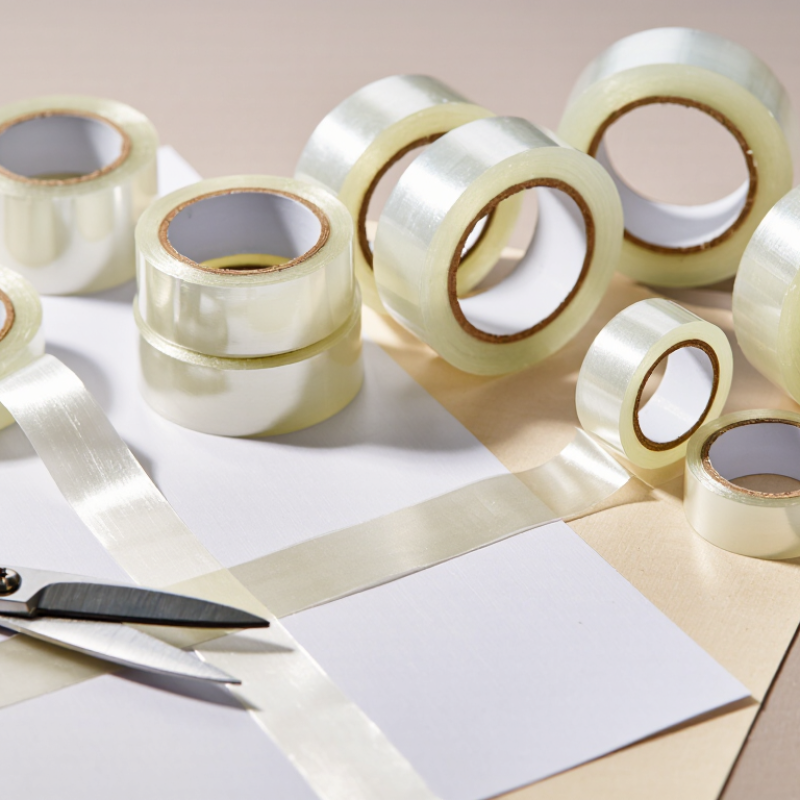
PET tape is a thin polyester-film tape with a pressure-sensitive adhesive. Its clear, smooth carrier helps journal makers attach pockets, reinforce page folds, or add crisp decorative strips without hiding the paper beneath. It resists stretching better than many soft films, so narrow lines stay neater during application. The feel matters, too. A glossy strip can look out of place on textured paper.
Grand View Research estimated the global adhesive-tape market at USD 75.3 billion in 2023, with projected annual growth of 5.4% from 2024 to 2030. That figure covers many tape types, not journal tape alone, but it shows the scale of the wider materials market.
For journal production, suppliers should provide consistent roll width, carrier thickness, adhesive details, and peel-adhesion test results. ASTM D3330/D3330M describes methods for measuring peel adhesion of pressure-sensitive tape. Ask for samples on the actual paper stock; coatings and paper fibers can change how tape grips.
A strong bond is not always better. It may tear a page during removal. I would test both fresh and aged samples, because a quick desk test can miss adhesive changes over time. Small detail. It matters.

Quality PET journal tape should feel smooth under a fingertip, unwind evenly, and cut without ragged edges. Its polyester backing needs consistent thickness; uneven film can wrinkle across a page or show trapped air. Adhesion matters just as much. A well-balanced adhesive should hold down a paper tab yet release without lifting fibers. Test samples on several paper finishes, not just glossy stock.
Grand View Research valued the global adhesive tapes market at USD 75.2 billion in 2023 and projected 5.2% annual growth from 2024 to 2030. That broad market figure does not guarantee journal-grade performance. Ask suppliers for documented peel and shear results, using methods such as ASTM D3330 and ASTM D3654.
Check whether the adhesive yellows or transfers after aging, and whether the release liner peels cleanly. Small details matter. A slightly imperfect edge can catch on a notebook cover; it is worth checking samples by hand. For archival-style projects, request paper compatibility information rather than relying on “acid-free” wording alone.
Assessing PET tape suppliers worldwide starts with the roll, not the sales pitch. Ask for film thickness, adhesive type, release force, and storage-life data. For journal use, test whether tape unwinds cleanly, lies flat on paper, and resists edge lift after repeated page handling. A glossy sample can look convincing; a week in a warm, closed notebook may tell a different story.
Compare suppliers using the same test conditions. ASTM D3330 measures peel adhesion, while ASTM D3654 evaluates shear adhesion; request results and test details, not just “high tack” claims. Check whether each batch has a certificate of analysis and traceable lot number. Grand View Research estimated the global adhesive tapes market at USD 75.3 billion in 2023, with projected growth through 2030. That broad market figure signals scale, but it does not prove that a supplier’s PET tape suits journals. Ask for samples from more than one production lot.
Supplier assessment also means checking communication and delivery reliability. Request lead times, minimum order quantities, packaging details, and clear procedures for reporting defects. If possible, trial the tape on coated and uncoated paper, then inspect it after several days for residue, curling, or adhesive transfer. Small test strips matter. Some results will still be subjective, especially when users prefer different levels of tack. Record those judgments rather than pretending every decision is perfectly measurable.
Use this buyer-side scorecard to compare suppliers consistently. The checks below are practical evaluation criteria, not claims about any particular supplier or universal product specifications. Set final limits to suit the journal design, application, and destination market.
| Assessment Area | What to Compare | Evidence to Request or Test | Practical Evaluation Guide |
|---|---|---|---|
| Product fit | Clear, colored, printed, or patterned PET tape; roll width and length; core size; total thickness; backing-film and adhesive details. | Product specification sheet, dimension drawing, and samples made to the proposed construction. | Confirm every dimension and material matches the journal artwork, dispenser, and packaging requirements. Do not compare thickness figures unless suppliers define what is included. |
| Adhesion | Initial tack, peel adhesion, and holding power on the intended paper, coated paper, and other target surfaces. | Test results with the test surface, application pressure, dwell time, peel angle, and test speed stated. ASTM D3330/D3330M is a recognized method for peel adhesion of pressure-sensitive tape. | Judge performance on the actual journal materials. Agree on an application-specific pass range before ordering; a single peel value does not establish suitability for every paper surface. |
| Residue and removability | Whether tape lifts cleanly, leaves adhesive residue, stains paper, or damages printed surfaces after the intended use period. | Application trials on representative paper stocks, including the planned dwell time and removal method; retain dated samples or photographs. | Use the real page stock and ink or coating. Record results after both short and longer dwell periods when users may leave tape in place. |
| Film strength | Backing-film thickness, tensile behavior, elongation, tear resistance, and ease of cutting or hand tearing, as relevant to the product. | Film or tape technical data and test method. ASTM D882 is commonly used for tensile properties of thin plastic sheeting. | Check that samples unwind and cut cleanly without unwanted stretching, splitting, or edge distortion. Compare results only when specimens and methods are comparable. |
| Appearance and print | Color consistency, transparency, print registration, surface finish, pattern alignment, and visible defects. | Pre-production proof, approved color reference, sample roll, and written inspection criteria for the finished tape. | Approve a signed or otherwise controlled reference sample. Check multiple rolls and positions across a roll, not just a single short sample. |
| Unwinding and roll quality | Unwind force, telescoping, blocking, wrinkles, edge quality, roll tightness, and consistency of winding. | Production samples and a documented roll-inspection checklist; test rolls with the intended dispenser if one will be used. | Run a practical dispensing trial. Define acceptable roll defects and packaging protection before approving mass production. |
| Quality management | Documented production controls, traceability, inspection records, change management, and handling of nonconforming product. | Current quality-system documentation, sample inspection report, lot identification example, and corrective-action process. | Verify certificate scope and validity where certification is claimed. A quality certificate supports supplier review but does not replace product testing. |
| Chemical compliance | Compliance requirements for the intended sales markets and the specific tape construction, including film, inks, and adhesive. | Material declarations and relevant test reports tied to the product or material grade. Check applicable requirements such as REACH or RoHS only where relevant to the product and market. | Confirm the report covers the supplied construction and current requirements. Avoid relying on a generic declaration that does not identify its scope. |
| Capacity and delivery | Sample lead time, production lead time, minimum order quantity, monthly capacity, shipping terms, and peak-season planning. | Written quotation with order assumptions, production schedule, capacity statement, and proposed shipment terms. | Compare like-for-like order quantities and delivery terms. Confirm lead times in writing and ask how delays or changes are communicated. |
| Cost and total value | Unit price, tooling or setup charges, printing costs, packaging, freight, duties, and costs of inspection or rejected goods. | Itemized quotation with currency, validity period, price breaks, packaging details, and payment terms. | Compare total landed cost and specification compliance rather than unit price alone. Confirm whether quoted prices include custom printing or other one-time charges. |
| Communication and service | Response clarity, technical support, sample handling, complaint response, and ability to manage specification changes. | Written answers to a standard request for quotation, sample records, and an agreed process for claims and corrective actions. | Score suppliers consistently on response completeness, accuracy, and follow-through—not simply on response speed. |
| Suggested scoring | Apply the same weighted score to every candidate after document review and sample testing. | Score each area from 1 to 5: 1 = does not meet needs; 3 = meets core needs with open issues; 5 = fully verified against agreed requirements. | Set category weights before reviewing quotations. Treat unresolved safety, compliance, or critical performance issues as approval blockers, regardless of total score. |
Journal makers often source PET tape from manufacturing hubs in East Asia, while suppliers in Europe and North America may offer local converting, warehousing, or smaller order support. These are broad patterns, not guarantees; verify each supplier’s production location and shipping arrangements. Product ranges can include clear, matte, and holographic films, printed designs, foil details, and different widths for page borders or small accents. Check the tape’s film thickness, adhesive type, roll length, and core size. Small details matter.
Customization can cover artwork, repeat length, color matching, slit width, packaging, and private-label cartons. Send a simple design file and ask for a physical proof before approving a large run. On a sample roll, test adhesion on coated paper and textured journal pages; also check whether ink or foil scratches during handling. Ask for a specification sheet, sample lead time, minimum order quantity, and defect policy in writing. A low unit price may hide setup fees or excess packaging. And samples can mislead. A short roll may unwind smoothly, while a production batch behaves differently, so request a batch sample when timing allows. Color matching is not exact, either. Agree on acceptable variation before production.
Ordering PET tape for journals starts with a clear specification. State the roll width, length, thickness, color, finish, and core size. Ask for quoted minimum quantities, production lead times, and packaging details before approving an order. A small trial order can reveal problems that a polished sample may hide. Small tests matter.
Check tape on the paper and cover materials you actually use. Apply it to clean surfaces, then inspect adhesion, edge lift, color consistency, and removal after several days. Test the roll in your dispenser, too; smooth unwinding matters during assembly. Keep the record. Note batch numbers, test dates, and room conditions, since humidity can affect results. No sample is perfect. One test may miss a defect, so repeat checks across several rolls when possible.
For long-term supplier selection, look beyond the lowest unit price. Compare response times, specification control, delivery consistency, and how clearly problems are handled. Request updated samples when materials or production settings change. Ask how the supplier traces batches and reports corrective actions. A helpful contact is valuable, but written specifications reduce misunderstandings when staff change. Even careful checks cannot prevent every variation; plan a reasonable tolerance and discuss it before larger orders.
Suggested scorecard weights for comparing PET tape suppliers: assess product conformity and adhesive performance alongside batch consistency, delivery reliability, and documentation. These percentages are an illustrative buyer-planning template, not published market averages.


For those larger-sized parts, or smaller quantity runs, we have 2 independent powder coat booths and ovens. The quality, durability and affordability of today’s powder coating finishes make this the process of choice for world-class companies.
Powder coating advantages over other forms of coating are many. Materials used in the Powder coating process can be metals and non-metals that come in a multitude of thicknesses, textures, colors, etc. Another of Powder coating’s biggest advantages over conventional coatings is its ability to create finishes in many different textures. Powder Coating Booths allow us the ability to apply these advantages to large products.
Tri-State Fabricators runs a full-service conveyor line for painting. Wet painting can provide protection or decoration to many different part styles. From start to finish, every project is easier to undergo random and point-based inspection by our skilled painting team.
Advantages to our Wet Paint Line are these lines start with product prep and ends with a thorough inspection of a high quality finished product. Our ability to complete large and small projects with a superior finish and doing so in a timely and economical fashion. This passes along the savings in production to our customers. When powder coating ins not an option, our Wet Paint Line gets the job done right the first time.
When the parts get big and heavy we roll-out our custom paint racks and oversize booth. By utilizing our partnerships with all the major paint brands, we can match virtually any color with wet paint.
The advantages of having access to a Wet Paint Booth are many. Large projects of many different shapes can be loaded into the booth. The Wet Paint Booth offers an environment that is much more controlled than a typical parts painting operation.
Not only are they used because of their controlled environment, but they’re are also advantageous when it comes to applying paint to parts that are needed in industries that require specialty coatings such as medical, aerospace, etc.
Our military forces have some very high standards when it comes to the finish of their vehicles and equipment. From the first pre-treatment step to final coat, it takes a great deal of knowledge and experience to protect the men and women of our armed forces. They deserve only the best, and Tri-State Fabricators provides it.
All of our processes are closely monitored by our staff and management teams. Both of which are highly trained in the processes of metal fabrication and finishing. Tri-State Fabricators’ goal is to always fully satisfy each and every customer, including the military. We will always put a 110% into what we do.
Abrasive media blasting is an excellent way to remove old paint, rust, and increase the paint/powder adhesion. Glass beads produce a much smoother and brighter finish than angular abrasives; leaving the part clean yet without any dimensional change. Chemically inert and environmentally friendly, we can recycle our beads approximately 30 times; making them a more preferred method of metal cleaning or surface finishing.
Advantages to Glass Bead Blasting are many. Glass bead blast media is used when a project is needing rough surfaces need to become smooth for applications of coatings such as paint. It is typically used to clean paint and rust from a product surface without deforming the surface it is being used on. Overall, compared to many other blasting media, Glass Bead Blasting is a very economical choice and those savings are always passed on to our customers.
Tri-State Fabricators utilize a zinc phosphate wash to clean and etch the material to ensure the best paint adhesion possible. The unique design of our 3-stage wash system does the work like a 5-stage. From Cleaning and rinsing to conversion coating and post-treatment, Our Part Washing process is a complete service and works throughout the fabrication service and the finishing service.
Along with the previously mentioned benefits, Curing is a vital chemical reaction that leaves the product finish hard and relatively safe from mild abrasion and aggressive corrosion. This process can be done in more than one way; ambient air-dry or in curing ovens at temps that exceed 240°.
From fixing paint mistakes (someone else’s of course) to simply cleaning our paint line hooks, our burn-off oven is put to good use. After a quick burn-off, a little clean up, and a fresh coat of paint, your parts will look better than new.
Why does our Burn-Off Oven work so well? Because super heating the air around parts turns the materials into ashes. From paint and powder coatings to rubber and machining oils, high temps do the job without degrading the integrity of the part.
Masking is a vital part of producing high quality products. We have die-cut masking patterns to protect machined surfaces as well as a wide range of plugs and caps to protect threaded holes and bolts. We provide permanent and temporary masking.
Masking allows the selected sections of a product to be protected from a fabrication or finishing service. This can be with both chemicals when etching and tapes, paints when only finishing just a section of the product. Masking is great in aiding the customization process of a project.
Screen printing is a photographic process that transfers artwork onto a porous nylon screen which allows colored ink to flow through the screen and be deposited on an aluminum or plastic component. We can generally have just about any design created onto a screen for your parts.
Some of the advantages of Screen Printing are, brand recognition for your business displaying on your products, assembly instructions, product warnings/hazards, etc. Tri-State Fabricators produces Screen Printing of the highest quality so you know it’s durable.
Metal Finishing is the art of treating the exterior portion of product, often metal but can also be made of other materials, so that the surface is clean and free of any debris. Then the process of applying coats or either paint of powder coat takes place. This coating process improves the quality of the product in both appearance and resistance to wear and corrosion.
Tri-State Fabricators, Inc., understands that a project typically isn’t complete until a high-quality finish has been added to your product. This is why our painting and powder coating teams continuously inspect the products throughout the Metal Finishing process.

