


Choosing the right Ventless Electric Fireplace requires more than comparing flame colors and retail prices. Global buyers must examine heating output, voltage compatibility, plug design, certifications, room size, controls, and warranty support. A realistic comparison also asks whether the unit provides useful warmth or mainly creates visual comfort beside a sofa.
Lorraine Carli, a fire-safety communications expert associated with the National Fire Protection Association, emphasizes, “Space heaters should be plugged directly into a wall outlet.” That advice matters here. A Ventless Electric Fireplace produces no combustion gases, but it still contains heating elements, wiring, and electronic controls. Keep curtains, paper, rugs, and furniture away from hot surfaces. Confirm the manufacturer’s clearance guidance. Never assume every model suits every country.
This guide reviews ten leading options for international customers. Each selection is considered through practical details: heat performance, flame realism, installation flexibility, energy use, control systems, and service reliability. Some models look impressive in photographs but feel underpowered in larger rooms. Others offer strong heating but lack convincing visual depth. That trade-off deserves attention.
“Ventless” can also sound safer than it really means. It describes the absence of a chimney or combustion vent, not freedom from installation responsibilities. Buyers should check local electrical requirements and product documentation before ordering. A perfect fireplace does not exist. The best choice depends on climate, room design, budget, and personal expectations. Small details matter.
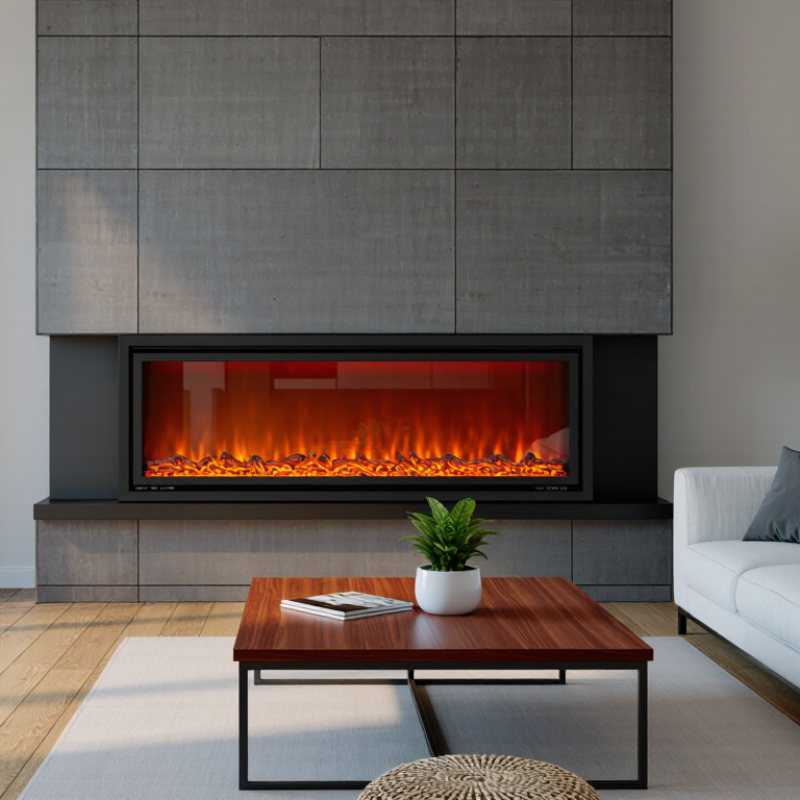
Ventless electric fireplaces create flame-like visuals without burning wood, gas, or other fuel. They need no chimney, flue, or permanent exhaust opening. Most models combine LED flame effects with an electric heating element, thermostat, and remote control. This design suits apartments, hotels, and renovated rooms where structural changes are difficult. However, “ventless” does not mean installation-free. Heat still requires safe clearance, suitable wiring, and adequate airflow around the unit.
Design choices affect both appearance and daily comfort. Wall-mounted models save floor space, while recessed units provide a cleaner architectural finish. Freestanding versions are easier to relocate. Logs, crystals, ember beds, adjustable flame colors, and dimming controls create different visual moods. A realistic display can look impressive in a dim room, but it may appear less natural in bright daylight. That small detail is easy to overlook. Heating performance also depends on room size, insulation, and local voltage standards.
Tips: Check voltage, frequency, plug type, certification, and installation instructions before ordering internationally. Confirm the recommended room area rather than trusting maximum heating claims. Keep curtains, furniture, and paper products away from hot surfaces. Test the thermostat and flame settings after installation. If hardwiring is required, use a qualified local electrician. A model may look perfect online, yet its noise level, glass reflection, or control layout may disappoint in person. Careful product inspection remains worthwhile.

Top 10 Ventless Electric Fireplaces for Global Buyers
Ventless electric fireplaces work without a chimney because they burn nothing. An electric heating element warms the room, while LED lights create the appearance of flames. A quiet fan may distribute warm air through a front grille. There is no smoke, ash, carbon monoxide, or gas connection. Many models also offer flame effects without heat, which suits bedrooms or mild climates. The unit usually needs a properly grounded electrical outlet, not a flue or fuel pipe.
In practical use, check the room size before choosing a heating rating. A small lounge may warm quickly, but an open-plan space can feel uneven. Keep curtains, furniture, and rugs away from the air outlet. A thermostat can reduce wasted electricity, although it may not maintain equal comfort across a large room. “Ventless” can sound completely risk-free, but that wording needs reflection. Electrical heat still draws significant power, and poor wiring can create danger. Follow the installation guide and local electrical requirements.
Tips: Measure the wall and outlet location first. Do not rely on an extension cord unless the instructions clearly allow it. Clean the air intake regularly, since dust can restrict airflow and reduce performance. Ask a qualified electrician to inspect uncertain wiring. Some details are easy to overlook. Check voltage compatibility before importing a unit across borders.
Global buyers should compare ventless electric fireplaces by measurable performance, not visual flame effects. Electric resistance heating converts nearly 100% of incoming electricity into heat at the point of use, according to the U.S. Department of Energy. That does not guarantee low running costs. A 1,500-watt heater used for four hours consumes 6 kWh. Local tariffs can change the final cost sharply.
Voltage and frequency require careful checking. Models designed for 120V systems may not operate safely on 220–240V supplies. Buyers should verify plug type, rated wattage, regional certification, and available service support. IEC 60335-2-30 provides a useful safety reference for household electric room heaters. The International Energy Agency reported that global electricity demand is expected to grow by about 3.4% annually from 2024 to 2026. Efficient controls matter more as electricity use rises.
Heat output, thermostat accuracy, noise, and installation clearance deserve hands-on testing. Look for stable temperature control, clear manuals, and automatic overheat protection. Remote controls are convenient, but replacement access differs across markets. Packaging strength also matters after long-distance shipping. I would not rank flame realism above electrical compatibility. That mistake is common. A beautiful unit can become expensive when parts, adapters, or repairs are unavailable. Data from the IEA and U.S. DOE supports the energy analysis, but real household results still depend on room size, insulation, climate, and usage habits.
| Rank | Configuration Type | Installation Format | Rated Input | Approx. Heat Output | Recommended Room Area | Common Voltage / Frequency | Typical Product Dimensions (W × H × D) | Flame Effect | Controls & Safety | Global-Buying Consideration |
|---|---|---|---|---|---|---|---|---|---|---|
| 1 | Wide built-in linear insert | Recessed wall or media-wall installation | 1,500 W | 5,118 BTU/h 1.50 kW | Up to 20 m² 215 sq ft | 120 V / 60 Hz or 220–240 V / 50 Hz | 152 × 45 × 23 cm | LED flame effect with adjustable brightness and ember-bed lighting | Remote control, thermostat, timer, open-window detection, overheat protection | High visual impact Confirm cavity depth and local electrical certification before purchase. |
| 2 | Three-sided panoramic insert | Built-in installation with front and side viewing panels | 1,500 W | 5,118 BTU/h 1.50 kW | Up to 20 m² 215 sq ft | 120 V / 60 Hz or 220–240 V / 50 Hz | 122 × 45 × 25 cm | Multi-angle LED flame effect with selectable flame colors | Touch panel, remote control, thermostat, child-lock function, thermal cut-off | Best for open-plan views Side clearances and framing requirements vary by installation method. |
| 3 | Freestanding stove-style unit | Freestanding; no permanent wall opening required | 1,500 W | 5,118 BTU/h 1.50 kW | Up to 20 m² 215 sq ft | 120 V / 60 Hz or 220–240 V / 50 Hz | 49 × 84 × 37 cm | Log-set or ember-bed LED effect | Manual and remote controls, thermostat, timer, overheat protection | Simplest installation Check plug type, cable length, floor stability, and rear ventilation clearance. |
| 4 | Compact wall-mounted fireplace | Surface-mounted on a load-bearing wall | 1,500 W | 5,118 BTU/h 1.50 kW | Up to 18 m² 194 sq ft | 120 V / 60 Hz or 220–240 V / 50 Hz | 91 × 51 × 13 cm | Edge-lit LED flame effect with adjustable intensity | Remote control, digital thermostat, weekly timer, overheat protection | Space-saving Suitable for retrofit projects where a recessed cavity is not available. |
| 5 | Large media-console fireplace | Freestanding media unit or entertainment-console installation | 1,500 W | 5,118 BTU/h 1.50 kW | Up to 20 m² 215 sq ft | 120 V / 60 Hz or 220–240 V / 50 Hz | 152 × 76 × 36 cm | LED flame effect with decorative fuel-bed media | Remote control, thermostat, timer, cool-touch front glass, thermal cut-off | Furniture-plus-heater format Review shipping volume, assembly requirements, and load capacity. |
| 6 | Double-sided room divider | Built into a partition wall or divider | 1,500 W | 5,118 BTU/h 1.50 kW | Up to 20 m² 215 sq ft | 120 V / 60 Hz or 220–240 V / 50 Hz | 122 × 50 × 28 cm | Two-sided LED flame display with adjustable brightness | Remote control, thermostat, timer, overheat protection, child-lock function | Architectural applications Requires careful wall framing, cable routing, and access for servicing. |
| 7 | Extra-wide premium linear insert | Recessed built-in installation | 2,000 W | 6,824 BTU/h 2.00 kW | Up to 27 m² 290 sq ft | 220–240 V / 50 Hz Dedicated circuit commonly required | 183 × 45 × 25 cm | High-definition LED flame effect with multiple color settings | Remote control, electronic thermostat, timer, open-window detection, thermal cut-off | Higher heat capacity Verify circuit rating, plug standard, and local installation regulations. |
| 8 | Small inset fireplace cassette | Recessed into an existing non-combustible opening | 1,000 W | 3,412 BTU/h 1.00 kW | Up to 12 m² 129 sq ft | 120 V / 60 Hz or 220–240 V / 50 Hz | 61 × 45 × 20 cm | Compact LED flame and ember effect | Remote control, thermostat, timer, overheat protection | Low-power option Well suited to bedrooms, studies, and smaller apartments with limited electrical capacity. |
| 9 | Corner fireplace insert | Corner installation with angled viewing profile | 1,500 W | 5,118 BTU/h 1.50 kW | Up to 20 m² 215 sq ft | 120 V / 60 Hz or 220–240 V / 50 Hz | 91 × 76 × 36 cm | LED flame effect with adjustable brightness | Remote control, thermostat, timer, child-lock function, thermal cut-off | Good for unused corners Measure the corner angle, front clearance, and nearby furniture spacing. |
| 10 | Portable tabletop or compact freestanding unit | Portable placement on a stable, heat-resistant surface | 750–1,500 W | 2,559–5,118 BTU/h 0.75–1.50 kW | Up to 15 m² 161 sq ft | 120 V / 60 Hz or 220–240 V / 50 Hz | 43 × 51 × 25 cm | Compact LED flame effect with optional ember lighting | Manual or remote controls, thermostat, timer, overheat protection | Most portable Confirm anti-tip stability, plug compatibility, and minimum clearance from combustibles. |
For global buyers, the top 10 ventless electric fireplaces should be judged by use, style, and performance. Compact wall-mounted models suit bedrooms, apartments, and study areas. Freestanding units work well in rental homes because they need minimal installation. Built-in designs create a cleaner appearance in living rooms, although they require accurate measurements. Media-console fireplaces combine storage and atmosphere for family spaces. Corner models save floor area. Double-sided units add visual interest between connected rooms.
Style choices include realistic log beds, modern glass fronts, slim frames, and traditional mantel profiles. Performance deserves closer attention. Compare heat settings, thermostat accuracy, flame brightness, fan noise, and remote response. A model may look impressive but provide uneven warmth. That matters in a large room. Check voltage compatibility before ordering internationally. Also inspect plug design, control labels, and warranty support. These details are easy to overlook.
Tips: Measure the wall twice. Leave clear airflow space. Test the flame effect without heat. Choose adjustable brightness for evening use. Read independent reviews, not only product claims. In my view, the best fireplace balances quiet operation with believable light and dependable heating. Still, no electric flame perfectly matches real fire. That small compromise should shape expectations. A warmer color may appear less dramatic, yet it often feels more natural. Safety certifications and clear installation instructions also deserve priority, especially when products cross borders.
For global buyers, a ventless electric fireplace should be treated as an electrical appliance, not a simple decoration.
It produces no combustion gases, so it does not need a chimney or gas connection. However, the heating element still creates heat. Keep curtains, furniture, and paper items away from the outlet area. A practical safety check includes the plug, cord, wall surface, and airflow openings. Never cover the ventilation slots. Confirm that the unit carries recognized safety certification for the destination market, not only the exporting country.
Installation depends on the model and the building.
Wall-mounted units need suitable anchors and a level surface. Recessed installation may require professional electrical work and accurate cavity measurements. Check voltage, frequency, plug type, and circuit capacity before ordering. A travel adapter cannot correct an incorrect voltage. In damp rooms, use only equipment specifically approved for that environment. Local electrical rules may also require residual-current protection. Small details matter here.
Maintenance is simple but not optional.
Unplug the unit before cleaning, then remove dust with a soft, dry cloth or a low-suction vacuum. Inspect the cord for cuts, heat marks, or loose connections. Do not spray liquid into the display or heater. International buyers should also confirm spare-part access, warranty coverage, translated instructions, import packaging, and local service support. I would not rely on online photographs alone. Measurements can be misleading. No checklist catches every installation problem, so a qualified local electrician should inspect the final connection.


For those larger-sized parts, or smaller quantity runs, we have 2 independent powder coat booths and ovens. The quality, durability and affordability of today’s powder coating finishes make this the process of choice for world-class companies.
Powder coating advantages over other forms of coating are many. Materials used in the Powder coating process can be metals and non-metals that come in a multitude of thicknesses, textures, colors, etc. Another of Powder coating’s biggest advantages over conventional coatings is its ability to create finishes in many different textures. Powder Coating Booths allow us the ability to apply these advantages to large products.
Tri-State Fabricators runs a full-service conveyor line for painting. Wet painting can provide protection or decoration to many different part styles. From start to finish, every project is easier to undergo random and point-based inspection by our skilled painting team.
Advantages to our Wet Paint Line are these lines start with product prep and ends with a thorough inspection of a high quality finished product. Our ability to complete large and small projects with a superior finish and doing so in a timely and economical fashion. This passes along the savings in production to our customers. When powder coating ins not an option, our Wet Paint Line gets the job done right the first time.
When the parts get big and heavy we roll-out our custom paint racks and oversize booth. By utilizing our partnerships with all the major paint brands, we can match virtually any color with wet paint.
The advantages of having access to a Wet Paint Booth are many. Large projects of many different shapes can be loaded into the booth. The Wet Paint Booth offers an environment that is much more controlled than a typical parts painting operation.
Not only are they used because of their controlled environment, but they’re are also advantageous when it comes to applying paint to parts that are needed in industries that require specialty coatings such as medical, aerospace, etc.
Our military forces have some very high standards when it comes to the finish of their vehicles and equipment. From the first pre-treatment step to final coat, it takes a great deal of knowledge and experience to protect the men and women of our armed forces. They deserve only the best, and Tri-State Fabricators provides it.
All of our processes are closely monitored by our staff and management teams. Both of which are highly trained in the processes of metal fabrication and finishing. Tri-State Fabricators’ goal is to always fully satisfy each and every customer, including the military. We will always put a 110% into what we do.
Abrasive media blasting is an excellent way to remove old paint, rust, and increase the paint/powder adhesion. Glass beads produce a much smoother and brighter finish than angular abrasives; leaving the part clean yet without any dimensional change. Chemically inert and environmentally friendly, we can recycle our beads approximately 30 times; making them a more preferred method of metal cleaning or surface finishing.
Advantages to Glass Bead Blasting are many. Glass bead blast media is used when a project is needing rough surfaces need to become smooth for applications of coatings such as paint. It is typically used to clean paint and rust from a product surface without deforming the surface it is being used on. Overall, compared to many other blasting media, Glass Bead Blasting is a very economical choice and those savings are always passed on to our customers.
Tri-State Fabricators utilize a zinc phosphate wash to clean and etch the material to ensure the best paint adhesion possible. The unique design of our 3-stage wash system does the work like a 5-stage. From Cleaning and rinsing to conversion coating and post-treatment, Our Part Washing process is a complete service and works throughout the fabrication service and the finishing service.
Along with the previously mentioned benefits, Curing is a vital chemical reaction that leaves the product finish hard and relatively safe from mild abrasion and aggressive corrosion. This process can be done in more than one way; ambient air-dry or in curing ovens at temps that exceed 240°.
From fixing paint mistakes (someone else’s of course) to simply cleaning our paint line hooks, our burn-off oven is put to good use. After a quick burn-off, a little clean up, and a fresh coat of paint, your parts will look better than new.
Why does our Burn-Off Oven work so well? Because super heating the air around parts turns the materials into ashes. From paint and powder coatings to rubber and machining oils, high temps do the job without degrading the integrity of the part.
Masking is a vital part of producing high quality products. We have die-cut masking patterns to protect machined surfaces as well as a wide range of plugs and caps to protect threaded holes and bolts. We provide permanent and temporary masking.
Masking allows the selected sections of a product to be protected from a fabrication or finishing service. This can be with both chemicals when etching and tapes, paints when only finishing just a section of the product. Masking is great in aiding the customization process of a project.
Screen printing is a photographic process that transfers artwork onto a porous nylon screen which allows colored ink to flow through the screen and be deposited on an aluminum or plastic component. We can generally have just about any design created onto a screen for your parts.
Some of the advantages of Screen Printing are, brand recognition for your business displaying on your products, assembly instructions, product warnings/hazards, etc. Tri-State Fabricators produces Screen Printing of the highest quality so you know it’s durable.
Metal Finishing is the art of treating the exterior portion of product, often metal but can also be made of other materials, so that the surface is clean and free of any debris. Then the process of applying coats or either paint of powder coat takes place. This coating process improves the quality of the product in both appearance and resistance to wear and corrosion.
Tri-State Fabricators, Inc., understands that a project typically isn’t complete until a high-quality finish has been added to your product. This is why our painting and powder coating teams continuously inspect the products throughout the Metal Finishing process.

