


Decorative Sconces do more than fill an empty patch of wall. They shape how a room feels after sunset, add useful light beside a bed, and draw attention to artwork or architectural details. The right style depends on more than appearance. Room size, mounting height, bulb warmth, shade direction, and nearby furniture all affect the result. A polished brass candle-style pair can feel formal in a hallway, while a linen-shaded swing-arm sconce may make a reading corner more comfortable. Some glow softly. Others cast sharper patterns.
This guide explores popular types, including candle, lantern, shaded, swing-arm, picture, and flush-mounted sconces. Each has a different balance of decoration and task lighting. An upward-facing shade can brighten a ceiling, while a downward beam helps illuminate a console or bedside book. Finishes and materials matter, too: glass can spread light, fabric softens it, and metal often directs it more clearly. Check whether a fixture is hardwired or plug-in, and consider how easily its bulbs can be replaced. Measurements are worth taking before choosing. It is easy to fall for a beautiful silhouette and then discover it crowds a narrow passage. That happens. The sections ahead compare each type’s appearance, best uses, and practical limits, helping readers choose a sconce that suits both the room and everyday routines.
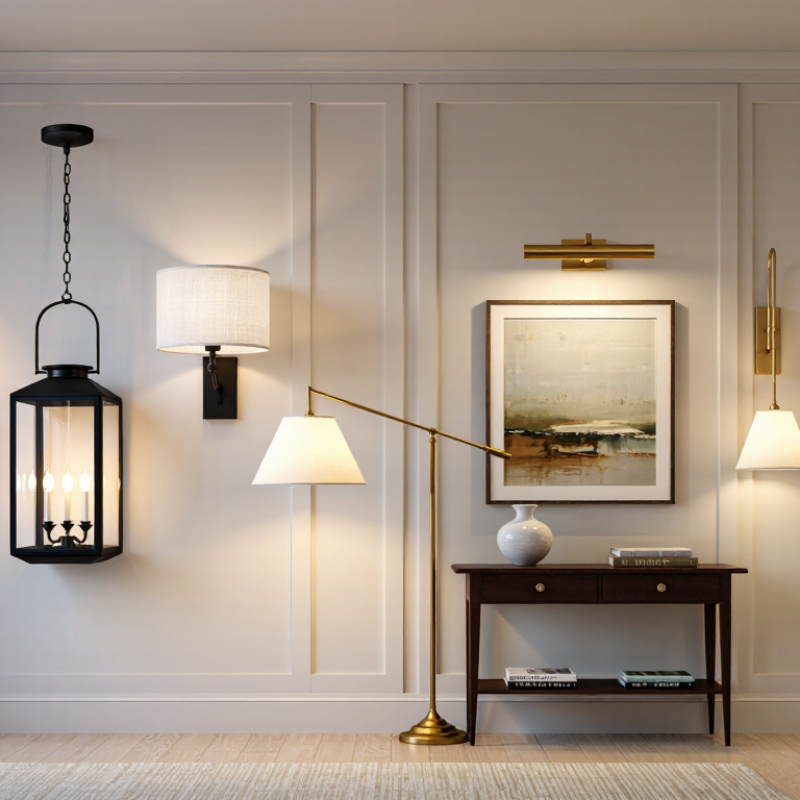
Decorative sconces are often classified by the way they shape light. Up-lighting designs send illumination toward the ceiling, creating a softer glow in a hallway or sitting room. Down-lighting fixtures cast light lower on a wall, where their patterns can highlight textured plaster or a narrow entry. Some models direct light both ways. Their paired beams can make a wall feel taller, though the effect depends on ceiling height and finish.
Function offers another useful classification. Swing-arm sconces can be adjusted for reading beside a bed or chair. Picture lights focus illumination on artwork, while vanity sconces place light near a mirror for grooming. Candle-style fixtures mainly provide visual character, with some electric versions adding practical ambient light. A fixture’s label is only a starting point. Many designs serve more than one purpose.
Scale and placement matter as much as style. A broad shade may overwhelm a tight corridor, while a small fixture can disappear on a large stone wall. Check the light source, projection, and mounting height before choosing. A frosted shade can reduce glare, but may soften details too much for close tasks. Small caveat: room lighting rarely comes from one sconce alone. Combining wall fixtures with ceiling or task lighting usually gives more control.

Candle-style sconces bring the shape of traditional candle holders to a wall, usually with slim, upward-facing lamps. Their simple outlines work well beside a mirror, along a hallway, or flanking a fireplace. Look closely at the backplate and arm: a broad plate can feel heavy on a narrow wall, while a very thin arm may disappear against patterned wallpaper. Warm, diffused bulbs soften the effect; clear bulbs create sharper shadows. Small details matter.
Multi-arm sconces spread light across a wider area and add a stronger decorative presence. Two or three arms often suit a dining nook or a wide entryway, especially when the fixture echoes nearby furniture lines. Measure the wall space before choosing one. A fixture that looks balanced in a showroom can crowd a doorway at home. I would also check whether the arms and shades can be cleaned easily; dust collects where they meet. More arms do not always mean better light. Sometimes they simply make a small room feel busier. Fixture height, bulb brightness, and nearby light sources all affect the result, so the best choice may take a little trial and adjustment.
Flush-mount sconces sit close to the wall, making them useful in narrow hallways, beside mirrors, or where a projecting shade could snag a shoulder. Their compact profile keeps the fixture visually quiet, but light can feel flat if the shade blocks too much output. Check the bulb direction and wall finish before choosing one; glossy paint may reveal glare.
Half-moon sconces cast light upward, downward, or through a translucent cover, depending on their design. Their curved shape softens a bare wall and works well beside a doorway or above a short stair landing. They are not automatically flattering, though: a dark or opaque shade can create a dim patch directly beneath the fixture. Small detail, big difference.
Up-and-down sconces send light in two directions, creating distinct pools above and below the fixture. They can add depth to a plain wall, especially when spaced evenly, but perfect symmetry is not always practical around switches or furniture. I would test the beam height before fixing the position. For any style, efficient bulbs matter: the U.S. Department of Energy’s Energy Saver guidance says LEDs use at least 75% less energy and last up to 25 times longer than incandescent bulbs. Check the fixture’s compatibility and dimmer requirements, too.
Picture lights give framed art a deliberate pool of light, but placement matters. A fixture mounted too high can cast glare across glazing; one mounted too low may leave the frame’s upper edge dim. Choose an adjustable head and test the beam from the main viewing angle. CIE 157:2004 uses 50 lux as a benchmark for highly light-sensitive museum objects. That is not a universal home setting, but it is a useful reminder: delicate works need restrained exposure. A dimmer helps, especially in rooms with daylight. Small adjustment, big difference.
Adjustable swing-arm sconces suit reading corners and bedsides because the light can move with the task. Extend the arm over a book, then fold it back to clear a narrow walkway. Check the full reach before installation; an arm that looks elegant on a sample board can feel awkward beside a tall headboard. The U.S. Department of Energy’s Energy Saver guidance says LED bulbs use at least 75% less energy and last up to 25 times longer than incandescent bulbs. Pairing a compatible LED with a dimmer can make frequent repositioning more practical. There is a catch: a bright, exposed bulb can still feel harsh, even when the arm is adjustable. Choose a shielded shade and test the light at night, not just in a showroom.
Picture lights focus on artwork, while adjustable swing-arm sconces extend from the wall and can be repositioned. This qualitative comparison shows each type’s typical design features; details vary by fixture.
Choosing a sconce starts with the room’s purpose, not its decorative style. Note where people sit, walk, or read, then place the light where it serves that activity. In a narrow hallway, a compact up-and-down sconce can brighten the wall without projecting far into the path. A swing-arm fixture beside a bed offers adjustable light for reading and folds closer to the wall when unused.
Match the shape and finish to the room’s character. Traditional interiors often suit curved arms, fabric shades, or aged-looking metal. Modern rooms may feel more balanced with clean lines, simple cylinders, or opal glass. Keep nearby details in mind: a dark fixture can stand out against pale paint, while a lighter finish may blend into a busy wall. Small rooms matter. Oversized shades can make them feel tighter.
For bedrooms and living areas, a shade that softens the bulb can reduce glare. In bathrooms, choose a fixture rated for its intended location, and have a qualified electrician confirm suitable placement and installation. A dimmer can help shift the mood, though not every bulb or fixture supports one. The perfect height is not always obvious; mock up the position with paper before drilling, especially beside a mirror or headboard.
| Sconce Type | Typical Design and Light | Suitable Rooms | Interior Styles | Choosing Tips |
|---|---|---|---|---|
| Candle Sconce | A candle-shaped lamp or holder on a wall plate; often creates a warm, decorative glow. | Entryways, dining rooms, hallways, and living rooms. | Traditional, transitional, French country, and classic interiors. | Use as accent lighting rather than the sole source of room light. Check whether the fixture is designed for one or multiple lamps. |
| Swing-Arm Sconce | An adjustable arm lets the light be repositioned toward a task or reading area. | Bedrooms, reading corners, home offices, and beside seating. | Modern, industrial, transitional, and practical contemporary rooms. | Confirm that the arm can move freely without hitting furniture, doors, or artwork. A shade can help direct light and reduce glare. |
| Picture Light | A narrow fixture positioned above or beside artwork to provide focused illumination. | Galleries, hallways, living rooms, and spaces displaying framed art or photographs. | Traditional, contemporary, minimalist, and eclectic interiors. | Choose a fixture that suits the artwork’s width and mounting position. Use suitable light levels and avoid excessive heat or glare on sensitive pieces. |
| Up-and-Down Sconce | Directs light upward, downward, or in both directions, creating wall washes and defined patterns. | Hallways, stairways, living rooms, and exterior entry areas when rated for outdoor use. | Modern, minimalist, contemporary, and architectural interiors. | Check the beam direction and wall finish, since textured or uneven surfaces can make light patterns more noticeable. |
| Flush-Mount Wall Sconce | Sits close to the wall, often with a covered diffuser that spreads light softly. | Narrow hallways, small bedrooms, stair landings, and spaces with limited clearance. | Contemporary, transitional, minimalist, and space-conscious interiors. | A low-profile design helps reduce protrusion into walkways. Check the diffuser material and lamp compatibility for the desired light quality. |
| Lantern Sconce | A frame surrounds the light source, sometimes with clear or seeded glass panels. | Entryways, porches, mudrooms, and hallways; outdoor use requires an appropriate weather rating. | Traditional, farmhouse, coastal, and rustic interiors. | For exterior locations, check the fixture’s wet- or damp-location rating and follow local electrical requirements. |
| Shaded Sconce | A fabric, glass, or metal shade softens or directs light while adding a decorative shape. | Bedrooms, living rooms, dining areas, and beside mirrors where suitable for the task. | Traditional, transitional, mid-century-inspired, and soft contemporary interiors. | Opaque shades concentrate light, while translucent shades allow more light to pass through. Consider lamp access and cleaning needs. |
| Sculptural or Geometric Sconce | Uses a distinctive outline, repeated shapes, or exposed structure as a visual feature as well as a light source. | Living rooms, entryways, dining rooms, and feature walls. | Contemporary, art deco-inspired, eclectic, and modern interiors. | Treat the fixture as a focal point. Check its scale against nearby furniture and artwork, and consider how exposed lamps appear when lit. |


For those larger-sized parts, or smaller quantity runs, we have 2 independent powder coat booths and ovens. The quality, durability and affordability of today’s powder coating finishes make this the process of choice for world-class companies.
Powder coating advantages over other forms of coating are many. Materials used in the Powder coating process can be metals and non-metals that come in a multitude of thicknesses, textures, colors, etc. Another of Powder coating’s biggest advantages over conventional coatings is its ability to create finishes in many different textures. Powder Coating Booths allow us the ability to apply these advantages to large products.
Tri-State Fabricators runs a full-service conveyor line for painting. Wet painting can provide protection or decoration to many different part styles. From start to finish, every project is easier to undergo random and point-based inspection by our skilled painting team.
Advantages to our Wet Paint Line are these lines start with product prep and ends with a thorough inspection of a high quality finished product. Our ability to complete large and small projects with a superior finish and doing so in a timely and economical fashion. This passes along the savings in production to our customers. When powder coating ins not an option, our Wet Paint Line gets the job done right the first time.
When the parts get big and heavy we roll-out our custom paint racks and oversize booth. By utilizing our partnerships with all the major paint brands, we can match virtually any color with wet paint.
The advantages of having access to a Wet Paint Booth are many. Large projects of many different shapes can be loaded into the booth. The Wet Paint Booth offers an environment that is much more controlled than a typical parts painting operation.
Not only are they used because of their controlled environment, but they’re are also advantageous when it comes to applying paint to parts that are needed in industries that require specialty coatings such as medical, aerospace, etc.
Our military forces have some very high standards when it comes to the finish of their vehicles and equipment. From the first pre-treatment step to final coat, it takes a great deal of knowledge and experience to protect the men and women of our armed forces. They deserve only the best, and Tri-State Fabricators provides it.
All of our processes are closely monitored by our staff and management teams. Both of which are highly trained in the processes of metal fabrication and finishing. Tri-State Fabricators’ goal is to always fully satisfy each and every customer, including the military. We will always put a 110% into what we do.
Abrasive media blasting is an excellent way to remove old paint, rust, and increase the paint/powder adhesion. Glass beads produce a much smoother and brighter finish than angular abrasives; leaving the part clean yet without any dimensional change. Chemically inert and environmentally friendly, we can recycle our beads approximately 30 times; making them a more preferred method of metal cleaning or surface finishing.
Advantages to Glass Bead Blasting are many. Glass bead blast media is used when a project is needing rough surfaces need to become smooth for applications of coatings such as paint. It is typically used to clean paint and rust from a product surface without deforming the surface it is being used on. Overall, compared to many other blasting media, Glass Bead Blasting is a very economical choice and those savings are always passed on to our customers.
Tri-State Fabricators utilize a zinc phosphate wash to clean and etch the material to ensure the best paint adhesion possible. The unique design of our 3-stage wash system does the work like a 5-stage. From Cleaning and rinsing to conversion coating and post-treatment, Our Part Washing process is a complete service and works throughout the fabrication service and the finishing service.
Along with the previously mentioned benefits, Curing is a vital chemical reaction that leaves the product finish hard and relatively safe from mild abrasion and aggressive corrosion. This process can be done in more than one way; ambient air-dry or in curing ovens at temps that exceed 240°.
From fixing paint mistakes (someone else’s of course) to simply cleaning our paint line hooks, our burn-off oven is put to good use. After a quick burn-off, a little clean up, and a fresh coat of paint, your parts will look better than new.
Why does our Burn-Off Oven work so well? Because super heating the air around parts turns the materials into ashes. From paint and powder coatings to rubber and machining oils, high temps do the job without degrading the integrity of the part.
Masking is a vital part of producing high quality products. We have die-cut masking patterns to protect machined surfaces as well as a wide range of plugs and caps to protect threaded holes and bolts. We provide permanent and temporary masking.
Masking allows the selected sections of a product to be protected from a fabrication or finishing service. This can be with both chemicals when etching and tapes, paints when only finishing just a section of the product. Masking is great in aiding the customization process of a project.
Screen printing is a photographic process that transfers artwork onto a porous nylon screen which allows colored ink to flow through the screen and be deposited on an aluminum or plastic component. We can generally have just about any design created onto a screen for your parts.
Some of the advantages of Screen Printing are, brand recognition for your business displaying on your products, assembly instructions, product warnings/hazards, etc. Tri-State Fabricators produces Screen Printing of the highest quality so you know it’s durable.
Metal Finishing is the art of treating the exterior portion of product, often metal but can also be made of other materials, so that the surface is clean and free of any debris. Then the process of applying coats or either paint of powder coat takes place. This coating process improves the quality of the product in both appearance and resistance to wear and corrosion.
Tri-State Fabricators, Inc., understands that a project typically isn’t complete until a high-quality finish has been added to your product. This is why our painting and powder coating teams continuously inspect the products throughout the Metal Finishing process.

