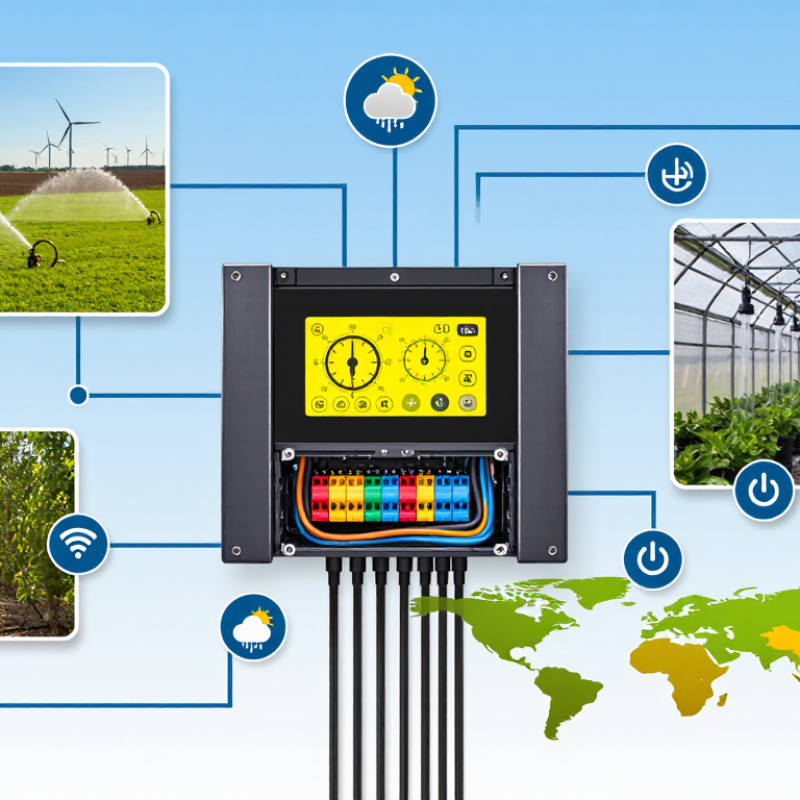
2026 Top Sprinkler Irrigation Controllers for Global Buyers

Choosing the right Sprinkler Irrigation Controller in 2026 requires more than comparing prices and screen designs. Global buyers must consider water pressure, power supply, climate, field size, and local installation practices. A controller that performs well in a California orchard may struggle in a small greenhouse in Kenya or a windy farm in Australia.

This guide examines leading models through practical criteria, including scheduling accuracy, weather-based adjustment, sensor compatibility, remote access, durability, and service support. It also considers installation details that product pages often overlook. Clear terminals matter. So does a strong enclosure. A bright display can help technicians work beside wet valve boxes, while reliable connectivity supports farms far from urban networks.

Real-world experience remains important. Testing should include seasonal changes, unstable internet connections, and unexpected rain. Some controllers appear intelligent but still require careful programming. Others offer impressive apps yet provide limited local support. That matters. Buyers should verify warranty terms, software availability, replacement parts, and regional voltage requirements before ordering.

The models discussed here are not ranked by marketing claims alone. Their strengths and weaknesses deserve equal attention. No controller fits every landscape. That is easy to forget. A smaller, simpler system may outperform a feature-heavy model when maintenance resources are limited. This review aims to help distributors, growers, contractors, and property managers make dependable choices for 2026, while recognizing that field conditions can expose flaws no brochure predicts.

2026 Top Sprinkler Irrigation Controllers for Global Buyers

Smart Irrigation Controllers: ET, Soil-Moisture, Rain and Flow Inputs

Smart irrigation controllers are becoming practical water-management tools, not decorative automation. FAO AQUASTAT reports that agriculture uses about 70% of global freshwater withdrawals. For global buyers, ET inputs are valuable because they estimate crop water loss from weather, temperature, wind, and solar radiation. Soil-moisture sensors add a direct check near the root zone. These systems can disagree. That is normal.

Rain sensors should pause scheduled irrigation after measurable rainfall, while flow sensors detect broken pipes, blocked filters, or unusual consumption. The U.S. EPA WaterSense program reports that weather-based irrigation controllers can reduce landscape water use by up to 15% when correctly installed and programmed. Field commissioning often shows a harder truth: poor sensor placement can erase those gains. A sensor under a roof gives misleadingly dry readings. A shallow probe may miss deeper root moisture.

Tips: Match sensor depth to the crop’s active roots. Test flow alerts with a controlled leak simulation. Review ET settings after seasonal weather changes. Keep manual inspection in the schedule. Software cannot see every clogged nozzle.

A reliable controller should accept several inputs, record events, and allow local adjustment when internet service fails. Rain alone is not enough for sloped sites or sandy soil. Flow data also needs a baseline from normal watering cycles. Buyers should request calibration procedures, replacement-sensor availability, and clear data export terms. The perfect setting rarely exists. Real landscapes change.

2026 Top Sprinkler Irrigation Controllers for Global Buyers - Smart Irrigation Controllers: ET, Soil-Moisture, Rain and Flow Inputs
Controller Category Recommended Application Typical Station Capacity Core Sensor Inputs Weather and ET Functions Soil-Moisture Management Flow Monitoring Connectivity Power Options Typical Enclosure Rating Best-Fit Buyer Profile
Premium Cloud-Managed Smart Controller Large residential properties, commercial landscapes, hotels, campuses and multi-site facilities 12–48 stations; expandable architecture available Rain sensor, flow meter, soil-moisture sensor, temperature sensor and pressure-switch input Automatic weather adjustment, reference ET scheduling, seasonal water-budget control and forecast-based skip days Adjusts or suspends irrigation when measured root-zone moisture reaches a defined threshold Real-time flow alerts, leak detection, high-flow and low-flow alarms Wi-Fi, cellular or Ethernet; browser and mobile-app access 24 VAC transformer; battery backup commonly used for memory and clock retention Indoor cabinet or outdoor enclosure rated up to IP65, depending on configuration Global buyers needing remote management, centralized reporting and water-use accountability
ET-Based Commercial Controller Municipal parks, sports fields, golf-course zones and public landscape projects 24–96 stations through modular expansion On-site weather station, rain sensor, temperature, wind, solar-radiation and humidity inputs Uses reference evapotranspiration and crop or landscape coefficients to calculate irrigation runtimes Optional soil-moisture feedback for runtime correction and irrigation lockout Flow sensing by master valve, pulse-output meter or digital flow sensor Cellular, Ethernet, radio or local field-bus connection 24 VAC control output; surge protection and backup power recommended Outdoor cabinet commonly specified at IP54–IP66 according to installation conditions Professional operators managing large areas with variable climate and irrigation demand
Soil-Moisture Feedback Controller Water-sensitive landscapes, sandy soils, tree zones, nurseries and high-value planting areas 4–24 stations Capacitance, frequency-domain or tensiometer-type soil-moisture sensors; rain input optional Can combine programmed schedules with weather-based seasonal adjustment Starts, shortens or skips irrigation according to measured volumetric water content or soil-water tension Optional master-valve and flow-meter monitoring Wired sensor network, LoRaWAN, Bluetooth commissioning or cellular gateway 24 VAC mains supply; solar power may be used for remote sensor nodes Outdoor controller commonly specified at IP55 or higher Buyers prioritizing root-zone control, reduced runoff and protection against overwatering
Rain- and Flow-Safety Controller Residential irrigation, retail sites, offices and small commercial landscapes 4–16 stations Rain shutoff sensor, master-valve output and flow-meter input Seasonal adjustment and rain-delay functions; full ET capability depends on the connected service Usually not included; may support a single moisture sensor through an auxiliary input Detects no-flow, low-flow and excessive-flow conditions to limit water loss Wi-Fi, cellular or local programming interface 24 VAC transformer with optional surge protection Indoor or weather-resistant outdoor housing; verify the stated IP or NEMA rating Buyers seeking practical water conservation and basic fault protection at moderate cost
Solar-Powered Remote-Area Controller Farms, roadside planting, remote gardens, temporary sites and locations without grid electricity 1–16 stations; normally designed for low-voltage latching solenoids Rain, soil-moisture, tank-level, pressure and flow inputs, depending on the model Weather adjustment may be provided through a cellular or satellite-connected gateway Supports threshold-based irrigation using local soil-moisture readings Optional pulse flow meter and pump-status input Cellular, LoRaWAN, satellite or local Bluetooth configuration Solar panel with rechargeable battery; system sizing depends on valve count and communications load Outdoor housing commonly rated IP65 or higher for exposed installations Global buyers requiring autonomous operation where grid power and wired communications are limited
Pump-and-Fertigation Irrigation Controller Greenhouses, nurseries, agricultural blocks and pressurized drip or sprinkler systems 8–64 irrigation zones with pump, valve and dosing outputs Flow, pressure, tank level, conductivity, pH, rain and soil-moisture inputs Can apply weather or ET adjustments to scheduled irrigation cycles Uses moisture thresholds to initiate irrigation or modify cycle duration Monitors mainline flow, zone flow and pump performance; supports alarm shutdown Industrial Ethernet, RS-485, cellular or supervisory-control integration 24 VAC outputs with separate pump-control circuits; 100–240 VAC supply is common at the cabinet Industrial outdoor cabinet commonly specified at IP65 or higher Buyers needing coordinated control of valves, pumps, filters and nutrient-injection equipment
Modular Field-Bus Controller Large landscapes, distributed parks, campuses and projects with long cable distances 32–256 stations through remote two-wire or field-bus modules Rain, flow, pressure, soil-moisture and pump-status inputs through local interface modules Supports seasonal adjustment; ET functions are commonly supplied by a central platform Zone-level moisture feedback is available when compatible sensor modules are installed Centralized flow monitoring with station-level alarm reporting Two-wire field bus, RS-485, Ethernet, cellular or radio communication 24 VAC controller supply; field modules may use two-wire communication and local power conditioning Controller and field enclosures commonly rated IP54–IP66 Project buyers seeking reduced trenching, scalable expansion and centralized maintenance
Residential Wi-Fi Smart Controller Homes, small gardens, rooftop landscapes and low-complexity sprinkler systems 4–16 stations Rain sensor and flow input; soil-moisture input is optional on selected configurations App-based weather adjustment, rain delay and seasonal percentage control Limited or optional sensor-based control; schedule-based operation remains common Optional flow meter for leak and broken-pipe alerts 2.4 GHz Wi-Fi is common; Bluetooth is often used for initial setup 24 VAC plug-in transformer Indoor installation or weather-resistant enclosure; outdoor rating must be verified before mounting Household and small-site buyers wanting simple mobile control and low installation complexity
Selection note: Sensor compatibility, station capacity, communication bands, enclosure ratings and electrical requirements vary by configuration. Buyers should confirm local radio regulations, supply voltage, valve type, climate data availability and applicable electrical or water-management standards before purchase.

Global Water Context: Agriculture Uses About 70% of Freshwater Withdrawals (FAO)

Agriculture uses about 70% of global freshwater withdrawals, according to the FAO. This pressure makes irrigation control more important for farms, nurseries, and landscape projects worldwide. The best 2026 sprinkler irrigation controllers should adjust watering by soil moisture, rainfall, crop needs, and local weather. Fixed schedules often waste water after storms or during cooler weeks.

Practical field evaluations show that reliable controllers need clear zone settings, stable connectivity, and manual backup controls. Buyers should check voltage compatibility, sensor support, enclosure protection, and language options before installation. Remote access can help managers respond quickly to leaks, blocked sprinklers, or unexpected heat. Yet technology alone cannot solve poor nozzle selection or uneven pressure. That part is often overlooked. A well-designed system still needs regular inspection and seasonal calibration.

Tips: Start with a small test zone. Compare soil moisture before and after irrigation. Review water use weekly, not only after a dry season. Keep manual controls available during network failures. Do not assume the most advanced dashboard delivers the best result; simple data can be easier for farm workers to trust and act upon.

2026 Controller Types: Weather-Based, Sensor-Based, Hybrid and Timer Models

2026 Controller Types: Weather-Based, Sensor-Based, Hybrid and Timer Models

Weather-based controllers adjust watering from rainfall, temperature, wind, and seasonal demand. They suit large landscapes with changing weather patterns. However, regional weather data may not match conditions beside a greenhouse or shaded courtyard. Check forecast coverage, adjustment intervals, and manual override functions before purchasing. Practical installation experience shows that reliable control depends on correct station settings, not software alone.

Sensor-based controllers measure soil moisture, rain, or flow directly at the site. They can prevent watering after unexpected rainfall and identify possible pipe leaks. Sensor placement matters greatly. A probe near a walkway may dry faster than one under dense plants. Use durable sensors, protected wiring, and simple calibration procedures. Small errors matter.

Hybrid models combine weather data with local sensor readings. They offer stronger decision-making for farms, public gardens, and multi-zone properties, but setup requires more technical attention. Timer models remain useful for small gardens, stable climates, and low-cost installations. They need seasonal adjustment and regular inspection. Simple still works. Global buyers should compare voltage compatibility, enclosure protection, water-pressure requirements, spare-part access, and documentation. I would not choose the most advanced controller automatically. A dependable timer may outperform a connected system when internet service is unreliable or staff training is limited. Keep records. Review watering results after several weeks, then refine each zone.

Water-Efficiency Benchmarks from EPA WaterSense and ASABE Standards

For global buyers, the strongest sprinkler irrigation controllers in 2026 should be judged against measurable water-efficiency practices, not app design alone. EPA WaterSense criteria provide a useful reference for weather-based and soil-moisture-based controllers. A qualified controller should adjust watering after rainfall, changing temperatures, and seasonal plant demand. EPA estimates that properly managed smart irrigation can reduce landscape water use by about 20 percent. Actual savings still depend on installation and programming.

ASABE standards add technical discipline to the comparison. They support consistent testing language for irrigation performance, scheduling, soil conditions, and distribution uniformity. Buyers should request test data showing how the controller handles station runtimes, cycle-and-soak operation, rain delays, and sensor inputs.

A controller may look efficient on paper. Poor sprinkler spacing can waste water anyway. On a sloped clay lawn, I would inspect runoff after a short morning cycle, then adjust the schedule rather than trust factory settings.

Small details matter. Check local weather-data coverage, manual override access, multilingual instructions, and offline operation during internet outages. Review whether the system records actual watering events, not only planned schedules. Some savings claims feel too clean. Field performance varies with nozzle pressure, soil compaction, wind, and maintenance. An honest comparison should show these limits beside laboratory results. Pairing EPA WaterSense guidance with ASABE-based testing gives buyers a clearer, more defensible basis for selecting controllers across different climates.

Global Buyer Checklist: Voltage, IP Ratings, Connectivity and Certifications

2026 Top Sprinkler Irrigation Controllers for Global Buyers

Global buyers should begin with voltage, not app features. Many controllers use 24 VAC outputs, while input power may support 100–240 VAC at 50/60 Hz. Confirm the local plug, transformer, frequency, and surge protection. FAO AQUASTAT reports that agriculture uses about 70% of global freshwater withdrawals. Reliable scheduling is therefore an efficiency issue, not merely a convenience.

IP ratings also need careful interpretation. IEC 60529 defines IP65 as dust-tight protection with resistance to water jets. It does not guarantee protection from flooding, condensation, or ultraviolet exposure. For outdoor cabinets, check cable glands, drainage, operating temperature, and installation height.

Connectivity deserves equal attention. A controller may offer Wi-Fi, cellular service, or long-range radio, yet weak rural coverage can interrupt updates. Offline schedules and manual controls remain valuable. I would not assume “smart” means dependable.

Tips: Request test reports for CE, FCC, UKCA, or other required regional approvals. Check whether certification covers the complete controller, not only its power adapter. Compare 2.4 GHz compatibility, mobile-network bands, data security, and subscription costs. Read the installation manual before ordering. Specifications can look perfect on paper, but local electricians often reveal the missing detail.

Powder Coat Booths

For those larger-sized parts, or smaller quantity runs, we have 2 independent powder coat booths and ovens. The quality, durability and affordability of today’s powder coating finishes make this the process of choice for world-class companies.

Powder coating advantages over other forms of coating are many. Materials used in the Powder coating process can be metals and non-metals that come in a multitude of thicknesses, textures, colors, etc. Another of Powder coating’s biggest advantages over conventional coatings is its ability to create finishes in many different textures. Powder Coating Booths allow us the ability to apply these advantages to large products.

Wet Paint Line

Tri-State Fabricators runs a full-service conveyor line for painting. Wet painting can provide protection or decoration to many different part styles. From start to finish, every project is easier to undergo random and point-based inspection by our skilled painting team.

Advantages to our Wet Paint Line are these lines start with product prep and ends with a thorough inspection of a high quality finished product. Our ability to complete large and small projects with a superior finish and doing so in a timely and economical fashion. This passes along the savings in production to our customers. When powder coating ins not an option, our Wet Paint Line gets the job done right the first time.

Wet Paint Booths

When the parts get big and heavy we roll-out our custom paint racks and oversize booth. By utilizing our partnerships with all the major paint brands, we can match virtually any color with wet paint.

The advantages of having access to a Wet Paint Booth are many. Large projects of many different shapes can be loaded into the booth. The Wet Paint Booth offers an environment that is much more controlled than a typical parts painting operation.

Not only are they used because of their controlled environment, but they’re are also advantageous when it comes to applying paint to parts that are needed in industries that require specialty coatings such as medical, aerospace, etc.

Military CARC

Our military forces have some very high standards when it comes to the finish of their vehicles and equipment. From the first pre-treatment step to final coat, it takes a great deal of knowledge and experience to protect the men and women of our armed forces. They deserve only the best, and Tri-State Fabricators provides it.

All of our processes are closely monitored by our staff and management teams. Both of which are highly trained in the processes of metal fabrication and finishing. Tri-State Fabricators’ goal is to always fully satisfy each and every customer, including the military. We will always put a 110% into what we do.

Glass-Bead Blasting

Abrasive media blasting is an excellent way to remove old paint, rust, and increase the paint/powder adhesion. Glass beads produce a much smoother and brighter finish than angular abrasives; leaving the part clean yet without any dimensional change. Chemically inert and environmentally friendly, we can recycle our beads approximately 30 times; making them a more preferred method of metal cleaning or surface finishing.

Advantages to Glass Bead Blasting are many. Glass bead blast media is used when a project is needing rough surfaces need to become smooth for applications of coatings such as paint. It is typically used to clean paint and rust from a product surface without deforming the surface it is being used on. Overall, compared to many other blasting media, Glass Bead Blasting is a very economical choice and those savings are always passed on to our customers.

Part Washing

Tri-State Fabricators utilize a zinc phosphate wash to clean and etch the material to ensure the best paint adhesion possible. The unique design of our 3-stage wash system does the work like a 5-stage. From Cleaning and rinsing to conversion coating and post-treatment, Our Part Washing process is a complete service and works throughout the fabrication service and the finishing service.

Along with the previously mentioned benefits, Curing is a vital chemical reaction that leaves the product finish hard and relatively safe from mild abrasion and aggressive corrosion. This process can be done in more than one way; ambient air-dry or in curing ovens at temps that exceed 240°.

Burn-Off Oven

From fixing paint mistakes (someone else’s of course) to simply cleaning our paint line hooks, our burn-off oven is put to good use. After a quick burn-off, a little clean up, and a fresh coat of paint, your parts will look better than new.

Why does our Burn-Off Oven work so well? Because super heating the air around parts turns the materials into ashes. From paint and powder coatings to rubber and machining oils, high temps do the job without degrading the integrity of the part.

Masking

Masking is a vital part of producing high quality products. We have die-cut masking patterns to protect machined surfaces as well as a wide range of plugs and caps to protect threaded holes and bolts. We provide permanent and temporary masking.

Masking allows the selected sections of a product to be protected from a fabrication or finishing service. This can be with both chemicals when etching and tapes, paints when only finishing just a section of the product. Masking is great in aiding the customization process of a project.

Screen Printing

Screen printing is a photographic process that transfers artwork onto a porous nylon screen which allows colored ink to flow through the screen and be deposited on an aluminum or plastic component. We can generally have just about any design created onto a screen for your parts.

Some of the advantages of Screen Printing are, brand recognition for your business displaying on your products, assembly instructions, product warnings/hazards, etc. Tri-State Fabricators produces Screen Printing of the highest quality so you know it’s durable.

Metal Finishing

Metal Finishing is the art of treating the exterior portion of product, often metal but can also be made of other materials, so that the surface is clean and free of any debris. Then the process of applying coats or either paint of powder coat takes place. This coating process improves the quality of the product in both appearance and resistance to wear and corrosion.

Tri-State Fabricators, Inc., understands that a project typically isn’t complete until a high-quality finish has been added to your product. This is why our painting and powder coating teams continuously inspect the products throughout the Metal Finishing process.