


The right Snap Button Kit can make a garment easier to assemble, repair, and use. Yet global buyers face a crowded mix of sew-on snaps, prong-style fasteners, spring snaps, and plastic resin options. Small parts matter. A kit may look complete, but mismatched cap sizes, thin setting tools, or unclear instructions can slow production and create avoidable waste.
The market context is substantial. Textile Exchange’s Materials Market Report 2024 estimates that global fiber production reached 124 million tonnes in 2023 and could rise to 160 million tonnes by 2030. That report does not forecast snap-button demand, but it highlights the scale of the material supply chain these components serve. McKinsey and The Business of Fashion’s State of Fashion reports also track shifting sourcing priorities, including cost pressure and supply-chain resilience. For buyers, those pressures make specifications and supplier checks more than paperwork.
Fit comes first. This guide compares kit types by fastening mechanism, fabric compatibility, tool quality, pack contents, and likely use—from lightweight shirts to bags and heavier denim. It also considers sample testing, size consistency, and replacement parts, since a low unit price can hide extra setup costs. Not every kit fits. Product descriptions can be incomplete, and real fabric may behave differently from a sample swatch. Use the comparisons as a starting point, then test the chosen kit on the intended material before placing a larger order.
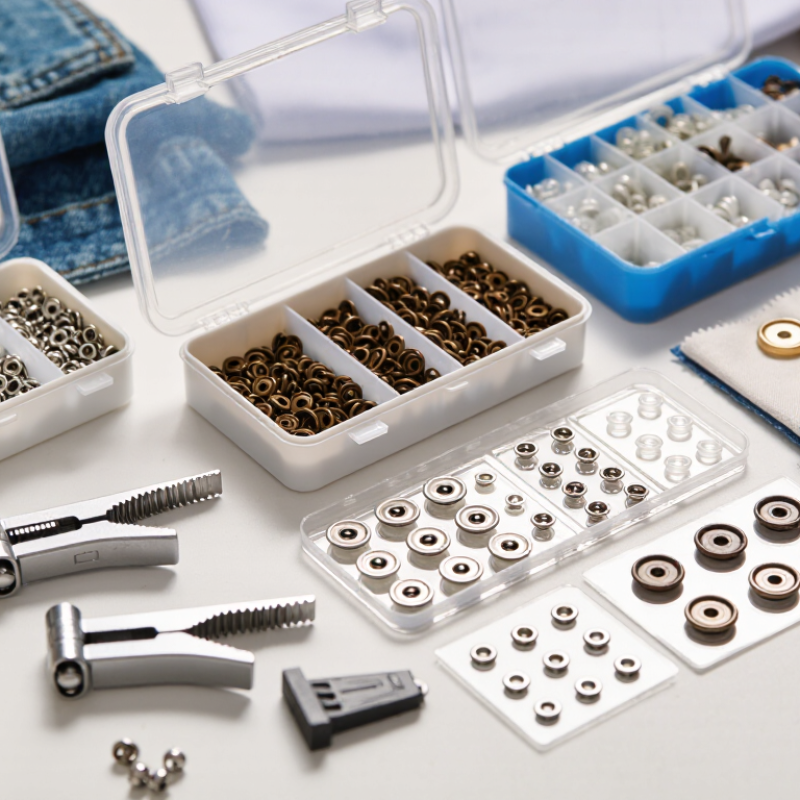
A snap button kit contains four small parts: cap, socket, stud, and post. Each has a separate role. The cap forms the visible front, often with a smooth or textured finish. Behind it, the socket receives the stud and creates the familiar snap closure. A clean click is useful, but it is not the only sign of a good fit. Loose fabric, misaligned parts, or uneven pressure can make a fastener wobble or fail to close securely.
The stud fits into the socket, while the post anchors the stud through the fabric. In many common kits, the cap and socket sit on one side of the material; the stud and post sit on the other. Exact shapes can vary, so check the kit’s instructions before setting parts. Test one snap on a fabric scrap first. It reveals whether the post length suits the material thickness and whether the closure feels too tight. Small differences matter. A thin cotton panel may need a gentler setting than layered canvas. Even careful hands can misalign a part, so inspect the first finished snap before repeating the process.

Prong snaps use pointed posts that pass through the fabric and lock into a socket. They suit fast assembly on stable, medium-weight materials, but delicate cloth can tear around the puncture. Ring-spring snaps use a spring ring inside the socket to hold the stud. They offer a firm, clean closure for jackets and bags; check opening force on the actual fabric stack, not just a loose sample. Small details matter. Textile Exchange’s Materials Market Report 2024 estimates global fiber production reached 124 million tonnes in 2023 and could reach 160 million tonnes by 2030. That scale makes consistent hardware selection and testing important across varied materials.
Sew-on snaps attach through small holes around the rim, avoiding a press and piercing the fabric body. They work well for delicate garments and repairs, though hand placement can vary. Jean snaps use a post and cap designed to anchor through heavier denim. Choose post length to match the fabric thickness, and test the setting pressure: too much can flatten the cap or mark the cloth. A snap may feel secure on one sample, then loosen after laundering. That is an easy detail to miss. For global purchasing, request material-specific pull and cycling tests, and record the fabric weight, post length, and installation method with each sample.
| Snap Type | Fastener Design | Typical Attachment Method | Common Materials | Typical Cap Diameter | Common Applications | Buyer Checks |
|---|---|---|---|---|---|---|
| Prong snaps | Prongs on the cap or socket pass through the fabric and are secured by a mating component. | Installed with a compatible hand press or snap-setting tool and matching dies. | Brass, steel, stainless steel, and assorted plated metals. | About 9.5–15 mm | Light- to medium-weight clothing, baby garments, accessories, and craft projects. | Match the prong length to the fabric thickness; verify component compatibility and finish requirements. |
| Ring-spring snaps | A metal ring in the socket provides spring tension to hold the stud in place. | Set through the material using a press or hand tool with the correct dies. | Brass, steel, stainless steel, and plated alloys. | About 10–15 mm | Shirts, jackets, bags, uniforms, and other garments needing a firm, reusable closure. | Check spring action, pull strength for the intended fabric, component set, and corrosion resistance. |
| Sew-on snaps | Two separate components, each with sewing holes, are stitched directly to the fabric. | Hand-sewn or machine-sewn; no setting press is normally required. | Metal or plastic. | About 6–21 mm | Delicate garments, knitwear, costumes, cushions, and projects where a setting tool is unsuitable. | Choose a size and material suited to the fabric; check hole placement and sewing access. |
| Jean snaps | A decorative cap, socket, stud, and post form a sturdy snap assembly designed for heavier materials. | Installed through denim or similar fabric with a compatible press or setting tool. | Brass, steel, zinc alloy, and other metals, often with a plated or coated finish. | About 15–20 mm | Denim jackets, jeans, workwear, bags, and other medium- to heavyweight products. | Confirm post length for the fabric stack, cap style, setting-die fit, and finish durability. |
Size note: Diameter ranges are indicative examples of commonly encountered sizes, not a universal standard. Actual sizes, component designs, materials, and tool requirements vary by product specification.
Brass, stainless steel, and 304-grade components each suit different snap button priorities. Brass offers a warm finish and workable forming characteristics, making it useful for decorative garments and accessories. Stainless steel is valued for durability, but “stainless” alone does not identify its grade. Grade 304 is a specific stainless option, commonly described as 18/8 for its approximate chromium and nickel content. The World Stainless Association reported 58.4 million metric tons of global stainless crude steel production in 2023, showing the material’s broad industrial use—not proving that every snap button is suitable for every environment.
For buyers, check which parts use the named material: cap, socket, stud, and spring may differ. A 304 cap paired with another alloy’s spring is not an all-304 set. Ask suppliers for material specifications and test results, especially when buttons face frequent washing, sweat, or coastal humidity. Corrosion resistance still depends on surface finish, construction, and exposure. Small details matter. Brass can tarnish, while stainless steel can still stain in harsh, chloride-rich conditions. A polished sample alone may hide these differences.
Tips: Test a sample on the actual fabric. Open and close it repeatedly, then inspect the finish and fastening force. One overlooked point: fabric thickness can affect performance as much as metal choice.
Cap diameter is a useful starting point, not a complete sizing rule. A 9.5 mm cap gives a neat, low-profile finish on lightweight cotton shirts, bibs, and small accessories. Caps around 12–15 mm are easier to handle on jackets, bags, and medium-weight canvas. Small caps suit detail.
Heavy denim or layered fleece may need larger caps and longer posts, but diameter alone cannot ensure a secure closure. Match post length to the compressed fabric thickness, and use compatible socket and stud components. A post that is too short may not set firmly; one that is too long can deform or loosen. Test on fabric scraps first.
For bulk sourcing, note the cap diameter, fabric layers, and intended application in the sample brief. Check closure force by hand, then open and close each sample repeatedly. A snap that feels secure on a flat swatch may struggle near seams or folded hems. I would not assume one size fits every fabric finish; coatings can change the fit slightly. Record the results before ordering at scale.
For global buyers comparing snap button kits, ISO 9227 neutral salt spray (NSS) provides a repeatable corrosion screen. The test uses a 5% sodium chloride solution at 35°C under controlled conditions. This gives suppliers and buyers a shared basis for comparing samples. Small details matter. A cap, socket, stud, spring, and coating edge may react differently.
Ask for the exposure duration, sample preparation, and assessment criteria alongside the test result. Check whether the report covers individual components or fully assembled buttons. Look for clear photographs and notes on visible corrosion, especially around folds, cut edges, and moving parts. A clean-looking cap alone may not tell the whole story.
NSS is useful, but it does not predict an exact number of years in real use. Wear, sweat, storage, and local climate can change performance. One limitation is easy to overlook: test results only help when the acceptance standard is agreed in advance. Buyers should compare like with like, and question results that omit test details. That extra check takes time. It can prevent a confident decision based on incomplete evidence.
Global Corrosion Testing: ISO 9227 NSS uses 5% sodium chloride (NaCl) at 35°C.
The chart shows the NSS spray-solution pH range of 6.5–7.2. The 5% NaCl concentration and 35°C chamber temperature are test conditions, not a predicted service life or a guarantee of corrosion resistance. Compare snap-button materials and finishes using an agreed test duration and evaluation criteria.


For those larger-sized parts, or smaller quantity runs, we have 2 independent powder coat booths and ovens. The quality, durability and affordability of today’s powder coating finishes make this the process of choice for world-class companies.
Powder coating advantages over other forms of coating are many. Materials used in the Powder coating process can be metals and non-metals that come in a multitude of thicknesses, textures, colors, etc. Another of Powder coating’s biggest advantages over conventional coatings is its ability to create finishes in many different textures. Powder Coating Booths allow us the ability to apply these advantages to large products.
Tri-State Fabricators runs a full-service conveyor line for painting. Wet painting can provide protection or decoration to many different part styles. From start to finish, every project is easier to undergo random and point-based inspection by our skilled painting team.
Advantages to our Wet Paint Line are these lines start with product prep and ends with a thorough inspection of a high quality finished product. Our ability to complete large and small projects with a superior finish and doing so in a timely and economical fashion. This passes along the savings in production to our customers. When powder coating ins not an option, our Wet Paint Line gets the job done right the first time.
When the parts get big and heavy we roll-out our custom paint racks and oversize booth. By utilizing our partnerships with all the major paint brands, we can match virtually any color with wet paint.
The advantages of having access to a Wet Paint Booth are many. Large projects of many different shapes can be loaded into the booth. The Wet Paint Booth offers an environment that is much more controlled than a typical parts painting operation.
Not only are they used because of their controlled environment, but they’re are also advantageous when it comes to applying paint to parts that are needed in industries that require specialty coatings such as medical, aerospace, etc.
Our military forces have some very high standards when it comes to the finish of their vehicles and equipment. From the first pre-treatment step to final coat, it takes a great deal of knowledge and experience to protect the men and women of our armed forces. They deserve only the best, and Tri-State Fabricators provides it.
All of our processes are closely monitored by our staff and management teams. Both of which are highly trained in the processes of metal fabrication and finishing. Tri-State Fabricators’ goal is to always fully satisfy each and every customer, including the military. We will always put a 110% into what we do.
Abrasive media blasting is an excellent way to remove old paint, rust, and increase the paint/powder adhesion. Glass beads produce a much smoother and brighter finish than angular abrasives; leaving the part clean yet without any dimensional change. Chemically inert and environmentally friendly, we can recycle our beads approximately 30 times; making them a more preferred method of metal cleaning or surface finishing.
Advantages to Glass Bead Blasting are many. Glass bead blast media is used when a project is needing rough surfaces need to become smooth for applications of coatings such as paint. It is typically used to clean paint and rust from a product surface without deforming the surface it is being used on. Overall, compared to many other blasting media, Glass Bead Blasting is a very economical choice and those savings are always passed on to our customers.
Tri-State Fabricators utilize a zinc phosphate wash to clean and etch the material to ensure the best paint adhesion possible. The unique design of our 3-stage wash system does the work like a 5-stage. From Cleaning and rinsing to conversion coating and post-treatment, Our Part Washing process is a complete service and works throughout the fabrication service and the finishing service.
Along with the previously mentioned benefits, Curing is a vital chemical reaction that leaves the product finish hard and relatively safe from mild abrasion and aggressive corrosion. This process can be done in more than one way; ambient air-dry or in curing ovens at temps that exceed 240°.
From fixing paint mistakes (someone else’s of course) to simply cleaning our paint line hooks, our burn-off oven is put to good use. After a quick burn-off, a little clean up, and a fresh coat of paint, your parts will look better than new.
Why does our Burn-Off Oven work so well? Because super heating the air around parts turns the materials into ashes. From paint and powder coatings to rubber and machining oils, high temps do the job without degrading the integrity of the part.
Masking is a vital part of producing high quality products. We have die-cut masking patterns to protect machined surfaces as well as a wide range of plugs and caps to protect threaded holes and bolts. We provide permanent and temporary masking.
Masking allows the selected sections of a product to be protected from a fabrication or finishing service. This can be with both chemicals when etching and tapes, paints when only finishing just a section of the product. Masking is great in aiding the customization process of a project.
Screen printing is a photographic process that transfers artwork onto a porous nylon screen which allows colored ink to flow through the screen and be deposited on an aluminum or plastic component. We can generally have just about any design created onto a screen for your parts.
Some of the advantages of Screen Printing are, brand recognition for your business displaying on your products, assembly instructions, product warnings/hazards, etc. Tri-State Fabricators produces Screen Printing of the highest quality so you know it’s durable.
Metal Finishing is the art of treating the exterior portion of product, often metal but can also be made of other materials, so that the surface is clean and free of any debris. Then the process of applying coats or either paint of powder coat takes place. This coating process improves the quality of the product in both appearance and resistance to wear and corrosion.
Tri-State Fabricators, Inc., understands that a project typically isn’t complete until a high-quality finish has been added to your product. This is why our painting and powder coating teams continuously inspect the products throughout the Metal Finishing process.

