


Choosing a Robot Fence manufacturer is not just a price comparison. A fence must fit the robot cell, the workpiece, and the daily movement of operators and materials. A narrow gate can slow production. A poorly placed panel can leave a blind spot. Small details matter.
For an illustrative framing, fictional automation-safety specialist Daniel Mercer might say, “A fence works only when it protects the cell without fighting the workflow.” This is an original editorial line, not a verified quotation from a real expert. A real comparison should rely on verifiable product specifications, installation records, and customer references.
This guide examines ten manufacturers for global buyers. It considers enclosure design, modularity, access options, documentation, and support across regions. Buyers should check panel dimensions, mounting methods, gate configurations, and compatibility with their specific robot cell. A polished catalog is not enough. Ask how replacement parts are handled, and whether drawings match the equipment on your floor.
Details vary. They always do. One supplier may offer flexible panels, while another may provide clearer technical documentation or stronger local support. These differences deserve careful review, not assumptions. No single manufacturer suits every facility, and a ranked list cannot replace an engineering assessment. Use the comparisons as a starting point, then confirm requirements with qualified professionals and the manufacturers themselves. A sensible shortlist begins with the actual cell—not the brochure.
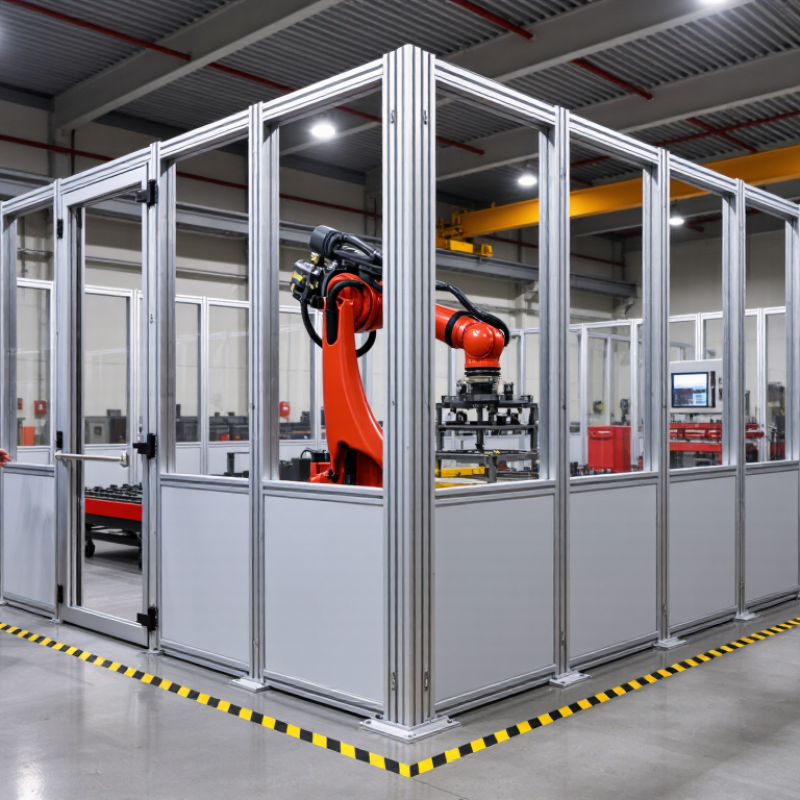
Robot fencing is a physical guarding system that separates industrial robots and their work zones from nearby people. It commonly combines steel-mesh panels, posts, access gates, and safety devices such as interlocked switches. When a gate opens, an appropriate safety circuit can stop hazardous motion, subject to the cell’s design and validation. The barrier may also help contain moving parts or ejected materials, though it cannot replace sound machine design. Small details matter.
A safe enclosure starts with a task-based risk assessment, not a panel height chosen by habit. Engineers consider robot reach, stopping time, openings, access frequency, and whether someone could reach over or around the guard. Controls and emergency stops should be reachable without entering a danger zone, and interlocks need verification during commissioning and maintenance. Clear sightlines help workers notice faults; tidy cable routing reduces everyday confusion. Fences can slow material flow or create blind spots. That trade-off deserves review. A guard is dependable only when it stays intact, doors close correctly, and cell changes trigger another safety check.

A reliable robot fence manufacturer should provide more than standard panels and a price list. Check whether its team can review cell drawings, robot reach, loading points, and maintenance access. Ask for clear layout plans showing posts, doors, mesh panels, and floor anchors. Small gaps around conveyors or corners can become costly problems later.
Safety documentation matters. Request material specifications, installation instructions, and records showing how access gates and interlocks are intended to work with the wider cell. Requirements vary by project and location, so confirm that the proposed design can be assessed against applicable standards. Ask for evidence. A polished catalogue alone is not enough; drawings may leave awkward access points unresolved.
Compare coating quality, panel rigidity, spare-part availability, and realistic delivery times. If possible, inspect a sample panel and check its finish, welds, and edges. Ask who handles installation support and how damaged sections can be replaced. A low quote can omit freight, site modifications, or extra gates, so compare complete project costs. The spreadsheet may still miss something. Record open questions before ordering, especially when equipment layouts are likely to change.
Choosing from the top 10 robot fence manufacturers for global buyers takes more than comparing prices. A suitable supplier should explain how its panels, posts, gates, and fixings work with your robot cell layout. Ask for drawings, material details, and clear installation instructions. Check whether the fence can accommodate service access without leaving unguarded gaps. Small details matter.
Buyers should also compare lead times, replacement-part availability, packing methods, and technical support across time zones. Ask suppliers to identify relevant safety standards for your destination and provide supporting documents; requirements can vary by market and project. A polished catalog is not proof of a good fit. It is easy to overlook how a door’s swing or a cable opening affects the finished installation. Verify these points against your own layout before ordering.
Tips: Request a sample panel or inspect a completed installation when practical. Confirm coating, mesh size, and color in writing. Ask who handles design changes after approval. Keep the comparison factual, but leave room for judgment: the lowest quote may not include the support your project needs.
Buyer comparison checklist: use these ten criteria to assess suppliers. Requirements depend on the robot application, risk assessment, and destination market; this is not a ranked list of companies.
| No. | Evaluation dimension | Fact-based buyer check | Why it matters |
|---|---|---|---|
| 1 | Guard design and construction | Check whether the proposed fixed or movable guards are designed with reference to ISO 14120. | ISO 14120 sets general requirements for the design and construction of guards used to protect people from mechanical hazards. |
| 2 | Safety distances and openings | Ask how panel openings, gaps, and guard placement are assessed against ISO 13857 for preventing access to hazard zones. | Safe distances depend on the opening and the body part that could reach through or over it; there is no single mesh size that is suitable for every installation. |
| 3 | Access-door interlocking | For interlocked movable guards, check the selection and installation approach against ISO 14119. | Interlocking helps ensure that opening a guard initiates the required safety response; the correct arrangement depends on the machine risk assessment. |
| 4 | Safety-related control integration | Confirm that safety functions involving guard switches or other safety devices are specified and validated for the required performance level, where applicable, using ISO 13849-1. | A fence alone does not establish the safety performance of the complete machine control system. |
| 5 | Electrical equipment interface | Where the fence package includes electrical equipment or interfaces, review the project’s applicable requirements with reference to IEC 60204-1. | IEC 60204-1 addresses electrical equipment of machinery; applicability and compliance responsibility should be agreed for the complete installation. |
| 6 | Site-specific layout | Request a layout showing fence runs, posts, doors, robot reach, adjacent equipment, and material-transfer openings. | Safe distances and access arrangements must be evaluated for the actual cell and hazards; a standard fence height or layout cannot be assumed to fit every application. |
| 7 | Mechanical strength and fixing | Ask for documented design assumptions, panel and post details, anchoring requirements, and any applicable test evidence for the intended environment. | Loads, impact risks, floor conditions, and installation method affect the suitability of the guard assembly. |
| 8 | Materials and environment | Specify the operating environment and verify material, coating, and corrosion-resistance suitability against the site conditions. | Moisture, cleaning chemicals, temperature, and outdoor exposure can affect service life and maintenance needs. |
| 9 | Installation and documentation | Request assembly drawings, installation instructions, parts identification, inspection guidance, and documents defining the supplier’s scope. | Clear documentation supports correct installation, inspection, maintenance, and responsibility handover. |
| 10 | Export and project support | Confirm the delivery scope, packaging, shipping terms, spare-parts availability, language of documentation, and support arrangements for the destination country. | Import, installation, and support needs differ by project and market; confirm them contractually rather than relying on general claims. |
Note: Standards and regulations applicable to a robot cell depend on the machine, risk assessment, and jurisdiction. Verify the current requirements with the responsible machine integrator and qualified safety professionals.
Top 10 Robot Fence Manufacturers for Global Buyers?
Comparing manufacturers takes more than checking panel prices. Start with the application: robot reach, tool changes, material flow, and operator access all affect fence layout. Capable suppliers can review drawings, identify blind spots, and explain how doors, interlocks, and emergency access fit the cell. Ask for dimensioned layouts, not just product photos.
Products vary in useful ways. Look for modular mesh panels, rigid posts, adjustable brackets, guarded sliding doors, and compatible safety switches. A sample panel can reveal weld quality and coating consistency. Small details count. Also check whether the supplier handles installation guidance, replacement parts, and clear documentation. An impressive catalog does not prove that every configuration is available or tested.
Certifications need careful comparison. Request current certificates and confirm their scope, issuing body, and relevance to the supplied components. Quality-management certification may support consistent production, while machinery and guarding standards address different safety questions. Requirements differ by destination and project, so buyers should confirm them with qualified local advisers. A tidy certificate file can still leave unanswered questions. Ask for test records, traceability details, and examples of similar installations; then compare how directly each manufacturer responds.
Selected international machinery-safety standards relevant to robot-cell guarding and related equipment
How to read this chart: Each bar counts the selected standards mapped to that safety area. The chart summarizes standards relevance—not manufacturer rankings, product performance, or proof of certification. Requirements depend on the application and market; buyers should verify the applicable standards and request current certificates from suppliers.
Standards in this reference set: ISO 12100 (risk assessment), ISO 13857 (safety distances), ISO 14120 (guards), ISO 14119 (interlocking devices), ISO 13849-1 and IEC 62061 (safety-related control systems), and IEC 60204-1 (electrical equipment of machines).
Robot fencing is not just a row of panels around a machine. Buyers should share the robot’s reach, tool dimensions, payload, and planned movement with potential suppliers. A safety layout must account for the full operating envelope, including areas where an arm can swing or a part can fall. Small gaps matter.
Check the mesh opening, panel height, post spacing, and fixing method against the site conditions. A fence anchored to a smooth concrete floor may behave differently from one installed beside a trench or uneven slab. Confirm how access gates are monitored and how the system interfaces with the cell’s safety controls. Ask for drawings, material details, and installation instructions before approving production. Clear records make later changes easier.
Global sourcing adds practical questions. Can replacement panels and hinges be shipped in suitable sizes? Are installation support and technical documents available in a language your team can use? Ask the manufacturer to identify the standards and test evidence relevant to your destination, then have qualified local professionals review the design. A lower price may be reasonable, but only if the mesh, coating, and hardware suit the environment. Salt air and forklift traffic are easy to overlook. Even a detailed quote can miss a site constraint, so leave room for a design review before fabrication.


For those larger-sized parts, or smaller quantity runs, we have 2 independent powder coat booths and ovens. The quality, durability and affordability of today’s powder coating finishes make this the process of choice for world-class companies.
Powder coating advantages over other forms of coating are many. Materials used in the Powder coating process can be metals and non-metals that come in a multitude of thicknesses, textures, colors, etc. Another of Powder coating’s biggest advantages over conventional coatings is its ability to create finishes in many different textures. Powder Coating Booths allow us the ability to apply these advantages to large products.
Tri-State Fabricators runs a full-service conveyor line for painting. Wet painting can provide protection or decoration to many different part styles. From start to finish, every project is easier to undergo random and point-based inspection by our skilled painting team.
Advantages to our Wet Paint Line are these lines start with product prep and ends with a thorough inspection of a high quality finished product. Our ability to complete large and small projects with a superior finish and doing so in a timely and economical fashion. This passes along the savings in production to our customers. When powder coating ins not an option, our Wet Paint Line gets the job done right the first time.
When the parts get big and heavy we roll-out our custom paint racks and oversize booth. By utilizing our partnerships with all the major paint brands, we can match virtually any color with wet paint.
The advantages of having access to a Wet Paint Booth are many. Large projects of many different shapes can be loaded into the booth. The Wet Paint Booth offers an environment that is much more controlled than a typical parts painting operation.
Not only are they used because of their controlled environment, but they’re are also advantageous when it comes to applying paint to parts that are needed in industries that require specialty coatings such as medical, aerospace, etc.
Our military forces have some very high standards when it comes to the finish of their vehicles and equipment. From the first pre-treatment step to final coat, it takes a great deal of knowledge and experience to protect the men and women of our armed forces. They deserve only the best, and Tri-State Fabricators provides it.
All of our processes are closely monitored by our staff and management teams. Both of which are highly trained in the processes of metal fabrication and finishing. Tri-State Fabricators’ goal is to always fully satisfy each and every customer, including the military. We will always put a 110% into what we do.
Abrasive media blasting is an excellent way to remove old paint, rust, and increase the paint/powder adhesion. Glass beads produce a much smoother and brighter finish than angular abrasives; leaving the part clean yet without any dimensional change. Chemically inert and environmentally friendly, we can recycle our beads approximately 30 times; making them a more preferred method of metal cleaning or surface finishing.
Advantages to Glass Bead Blasting are many. Glass bead blast media is used when a project is needing rough surfaces need to become smooth for applications of coatings such as paint. It is typically used to clean paint and rust from a product surface without deforming the surface it is being used on. Overall, compared to many other blasting media, Glass Bead Blasting is a very economical choice and those savings are always passed on to our customers.
Tri-State Fabricators utilize a zinc phosphate wash to clean and etch the material to ensure the best paint adhesion possible. The unique design of our 3-stage wash system does the work like a 5-stage. From Cleaning and rinsing to conversion coating and post-treatment, Our Part Washing process is a complete service and works throughout the fabrication service and the finishing service.
Along with the previously mentioned benefits, Curing is a vital chemical reaction that leaves the product finish hard and relatively safe from mild abrasion and aggressive corrosion. This process can be done in more than one way; ambient air-dry or in curing ovens at temps that exceed 240°.
From fixing paint mistakes (someone else’s of course) to simply cleaning our paint line hooks, our burn-off oven is put to good use. After a quick burn-off, a little clean up, and a fresh coat of paint, your parts will look better than new.
Why does our Burn-Off Oven work so well? Because super heating the air around parts turns the materials into ashes. From paint and powder coatings to rubber and machining oils, high temps do the job without degrading the integrity of the part.
Masking is a vital part of producing high quality products. We have die-cut masking patterns to protect machined surfaces as well as a wide range of plugs and caps to protect threaded holes and bolts. We provide permanent and temporary masking.
Masking allows the selected sections of a product to be protected from a fabrication or finishing service. This can be with both chemicals when etching and tapes, paints when only finishing just a section of the product. Masking is great in aiding the customization process of a project.
Screen printing is a photographic process that transfers artwork onto a porous nylon screen which allows colored ink to flow through the screen and be deposited on an aluminum or plastic component. We can generally have just about any design created onto a screen for your parts.
Some of the advantages of Screen Printing are, brand recognition for your business displaying on your products, assembly instructions, product warnings/hazards, etc. Tri-State Fabricators produces Screen Printing of the highest quality so you know it’s durable.
Metal Finishing is the art of treating the exterior portion of product, often metal but can also be made of other materials, so that the surface is clean and free of any debris. Then the process of applying coats or either paint of powder coat takes place. This coating process improves the quality of the product in both appearance and resistance to wear and corrosion.
Tri-State Fabricators, Inc., understands that a project typically isn’t complete until a high-quality finish has been added to your product. This is why our painting and powder coating teams continuously inspect the products throughout the Metal Finishing process.

