


Choosing a top RF Amplifier manufacturer in China takes more than comparing catalog power ratings. Buyers should examine frequency coverage, gain flatness, noise figure, linearity, efficiency, and thermal performance. Those specifications shape real results. A compact module may fit a crowded communications enclosure, while a high-power unit may need careful cooling and installation planning.
Steve C. Cripps is a recognized authority on RF power-amplifier design. As a paraphrase of the principles in his published engineering work: “A successful RF power amplifier balances output power, efficiency, linearity, bandwidth, and thermal limits.” Treat this as a summary, not a verbatim quotation. That distinction matters. A credible supplier should provide traceable test data, clear operating limits, and practical support—not just polished marketing claims.
This overview can help readers compare Chinese manufacturers by product range, engineering capability, customization, quality controls, and after-sales service. Look for evidence such as measured performance across the specified band, realistic operating conditions, and consistent documentation. Ask how prototypes are tested and how production units are checked. Details matter. A supplier’s answer may reveal more than its headline specification. Even strong manufacturers have trade-offs; availability, lead times, and support can vary by product and project. No ranking replaces direct verification. Use the comparison as a starting point, then match each RF Amplifier to the actual system requirements.
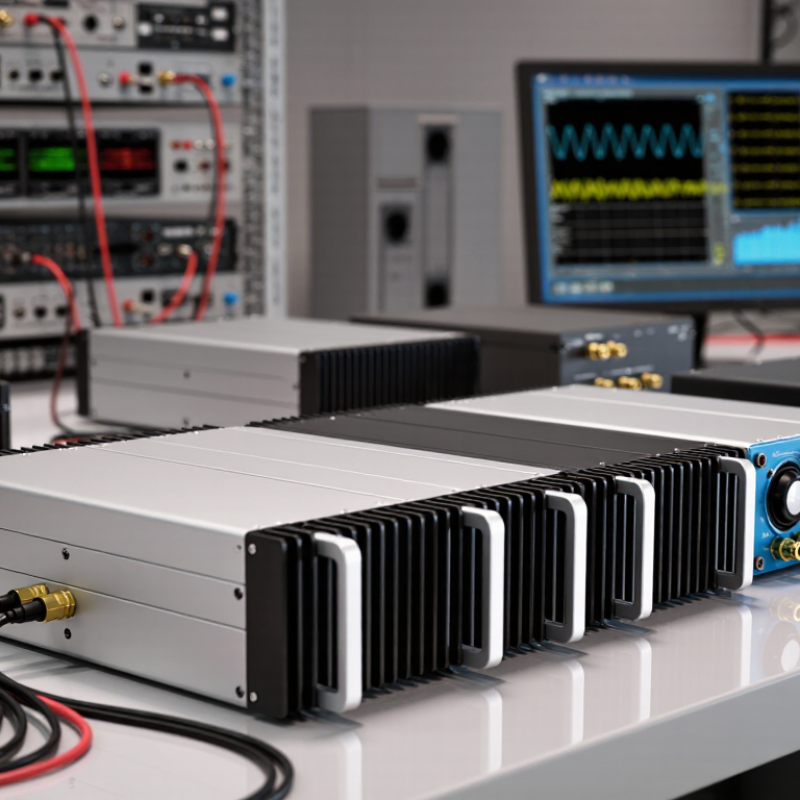
An RF amplifier raises radio-frequency signals so they can travel through a transmitter chain or be detected more reliably by a receiver. Its role depends on its position: a low-noise stage preserves faint incoming signals, while a power stage drives an antenna. These circuits support cellular networks, Wi-Fi equipment, satellite links, radar, and laboratory test systems. Small component, big job.
The Ericsson Mobility Report, June 2024, forecasts average mobile data traffic per smartphone rising from about 21 GB per month in 2024 to 56 GB by 2030. That growth puts pressure on network capacity and efficient radio hardware. Amplifier design balances output power, linearity, bandwidth, noise, and energy use; improving one can compromise another. A compact module may also heat up quickly, especially in a sealed outdoor radio unit. Heat is real.
The GSMA’s Mobile Economy 2024 report estimates 5.6 billion unique mobile subscribers in 2023, around 69% of the global population. More connected devices mean RF amplifiers must work across varied frequencies and signal conditions. In practice, engineers check gain, impedance matching, and thermal performance in the intended system, not just on a datasheet. I would treat any single benchmark cautiously: antenna placement, cabling, and local interference can change measured results.
RF amplifier categories and representative performance ranges. Values vary by design, frequency, operating conditions, and test method; they are indicative rather than guaranteed specifications.
| RF Amplifier Category | Representative Frequency Range | Typical Gain | Typical Output Power | Key Performance Considerations | Common Applications |
|---|---|---|---|---|---|
| Low-Noise Amplifier (LNA) | VHF through microwave bands; commonly designed for a specific band from tens of MHz to several GHz | About 10–30 dB | Often around −10 to +20 dBm at the 1 dB compression point | Low noise figure, input matching, stability, and adequate linearity for the expected signal level | Receiver front ends, satellite navigation, radio astronomy, radar, and wireless infrastructure |
| RF Driver Amplifier | Band-specific designs spanning HF, VHF, UHF, and microwave frequencies | About 10–25 dB | Often around +20 to +33 dBm at the 1 dB compression point | Gain flatness, linearity, and the ability to drive a final power amplifier without excessive distortion | Transmitter chains, test equipment, communication systems, and radar transmitters |
| RF Power Amplifier (PA) | Commonly designed for a defined operating band; applications include sub-6 GHz cellular and broadcast bands | About 10–30 dB, depending on output level and design | Ranges from below 1 W to tens of watts or more in many system designs | Output power, efficiency, heat dissipation, bandwidth, and linearity; modulation schemes may require linearization | Cellular base stations, two-way radios, broadcasting, public-safety communications, and industrial RF systems |
| Broadband Amplifier | May cover multiple octaves, for example from a few MHz to several GHz, depending on the design | About 10–40 dB across the specified band | Typically specified by output power or compression point at particular frequencies | Gain flatness, input and output match, stability across the full band, and usable bandwidth | Laboratory instrumentation, EMC testing, antenna systems, and broadband communications |
| Millimeter-Wave Amplifier | Commonly covers bands such as 24–40 GHz or other designated millimeter-wave ranges | About 10–30 dB per amplifier stage | Often lower than comparable lower-frequency PAs; output is specified for the particular band and device | High-frequency gain, packaging and interconnect losses, thermal management, and precise RF layout | Millimeter-wave communications, point-to-point links, automotive radar, and test systems |
| Bidirectional or T/R Amplifier | Designed for the system’s operating band, from VHF and UHF through microwave frequencies | Varies by receive and transmit path; commonly specified separately for each path | Receive and transmit power ratings differ substantially by design | Transmit/receive isolation, switching speed, receiver protection, and low receive-path noise | Radar, time-division communication systems, shared-antenna radios, and wireless test setups |

Selection note: Compare amplifier specifications at the intended frequency and operating conditions. Check gain, noise figure, output compression or saturation power, linearity, impedance, supply requirements, thermal limits, and applicable compliance requirements.
Top RF Amplifier Manufacturers in China?
China’s RF amplifier industry has grown alongside mobile networks, satellite links, and connected devices. MIIT’s 2024 Communications Industry Statistical Bulletin reported 4.25 million 5G base stations nationwide by year-end. Each station relies on power amplifiers to send stable signals through feeders, antennas, and crowded urban airwaves. The scale is visible.
Development also draws on a broader semiconductor base. The China Semiconductor Industry Association reported 2023 integrated-circuit industry sales of RMB 1.229 trillion, up 2.3% year over year. This covers the entire IC sector, not RF amplifiers alone, but indicates a larger pool of design, packaging, and testing capabilities. Progress is uneven.
Chinese manufacturers are developing gallium nitride for high-power systems and gallium arsenide for established microwave applications. Silicon-based designs remain attractive where cost and integration matter. Engineers face difficult trade-offs: heat, efficiency, linearity, and reliability can pull in different directions. A datasheet rarely shows the full story. Thermal cycling and repeatable production matter as much as peak output. Further progress depends on reliable materials, measurement tools, and skilled RF teams. Some gaps remain, and they deserve honest attention.
Leading RF amplifier manufacturers in China are best assessed by engineering evidence, not catalogue breadth. Their products serve cellular infrastructure, satellite communications, industrial radios, and laboratory test systems. Buyers should compare operating frequency, gain flatness, noise figure, output power, linearity, and thermal behavior. These factors affect stability inside a crowded equipment rack or an outdoor radio enclosure. Small details matter. Ask for test conditions, not just headline specifications. A gain figure without frequency, temperature, and input-power context says little.
MarketsandMarkets estimated the global RF power amplifier market at US$6.1 billion in 2023 and forecast US$8.4 billion by 2028, a 6.6% compound annual growth rate. This is a worldwide estimate, not a ranking of Chinese suppliers. For practical evaluation, request performance data across the intended band and check calibration, traceability, and production consistency. Compare samples under realistic load and temperature conditions. A polished datasheet is not proof of repeatable field performance. Public market reports rarely reveal supplier-level quality variation, so that uncertainty deserves attention during qualification. Ask clear questions, and keep the answers on record.
Common RF amplifier frequency bands
The bars show conventional frequency ranges for common RF bands, not market share or specifications for any manufacturer. Band definitions can vary by application, and an amplifier’s supported range depends on its individual design.
RF amplifiers are not one-size-fits-all components. Their technology and configuration depend on frequency, output power, bandwidth, and signal quality. Common solid-state designs use LDMOS or GaN transistors. LDMOS can suit many established communication bands, while GaN is often selected when higher power density or wider bandwidth matters. Neither choice wins in every application.
Product types include narrowband amplifiers tuned for a specific frequency range, broadband units covering multiple bands, and power amplifiers designed to drive a load. Low-noise amplifiers are used near a receiver input, where added noise can weaken a small signal. Linear Class A or Class AB designs may preserve modulation detail, but they can generate more heat. Efficiency matters.
When comparing specifications, check gain, noise figure, output power, and operating bandwidth together. A high gain figure alone tells little. On a test bench, a spectrum analyzer can reveal unwanted harmonics that a simple power reading misses. Cooling also deserves attention: a compact metal enclosure may become warm during sustained operation. Not always obvious. Datasheets may not reflect every installation, so verify performance under the intended supply voltage, load, and temperature before choosing a unit.
Choosing an RF amplifier supplier takes more than comparing power ratings. Start with the operating range, gain, noise figure, output power, and linearity required by your system. Ask for test data at the frequencies and power levels you actually use. A neat specification sheet is useful, but it may not show performance across temperature or under continuous operation. Details matter.
Check how the manufacturer verifies each unit. Can it provide calibration records, production test procedures, and clear explanations of measurement conditions? Ask about component traceability, burn-in testing, and steps for handling failures. If possible, review a sample report or evaluate a sample unit in your own setup. Small differences in connectors, heat sinking, or cable loss can affect results. The bench tells the truth.
Communication is another practical measure. A reliable engineering team should answer technical questions directly and explain limits without promising perfect performance. Discuss lead times, customization, repair options, and documentation before ordering. Site visits or remote production audits may offer useful context, though they cannot replace independent testing. No supplier is flawless, and I would be cautious about treating one successful sample as proof of consistent production. Ask what happens when a batch falls outside its agreed specifications.


For those larger-sized parts, or smaller quantity runs, we have 2 independent powder coat booths and ovens. The quality, durability and affordability of today’s powder coating finishes make this the process of choice for world-class companies.
Powder coating advantages over other forms of coating are many. Materials used in the Powder coating process can be metals and non-metals that come in a multitude of thicknesses, textures, colors, etc. Another of Powder coating’s biggest advantages over conventional coatings is its ability to create finishes in many different textures. Powder Coating Booths allow us the ability to apply these advantages to large products.
Tri-State Fabricators runs a full-service conveyor line for painting. Wet painting can provide protection or decoration to many different part styles. From start to finish, every project is easier to undergo random and point-based inspection by our skilled painting team.
Advantages to our Wet Paint Line are these lines start with product prep and ends with a thorough inspection of a high quality finished product. Our ability to complete large and small projects with a superior finish and doing so in a timely and economical fashion. This passes along the savings in production to our customers. When powder coating ins not an option, our Wet Paint Line gets the job done right the first time.
When the parts get big and heavy we roll-out our custom paint racks and oversize booth. By utilizing our partnerships with all the major paint brands, we can match virtually any color with wet paint.
The advantages of having access to a Wet Paint Booth are many. Large projects of many different shapes can be loaded into the booth. The Wet Paint Booth offers an environment that is much more controlled than a typical parts painting operation.
Not only are they used because of their controlled environment, but they’re are also advantageous when it comes to applying paint to parts that are needed in industries that require specialty coatings such as medical, aerospace, etc.
Our military forces have some very high standards when it comes to the finish of their vehicles and equipment. From the first pre-treatment step to final coat, it takes a great deal of knowledge and experience to protect the men and women of our armed forces. They deserve only the best, and Tri-State Fabricators provides it.
All of our processes are closely monitored by our staff and management teams. Both of which are highly trained in the processes of metal fabrication and finishing. Tri-State Fabricators’ goal is to always fully satisfy each and every customer, including the military. We will always put a 110% into what we do.
Abrasive media blasting is an excellent way to remove old paint, rust, and increase the paint/powder adhesion. Glass beads produce a much smoother and brighter finish than angular abrasives; leaving the part clean yet without any dimensional change. Chemically inert and environmentally friendly, we can recycle our beads approximately 30 times; making them a more preferred method of metal cleaning or surface finishing.
Advantages to Glass Bead Blasting are many. Glass bead blast media is used when a project is needing rough surfaces need to become smooth for applications of coatings such as paint. It is typically used to clean paint and rust from a product surface without deforming the surface it is being used on. Overall, compared to many other blasting media, Glass Bead Blasting is a very economical choice and those savings are always passed on to our customers.
Tri-State Fabricators utilize a zinc phosphate wash to clean and etch the material to ensure the best paint adhesion possible. The unique design of our 3-stage wash system does the work like a 5-stage. From Cleaning and rinsing to conversion coating and post-treatment, Our Part Washing process is a complete service and works throughout the fabrication service and the finishing service.
Along with the previously mentioned benefits, Curing is a vital chemical reaction that leaves the product finish hard and relatively safe from mild abrasion and aggressive corrosion. This process can be done in more than one way; ambient air-dry or in curing ovens at temps that exceed 240°.
From fixing paint mistakes (someone else’s of course) to simply cleaning our paint line hooks, our burn-off oven is put to good use. After a quick burn-off, a little clean up, and a fresh coat of paint, your parts will look better than new.
Why does our Burn-Off Oven work so well? Because super heating the air around parts turns the materials into ashes. From paint and powder coatings to rubber and machining oils, high temps do the job without degrading the integrity of the part.
Masking is a vital part of producing high quality products. We have die-cut masking patterns to protect machined surfaces as well as a wide range of plugs and caps to protect threaded holes and bolts. We provide permanent and temporary masking.
Masking allows the selected sections of a product to be protected from a fabrication or finishing service. This can be with both chemicals when etching and tapes, paints when only finishing just a section of the product. Masking is great in aiding the customization process of a project.
Screen printing is a photographic process that transfers artwork onto a porous nylon screen which allows colored ink to flow through the screen and be deposited on an aluminum or plastic component. We can generally have just about any design created onto a screen for your parts.
Some of the advantages of Screen Printing are, brand recognition for your business displaying on your products, assembly instructions, product warnings/hazards, etc. Tri-State Fabricators produces Screen Printing of the highest quality so you know it’s durable.
Metal Finishing is the art of treating the exterior portion of product, often metal but can also be made of other materials, so that the surface is clean and free of any debris. Then the process of applying coats or either paint of powder coat takes place. This coating process improves the quality of the product in both appearance and resistance to wear and corrosion.
Tri-State Fabricators, Inc., understands that a project typically isn’t complete until a high-quality finish has been added to your product. This is why our painting and powder coating teams continuously inspect the products throughout the Metal Finishing process.

