


Global buyers are reassessing kitchen fixtures as renovation demand, hygiene expectations, and supply-chain risks continue to shape purchasing decisions. Grand View Research reports that the global engineered stone market is expanding, supported by residential construction and remodeling activity. Its market analysis also identifies quartz-based surfaces as a major growth segment. However, a quartz sink is not simply a smaller countertop. Its resin composition, wall thickness, drainage design, and surface finish can strongly affect long-term performance.
This guide examines leading quartz sink manufacturers for international buyers. The assessment considers production capacity, material consistency, mold precision, export experience, private-label support, and after-sales service. It also considers practical evidence, such as scratch resistance, thermal-shock testing, packaging quality, and batch inspection records. NSF International’s standards for food equipment materials offer useful guidance for evaluating surfaces that contact kitchen environments. ISO 9001 certification can further indicate a structured quality-management system, although certification alone proves little about product durability.
Supplier claims deserve careful checking. A beautiful sample may not represent every production batch. Buyers should request technical sheets, independent test reports, factory photographs, and references from comparable markets. Intertek and SGS inspection services can help verify dimensions, color consistency, and carton protection before shipment. GlobalData and other construction-market analysts continue to highlight uneven regional demand, so delivery reliability matters as much as appearance. This list is not permanently correct. Manufacturers change factories, materials, and policies. That is worth remembering. The strongest supplier is the one that combines stable quartz sink quality with transparent documentation and dependable communication.
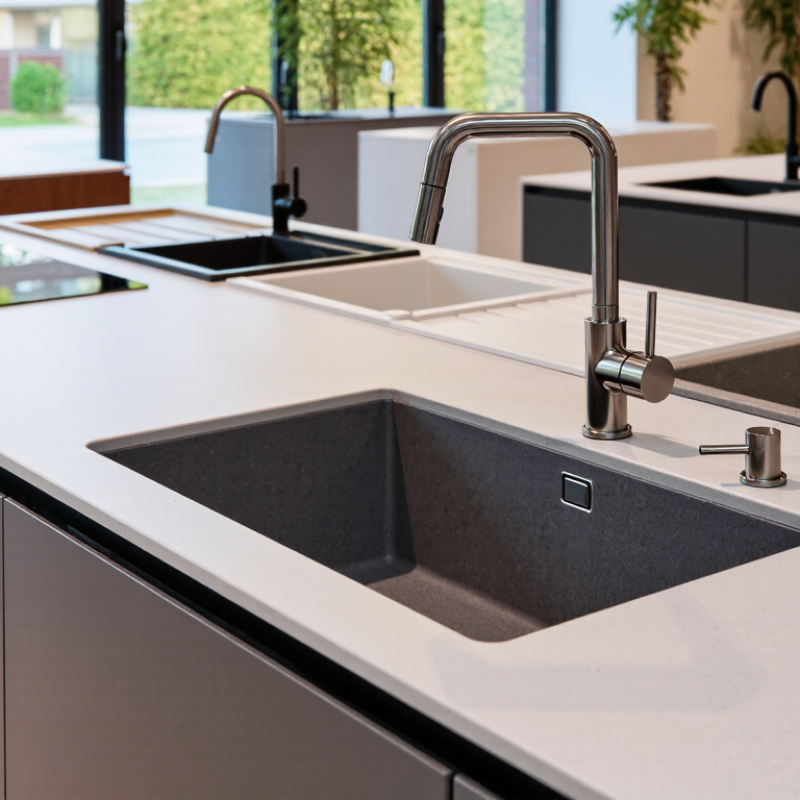
Quartz sinks are engineered composite basins made from crushed quartz, mineral fillers, and binding resin. They are not carved from a single quartz block. That distinction matters.
The quartz content gives the basin a dense, stone-like surface and a solid feel under running water. Resin helps manufacturers shape the bowl, drain area, and installation edge with consistent accuracy. Common finishes include matte, lightly textured, and polished surfaces. Dark colors can hide food marks, but they may reveal mineral deposits more clearly.
A practical inspection should examine wall thickness, drain alignment, surface uniformity, and edge strength. Buyers should also check the material ratio, because “quartz” alone does not prove consistent quality. Poorly mixed material may show uneven color or weak areas near the drain. That is not always visible in product photos.
Quartz composites usually resist scratches, stains, heat, and everyday impact better than many basic sink materials. However, no sink is maintenance-free. Very hot cookware, abrasive powders, and sudden temperature changes can still damage the surface. A soft sponge, mild cleaner, and prompt drying are safer choices. For global purchasing, confirm installation dimensions, packaging protection, test standards, and replacement support before placing a large order. Small details matter.

Evaluating quartz sink manufacturers requires more than comparing catalog prices. Ask for the quartz content, resin specification, and product test reports. Reliable manufacturers should explain these details clearly. Vague answers deserve caution.
Request a physical sample before placing a large order. Check its color under warm and cool lighting. Inspect the drain opening, rim thickness, and underside reinforcement. A difference of two millimeters can complicate installation. Ask how each batch is inspected. Useful records include dimensional checks, surface inspections, and water-resistance testing. Independent laboratory reports add stronger evidence than factory claims alone.
Packaging matters during international shipping. Ask for carton photos, drop-test procedures, pallet details, and replacement policies. Confirm production capacity using a realistic monthly quantity, not an attractive maximum figure. Verify lead times during busy seasons. Communication is also practical evidence: precise answers, revised drawings, and clear purchase terms reduce mistakes. I once focused too heavily on appearance and overlooked drain compatibility. That error caused extra labor and delayed delivery. A careful manufacturer should provide installation drawings, care instructions, and consistent technical support. Still, no supplier is perfect. Samples may differ slightly from later batches, so written tolerances and approval procedures remain important. Check warranty coverage, response times, and documentation before making the final decision.
Quartz sink production is concentrated in regions with strong stone-processing and resin-forming capabilities. China offers broad capacity, flexible customization, and competitive pricing for large orders. India is known for engineered stone processing and export-oriented workshops. Turkey benefits from established natural-stone expertise and nearby European markets. Vietnam is becoming attractive for buyers seeking alternative production bases.
Supplier types vary considerably. Large OEM factories usually provide stable output, mold development, and container-scale orders. Specialized manufacturers may offer better control over sink thickness, drainage design, and surface texture. Trading companies can combine products from several factories, but quality control may depend on their partners. This difference matters.
A reliable buyer should request recent factory audit records, production photos, and physical samples. Check bowl depth, edge straightness, color consistency, and packaging strength. Ask for water absorption, impact, heat, and stain-resistance test results. International shipments need accurate carton dimensions and clear pallet information. Small details prevent expensive surprises.
In supplier evaluations, the cheapest quotation is rarely the complete cost. Freight damage, replacement delays, and inconsistent colors can erase the initial saving. I have seen buyers focus heavily on price and overlook mold ownership. That decision can limit future production. A better process compares samples, factory capacity, technical communication, and after-sales responsibility. Mistakes still happen, especially with new suppliers. The goal is to identify them before mass production.
| Manufacturing Region | Common Supplier Type | Typical Product Focus | Common Material and Construction | Production and Customization Strengths | Typical Buyer Fit | Key Sourcing Checks |
|---|---|---|---|---|---|---|
| China | Large OEM / ODM Factory | Single-bowl, double-bowl, workstation, bar, laundry and customized kitchen sinks | Quartz or granite mineral filler combined with acrylic, polyester or other resin binders; molded composite construction | Broad size range, private-label production, color development, tooling support and high-volume manufacturing | Importers, kitchen distributors, retail programs and project buyers | Confirm resin-to-mineral composition, color consistency, mold accuracy, packaging strength, inspection process and export documentation |
| India | Export-Oriented Manufacturer | Granite-composite and quartz-composite sinks for residential kitchens and hospitality projects | Crushed natural stone or quartz aggregate mixed with resin and molded under controlled pressure and temperature | Competitive production costs, natural-stone appearance, private-label options and growing export capability | Regional wholesalers, home-improvement distributors and value-focused importers | Review aggregate grading, surface uniformity, drainage design, packing method, production capacity and destination-market compliance |
| Turkey | Stone and Kitchen Fixture Manufacturer | Premium-looking composite sinks, coordinated kitchen products and architectural project items | Mineral-filled resin composite, often designed to reproduce the appearance of natural stone | Strong stone-processing knowledge, design-oriented finishes, European logistics access and medium-to-large production runs | European buyers, kitchen studios, contract projects and mid-to-premium distributors | Check finish durability, edge quality, bowl geometry, pallet configuration, lead time and applicable European product requirements |
| Vietnam | Private-Label Export Factory | Standard-size composite sinks, modern color ranges and selected custom collections | Mineral aggregate and thermoset resin formed into one-piece sink bodies | Flexible export production, increasing capacity, competitive labor costs and suitability for diversified sourcing | Retail importers, online sellers and buyers seeking an alternative Asian supply base | Validate mold ownership, production stability, color repeatability, carton testing, container loading and supplier audit records |
| Italy and Central Europe | Design-Led Specialist Manufacturer | Premium undermount, flush-fit, integrated and design-focused composite sinks | Engineered mineral-resin composites with controlled surface texture, color and dimensional tolerances | Product design, engineering precision, premium finishing, advanced quality systems and support for specification-led projects | Premium kitchen brands, architects, showrooms and high-end residential projects | Compare technical datasheets, installation tolerances, warranty terms, repair guidance and regional conformity documentation |
| South Korea and Japan | Technology-Focused Component Manufacturer | Compact, precision-finished and design-specific sinks for modern kitchens and space-efficient housing | High-consistency engineered mineral composite with carefully controlled molding and finishing processes | Dimensional accuracy, compact designs, clean surfaces and attention to installation details | Design-conscious distributors, modular-kitchen suppliers and specialized project buyers | Assess minimum order quantities, export experience, installation compatibility, replacement-part availability and communication procedures |
| North America | Domestic or Regional Contract Manufacturer | Standard replacement sizes, custom project orders and products tailored to local cabinet dimensions | Quartz or granite mineral composite produced through molded or cast manufacturing methods | Shorter domestic lead times, local service, lower cross-border complexity and easier project coordination | Domestic distributors, builders, remodelers and buyers prioritizing local fulfillment | Check local plumbing dimensions, delivery coverage, warranty service, replacement policy and total landed cost compared with imports |
A reliable quartz sink manufacturer treats quality as a measurable process, not a catalog promise. The blend matters. Factories should control quartz aggregate grading, resin ratios, pigments, and curing temperatures for every batch. Experienced teams also inspect bowl thickness, corner radii, drain openings, and underside reinforcement. Small dimensional errors can cause leaks or difficult countertop installation.
Global buyers should request current certificates, test reports, and factory audit records. ISO 9001 can indicate controlled procedures, but its scope must cover the actual production site. Certification alone is not proof of sink performance. Ask whether documents identify test methods, sample dates, and accredited laboratories. Useful evaluations include stain resistance, thermal shock, impact strength, water absorption, and drainage behavior. Requirements differ by market.
Manufacturing capability appears in the details. A dependable facility can show mold capacity, CNC or waterjet equipment, automated polishing, and manual inspection records. It should explain how defects are classified and replaced before shipment. Traceable carton labels and retained samples strengthen accountability during international claims. Still, no factory is flawless. I would treat unusually perfect inspection rates as a question, not reassurance. Clear corrective-action records often reveal more professionalism than glossy photographs. That evidence helps buyers compare suppliers on repeatability, not appearance.
Choosing a quartz sink supplier requires more than comparing catalog prices. Request physical samples and inspect the surface under bright light. Check color consistency, edge finishing, bowl depth, drain placement, and cutout tolerances. A sink that looks excellent online may feel uneven after installation. Measure your cabinet and countertop drawings carefully. Small errors become expensive problems.
Ask suppliers for production photos, quality-control records, and recent test reports. Clarify quartz content, resin type, thickness, load resistance, stain performance, and warranty terms. Reliable manufacturers should explain how they handle cracks, color variation, and replacement claims. Request a sample before approving bulk production. I have found that written specifications prevent more disputes than friendly promises. Still, samples cannot represent every batch perfectly.
For importing, compare minimum order quantities, lead times, packaging strength, and payment conditions. Confirm the correct trade terms and ask who manages export documents. A wooden crate with corner protection can reduce damage, but it also changes freight costs. Use a third-party inspection before shipment, especially for a first order. Check carton labels, product codes, certificates, and destination customs requirements with a qualified broker. Do not assume the supplier understands your local rules. One overlooked document can delay an otherwise well-packed container. Keep communication records, approve a final production sample, and include measurable acceptance standards in the purchase contract.
This buyer-defined benchmark allocates 100% of the supplier evaluation across the factors that most directly affect international quartz sink purchasing. Product quality and compliance should receive the highest weighting, followed by delivered cost, production capacity, lead time, customization, and after-sales support. Buyers can adjust these percentages according to their market, order volume, and import requirements.


For those larger-sized parts, or smaller quantity runs, we have 2 independent powder coat booths and ovens. The quality, durability and affordability of today’s powder coating finishes make this the process of choice for world-class companies.
Powder coating advantages over other forms of coating are many. Materials used in the Powder coating process can be metals and non-metals that come in a multitude of thicknesses, textures, colors, etc. Another of Powder coating’s biggest advantages over conventional coatings is its ability to create finishes in many different textures. Powder Coating Booths allow us the ability to apply these advantages to large products.
Tri-State Fabricators runs a full-service conveyor line for painting. Wet painting can provide protection or decoration to many different part styles. From start to finish, every project is easier to undergo random and point-based inspection by our skilled painting team.
Advantages to our Wet Paint Line are these lines start with product prep and ends with a thorough inspection of a high quality finished product. Our ability to complete large and small projects with a superior finish and doing so in a timely and economical fashion. This passes along the savings in production to our customers. When powder coating ins not an option, our Wet Paint Line gets the job done right the first time.
When the parts get big and heavy we roll-out our custom paint racks and oversize booth. By utilizing our partnerships with all the major paint brands, we can match virtually any color with wet paint.
The advantages of having access to a Wet Paint Booth are many. Large projects of many different shapes can be loaded into the booth. The Wet Paint Booth offers an environment that is much more controlled than a typical parts painting operation.
Not only are they used because of their controlled environment, but they’re are also advantageous when it comes to applying paint to parts that are needed in industries that require specialty coatings such as medical, aerospace, etc.
Our military forces have some very high standards when it comes to the finish of their vehicles and equipment. From the first pre-treatment step to final coat, it takes a great deal of knowledge and experience to protect the men and women of our armed forces. They deserve only the best, and Tri-State Fabricators provides it.
All of our processes are closely monitored by our staff and management teams. Both of which are highly trained in the processes of metal fabrication and finishing. Tri-State Fabricators’ goal is to always fully satisfy each and every customer, including the military. We will always put a 110% into what we do.
Abrasive media blasting is an excellent way to remove old paint, rust, and increase the paint/powder adhesion. Glass beads produce a much smoother and brighter finish than angular abrasives; leaving the part clean yet without any dimensional change. Chemically inert and environmentally friendly, we can recycle our beads approximately 30 times; making them a more preferred method of metal cleaning or surface finishing.
Advantages to Glass Bead Blasting are many. Glass bead blast media is used when a project is needing rough surfaces need to become smooth for applications of coatings such as paint. It is typically used to clean paint and rust from a product surface without deforming the surface it is being used on. Overall, compared to many other blasting media, Glass Bead Blasting is a very economical choice and those savings are always passed on to our customers.
Tri-State Fabricators utilize a zinc phosphate wash to clean and etch the material to ensure the best paint adhesion possible. The unique design of our 3-stage wash system does the work like a 5-stage. From Cleaning and rinsing to conversion coating and post-treatment, Our Part Washing process is a complete service and works throughout the fabrication service and the finishing service.
Along with the previously mentioned benefits, Curing is a vital chemical reaction that leaves the product finish hard and relatively safe from mild abrasion and aggressive corrosion. This process can be done in more than one way; ambient air-dry or in curing ovens at temps that exceed 240°.
From fixing paint mistakes (someone else’s of course) to simply cleaning our paint line hooks, our burn-off oven is put to good use. After a quick burn-off, a little clean up, and a fresh coat of paint, your parts will look better than new.
Why does our Burn-Off Oven work so well? Because super heating the air around parts turns the materials into ashes. From paint and powder coatings to rubber and machining oils, high temps do the job without degrading the integrity of the part.
Masking is a vital part of producing high quality products. We have die-cut masking patterns to protect machined surfaces as well as a wide range of plugs and caps to protect threaded holes and bolts. We provide permanent and temporary masking.
Masking allows the selected sections of a product to be protected from a fabrication or finishing service. This can be with both chemicals when etching and tapes, paints when only finishing just a section of the product. Masking is great in aiding the customization process of a project.
Screen printing is a photographic process that transfers artwork onto a porous nylon screen which allows colored ink to flow through the screen and be deposited on an aluminum or plastic component. We can generally have just about any design created onto a screen for your parts.
Some of the advantages of Screen Printing are, brand recognition for your business displaying on your products, assembly instructions, product warnings/hazards, etc. Tri-State Fabricators produces Screen Printing of the highest quality so you know it’s durable.
Metal Finishing is the art of treating the exterior portion of product, often metal but can also be made of other materials, so that the surface is clean and free of any debris. Then the process of applying coats or either paint of powder coat takes place. This coating process improves the quality of the product in both appearance and resistance to wear and corrosion.
Tri-State Fabricators, Inc., understands that a project typically isn’t complete until a high-quality finish has been added to your product. This is why our painting and powder coating teams continuously inspect the products throughout the Metal Finishing process.

