


Choosing the right filament can determine whether a 3D print feels professional or merely acceptable. For global buyers, Pla 3d Printing filament offers an accessible balance of printability, cost, appearance, and environmental considerations. Yet product labels often hide important differences. Diameter tolerance, moisture resistance, pigment consistency, spool design, and packaging quality can change the final result.
This guide examines ten PLA 3D Printing filaments selected for practical international purchasing decisions. Each option is considered through real printing factors, including nozzle performance, bed adhesion, layer visibility, surface finish, and dimensional stability. A filament that works smoothly at 210°C on one printer may require adjustment on another. That is normal. Printer calibration, storage conditions, and model geometry still matter.
We also consider evidence that buyers can verify, such as manufacturer specifications, test samples, material information, and user feedback. Where claims seem broad, they deserve closer inspection. “Easy to print” is not a universal promise. A roll arriving in a damp warehouse may behave differently from one opened in a dry workshop. Small details matter.
The ranking is practical, not absolute. Color accuracy may matter more to a designer than maximum strength. A school, prototyping studio, or production team may follow different priorities. Some evaluations remain subjective, and further testing would improve confidence. Still, these ten filaments provide a useful starting point for comparing quality, value, reliability, and global availability before placing an order.
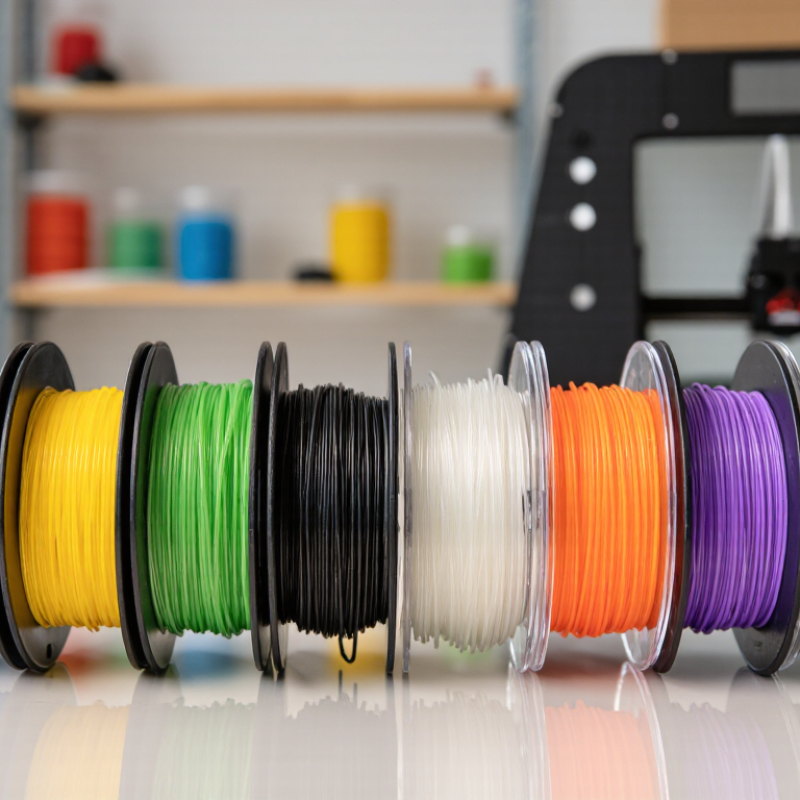
PLA, or polylactic acid, is a thermoplastic made from renewable plant-based sources. It melts at relatively low temperatures and usually prints with limited warping. For global buyers, this balance can reduce setup time across different desktop printers. PLA also offers sharp edges, bright colors, and a smooth surface for prototypes, models, and classroom projects. Still, easy printing does not mean universal performance.
In real print testing, I check nozzle temperature, cooling, layer bonding, and dimensional accuracy. A spool that prints well in a dry workshop may behave differently in a humid coastal warehouse. PLA absorbs moisture slowly, but damp filament can cause popping, rough walls, and weak layers. Buyers should review diameter tolerance, recommended settings, packaging quality, and storage instructions. I have seen attractive samples fail because the filament arrived with loose winding. That mistake is easy to underestimate.
Tips: Request a small sample before placing a large order. Print a thin tower and a detailed mechanical part. Check surface quality, layer adhesion, and spool consistency. Ask for technical data and production-batch information. Do not judge PLA by color alone. Some assumptions need testing.
PLA is a plant-based thermoplastic known for easy printing, low warping, and a relatively low processing temperature. The chart compares typical nozzle-temperature midpoints for ten commonly purchased PLA formulations. Actual settings vary by printer, layer height, color, additives, and manufacturer, so buyers should always verify the technical data sheet before production.
Top 10 PLA 3D Printing Filaments for Global Buyers
When comparing PLA filament, start with measurable quality rather than attractive packaging. Check the declared diameter tolerance, usually near ±0.02 mm for consistent products. Uneven filament can cause clicking extruders, thin walls, and visible gaps. Inspect the spool edge for clean winding. Tangled filament wastes more time than a slightly higher purchase price.
Performance depends on more than melting temperature. A dependable PLA should produce sharp corners, smooth top layers, and stable bridges at ordinary speeds. Test a small calibration cube before ordering in bulk. Record nozzle temperature, bed temperature, layer height, and cooling settings. My own test was not flawless. A filament that printed beautifully at 60 mm/s became brittle during faster travel. That result changed my purchasing decision.
Compatibility also matters for global buyers. Confirm the filament diameter matches the printer’s extruder system. Check spool width, center-hole size, and maximum spool weight before shipping. Some enclosed printers need tighter dimensional control. Moisture can create bubbles, rough surfaces, and weak layers, even with good PLA. Look for sealed packaging with desiccant and clear batch information. Ask about storage conditions and production testing. A certificate helps, but practical samples reveal more. Keep a small amount from each batch for comparison. Prices, labels, and specifications can mislead. Test real prints.
For global buyers, PLA selection should follow the print, not the product page. The Wohlers Report 2024 valued the additive manufacturing industry at US$20.035 billion in 2023, after 13.5% growth. That expansion brings more material choices, but also more inconsistent labels. These ten PLA profiles cover common needs: standard PLA for prototypes, tough PLA for handling, high-speed PLA for rapid production, matte PLA for reduced layer lines, silk PLA for display pieces, transparent PLA for light effects, wood-filled PLA for texture, recycled PLA for lower-impact projects, glow PLA for visual markers, and heat-resistant PLA for warmer environments. The last category still needs caution.
Standard PLA is the forgiving baseline. Use a 0.4-millimeter nozzle and moderate cooling for clean corners. High-speed grades can shorten printing time, but only when the hot end supplies enough heat. Otherwise, weak bonding appears between layers. Tough PLA suits brackets and classroom models, though it is not a replacement for certified structural polymers. Matte and silk variants favor appearance over maximum interlayer strength. Wood-filled filament needs a wider nozzle. Tiny nozzles can clog.
Transparent PLA rarely becomes truly clear on ordinary FDM machines. It often looks translucent, especially after visible layer changes. Recycled and glow grades may vary between batches, so drying and a small test cube are sensible. ASTM D3418-based polymer testing commonly places PLA’s glass-transition range near 55–65°C. Hot car interiors remain a poor test. My ranking is practical, not absolute. Printer calibration, moisture, and supplier consistency can overturn it.
Top 10 PLA 3D Printing Filaments for Global Buyers
When comparing PLA filaments, supplier evaluation should begin with repeatable evidence. Request samples from several production batches. Check diameter tolerance, moisture levels, winding quality, and print consistency. A dependable supplier provides technical data, safety documents, production dates, and clear material specifications. Ask for a small test order before committing to a full container. Print a calibration cube, thin walls, and a bridging model. Small details matter.
Pricing should reflect the landed cost, not only the factory quote. Include packaging, inland transport, customs duties, insurance, and destination delivery fees. A low quote can become expensive. Compare minimum order quantities and payment terms carefully. Confirm whether pricing changes with color, spool size, or recycled content. For international shipping, request accurate carton dimensions, gross weight, pallet details, and export documents. Clarify the agreed Incoterm and delivery responsibility. Also check the supplier’s record for damaged spools and delayed dispatches. A beautiful sample proves little. Keep retained samples for future comparison. No scorecard is perfect. A supplier may perform well in summer but struggle during humid shipping seasons. That risk deserves a written question, not an assumption.
| Rank | PLA Filament Profile | Typical Technical Data | Best-Fit Applications | Indicative Export Price USD/kg | Typical MOQ | Supplier Evaluation Checks | Common Lead Time | International Shipping Considerations | Key Buying Risk |
|---|---|---|---|---|---|---|---|---|---|
| 1 | Standard PLA Best overall value | Nozzle: 190–220°C Bed: 45–60°C Density: approximately 1.24 g/cm³ Diameter tolerance: target ±0.02 mm | Prototypes, educational models, decorative parts, general-purpose printing, and low-stress components. | $8–18 | 100–500 kg | Request diameter-test data, moisture-control procedures, batch traceability, SDS, and a sample spool. Verify that the quoted price includes the specified spool, vacuum bag, desiccant, and carton. | 7–20 days after approval | Generally non-dangerous for transport. Sea freight is economical for pallets; air freight is practical for samples but has a higher cost per kilogram. Protect cartons from humidity. | Inconsistent diameter or moisture can cause under-extrusion, brittle filament, and variable surface quality. |
| 2 | PLA+ / Toughened PLA Improved durability | Nozzle: 195–225°C Bed: 45–65°C Usually higher impact resistance than standard PLA Blend composition may vary by supplier | Functional prototypes, brackets, housings, fixtures, and parts requiring better toughness than ordinary PLA. | $9–22 | 100–500 kg | Ask for tensile, impact, elongation, and heat-deflection data using stated test standards. Confirm whether “PLA+” is a defined formulation or only a marketing term. | 10–25 days after approval | Standard cargo handling is normally suitable. Use moisture-barrier packaging because additives and pigments can make print behavior more sensitive to humidity. | Mechanical properties can differ substantially between batches and suppliers despite similar “tough” labeling. |
| 3 | Matte PLA High visual quality | Nozzle: 190–220°C Bed: 45–60°C Low-gloss surface Usually hides layer lines better than glossy PLA | Display models, architectural prototypes, product mockups, gifts, and consumer-facing parts. | $10–24 | 100–300 kg | Compare sample prints for color consistency, layer adhesion, bridging, overhangs, and dimensional accuracy. Request color cards and a tolerance range for every color. | 10–25 days after approval | Pigment and additive content may increase product weight slightly. Confirm the actual net filament weight rather than relying only on spool size. | Surface appearance and shade may vary between production lots, especially for dark or pastel colors. |
| 4 | Silk PLA Decorative finish | Nozzle: 190–220°C Bed: 45–60°C Metallic or satin visual effect Lower functional durability than many engineering blends | Decorative objects, figurines, ornaments, awards, cosplay details, and visual prototypes. | $11–26 | 100–300 kg | Require test prints at multiple speeds. Check gloss consistency, pigment dispersion, color matching, layer adhesion, and whether the effect changes with print orientation. | 10–25 days after approval | No special dangerous-goods requirement is normally expected. Prevent crushing and heat exposure that could deform retail packaging during long transit. | The shiny effect can hide weak interlayer bonding or produce inconsistent appearance at different temperatures. |
| 5 | High-Temperature PLA Post-processable | Nozzle: commonly 210–240°C Bed: 50–70°C May be annealed to improve heat resistance Annealing can change dimensions | Heat-exposed prototypes, tooling concepts, educational engineering parts, and applications requiring post-processing. | $12–28 | 100–300 kg | Request before-and-after annealing data, dimensional shrinkage data, glass-transition or heat-deflection test results, and a defined annealing procedure. | 15–30 days after approval | Packaging is generally standard, but high ambient temperatures in containers can soften or deform poorly packed spools. Use strong cartons and avoid direct sun exposure. | Heat resistance claims may not be comparable unless the test method, annealing cycle, and specimen dimensions are identical. |
| 6 | Wood-Filled PLA Natural texture | Nozzle: 195–230°C Bed: 45–60°C Abrasive particles: low to moderate Larger nozzle, often 0.4–0.6 mm, may reduce clogging | Architectural models, sculptures, props, craft items, and parts intended for sanding or staining. | $14–32 | 100–300 kg | Confirm filler percentage and particle size. Test nozzle wear, clogging frequency, color variation, sanding behavior, and moisture sensitivity. | 15–30 days after approval | Fillers can increase settling or brittleness if storage is poor. Use sealed moisture-barrier bags and request clear handling instructions for warehouse storage. | Natural filler variation can affect color, flow rate, strength, and dimensional consistency. |
| 7 | Carbon-Fiber-Reinforced PLA Stiff and lightweight | Nozzle: 200–230°C Bed: 45–65°C High stiffness-to-weight ratio Hardened-steel or equivalent wear-resistant nozzle recommended | Lightweight brackets, jigs, fixtures, robotics prototypes, drone components, and dimensionally stable parts. | $18–38 | 100–300 kg | Verify fiber percentage, tensile and flexural data, nozzle-wear guidance, fiber length, print-orientation data, and electrical or regulatory declarations where relevant. | 15–35 days after approval | The filament is usually shipped as ordinary cargo, but reinforced material is more expensive per kilogram and should be packed against abrasion and spool damage. | Increased stiffness does not necessarily mean higher impact strength; parts may remain relatively brittle across the layer direction. |
| 8 | Glass-Fiber-Reinforced PLA Dimensional stability | Nozzle: 205–235°C Bed: 50–70°C Improved stiffness and reduced warping in suitable formulations Hardened nozzle recommended | Engineering prototypes, mounting fixtures, low-load tooling, and parts needing greater rigidity. | $16–35 | 100–300 kg | Request fiber content, moisture absorption data, tensile and flexural results, abrasion recommendations, and evidence that the extrusion line is designed for filled materials. | 15–35 days after approval | Heavier filler content can increase freight cost by actual weight. Confirm the net filament mass and carton gross weight for freight quotations. | Fiber alignment and nozzle wear can change surface finish, strength, and dimensional accuracy during long production runs. |
| 9 | Recycled-Content PLA Lower-impact option | Nozzle: 190–225°C Bed: 45–65°C Recycled content may range from partial to high content Properties depend on feedstock control | General prototypes, educational programs, sustainability-focused products, and non-critical decorative parts. | $8–20 | 100–500 kg | Request a documented recycled-content percentage, chain-of-custody evidence, contaminant controls, color-batch controls, tensile data, and environmental claims substantiation. | 10–30 days after approval | No special shipping classification is normally required. Make sure sustainability documentation matches the product actually shipped and the destination-market requirements. | Greater batch-to-batch variation may occur in color, odor, melt flow, and mechanical performance. |
| 10 | Transparent or Natural PLA Light-transmitting parts | Nozzle: 195–225°C Bed: 45–60°C Translucent rather than optically clear in ordinary FDM printing Print settings strongly affect appearance | Light covers, display prototypes, containers, signage, decorative parts, and visual testing models. | $9–22 | 100–300 kg | Test haze, bubbles, moisture level, color stability, layer adhesion, and print transparency at the intended wall thickness. Avoid suppliers that describe ordinary FDM PLA as optical-grade clear without test evidence. | 10–25 days after approval | Standard transport is generally suitable. Use sealed packaging and protect clear filament from dust, scuffing, and heat deformation. | “Transparent” results vary significantly with layer height, infill, wall count, temperature, and post-processing. |
Top 10 PLA 3D Printing Filaments for Global Buyers
Essential Buying Checks for Choosing the Right PLA Filament
Choosing PLA filament requires more than comparing prices. Check the stated diameter tolerance, usually near ±0.05 mm, and look for consistent measurement records. Uneven filament can cause thin walls, gaps, or sudden under-extrusion. Ask whether each spool is tested by batch. Traceability matters when a shipment performs differently.
Moisture is another practical concern. Reliable packaging should include a sealed barrier bag and a desiccant pouch. Examine the spool before printing. Brittle filament, surface bubbles, or popping sounds may indicate moisture exposure. A broad printing temperature range can help, but it does not replace careful calibration. Test a small temperature tower first. Small details matter.
Match the filament to your equipment and project. Confirm the spool width, inner hole, and winding quality before ordering internationally. A poorly wound spool can snag during a long print. Consider whether the color uses pigments or additives that may change flow behavior. Request technical data, safety information, and storage guidance from the supplier. Clear documentation supports safer, repeatable purchasing.
My own checks are not perfect. I once trusted a familiar color and ignored its different cooling behavior. The result was weak corners and disappointing overhangs. A sample spool is often wiser than a large order. Compare layer bonding, surface finish, dimensional accuracy, and actual shipping conditions before selecting a long-term supplier.



For those larger-sized parts, or smaller quantity runs, we have 2 independent powder coat booths and ovens. The quality, durability and affordability of today’s powder coating finishes make this the process of choice for world-class companies.
Powder coating advantages over other forms of coating are many. Materials used in the Powder coating process can be metals and non-metals that come in a multitude of thicknesses, textures, colors, etc. Another of Powder coating’s biggest advantages over conventional coatings is its ability to create finishes in many different textures. Powder Coating Booths allow us the ability to apply these advantages to large products.
Tri-State Fabricators runs a full-service conveyor line for painting. Wet painting can provide protection or decoration to many different part styles. From start to finish, every project is easier to undergo random and point-based inspection by our skilled painting team.
Advantages to our Wet Paint Line are these lines start with product prep and ends with a thorough inspection of a high quality finished product. Our ability to complete large and small projects with a superior finish and doing so in a timely and economical fashion. This passes along the savings in production to our customers. When powder coating ins not an option, our Wet Paint Line gets the job done right the first time.
When the parts get big and heavy we roll-out our custom paint racks and oversize booth. By utilizing our partnerships with all the major paint brands, we can match virtually any color with wet paint.
The advantages of having access to a Wet Paint Booth are many. Large projects of many different shapes can be loaded into the booth. The Wet Paint Booth offers an environment that is much more controlled than a typical parts painting operation.
Not only are they used because of their controlled environment, but they’re are also advantageous when it comes to applying paint to parts that are needed in industries that require specialty coatings such as medical, aerospace, etc.
Our military forces have some very high standards when it comes to the finish of their vehicles and equipment. From the first pre-treatment step to final coat, it takes a great deal of knowledge and experience to protect the men and women of our armed forces. They deserve only the best, and Tri-State Fabricators provides it.
All of our processes are closely monitored by our staff and management teams. Both of which are highly trained in the processes of metal fabrication and finishing. Tri-State Fabricators’ goal is to always fully satisfy each and every customer, including the military. We will always put a 110% into what we do.
Abrasive media blasting is an excellent way to remove old paint, rust, and increase the paint/powder adhesion. Glass beads produce a much smoother and brighter finish than angular abrasives; leaving the part clean yet without any dimensional change. Chemically inert and environmentally friendly, we can recycle our beads approximately 30 times; making them a more preferred method of metal cleaning or surface finishing.
Advantages to Glass Bead Blasting are many. Glass bead blast media is used when a project is needing rough surfaces need to become smooth for applications of coatings such as paint. It is typically used to clean paint and rust from a product surface without deforming the surface it is being used on. Overall, compared to many other blasting media, Glass Bead Blasting is a very economical choice and those savings are always passed on to our customers.
Tri-State Fabricators utilize a zinc phosphate wash to clean and etch the material to ensure the best paint adhesion possible. The unique design of our 3-stage wash system does the work like a 5-stage. From Cleaning and rinsing to conversion coating and post-treatment, Our Part Washing process is a complete service and works throughout the fabrication service and the finishing service.
Along with the previously mentioned benefits, Curing is a vital chemical reaction that leaves the product finish hard and relatively safe from mild abrasion and aggressive corrosion. This process can be done in more than one way; ambient air-dry or in curing ovens at temps that exceed 240°.
From fixing paint mistakes (someone else’s of course) to simply cleaning our paint line hooks, our burn-off oven is put to good use. After a quick burn-off, a little clean up, and a fresh coat of paint, your parts will look better than new.
Why does our Burn-Off Oven work so well? Because super heating the air around parts turns the materials into ashes. From paint and powder coatings to rubber and machining oils, high temps do the job without degrading the integrity of the part.
Masking is a vital part of producing high quality products. We have die-cut masking patterns to protect machined surfaces as well as a wide range of plugs and caps to protect threaded holes and bolts. We provide permanent and temporary masking.
Masking allows the selected sections of a product to be protected from a fabrication or finishing service. This can be with both chemicals when etching and tapes, paints when only finishing just a section of the product. Masking is great in aiding the customization process of a project.
Screen printing is a photographic process that transfers artwork onto a porous nylon screen which allows colored ink to flow through the screen and be deposited on an aluminum or plastic component. We can generally have just about any design created onto a screen for your parts.
Some of the advantages of Screen Printing are, brand recognition for your business displaying on your products, assembly instructions, product warnings/hazards, etc. Tri-State Fabricators produces Screen Printing of the highest quality so you know it’s durable.
Metal Finishing is the art of treating the exterior portion of product, often metal but can also be made of other materials, so that the surface is clean and free of any debris. Then the process of applying coats or either paint of powder coat takes place. This coating process improves the quality of the product in both appearance and resistance to wear and corrosion.
Tri-State Fabricators, Inc., understands that a project typically isn’t complete until a high-quality finish has been added to your product. This is why our painting and powder coating teams continuously inspect the products throughout the Metal Finishing process.