


Choosing a Mipi Tft Display supplier in China involves more than comparing catalog prices. A bright sample on a desk may look convincing, yet still leave questions about long-term availability, integration support, and production consistency. Small details matter. Check the interface version, resolution, viewing direction, brightness, connector pitch, and operating temperature against your actual design. A mismatch can delay a prototype even when the display appears suitable.
This article examines how to assess leading Chinese suppliers through practical, verifiable criteria rather than unsupported rankings. Look for clear datasheets, responsive engineering contacts, sample options, and documented quality procedures. Ask how the supplier handles customization, minimum order quantities, lead times, and changes to components. If possible, test a sample with your own controller and enclosure; indoor lighting can hide readability problems that become obvious in a vehicle or outdoor device. Request current specifications and confirm that the quoted model matches the delivered part. Not every supplier will provide the same level of detail. That is worth noting, not glossing over. A strong shortlist should balance technical fit, communication, manufacturing capability, and dependable follow-up. The sections ahead offer a grounded starting point for comparing suppliers and asking better questions before committing to a design.
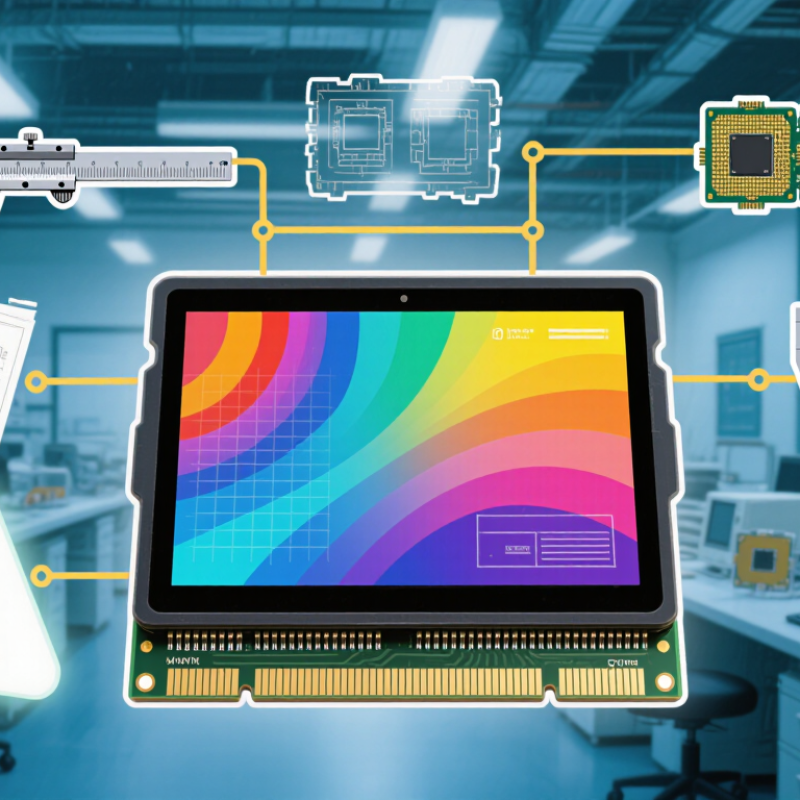
A MIPI TFT display combines a thin-film transistor pixel panel with a MIPI interface, commonly using Display Serial Interface (DSI). The TFT layer controls individual pixels, while DSI carries image data and commands from a processor to the display. Think of a small screen showing a camera preview: the processor sends pixel information through high-speed data lanes, and the panel refreshes its rows to form the image. The backlight, when required, illuminates the pixels; it is not supplied by the image data itself.
MIPI DSI can use fewer signal wires than many parallel interfaces, which helps save board space in compact devices. It can also support different transfer modes and lane configurations, depending on the controller and panel. Not magic. Engineers still need to match resolution, refresh rate, voltage levels, connector pinout, and software initialization settings. A mismatch may cause a blank screen, flicker, or incorrect colors. In practical integration work, checking the panel’s timing specifications and testing the display with the intended processor are essential. Some details can be frustratingly device-specific. A MIPI label alone does not guarantee compatibility.

When evaluating MIPI TFT display suppliers in China, start with technical fit, not a broad product catalogue. Confirm the panel’s resolution, brightness, viewing angles, and operating temperature against your device requirements. Then check the MIPI interface details: lane count, data rate, connector pinout, and timing parameters. A compatible-looking connector does not guarantee a stable image. That matters.
Ask how the supplier verifies compatibility with your host processor and display controller. Request sample units, interface documentation, and relevant test records. Run the samples on your own hardware, checking startup behavior, image stability, and performance after repeated power cycles. A datasheet is useful, but it cannot reveal every integration problem.
Production consistency deserves equal attention. Ask how incoming materials, optical performance, and finished modules are inspected, and whether inspection records can be reviewed. Clarify sample-to-production lead times, customization limits, change notifications, and warranty terms in writing. Supplier experience is more convincing when supported by specific project examples and clear engineering responses. I would not rely on a confident sales call alone; even a well-organized evaluation can miss an issue until the display meets real operating conditions. Keep test notes, including the awkward failures. They often reveal more than a polished presentation.
Suggested weighting for a supplier evaluation framework
The chart presents an illustrative procurement rubric, not measured supplier performance or market rankings. Buyers can adjust the weights to match their application, volume, and qualification requirements.
China’s leading MIPI TFT display suppliers are typically manufacturers with in-house display engineering, stable panel sourcing, and experience integrating screens into finished equipment. The strongest candidates can explain how their interface configuration, resolution, brightness, and connector layout match your host board. Ask for a current datasheet and a sample that uses the intended cable and controller. A display that works on a test bench may behave differently inside a compact enclosure.
Tips: Test the sample with your own board. Check image stability, startup behavior, and touch response, if applicable. Request written confirmation of operating temperature and production tolerances.
Supplier quality is not measured by screen specifications alone. Review sample consistency, inspection records, and how clearly the engineering team handles changes. Ask what happens if a panel or component becomes unavailable during production. Reliable suppliers should describe their quality checks and provide traceable documentation, rather than promising perfection. That matters. A tidy specification sheet can still leave practical questions unanswered, and I would verify details before approving a production run. Compare lead times and communication as well as price; a small mismatch in cable orientation can delay integration.
| Supplier Profile | Typical MIPI DSI Configuration | Common Display Size and Resolution | Panel Technology | Integration Capabilities | Typical Applications | Evaluation Priorities |
|---|---|---|---|---|---|---|
| Compact-display specialist | Commonly 1–2 data lanes; lane count and supported data rate depend on the display module and host device. | Typically small-format panels, approximately 1.0–5.0 inches; resolutions vary by aspect ratio and product design. | Usually TFT LCD; IPS options are available in the market for wider viewing angles. | May offer display modules with a touch panel, cover lens, or customized FPC. | Handheld instruments, smart-home controls, portable medical devices, and compact consumer electronics. | Check connector pinout, active area, brightness, viewing angle, touch compatibility, and sample availability. |
| Mid-size module supplier | Commonly 2–4 data lanes; confirm lane mapping, clock mode, pixel format, and host compatibility for each module. | Often approximately 4.0–10.1 inches; resolutions range from lower-density formats to Full HD, depending on size and design. | TFT LCD, including IPS variants; backlight configuration is selected for the intended brightness and power target. | Customization may include FPC length, connector position, touch integration, and mechanical dimensions. | Industrial HMIs, control panels, point-of-sale terminals, and embedded computing devices. | Assess operating temperature, backlight lifetime, optical bonding options, mechanical drawings, and production consistency. |
| High-resolution display specialist | Typically uses multiple DSI data lanes; achievable performance depends on resolution, refresh rate, pixel format, and host bandwidth. | Often mid-size or larger panels; resolutions may extend to Full HD and above where the module and host design support them. | TFT LCD, with panel choice and optical performance determined by the product specification. | May support customized touch assemblies, cover glass, bonding, and display-side interface adaptation. | Advanced dashboards, medical equipment, professional control systems, and high-information-density interfaces. | Verify end-to-end bandwidth, timing requirements, thermal behavior, optical performance, and host-driver validation. |
| Industrial-grade module supplier | MIPI DSI configuration varies by module; interface timing and supported lane rates should be confirmed in the datasheet. | Available sizes and resolutions vary; industrial projects commonly prioritize a specified viewing area and long-term availability. | Typically TFT LCD, with options selected for environmental and optical requirements. | May provide extended-temperature options, customized mechanical structures, and project-specific module configurations. | Factory automation, transportation equipment, outdoor terminals, and industrial monitoring systems. | Review temperature range, vibration requirements, supply continuity, change-control procedures, and qualification reports. |
| Custom-display solution provider | Interface configuration is project-specific; MIPI DSI compatibility must be checked against the target processor or display controller. | Size and resolution are selected to fit the product enclosure, viewing distance, and graphical requirements. | Technology depends on the project, with TFT LCD commonly used for many embedded display designs. | Potential services include touch integration, cover-lens customization, FPC design, optical bonding, and prototype support. | Specialized instruments, branded equipment, connected devices, and low-to-medium-volume products. | Compare engineering support, prototype lead time, documentation quality, validation process, and total project cost. |
Note: This table compares supplier capability profiles rather than ranking named companies. The size, resolution, lane-count, and service descriptions are indicative industry ranges, not specifications for a particular supplier or module. Confirm exact electrical, optical, mechanical, and lifecycle specifications with the supplier’s current datasheet.
Chinese MIPI TFT suppliers differ less by interface name than by how well they match a product’s real operating conditions. Some focus on compact panels for handheld devices, while others offer larger sizes, higher resolutions, or integrated capacitive touch. Check the panel’s brightness, viewing angle, connector pitch, and operating temperature against your enclosure and environment. Small mismatches matter.
Engineering support is another dividing line. A capable supplier can share interface timing details, initialization guidance, and sample test results, then discuss changes to the flex cable or cover glass. Ask how incoming components and finished modules are inspected, and request samples from the intended production process. A sample can look excellent, yet behave differently after installation or across temperature changes. Test it in your own system. Production capacity, customization depth, and response time can vary, even among suppliers with similar catalogs. Compare documented specifications and actual test data, not only quoted prices. Some details may remain unclear until a design review; that is worth noticing.
A MIPI TFT supplier should be assessed against the actual device, not just a product page. Confirm the display size, resolution, connector pinout, and MIPI lane configuration match your board. Ask for a current datasheet and check voltage, brightness, viewing angle, and operating temperature. A panel that looks suitable may still need different timing or backlight settings.
Request samples before committing to a production order. Test them with your own processor and cable, then check image stability during startup and after repeated power cycles. Small details matter. Ask how the supplier handles revisions, failed samples, and changes in component availability. Clear answers and traceable test records are more useful than broad quality claims. Also compare lead times, minimum order quantities, packaging, and the process for reporting defects. One limitation is easy to miss: a supplier may provide a capable display but little engineering support. Agree on response times and technical documents early, and keep some time for integration issues. Bench results can differ from real-world use.


For those larger-sized parts, or smaller quantity runs, we have 2 independent powder coat booths and ovens. The quality, durability and affordability of today’s powder coating finishes make this the process of choice for world-class companies.
Powder coating advantages over other forms of coating are many. Materials used in the Powder coating process can be metals and non-metals that come in a multitude of thicknesses, textures, colors, etc. Another of Powder coating’s biggest advantages over conventional coatings is its ability to create finishes in many different textures. Powder Coating Booths allow us the ability to apply these advantages to large products.
Tri-State Fabricators runs a full-service conveyor line for painting. Wet painting can provide protection or decoration to many different part styles. From start to finish, every project is easier to undergo random and point-based inspection by our skilled painting team.
Advantages to our Wet Paint Line are these lines start with product prep and ends with a thorough inspection of a high quality finished product. Our ability to complete large and small projects with a superior finish and doing so in a timely and economical fashion. This passes along the savings in production to our customers. When powder coating ins not an option, our Wet Paint Line gets the job done right the first time.
When the parts get big and heavy we roll-out our custom paint racks and oversize booth. By utilizing our partnerships with all the major paint brands, we can match virtually any color with wet paint.
The advantages of having access to a Wet Paint Booth are many. Large projects of many different shapes can be loaded into the booth. The Wet Paint Booth offers an environment that is much more controlled than a typical parts painting operation.
Not only are they used because of their controlled environment, but they’re are also advantageous when it comes to applying paint to parts that are needed in industries that require specialty coatings such as medical, aerospace, etc.
Our military forces have some very high standards when it comes to the finish of their vehicles and equipment. From the first pre-treatment step to final coat, it takes a great deal of knowledge and experience to protect the men and women of our armed forces. They deserve only the best, and Tri-State Fabricators provides it.
All of our processes are closely monitored by our staff and management teams. Both of which are highly trained in the processes of metal fabrication and finishing. Tri-State Fabricators’ goal is to always fully satisfy each and every customer, including the military. We will always put a 110% into what we do.
Abrasive media blasting is an excellent way to remove old paint, rust, and increase the paint/powder adhesion. Glass beads produce a much smoother and brighter finish than angular abrasives; leaving the part clean yet without any dimensional change. Chemically inert and environmentally friendly, we can recycle our beads approximately 30 times; making them a more preferred method of metal cleaning or surface finishing.
Advantages to Glass Bead Blasting are many. Glass bead blast media is used when a project is needing rough surfaces need to become smooth for applications of coatings such as paint. It is typically used to clean paint and rust from a product surface without deforming the surface it is being used on. Overall, compared to many other blasting media, Glass Bead Blasting is a very economical choice and those savings are always passed on to our customers.
Tri-State Fabricators utilize a zinc phosphate wash to clean and etch the material to ensure the best paint adhesion possible. The unique design of our 3-stage wash system does the work like a 5-stage. From Cleaning and rinsing to conversion coating and post-treatment, Our Part Washing process is a complete service and works throughout the fabrication service and the finishing service.
Along with the previously mentioned benefits, Curing is a vital chemical reaction that leaves the product finish hard and relatively safe from mild abrasion and aggressive corrosion. This process can be done in more than one way; ambient air-dry or in curing ovens at temps that exceed 240°.
From fixing paint mistakes (someone else’s of course) to simply cleaning our paint line hooks, our burn-off oven is put to good use. After a quick burn-off, a little clean up, and a fresh coat of paint, your parts will look better than new.
Why does our Burn-Off Oven work so well? Because super heating the air around parts turns the materials into ashes. From paint and powder coatings to rubber and machining oils, high temps do the job without degrading the integrity of the part.
Masking is a vital part of producing high quality products. We have die-cut masking patterns to protect machined surfaces as well as a wide range of plugs and caps to protect threaded holes and bolts. We provide permanent and temporary masking.
Masking allows the selected sections of a product to be protected from a fabrication or finishing service. This can be with both chemicals when etching and tapes, paints when only finishing just a section of the product. Masking is great in aiding the customization process of a project.
Screen printing is a photographic process that transfers artwork onto a porous nylon screen which allows colored ink to flow through the screen and be deposited on an aluminum or plastic component. We can generally have just about any design created onto a screen for your parts.
Some of the advantages of Screen Printing are, brand recognition for your business displaying on your products, assembly instructions, product warnings/hazards, etc. Tri-State Fabricators produces Screen Printing of the highest quality so you know it’s durable.
Metal Finishing is the art of treating the exterior portion of product, often metal but can also be made of other materials, so that the surface is clean and free of any debris. Then the process of applying coats or either paint of powder coat takes place. This coating process improves the quality of the product in both appearance and resistance to wear and corrosion.
Tri-State Fabricators, Inc., understands that a project typically isn’t complete until a high-quality finish has been added to your product. This is why our painting and powder coating teams continuously inspect the products throughout the Metal Finishing process.

