Top Mild Steel Pipe Manufacturers and Suppliers Worldwide
Choosing among the top Mild Steel Pipe manufacturers and suppliers worldwide requires more than comparing prices. Buyers must examine production capacity, material traceability, testing practices, and delivery reliability. A pipe may look uniform on a warehouse rack, yet its weld quality and wall thickness determine performance in service.
Quality expert W. Edwards Deming said, “Quality comes not from inspection, but from the improvement of the production process.” This principle remains highly relevant to the Mild Steel Pipe industry. Dependable producers build quality into melting, forming, welding, heat treatment, and inspection. They also provide practical documents, including mill test certificates, dimensional reports, and chemical composition records.
Look beyond polished websites.
This guide evaluates manufacturers through recognizable evidence. It considers compliance with standards such as ASTM, API, EN, and ISO, where applicable. It also reviews manufacturing equipment, export experience, stock availability, and customer support. Strong suppliers can explain their grades, sizes, coatings, and pressure applications clearly. They do not hide limitations.
No global ranking is perfectly objective. Regional advantages, freight costs, energy prices, and project specifications can change the best choice. A supplier near a coastal fabrication yard may outperform a larger exporter because delivery is faster and easier to inspect. That detail matters.
The companies discussed here represent different strengths, from high-volume production to specialized fabrication. Readers should still verify current certificates, independent inspection options, and contract terms before purchasing. Careful comparison is slower, but it can prevent expensive failures in construction, water systems, manufacturing, and energy projects.
Mild Steel Pipe Manufacturing Methods and Industry Standards
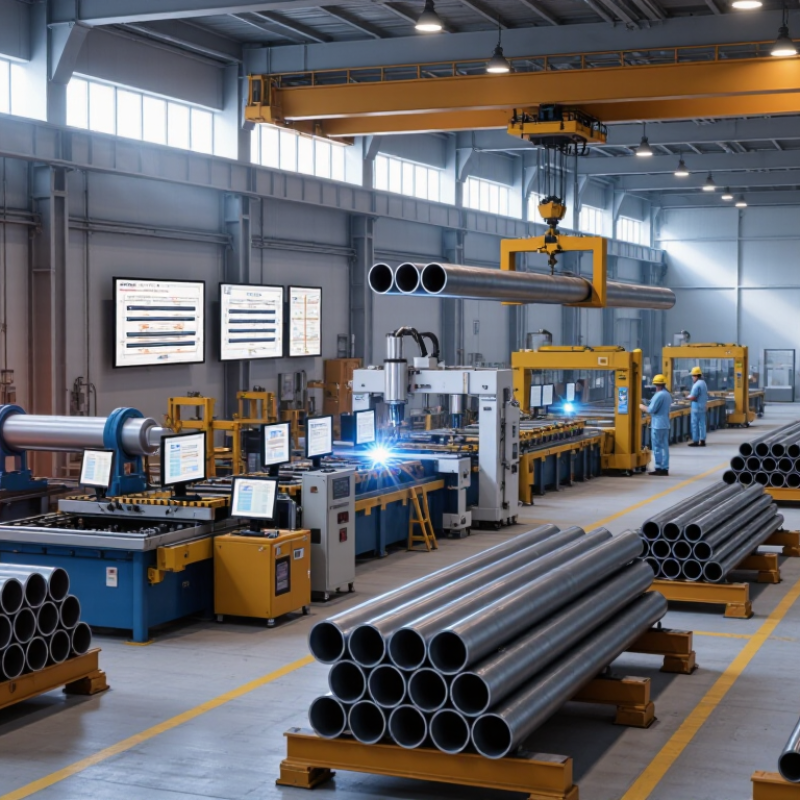
Mild steel pipe manufacturing begins with low-carbon steel, chosen for its weldability, strength, and reasonable cost. Electric resistance welding forms pipe from steel coils. The strip passes through rollers, creating a round shape before high-frequency current joins the edges. Some producers use seamless production instead. A heated billet is pierced, elongated, and sized without a longitudinal weld.
Quality depends on controlled details. Operators check strip thickness, welding temperature, ovality, and surface condition. Hydrostatic testing can reveal leakage under pressure. Ultrasonic or electromagnetic inspection may detect hidden flaws. Many facilities also use automatic dimensional gauges and traceable heat numbers. No method is perfect. Poor alignment can create weak areas, even when the outer surface looks clean.
Industry standards define more than chemical composition. They may specify tensile strength, yield strength, wall thickness, testing, marking, and permitted tolerances. ASTM A53 is commonly associated with general-purpose welded and seamless pipe. ASTM A500 covers structural tubing, while EN 10219 addresses cold-formed welded structural hollow sections. Project requirements should determine the correct standard, not price alone. Buyers should review mill certificates, test reports, coating requirements, and inspection plans. A supplier’s real reliability appears in consistent records and repeatable production, not attractive photographs. Yet standards are not interchangeable, and treating them as equivalent remains a common mistake.
Key Specifications and Grades of Mild Steel Pipes
Mild steel pipe selection depends on chemistry, dimensions, pressure, temperature, and service environment. Low carbon content usually improves weldability, but it does not guarantee suitable performance in every application. Common specifications include outside diameter, wall thickness, nominal pipe size, schedule, length, and end preparation. These details must match the drawing, not only the purchase description.
ASTM A53 Grade B is widely used for structural, water, air, and low-pressure mechanical service. ASTM A106 Grade B is designed for seamless service at elevated temperatures. For pipeline applications, API 5L grades such as Grade B and X42 may be specified, depending on strength and testing requirements. European projects may use grades such as S195T or S235 under relevant standards. Grade names are not interchangeable.
Check the mill certificate carefully. It should identify chemical composition, yield strength, tensile strength, elongation, heat number, and test results. For welded pipe, weld quality and non-destructive testing can be critical. Wall thickness also needs a practical tolerance review because thin sections may lose capacity through corrosion. A zinc coating can improve atmospheric resistance, but it is not a substitute for proper corrosion design. That distinction matters. In real purchasing work, a copied specification can hide conflicting requirements. Recheck pressure class, pipe ends, coating, and inspection scope before approval.
Leading Mild Steel Pipe Manufacturers by Global Region
Mild steel pipe manufacturers serve different industries across global regions. Regional capability matters.
Asian producers often support high-volume orders, with broad size ranges and competitive lead times. Many facilities use automated forming, submerged arc welding, and controlled heat treatment.
Buyers should verify wall thickness, outside diameter, and tensile strength before approval. A mill test certificate should match the shipped batch, not only the quotation.
European manufacturers commonly emphasize process control, traceability, and demanding project documentation. Their pipes may suit structural works, water networks, and industrial fabrication. North American suppliers often provide strong distribution coverage and stock common schedules for construction projects. They also focus on dimensional consistency, coating options, and inspection records. However, availability can change quickly during major infrastructure demand.
Producers in the Middle East and Africa often support energy, water, and building projects near regional ports. Latin American manufacturers may offer practical access to mining, agriculture, and municipal markets. Local logistics can reduce transport risk, though export capacity varies. No regional list is perfect. A lower quoted price may hide longer testing, port delays, or weaker packaging. Experienced buyers compare production evidence, independent inspection, corrosion protection, and after-sales communication. A small trial order can reveal problems that polished documents miss.
How to Evaluate Mild Steel Pipe Suppliers
Top Mild Steel Pipe Manufacturers and Suppliers Worldwide
How to Evaluate Mild Steel Pipe Suppliers
Evaluating a mild steel pipe supplier requires more than comparing quotations. The World Steel Association reported approximately 1.89 billion tonnes of crude steel production worldwide in 2023. OECD steel-capacity data also projected continued capacity growth through 2026. This scale creates choice, but not consistency. Ask where the billet was melted, how the pipe was formed, and which standard controls dimensions. A reliable supplier should provide heat numbers, chemical analysis, mechanical results, and traceable mill test certificates for every batch. Traceability matters.
Check quality systems, but do not stop at a certificate. Confirm whether the facility controls welding, ultrasonic testing, coating, and calibration internally. Request records matching the stated standard, including wall thickness, tensile strength, yield strength, and hydrostatic testing. Independent inspection can verify thickness at several points, especially near pipe ends. A single sample is not enough. Ask for recent nonconformance data. Suppliers may hesitate, yet hesitation is information.
Delivery performance deserves equal attention. Review the previous twelve months of on-time shipments, replacement rates, and claim-resolution times. Compare these figures with agreed purchase terms, not casual promises. Packaging should protect bevels and prevent standing water inside bundled pipes. Paper is not proof. My own checklist could still overvalue tidy documents and overlook communication during delays. A short pilot order, witnessed inspection, and clear acceptance criteria can expose that weakness before a large project begins.
Representative Minimum Yield Strength of Common Mild Steel Standards
Yield strength is a useful technical criterion when evaluating mild steel pipe suppliers. The values below are representative minimum requirements for commonly referenced steel grades, generally based on thinner product sections; requirements may vary by wall thickness, product form, and applicable edition of the standard. Buyers should verify mill certificates, dimensions, chemical composition, testing procedures, and compliance with the specified standard.
Reference standards: ASTM A36/A36M, ASTM A53/A53M Grade B, EN 10025-2 S275JR, JIS G3101 SS400, and GB/T 700 Q235B.





