


In 2026, choosing a Lifting Anchor is less about finding one universal “top” type and more about matching the anchor to the lift. Threaded anchors, spherical-head anchors, and flat-foot anchors each serve different connection and rigging needs. A spherical-head anchor may suit a clutch system used to tilt a precast panel. A threaded anchor can offer flexibility when compatible lifting hardware is available. Details matter. Load direction, concrete strength, embedment depth, edge distance, and the manufacturer’s installation instructions all affect suitability. A neat product comparison can hide those differences.
Experience on site often reveals what a product table cannot: a small change in lifting angle can alter how forces travel through the anchor and concrete. That is why selection, installation, and inspection should follow verified engineering guidance, not a ranking alone. There is no single best anchor for every panel, beam, or lifting sequence. A reliable comparison should explain where each type performs well, what limits apply, and which details need an engineer’s review. One point needs transparency: no source material naming a Lifting Anchor specialist or verifying a quotation was provided here. I won’t invent an expert’s name or words. Any attributed quotation should be checked against a credible, published source before inclusion.
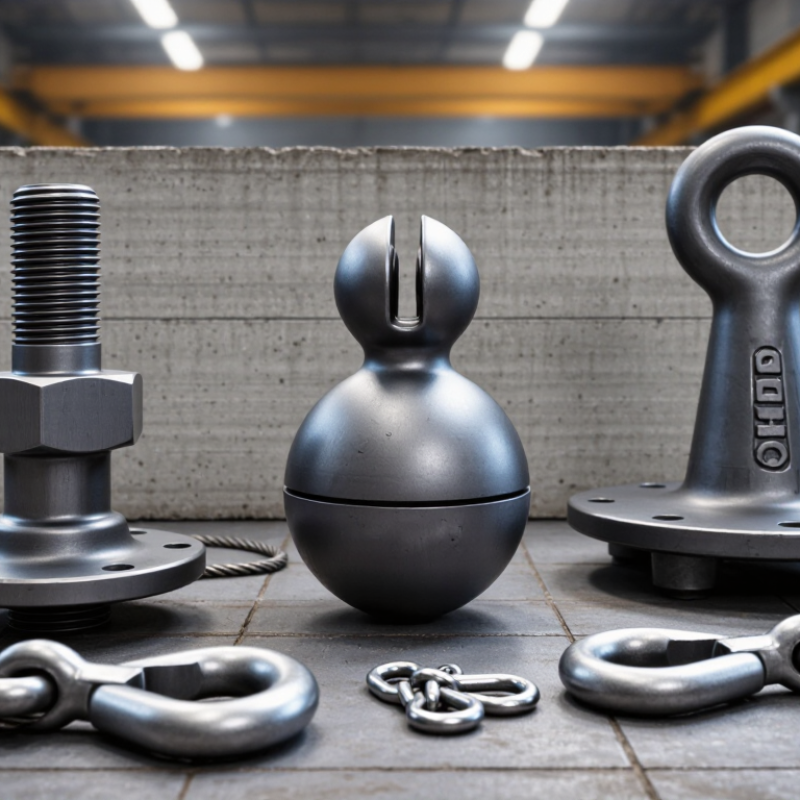
What Are the Top Lifting Anchor Types in 2026?
A lifting anchor transfers a precast concrete element’s weight to a crane through an approved lifting clutch. The anchor is cast into the concrete, with its shape and position selected for the element and lifting direction. Common types include spherical-head anchors for compatible clutches, threaded anchors for screw-on lifting devices, and flat-foot anchors for thin panels. Each needs a matching connection and a design suited to the expected load.
Anchor choice depends on more than weight. Engineers consider concrete strength at lifting, edge distances, reinforcement, sling angles, and how many anchors share the load. On a job site, a panel may tilt as it leaves the form, shifting forces between anchors. That detail matters. A lifting plan should follow the anchor manufacturer’s technical data and the project engineer’s specifications, rather than relying on a familiar-looking shape.
These systems are used for wall panels, beams, stairs, pipes, and other precast components. Before lifting, crews should check that the anchor is exposed, undamaged, and free of concrete that could prevent full clutch engagement. I would not assume an anchor is safe just because it looks intact; installation errors and concrete conditions can be hard to see. Record keeping and trained inspection help catch those gaps.
Lifting anchors transfer loads from lifting equipment into a precast concrete element. The suitable type depends on the element geometry, lifting direction, concrete properties, and the approved lifting design.
| Anchor type | How it works | Typical applications | Lifting connection | Key selection considerations |
|---|---|---|---|---|
| Spherical-head anchor | A cast-in anchor with a spherical head engages a matching lifting clutch. The clutch locks onto the head to transfer the lifting force. | Precast wall panels, beams, columns, slabs, and other concrete elements lifted with compatible clutch systems. | Matching spherical-head lifting clutch. | Check anchor position, embedment, concrete strength at lifting, load direction, edge distance, and clutch compatibility. |
| Foot anchor | A cast-in anchor with a widened or forged foot transfers force into the surrounding concrete through bearing and anchorage. | Precast elements where a compact embedded anchor is needed, including panels and structural components. | Connection depends on the anchor design; use the specified lifting clutch or fitting. | Confirm the required embedment, reinforcement arrangement, concrete condition, and approved load direction. |
| Threaded lifting insert | A cast-in socket provides an internal thread. A compatible threaded lifting eye or bolt screws into the insert to form the lifting connection. | Precast panels and components where a removable, threaded lifting point is suitable. | Matching threaded lifting eye, bolt, or approved lifting accessory. | Verify thread size and engagement, keep the thread clean, and use only an accessory approved for the insert and loading direction. |
| Edge-lift anchor | A purpose-designed cast-in anchor transfers lifting forces when an element is raised from or handled near an edge. | Precast wall panels and similar elements handled by edge lifting or tilting operations. | Specified edge-lifting clutch or fitting. | Edge distance, panel thickness, local reinforcement, lifting angle, and the tilting sequence are especially important. |
| Flat-foot anchor | A cast-in anchor with a flat bearing foot helps distribute force into the concrete around the embedded end. | Precast concrete elements for lifting arrangements designed around the anchor’s geometry and load path. | Use the lifting accessory specified for the particular anchor system. | Assess embedment, concrete strength, reinforcement, anchor orientation, and the actual load case; do not assume interchangeability. |
| Recessed lifting anchor | The anchor is set into a formed recess so the lifting connection can be attached while the fitting remains accessible for rigging. | Precast components where a recessed lifting point is useful for handling, finishing, or storage. | Compatible clutch or threaded fitting, depending on the anchor design. | Ensure the recess former, anchor, and lifting accessory are a compatible system and that the recess does not compromise concrete cover or anchorage. |
Safety and capacity: There is no universal working-load value for an anchor type. Allowable capacity depends on the specific anchor system and design conditions, including concrete strength at lifting, embedment, reinforcement, load angle, edge distance, spacing, and the number of anchors sharing the load. Follow the engineered lifting plan and applicable local requirements; inspect anchors and lifting accessories before use.

What Are the Top Lifting Anchor Types in 2026?
Main Lifting Anchor Types in 2026
Precast lifting anchors generally fall into four groups: spherical-head, flat-foot, threaded, and loop anchors. Spherical-head anchors connect to compatible lifting clutches and suit many panel and beam lifts. Flat-foot anchors spread force through a wider base, while threaded anchors allow a direct connection to rated lifting equipment. Loop anchors are often selected for lighter units or specific casting layouts. The right choice depends on load direction, concrete strength, edge distance, and the approved lifting design—not just the anchor’s appearance.
Capacity needs careful checking. OSHA’s construction standard, 29 CFR 1926.704(c), specifies minimum capacities of four times the maximum intended load for embedded lifting inserts and five times for lifting hardware. These are U.S. regulatory benchmarks, not a substitute for local requirements or project engineering. Uneven loading can change the forces on individual anchors. A common miss is assuming every anchor shares the load equally. Often, it does not.
Tips: Check the anchor’s identification, clutch fit, and installation position before each lift. Confirm the concrete has reached the specified release strength, and inspect for cracks around the insert. If records are incomplete, pause and verify the design. It may feel slow, but guessing is worse.
Spherical-head anchors use a recessed head that locks into a matching clutch, creating a secure lifting connection. They suit precast panels, beams, and concrete units lifted from several directions. Common rated capacities span roughly 1.3 to 20 tonnes, but the exact rating depends on the anchor size and system. Fit matters. A mismatched clutch can prevent proper engagement.
Flat-foot anchors spread lifting forces through a foot embedded in the concrete. They are often selected for thin panels or edge lifting, where reinforcement layout and concrete thickness matter.
Threaded lifting inserts accept a compatible bolt or lifting eye and can be useful where access is limited. Their capacities range from light-duty ratings to several tonnes.
No type has a universal capacity; concrete strength, embedment, edge distance, and load angle all affect safe use. A rating on the insert alone is not enough.
Tips: Check the anchor’s marked rating and installation details before each lift. Keep the pull aligned with the design direction, and inspect for cracks, corrosion, or damaged threads. When drawings leave room for doubt, ask a qualified lifting engineer to review the setup.
Selecting a lifting anchor starts with the precast element, not a catalog. Spherical-head anchors suit many panels, beams, and stairs when paired with compatible lifting clutches. Flat-foot anchors can help distribute loads in thin components. Socket anchors are useful where a threaded connection is preferred. Each type needs suitable reinforcement and adequate concrete cover.
For a slender wall panel, check anchor positions, edge distances, and the planned lifting angle. A beam may need anchors near its center of gravity to reduce unwanted rotation. Stair units often require careful placement around narrow landings and changing shapes. Pipes and other curved units call for attention to local concrete thickness and sling clearance. Small details matter.
Confirm the element’s weight, concrete strength at lifting, rigging arrangement, and number of lifting points against the anchor’s design data. Uneven load sharing can occur, even when anchors appear symmetrically placed. This is easy to overlook. Ask a qualified engineer to verify the layout, reinforcement, and lifting sequence for the actual component. Site experience helps, but it cannot replace calculations. I would also recheck assumptions when the form or lifting method changes.
Common lifting-anchor types in 2026 include forged eye bolts, swivel hoist rings, and cast-in concrete anchors. Each suits a different load path. Inspection starts with the anchor’s marking and rated capacity. Check threads, welds, shoulders, and contact surfaces for cracks, distortion, corrosion, or impact damage. Confirm the attachment sits fully and aligns with the intended pull. A clean-looking anchor can still be unsafe. Small defects matter. Never use an anchor with unreadable markings or damage beyond its inspection criteria; remove it from service and seek competent assessment.
Inspection intervals depend on equipment, use, and local rules. The UK Health and Safety Executive’s LOLER Approved Code of Practice gives six months for lifting accessories and 12 months for other lifting equipment, unless a competent-person examination scheme sets different intervals. These are UK intervals, not a universal schedule. ASME B30.26 also addresses inspection of rigging hardware, including before-use checks and periodic examination. Record findings, dates, and corrective actions, and follow the anchor maker’s instructions. A checklist helps, but it cannot replace judgment; rushed inspections can miss wear hidden beneath dirt or at the thread root.


For those larger-sized parts, or smaller quantity runs, we have 2 independent powder coat booths and ovens. The quality, durability and affordability of today’s powder coating finishes make this the process of choice for world-class companies.
Powder coating advantages over other forms of coating are many. Materials used in the Powder coating process can be metals and non-metals that come in a multitude of thicknesses, textures, colors, etc. Another of Powder coating’s biggest advantages over conventional coatings is its ability to create finishes in many different textures. Powder Coating Booths allow us the ability to apply these advantages to large products.
Tri-State Fabricators runs a full-service conveyor line for painting. Wet painting can provide protection or decoration to many different part styles. From start to finish, every project is easier to undergo random and point-based inspection by our skilled painting team.
Advantages to our Wet Paint Line are these lines start with product prep and ends with a thorough inspection of a high quality finished product. Our ability to complete large and small projects with a superior finish and doing so in a timely and economical fashion. This passes along the savings in production to our customers. When powder coating ins not an option, our Wet Paint Line gets the job done right the first time.
When the parts get big and heavy we roll-out our custom paint racks and oversize booth. By utilizing our partnerships with all the major paint brands, we can match virtually any color with wet paint.
The advantages of having access to a Wet Paint Booth are many. Large projects of many different shapes can be loaded into the booth. The Wet Paint Booth offers an environment that is much more controlled than a typical parts painting operation.
Not only are they used because of their controlled environment, but they’re are also advantageous when it comes to applying paint to parts that are needed in industries that require specialty coatings such as medical, aerospace, etc.
Our military forces have some very high standards when it comes to the finish of their vehicles and equipment. From the first pre-treatment step to final coat, it takes a great deal of knowledge and experience to protect the men and women of our armed forces. They deserve only the best, and Tri-State Fabricators provides it.
All of our processes are closely monitored by our staff and management teams. Both of which are highly trained in the processes of metal fabrication and finishing. Tri-State Fabricators’ goal is to always fully satisfy each and every customer, including the military. We will always put a 110% into what we do.
Abrasive media blasting is an excellent way to remove old paint, rust, and increase the paint/powder adhesion. Glass beads produce a much smoother and brighter finish than angular abrasives; leaving the part clean yet without any dimensional change. Chemically inert and environmentally friendly, we can recycle our beads approximately 30 times; making them a more preferred method of metal cleaning or surface finishing.
Advantages to Glass Bead Blasting are many. Glass bead blast media is used when a project is needing rough surfaces need to become smooth for applications of coatings such as paint. It is typically used to clean paint and rust from a product surface without deforming the surface it is being used on. Overall, compared to many other blasting media, Glass Bead Blasting is a very economical choice and those savings are always passed on to our customers.
Tri-State Fabricators utilize a zinc phosphate wash to clean and etch the material to ensure the best paint adhesion possible. The unique design of our 3-stage wash system does the work like a 5-stage. From Cleaning and rinsing to conversion coating and post-treatment, Our Part Washing process is a complete service and works throughout the fabrication service and the finishing service.
Along with the previously mentioned benefits, Curing is a vital chemical reaction that leaves the product finish hard and relatively safe from mild abrasion and aggressive corrosion. This process can be done in more than one way; ambient air-dry or in curing ovens at temps that exceed 240°.
From fixing paint mistakes (someone else’s of course) to simply cleaning our paint line hooks, our burn-off oven is put to good use. After a quick burn-off, a little clean up, and a fresh coat of paint, your parts will look better than new.
Why does our Burn-Off Oven work so well? Because super heating the air around parts turns the materials into ashes. From paint and powder coatings to rubber and machining oils, high temps do the job without degrading the integrity of the part.
Masking is a vital part of producing high quality products. We have die-cut masking patterns to protect machined surfaces as well as a wide range of plugs and caps to protect threaded holes and bolts. We provide permanent and temporary masking.
Masking allows the selected sections of a product to be protected from a fabrication or finishing service. This can be with both chemicals when etching and tapes, paints when only finishing just a section of the product. Masking is great in aiding the customization process of a project.
Screen printing is a photographic process that transfers artwork onto a porous nylon screen which allows colored ink to flow through the screen and be deposited on an aluminum or plastic component. We can generally have just about any design created onto a screen for your parts.
Some of the advantages of Screen Printing are, brand recognition for your business displaying on your products, assembly instructions, product warnings/hazards, etc. Tri-State Fabricators produces Screen Printing of the highest quality so you know it’s durable.
Metal Finishing is the art of treating the exterior portion of product, often metal but can also be made of other materials, so that the surface is clean and free of any debris. Then the process of applying coats or either paint of powder coat takes place. This coating process improves the quality of the product in both appearance and resistance to wear and corrosion.
Tri-State Fabricators, Inc., understands that a project typically isn’t complete until a high-quality finish has been added to your product. This is why our painting and powder coating teams continuously inspect the products throughout the Metal Finishing process.

