


What Are the Top Kitchen Faucet Accessories for OEM Buyers?

For OEM buyers, choosing kitchen faucet accessories is not just a matter of adding features. The right parts affect installation, daily use, maintenance, and the overall value of a faucet line. Kitchen Faucet Accessories Oem sourcing may include pull-down sprayers, flexible hoses, aerators, mounting kits, soap dispensers, and replacement cartridges. Small parts matter.

A sprayer should feel steady in the hand, switch modes cleanly, and connect securely to its hose. An aerator can shape the water stream, while a mounting kit can make installation easier across different countertop thicknesses. Compatibility deserves close attention. A low-cost component may create extra assembly work if dimensions, finishes, or connection types do not match the faucet design. Details can be easy to miss.

This guide looks at the accessories OEM buyers commonly evaluate and the practical questions behind each choice. Buyers can compare material specifications, finish consistency, replacement-part availability, and sample performance before confirming an order. Product documentation helps, but it does not replace checking fit and operation on a physical sample. Even a polished sample may not reflect every production batch, so quality checks should continue after approval. There is no single ideal accessory set: project requirements, price targets, and customer expectations differ. A careful selection process helps buyers build faucet packages that are functional, easier to assemble, and better suited to their intended market.
What Are the Top Kitchen Faucet Accessories for OEM Buyers?

Kitchen Faucet Accessories and Their Roles in an OEM Product Line

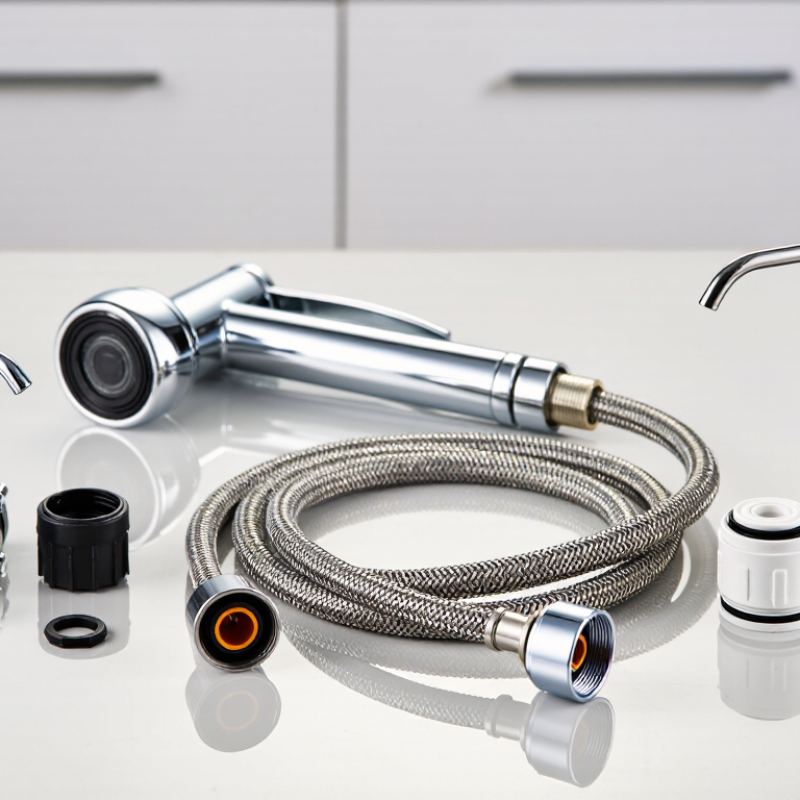
Kitchen faucet accessories do more than complete a fixture. They shape how it feels to use, install, and maintain. Pull-down spray heads offer a focused stream for rinsing produce, while flexible hoses need reliable retraction and docking. Aerators help control splash and flow. Side sprayers, soap dispensers, and filtration connections can support different kitchen layouts, but each adds installation and compatibility requirements.

For OEM buyers, these parts form a practical product-line strategy. Shared cartridges, mounting kits, and hose connections can simplify assembly and spare-parts planning across models. The 2024 Houzz & Home Study reported a median U.S. kitchen-remodel spend of $24,000. That investment context makes perceived durability and everyday convenience important purchasing factors, even for relatively small components. Small parts matter. Yet accessory counts can mislead: a broad assortment is not useful if fittings vary unexpectedly or instructions leave installers guessing.

Evaluate accessories as working systems, not isolated items. Test spray switching with wet hands, check hose clearance beneath a deep sink, and inspect docking after repeated use. Record fit, leakage, finish wear, and replacement-part needs during product validation. One detail is easy to overlook: a polished sample may perform differently after installation. OEM specifications should define connection dimensions, materials, and test conditions clearly, while leaving room for regional sink and cabinet variations.

What Are the Top Kitchen Faucet Accessories for OEM Buyers? — Kitchen Faucet Accessories and Their Roles in an OEM Product Line

Accessory Primary Role Common Materials or Features OEM Product-Line Considerations Useful Quality Checks
Pull-down or pull-out spray head Provides selectable stream and spray functions for rinsing dishes and cleaning the sink. Typically uses a molded polymer body, spray-face elastomer nozzles, and an internal flow-control mechanism. Offer compatible finish options and clearly specify spray modes, head dimensions, and hose connection requirements. Check mode switching, spray pattern, nozzle alignment, finish consistency, and leak-free connections.
Spray hose Connects a pull-down or pull-out spray head to the faucet waterway while allowing movement. Common constructions include a flexible polymer inner tube with a braided or smooth outer covering. Match hose length, connector type, bend behavior, and routing space to the faucet design and installation configuration. Inspect for kinks, abrasion, secure fittings, water leakage, and reliable retraction during repeated use.
Hose counterweight or retraction aid Helps guide the spray hose back into the faucet spout after use. May be a coated metal weight or another purpose-designed retraction component. Position it to avoid interference with cabinet contents, plumbing, and other under-sink components. Verify smooth hose travel, reliable return, secure attachment, and clearance throughout the hose’s movement.
Escutcheon or deck plate Covers unused mounting holes and provides a finished appearance for compatible sink or countertop layouts. Often made from metal or plated material, with a gasket or sealing layer underneath. Define the faucet-hole coverage, plate dimensions, finish match, and whether the plate is included or optional. Check flatness, edge finish, finish consistency, gasket fit, and compatibility with the intended mounting surface.
Mounting hardware Secures the faucet to a sink or countertop. May include a mounting nut or bracket, threaded components, washers, and a positioning aid. Specify compatible countertop thickness and installation-tool access; keep small parts organized in the package. Confirm thread fit, corrosion-resistant construction where appropriate, secure clamping, and completeness of the kit.
Hot- and cold-water supply lines Connect the faucet inlets to the household water supply. Typically flexible hoses with end fittings suited to the faucet inlet and local plumbing connections. Confirm fitting types, hose length, installation instructions, and suitability for the target market’s plumbing requirements. Check connection compatibility, hose condition, leak performance, and clear identification of hot and cold lines.
Aerator or flow-control insert Shapes the water stream and can help control faucet flow, depending on the design. Commonly includes a small insert with mesh or molded flow-shaping elements. Specify the intended flow behavior and service method; ensure the insert matches the faucet outlet and applicable requirements. Inspect stream quality, seating, ease of removal for cleaning, and resistance to clogging under intended use conditions.
Soap or lotion dispenser Adds a countertop-mounted dispensing option for compatible sinks and work surfaces. Usually includes a pump head, refillable bottle or reservoir, and a mounting shank. Coordinate finish, mounting-hole needs, refill access, and the dispenser’s position relative to the faucet. Check pump action, leakage, secure mounting, refill access, and compatibility with the intended liquid.
Side spray and hose Provides a separate handheld spray function in faucet configurations designed for a side spray. Typically includes a spray handle, flexible hose, and a compatible connection or diverter arrangement. Confirm that the faucet body supports the side-spray connection and that the sink layout provides a suitable mounting hole. Test spray operation, hose flexibility, connection sealing, and proper interaction with the faucet diverter.
Installation and care components Support correct installation, basic maintenance, and protection of the product during shipment. May include an instruction sheet, care guidance, protective caps, and small installation accessories. Use clear, market-appropriate instructions and align package contents with the product configuration and sales channel. Review instruction accuracy, parts-list completeness, legibility, and protection against finish damage in transit.

Core Accessory Types: Sprayers, Soap Dispensers, Filters, and Mounting Kits

What Are the Top Kitchen Faucet Accessories for OEM Buyers?

Pull-down and pull-out sprayers add reach for rinsing produce and cleaning sink corners. OEM buyers should check hose length, spray modes, and docking strength. A weak retraction system can leave the spray head hanging awkwardly. Soap dispensers keep bottles off the countertop. Check the refill opening and bottle capacity, especially for busy kitchens. Small details matter.

Filters and mounting kits affect installation and daily use. Filter options may include dedicated drinking-water spouts or compatible inline connections. Confirm connection sizes, replacement access, and whether the faucet layout can accommodate the extra hardware. A filter can sound like an easy upgrade, but added fittings may complicate a crowded cabinet. Mounting kits should match the sink or countertop thickness and hole pattern. Include clear fitting instructions and durable gaskets to reduce leaks during installation.

Tips: Test sprayer return after repeated pulls. Check dispenser refills by hand. Verify filter access beneath the sink. Ask suppliers for dimensioned drawings and sample components before finalizing specifications. One detail is easy to miss: cabinet clearance. A technically compatible accessory may still be difficult to service.

Material, Finish, and Compatibility Requirements for Each Accessory

For OEM buyers, accessory selection starts with wetted materials, not appearance. Brass diverters and stainless-steel hoses resist daily handling, while silicone spray nozzles are easier to clean. NSF/ANSI/CAN 372 limits weighted-average lead content in wetted surfaces to 0.25%; NSF/ANSI/CAN 61 separately evaluates health effects from drinking-water contact. These standards answer different questions. A material declaration alone does not replace certification evidence. Keep supplier test records tied to each part number.

Finish must match the faucet under bright showroom lighting and after real use. PVD, plated, and powder-coated parts can differ in color and wear, even when sellers use the same finish name. Request samples and abrasion or corrosion test results before approving production. Fit is equally specific: verify hose length, connection thread, diverter dimensions, spray-head seat, and required flow. EPA WaterSense reports that labeled bathroom faucets use at least 20% less water than standard models, but that figure is not a kitchen-faucet specification. Check kitchen performance separately. Small mismatch, costly rework.

I would still verify tolerances on assembled samples; drawings can look reassuring, while a hose kinks behind the cabinet.

How OEM Buyers Compare Accessory Quality, Function, and Cost

OEM buyers should compare faucet accessories by measurable performance, not appearance alone. Check spray heads for a steady stream, simple mode switching, and buttons that remain responsive after repeated use. Pull-down hoses should retract smoothly without scraping the cabinet wall. Small details matter. A rough thread or stiff connector can slow assembly and create avoidable service calls.

Material and finish need practical checks. Inspect aerators, mounting hardware, and hose fittings for consistent dimensions and clean edges. Test finishes under ordinary cleaning, since water spots and fingerprints may reveal differences quickly. Ask suppliers for material specifications and sample-test records, then compare samples under the same conditions. One polished sample proves little. We have seen attractive parts feel less reliable once handled repeatedly, so appearance should not settle the decision.

Function must fit the faucet model and the buyer’s market requirements. Confirm thread sizes, hose length, connection type, and replacement-part availability before approving a purchase. Then compare total cost, including packaging, inspection, expected defects, and minimum order quantities—not just the unit price. A cheaper accessory may add assembly minutes to every unit. That cost is easy to miss. Buyers should weigh quality against actual use, while admitting that early testing cannot predict every field condition. A small pilot order can expose fit or handling problems before volume production.

Sourcing Accessories Through Sampling, Testing, and Supplier Review

What Are the Top Kitchen Faucet Accessories for OEM Buyers?

Sourcing Accessories Through Sampling, Testing, and Supplier Review

For OEM buyers, accessory sourcing starts with the actual installation, not a glossy catalog. Sample the pull-down hose, spray head, aerator, and docking mechanism together. Check hose retraction under a full sink, spray switching with wet hands, and whether the head seats firmly after repeated use. Small details matter. A sample can still mislead: production materials or finish thickness may differ. Record specifications and approve a sealed reference sample before ordering.

Testing should match each part’s job. For water-contact components, request relevant test documentation and confirm its scope covers the supplied materials. NSF/ANSI/CAN 372 sets a maximum weighted-average lead content of 0.25% for plumbing products covered by the standard; NSF/ANSI/CAN 61 addresses health effects of drinking-water-contact materials. Ask suppliers for current reports, material traceability, and batch-level inspection records. Then compare samples from more than one production lot. One missed step can surface later as a leak, loose fit, or finish mismatch.

Tips: Ask for hose-cycle and spray-switch test results. Verify finish consistency under neutral lighting. Keep one approved sample for incoming inspection. Supplier review should include response time, corrective-action records, and clear change-control procedures—not just the lowest quote. A weak point in our process is often assuming that one successful sample proves every future batch.

Powder Coat Booths

For those larger-sized parts, or smaller quantity runs, we have 2 independent powder coat booths and ovens. The quality, durability and affordability of today’s powder coating finishes make this the process of choice for world-class companies.

Powder coating advantages over other forms of coating are many. Materials used in the Powder coating process can be metals and non-metals that come in a multitude of thicknesses, textures, colors, etc. Another of Powder coating’s biggest advantages over conventional coatings is its ability to create finishes in many different textures. Powder Coating Booths allow us the ability to apply these advantages to large products.

Wet Paint Line

Tri-State Fabricators runs a full-service conveyor line for painting. Wet painting can provide protection or decoration to many different part styles. From start to finish, every project is easier to undergo random and point-based inspection by our skilled painting team.

Advantages to our Wet Paint Line are these lines start with product prep and ends with a thorough inspection of a high quality finished product. Our ability to complete large and small projects with a superior finish and doing so in a timely and economical fashion. This passes along the savings in production to our customers. When powder coating ins not an option, our Wet Paint Line gets the job done right the first time.

Wet Paint Booths

When the parts get big and heavy we roll-out our custom paint racks and oversize booth. By utilizing our partnerships with all the major paint brands, we can match virtually any color with wet paint.

The advantages of having access to a Wet Paint Booth are many. Large projects of many different shapes can be loaded into the booth. The Wet Paint Booth offers an environment that is much more controlled than a typical parts painting operation.

Not only are they used because of their controlled environment, but they’re are also advantageous when it comes to applying paint to parts that are needed in industries that require specialty coatings such as medical, aerospace, etc.

Military CARC

Our military forces have some very high standards when it comes to the finish of their vehicles and equipment. From the first pre-treatment step to final coat, it takes a great deal of knowledge and experience to protect the men and women of our armed forces. They deserve only the best, and Tri-State Fabricators provides it.

All of our processes are closely monitored by our staff and management teams. Both of which are highly trained in the processes of metal fabrication and finishing. Tri-State Fabricators’ goal is to always fully satisfy each and every customer, including the military. We will always put a 110% into what we do.

Glass-Bead Blasting

Abrasive media blasting is an excellent way to remove old paint, rust, and increase the paint/powder adhesion. Glass beads produce a much smoother and brighter finish than angular abrasives; leaving the part clean yet without any dimensional change. Chemically inert and environmentally friendly, we can recycle our beads approximately 30 times; making them a more preferred method of metal cleaning or surface finishing.

Advantages to Glass Bead Blasting are many. Glass bead blast media is used when a project is needing rough surfaces need to become smooth for applications of coatings such as paint. It is typically used to clean paint and rust from a product surface without deforming the surface it is being used on. Overall, compared to many other blasting media, Glass Bead Blasting is a very economical choice and those savings are always passed on to our customers.

Part Washing

Tri-State Fabricators utilize a zinc phosphate wash to clean and etch the material to ensure the best paint adhesion possible. The unique design of our 3-stage wash system does the work like a 5-stage. From Cleaning and rinsing to conversion coating and post-treatment, Our Part Washing process is a complete service and works throughout the fabrication service and the finishing service.

Along with the previously mentioned benefits, Curing is a vital chemical reaction that leaves the product finish hard and relatively safe from mild abrasion and aggressive corrosion. This process can be done in more than one way; ambient air-dry or in curing ovens at temps that exceed 240°.

Burn-Off Oven

From fixing paint mistakes (someone else’s of course) to simply cleaning our paint line hooks, our burn-off oven is put to good use. After a quick burn-off, a little clean up, and a fresh coat of paint, your parts will look better than new.

Why does our Burn-Off Oven work so well? Because super heating the air around parts turns the materials into ashes. From paint and powder coatings to rubber and machining oils, high temps do the job without degrading the integrity of the part.

Masking

Masking is a vital part of producing high quality products. We have die-cut masking patterns to protect machined surfaces as well as a wide range of plugs and caps to protect threaded holes and bolts. We provide permanent and temporary masking.

Masking allows the selected sections of a product to be protected from a fabrication or finishing service. This can be with both chemicals when etching and tapes, paints when only finishing just a section of the product. Masking is great in aiding the customization process of a project.

Screen Printing

Screen printing is a photographic process that transfers artwork onto a porous nylon screen which allows colored ink to flow through the screen and be deposited on an aluminum or plastic component. We can generally have just about any design created onto a screen for your parts.

Some of the advantages of Screen Printing are, brand recognition for your business displaying on your products, assembly instructions, product warnings/hazards, etc. Tri-State Fabricators produces Screen Printing of the highest quality so you know it’s durable.

Metal Finishing

Metal Finishing is the art of treating the exterior portion of product, often metal but can also be made of other materials, so that the surface is clean and free of any debris. Then the process of applying coats or either paint of powder coat takes place. This coating process improves the quality of the product in both appearance and resistance to wear and corrosion.

Tri-State Fabricators, Inc., understands that a project typically isn’t complete until a high-quality finish has been added to your product. This is why our painting and powder coating teams continuously inspect the products throughout the Metal Finishing process.


