


Choosing the right Hdpe Plastic Sheets requires more than comparing price, color, and thickness. Global buyers must connect material performance with real operating conditions. A sheet used for chemical tank liners faces different demands from one used for food processing or outdoor fabrication.
This guide introduces ten practical types of HDPE sheets commonly considered by international buyers. It examines smooth, textured, black, natural, colored, UV-stabilized, recycled-content, food-contact, high-temperature, and wear-resistant options. Each type has distinct advantages, limitations, and suitable applications. Details matter.
In practical purchasing work, thickness alone rarely predicts service life. Surface finish, density, welding behavior, temperature exposure, and chemical contact can change the final result. A 6-millimeter sheet may perform well in one project but fail under stronger impact, heat, or continuous abrasion. Not every sheet fits.
Reliable decisions also depend on traceable technical data. Buyers should request certificates, test reports, batch information, tolerances, and clear production specifications. Food-contact and potable-water applications require especially careful verification against destination-market requirements. Supplier experience matters, but documented evidence matters more.
This overview follows engineering judgment and common fabrication practices, while recognizing that standards differ across regions. No list is perfect. Product names may also vary between manufacturers, causing confusion during quotation and inspection. That weakness deserves attention.
By comparing material properties with actual use, buyers can reduce waste, installation problems, and unexpected replacement costs. The goal is not to select the most advanced sheet automatically. It is to select the most suitable one, with evidence supporting every important decision.
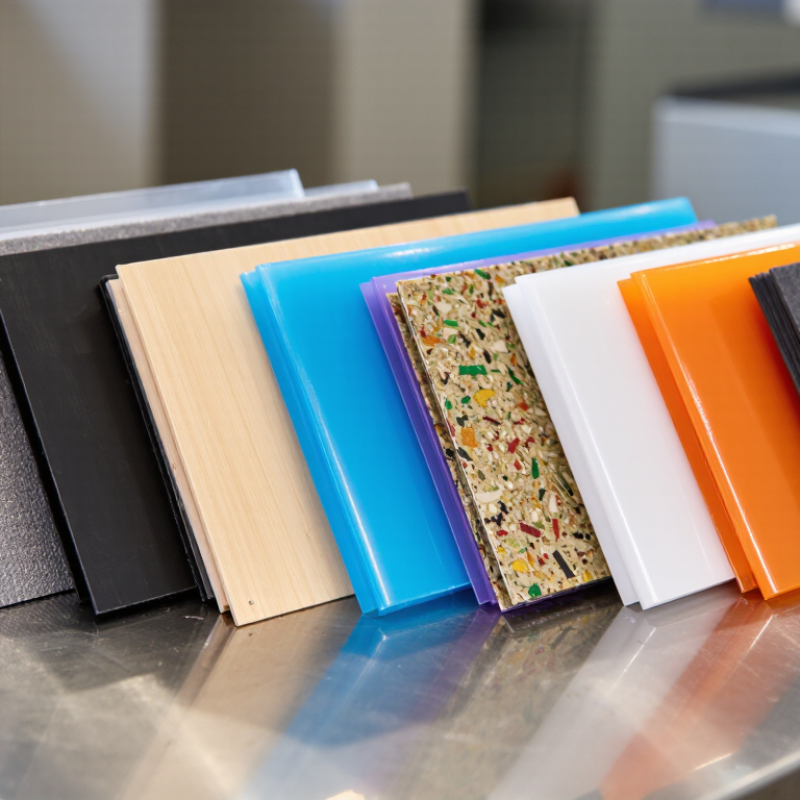
HDPE sheets are made from high-density polyethylene resin, a thermoplastic polymer with tightly arranged molecular chains. This structure gives the material high strength, low moisture absorption, and useful chemical resistance. Some sheets include colorants, ultraviolet stabilizers, or processing additives. These additions affect outdoor durability and surface appearance.
Manufacturers commonly produce HDPE sheets through extrusion, compression molding, or machining from thicker blocks. Extrusion pushes heated resin through a flat die, creating continuous sheets with controlled thickness.
Compression molding applies heat and pressure inside a mold. It can produce dense, heavy-duty panels, although cycle times may be longer. Cooling speed matters. Uneven cooling can create internal stress, warping, or dimensional changes.
The right sheet depends on its working environment. Standard grades suit fabricated barriers, liners, and protective panels. Textured surfaces can improve grip, while smooth surfaces simplify cleaning. HDPE resists many acids, alkalis, and salts, but it is not universally chemical-proof. Temperature also matters because stiffness decreases as heat rises. Designers should check actual service conditions, including load, impact, sunlight, and cleaning chemicals. A datasheet is useful, but it cannot replace application testing. Small misunderstandings can become expensive. Thickness alone does not guarantee performance. Some buyers focus on strength and overlook expansion, welding behavior, or edge damage during cutting. That oversight deserves attention.

HDPE sheets serve different duties, and one grade rarely fits every application. According to PlasticsEurope’s Plastics—The Fast Facts 2024, global plastics production reached 413.8 million tonnes in 2023. That scale increases demand for traceable, purpose-built sheet materials.
offer clean surfaces and consistent thickness.
reduce material waste but may show color variation.
require controlled formulations and documented compliance.
resist fading and brittleness in outdoor storage areas.
support easy cleaning around tanks and processing equipment.
improve grip on walkways and protective panels.
reduce weight while retaining useful stiffness.
can slow ignition, but they need verified test ratings.
help manage charge around sensitive equipment.
provide exceptional abrasion resistance and low friction.
Very different performance levels.
Technical selection should examine density, impact strength, operating temperature, chemical exposure, and thickness tolerance. ISO 1183 methods are commonly used to measure plastics density, while ISO 527 supports tensile testing comparisons.
A 6-millimeter sheet may work for a chemical splash guard, yet fail under repeated structural loading. That detail is often missed.
Recycled content also deserves scrutiny; inconsistent feedstock can affect welding behavior and surface appearance.
Buyers should request batch data, test reports, and application-specific samples before approving large international shipments.
HDPE sheet types should match the working environment, not only the purchase price. Smooth natural sheets suit food-processing tables, tank components, and clean-room fixtures. Black UV-stabilized sheets perform better in outdoor liners, agricultural equipment, and marine panels. Textured sheets can improve grip on walkways, although they may retain more dirt. Wear-grade sheets support conveyor guides, chute liners, and sliding pads. Conductive or antistatic grades serve controlled industrial areas where static discharge creates operational concerns. Reprocessed sheets reduce material costs, but their thickness and color consistency may vary.
The 2024 PlasticsEurope report recorded 413.8 million tonnes of global plastics production in 2023. This scale increases pressure to select longer-lasting materials. ASTM D4976 provides a recognized framework for polyethylene material classification, while manufacturers should still verify sheet-specific test data. Buyers should compare impact strength, tensile properties, operating temperature, chemical resistance, and water absorption. For tanks, chemical resistance matters most. For cutting surfaces, surface hardness and cleanability matter more. One specification rarely fits every application. That assumption causes avoidable replacement costs.
Tips: Request certificates, thickness tolerances, and test methods before ordering. Check whether “food-grade” applies to the finished sheet, not merely the resin. For outdoor use, ask for accelerated weathering results. A black sheet may resist sunlight better, but color alone proves little. Recycled content can be useful, yet it deserves closer inspection for demanding structural work. When in doubt, test a small panel under real load, temperature, and cleaning conditions.
HDPE plastic sheets serve different markets because their grades, dimensions, and performance targets vary widely. Common types include standard industrial sheets, UV-stabilized sheets, wear-resistant sheets, food-contact grades, and electrostatic-control sheets. Other options include textured, colored, flame-retardant, and reprocessed-content sheets. Each type needs a clear application review.
Global buyers should compare standards carefully. ASTM, ISO, and EN methods may measure similar properties differently. A reliable supplier should provide technical data, batch traceability, and test reports for tensile strength, impact resistance, density, and dimensional tolerance.
Food-contact applications require compliance with the rules of the destination market. Documentation matters.
Very important.
Standard sheet sizes often include 1,000 × 2,000 mm, 1,220 × 2,440 mm, and larger formats. Thicknesses may range from 0.5 mm to over 100 mm, depending on manufacturing method and use. Custom cutting, CNC machining, drilling, beveling, welding preparation, and color matching can reduce installation work.
Tolerances should be agreed before production, not after delivery. A small thickness variation can affect seals, guides, or fabricated tanks.
No single grade fits every project. Buyers sometimes select a lower-cost sheet, then discover poor wear life or unexpected warping. That choice deserves reflection.
Temperature, load, chemicals, sunlight, and cleaning methods should guide the specification. Samples and trial fabrication remain useful, even when the technical sheet looks convincing. Supplier communication can also be imperfect, so written drawings and approval records protect both sides.
Choosing among HDPE sheet types requires more than comparing price per kilogram. Global buyers may encounter smooth, textured, UV-stabilized, recycled-content, food-contact, black, white, colored, antistatic, and flame-retardant sheets. Each type suits different conditions. Smooth sheets support easy cleaning, while textured surfaces improve grip. UV-stabilized grades are more suitable for outdoor exposure. Recycled-content sheets can reduce material impact, but their consistency requires careful verification.
Supplier comparison should begin with measurable specifications. Check thickness tolerance, density, impact strength, operating temperature, and color stability. Ask for a current technical data sheet and independent test reports. Confirm whether the reported values apply to the exact grade, not a similar product. This detail matters. A sample should be inspected after cutting, drilling, bending, and exposure to the intended environment. Small warping may become a serious installation problem.
Production experience also matters. Reliable suppliers explain resin origin, batch traceability, inspection methods, and packaging protection. They should provide realistic lead times and clear replacement procedures for damaged sheets. Request reference samples from different production batches when consistency is critical. A lower quote can still be expensive. Hidden costs may include customs delays, poor edge protection, or unusable offcuts. I have found that buyers sometimes overfocus on certifications and overlook practical handling tests. The better decision balances verified performance, communication quality, total delivered cost, and the sheet’s real working conditions.
| HDPE Sheet Type | Typical Appearance | Common Thickness Range | Typical Density | Typical Tensile Strength | Key Performance Characteristics | Common Applications | Supplier Comparison Factors |
|---|---|---|---|---|---|---|---|
| General-Purpose Smooth HDPE Sheet | Natural, white, black, or custom colors; smooth surfaces | 1–100 mm | 0.94–0.97 g/cm³ | 20–35 MPa | Good impact resistance, low moisture absorption, easy machining, and broad chemical resistance | Fabricated components, tanks, guards, machine parts, agricultural equipment, and general industrial liners | Check thickness tolerance, flatness, color consistency, surface finish, machining quality, and test data to ASTM or ISO methods |
| UV-Stabilized Black HDPE Sheet | Opaque black with a uniform surface | 2–100 mm | 0.94–0.97 g/cm³ | 20–35 MPa | Improved resistance to ultraviolet exposure compared with non-stabilized grades; good outdoor durability | Outdoor liners, water-treatment equipment, construction protection, agricultural structures, and exposed fabricated parts | Request UV-stabilizer details, carbon-black dispersion, outdoor-aging test results, expected service life, and batch consistency |
| Natural or Translucent HDPE Sheet | Natural white to translucent; allows limited visual inspection | 0.5–50 mm | 0.94–0.96 g/cm³ | 20–33 MPa | Clean appearance, good chemical resistance, and easier visual checking of contamination or trapped material | Laboratory equipment, packaging components, fabricated containers, process equipment, and interior linings | Compare color clarity, cleanliness, additive package, odor, surface defects, and applicable food or chemical-contact documentation |
| Extrusion-Welding Grade HDPE Sheet | Natural, white, or black; commonly supplied with a consistent matte finish | 2–30 mm | 0.94–0.97 g/cm³ | 20–32 MPa | Designed for thermal welding and fabrication; good melt compatibility and strong welded joints when processed correctly | Storage tanks, ducting, scrubbers, chemical-processing equipment, wastewater systems, and custom fabrication | Verify welding compatibility, melt-flow range, recommended welding temperature, weld-test results, and sheet-to-welding-rod compatibility |
| Geomembrane-Grade HDPE Sheet | Usually black, smooth or textured | 0.75–3.0 mm | Approximately 0.94–0.96 g/cm³ | 18–30 MPa | High resistance to water, many chemicals, puncture, and environmental stress cracking; suitable for welded containment systems | Landfill liners, mining ponds, reservoirs, canals, secondary containment, and wastewater lagoons | Compare thickness, carbon-black content, tensile and tear results, puncture resistance, oxidative-induction data, seam-welding performance, and project standards |
| Textured or Embossed HDPE Sheet | One or both sides with raised texture or patterned surface | 1.5–25 mm | 0.94–0.97 g/cm³ | 20–35 MPa | Increased surface friction, improved bonding or handling, and reduced visible scratching on selected finishes | Walkway liners, anti-slip panels, truck-bed protection, equipment surfaces, and fabricated tanks | Assess texture depth, coefficient of friction, usable thickness below the texture, cleanability, warpage, and surface uniformity |
| Food-Contact HDPE Sheet | Typically natural white, blue, or other controlled colors | 2–80 mm | 0.94–0.97 g/cm³ | 20–35 MPa | Low moisture absorption, easy cleaning, good impact resistance, and suitability for food-contact applications when the formulation is compliant | Cutting boards, conveyor components, food-processing guides, bins, chutes, and hygienic fabrication parts | Request the exact compliance declaration for the destination market, migration testing, traceability, cleaning guidance, and additive disclosure |
| ESD or Electrically Conductive HDPE Sheet | Usually black or dark gray | 2–50 mm | 0.95–1.05 g/cm³ | 18–32 MPa | Controlled surface or volume resistivity; helps dissipate electrostatic charge when correctly grounded | Electronic assembly areas, material-handling fixtures, work surfaces, trays, and chemical-processing applications requiring charge control | Specify the required resistivity range, test voltage, humidity conditions, grounding method, permanent-versus-migrating additives, and lot-to-lot electrical consistency |
| Flame-Retardant HDPE Sheet | Black, gray, or controlled industrial colors | 2–50 mm | 0.95–1.05 g/cm³ | 18–32 MPa | Reduced flammability compared with standard HDPE; performance depends strongly on formulation, thickness, and test orientation | Electrical enclosures, transportation interiors, industrial guards, and applications with specified fire-performance requirements | Confirm the exact fire test standard, thickness classification, smoke requirements, certification scope, toxicology information, and mechanical-property trade-offs |
| Recycled-Content HDPE Sheet | Black, gray, green, or mixed-color appearance; may show minor color variation | 2–100 mm | 0.93–0.97 g/cm³ | 15–30 MPa | Can reduce virgin-resin consumption; properties vary with feedstock, sorting, contamination control, and processing history | Protective panels, pallets, dunnage, construction boards, landscaping products, and non-critical industrial components | Compare recycled-content percentage, source and sorting controls, contamination limits, mechanical test results, odor, color tolerance, and certificate-of-analysis practices |


For those larger-sized parts, or smaller quantity runs, we have 2 independent powder coat booths and ovens. The quality, durability and affordability of today’s powder coating finishes make this the process of choice for world-class companies.
Powder coating advantages over other forms of coating are many. Materials used in the Powder coating process can be metals and non-metals that come in a multitude of thicknesses, textures, colors, etc. Another of Powder coating’s biggest advantages over conventional coatings is its ability to create finishes in many different textures. Powder Coating Booths allow us the ability to apply these advantages to large products.
Tri-State Fabricators runs a full-service conveyor line for painting. Wet painting can provide protection or decoration to many different part styles. From start to finish, every project is easier to undergo random and point-based inspection by our skilled painting team.
Advantages to our Wet Paint Line are these lines start with product prep and ends with a thorough inspection of a high quality finished product. Our ability to complete large and small projects with a superior finish and doing so in a timely and economical fashion. This passes along the savings in production to our customers. When powder coating ins not an option, our Wet Paint Line gets the job done right the first time.
When the parts get big and heavy we roll-out our custom paint racks and oversize booth. By utilizing our partnerships with all the major paint brands, we can match virtually any color with wet paint.
The advantages of having access to a Wet Paint Booth are many. Large projects of many different shapes can be loaded into the booth. The Wet Paint Booth offers an environment that is much more controlled than a typical parts painting operation.
Not only are they used because of their controlled environment, but they’re are also advantageous when it comes to applying paint to parts that are needed in industries that require specialty coatings such as medical, aerospace, etc.
Our military forces have some very high standards when it comes to the finish of their vehicles and equipment. From the first pre-treatment step to final coat, it takes a great deal of knowledge and experience to protect the men and women of our armed forces. They deserve only the best, and Tri-State Fabricators provides it.
All of our processes are closely monitored by our staff and management teams. Both of which are highly trained in the processes of metal fabrication and finishing. Tri-State Fabricators’ goal is to always fully satisfy each and every customer, including the military. We will always put a 110% into what we do.
Abrasive media blasting is an excellent way to remove old paint, rust, and increase the paint/powder adhesion. Glass beads produce a much smoother and brighter finish than angular abrasives; leaving the part clean yet without any dimensional change. Chemically inert and environmentally friendly, we can recycle our beads approximately 30 times; making them a more preferred method of metal cleaning or surface finishing.
Advantages to Glass Bead Blasting are many. Glass bead blast media is used when a project is needing rough surfaces need to become smooth for applications of coatings such as paint. It is typically used to clean paint and rust from a product surface without deforming the surface it is being used on. Overall, compared to many other blasting media, Glass Bead Blasting is a very economical choice and those savings are always passed on to our customers.
Tri-State Fabricators utilize a zinc phosphate wash to clean and etch the material to ensure the best paint adhesion possible. The unique design of our 3-stage wash system does the work like a 5-stage. From Cleaning and rinsing to conversion coating and post-treatment, Our Part Washing process is a complete service and works throughout the fabrication service and the finishing service.
Along with the previously mentioned benefits, Curing is a vital chemical reaction that leaves the product finish hard and relatively safe from mild abrasion and aggressive corrosion. This process can be done in more than one way; ambient air-dry or in curing ovens at temps that exceed 240°.
From fixing paint mistakes (someone else’s of course) to simply cleaning our paint line hooks, our burn-off oven is put to good use. After a quick burn-off, a little clean up, and a fresh coat of paint, your parts will look better than new.
Why does our Burn-Off Oven work so well? Because super heating the air around parts turns the materials into ashes. From paint and powder coatings to rubber and machining oils, high temps do the job without degrading the integrity of the part.
Masking is a vital part of producing high quality products. We have die-cut masking patterns to protect machined surfaces as well as a wide range of plugs and caps to protect threaded holes and bolts. We provide permanent and temporary masking.
Masking allows the selected sections of a product to be protected from a fabrication or finishing service. This can be with both chemicals when etching and tapes, paints when only finishing just a section of the product. Masking is great in aiding the customization process of a project.
Screen printing is a photographic process that transfers artwork onto a porous nylon screen which allows colored ink to flow through the screen and be deposited on an aluminum or plastic component. We can generally have just about any design created onto a screen for your parts.
Some of the advantages of Screen Printing are, brand recognition for your business displaying on your products, assembly instructions, product warnings/hazards, etc. Tri-State Fabricators produces Screen Printing of the highest quality so you know it’s durable.
Metal Finishing is the art of treating the exterior portion of product, often metal but can also be made of other materials, so that the surface is clean and free of any debris. Then the process of applying coats or either paint of powder coat takes place. This coating process improves the quality of the product in both appearance and resistance to wear and corrosion.
Tri-State Fabricators, Inc., understands that a project typically isn’t complete until a high-quality finish has been added to your product. This is why our painting and powder coating teams continuously inspect the products throughout the Metal Finishing process.

