


Top 10 Hand Road Rollers for Global Buyers

Hand road rollers remain essential on compact jobsites where a larger machine cannot reach. Think narrow repair strips, footpaths, trench edges, and small parking areas. A compact drum, clear sightlines, and simple controls matter there. So does the operator’s ability to judge the surface. Small machines still demand careful work.

The Federal Highway Administration’s technical guidance treats compaction as a key part of durable pavement construction. The Association of Equipment Manufacturers’ market outlooks also track wider construction-equipment conditions, though they do not isolate hand rollers. That gap matters: buyers should not mistake broad market growth for proof that every model suits every project. World Bank urban-development indicators show that more than half of the world’s population lives in urban areas, increasing pressure on local infrastructure and repair work. It is context, not a direct sales forecast.

Geotechnical engineer David J. White’s published research offers a useful field lesson: compaction depends on material and moisture conditions, not drum weight alone. This guide compares ten hand road rollers through practical criteria, including operating weight, drum width, vibration settings, service access, and transport needs. Look closely at the details. A model may feel capable on a smooth test pad yet struggle on a confined, uneven repair. That judgment deserves a second look.
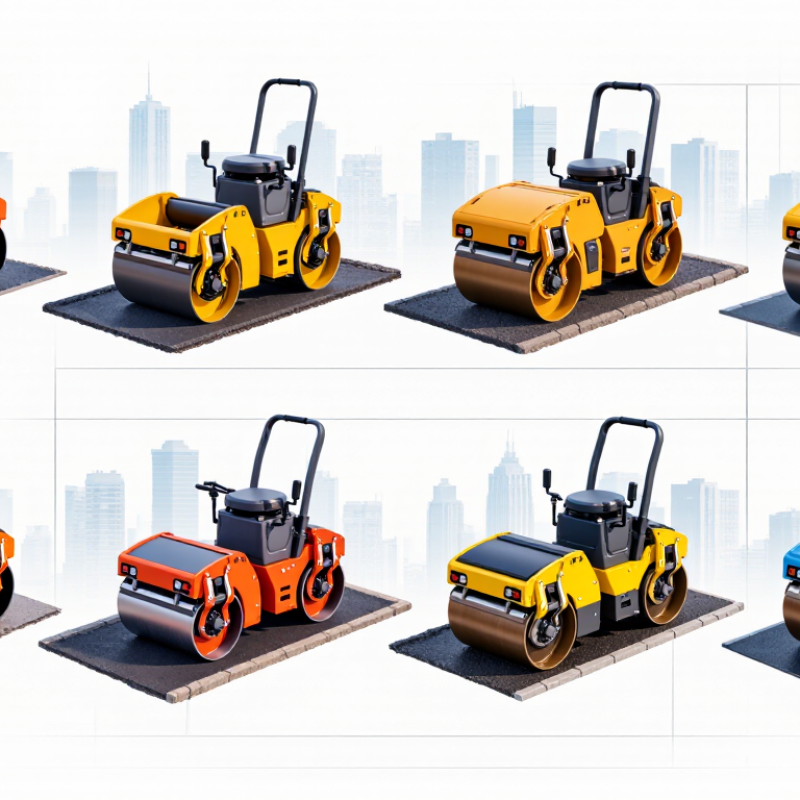
Top 10 Hand Road Rollers for Global Buyers

Hand Road Roller Basics: Static Load, Vibration, and Compaction Principles

A hand road roller compacts by pressing soil or asphalt with its drum. Static load comes from the machine’s weight, concentrated across the drum’s contact area. Vibration adds repeated force, helping particles rearrange and reducing air gaps. The effect depends on material, layer thickness, moisture, and the surface beneath. On a narrow patch, a few controlled passes may work better than pushing rapidly across the whole area. Watch the drum edge: loose material can gather there and leave a shallow ridge.

The U.S. Army Corps of Engineers’ EM 1110-2-1911 describes field compaction control using dry density relative to laboratory maximum dry density. A 95% target is common in specifications, but it is not universal; the project documents govern. For asphalt, FHWA’s Hot-Mix Asphalt Paving Handbook explains density control in relation to theoretical maximum density. That distinction matters: a roller can look busy while leaving a weak, under-compacted patch. Vibration may also be unsuitable near fragile edges or on very thin lifts. Check the material response, not just the number of passes. Honestly, operators sometimes rely too much on feel. A simple density test can challenge that habit.


Typical Specifications: 0.6–1.0 m Drum Width and 0.5–2.5 t Operating Mass

For global buyers comparing hand road rollers, a 0.6–1.0 m drum width and 0.5–2.5 t operating mass offer a useful screening range, not a universal specification. Narrow drums can reach path edges and tight repair zones. Wider drums cover more ground per pass. On soft subgrades, however, a heavier machine may sink or leave marks. Test the intended surface.

The Global Infrastructure Hub’s Global Infrastructure Outlook estimated worldwide infrastructure investment needs of US$94 trillion by 2040 across 56 countries. That is broad infrastructure, not a forecast for roller sales, but it signals varied site conditions and maintenance demands. For buyers, check transport weight, vibration settings, turning clearance, and access to service parts. A 0.8 m drum may suit sidewalks and patching; a 1.5 t unit can be easier to move than a machine near the top of the stated mass range. Small details matter.

Ask suppliers for compaction test records on comparable materials, rather than relying on drum width alone. Confirm whether operating mass includes fuel and water, since published figures can differ. On a sloped test strip, observe tracking and braking. Specs do not tell the whole story. I would still compare trial results: the stated range is practical, but not a substitute for site-specific testing.

Top 10 Hand Road Rollers Compared by Drum Design, Force, and Application

A useful comparison of ten hand road rollers starts with the drum, not the advertised machine weight. Smooth, single-drum models suit narrow asphalt patches and confined paths. Tandem drums leave a more even finish on small paving areas. Padfoot drums grip cohesive soil, while smooth drums are better suited to granular base and asphalt. Static models apply steady pressure; vibratory models add repeated impact. More force is not always better.

NAPA’s 2011 report, The Impact of Increased Density on Asphalt Pavement Performance, estimates that a one-percentage-point increase in asphalt density may extend pavement life by about 10 percent. Treat this as an industry estimate, not a guaranteed result: mix, weather, and site preparation all matter. FHWA technical guidance also identifies density as a key measure of asphalt compaction quality.

For a thin patch beside a curb, a narrow drum can reach the edge without scraping it. On a wider path, a broader drum may reduce overlapping passes. Check operating weight, vibration settings, turning space, and access to the work area. Soft subgrade can make aggressive vibration counterproductive. That detail is easy to overlook. A comparison table is helpful, but real performance still depends on the operator and the material under the drum.

Safety and Compliance: ISO 20474-13:2017 Requirements for Rollers

For buyers comparing hand road rollers, ISO 20474-13:2017 is a useful safety reference, but its scope matters. It sets roller-specific safety requirements and should be read alongside ISO 20474-1, which covers requirements common to earth-moving machinery. Ask the supplier to confirm in writing whether the offered hand-guided model falls within the standard’s scope. A product description alone is not proof of conformity.

Review the machine itself and its documents. Check that operating controls are clearly identified, protective measures match the roller’s configuration, and the operator’s manual explains safe use, inspection, and maintenance. Look closely at practical details: a reachable control handle, secure covers, clear warning labels, and instructions for working on slopes or near edges. These are useful inspection points, not a substitute for checking the standard’s applicable clauses. Paperwork can be incomplete.

Request the conformity documentation and the exact standard edition used for assessment. Confirm that it covers the delivered configuration, including optional equipment, rather than a similar model. Also check applicable destination-market requirements; ISO conformity does not automatically meet every local rule. A checklist can miss wear or poor assembly. Before acceptance, inspect the actual unit, test its controls under safe conditions, and record any unresolved findings.

Global Buying Criteria: Engine Emissions, Parts Availability, and Total Cost of Ownership

Global buyers should compare engine certificates by rated power and destination market, not rely on a generic “low-emission” label. The U.S. Environmental Protection Agency’s Tier 4 nonroad diesel fact sheet reports reductions of up to 90% in particulate matter and 50% in nitrogen oxides compared with earlier standards. These figures are benchmarks, not a guarantee for every roller: engine category and configuration matter. Check required fuel quality, exhaust after-treatment, and local acceptance before shipping.

Parts access can matter as much as the purchase price. Ask for lead times and prices for filters, belts, scrapers, and vibration-system components, plus a written service schedule. Then estimate total cost of ownership: purchase, fuel, routine service, wear parts, freight, downtime, and resale value. A machine that sits for a small seal can become expensive quickly. The spreadsheet may still miss real delays.

Tip: Request a sample parts shipment quote and confirm which service items are stocked near the job site. Compare like-for-like warranties and engine documentation. Keep the paperwork; it helps resolve questions later.

Powder Coat Booths

For those larger-sized parts, or smaller quantity runs, we have 2 independent powder coat booths and ovens. The quality, durability and affordability of today’s powder coating finishes make this the process of choice for world-class companies.

Powder coating advantages over other forms of coating are many. Materials used in the Powder coating process can be metals and non-metals that come in a multitude of thicknesses, textures, colors, etc. Another of Powder coating’s biggest advantages over conventional coatings is its ability to create finishes in many different textures. Powder Coating Booths allow us the ability to apply these advantages to large products.

Wet Paint Line

Tri-State Fabricators runs a full-service conveyor line for painting. Wet painting can provide protection or decoration to many different part styles. From start to finish, every project is easier to undergo random and point-based inspection by our skilled painting team.

Advantages to our Wet Paint Line are these lines start with product prep and ends with a thorough inspection of a high quality finished product. Our ability to complete large and small projects with a superior finish and doing so in a timely and economical fashion. This passes along the savings in production to our customers. When powder coating ins not an option, our Wet Paint Line gets the job done right the first time.

Wet Paint Booths

When the parts get big and heavy we roll-out our custom paint racks and oversize booth. By utilizing our partnerships with all the major paint brands, we can match virtually any color with wet paint.

The advantages of having access to a Wet Paint Booth are many. Large projects of many different shapes can be loaded into the booth. The Wet Paint Booth offers an environment that is much more controlled than a typical parts painting operation.

Not only are they used because of their controlled environment, but they’re are also advantageous when it comes to applying paint to parts that are needed in industries that require specialty coatings such as medical, aerospace, etc.

Military CARC

Our military forces have some very high standards when it comes to the finish of their vehicles and equipment. From the first pre-treatment step to final coat, it takes a great deal of knowledge and experience to protect the men and women of our armed forces. They deserve only the best, and Tri-State Fabricators provides it.

All of our processes are closely monitored by our staff and management teams. Both of which are highly trained in the processes of metal fabrication and finishing. Tri-State Fabricators’ goal is to always fully satisfy each and every customer, including the military. We will always put a 110% into what we do.

Glass-Bead Blasting

Abrasive media blasting is an excellent way to remove old paint, rust, and increase the paint/powder adhesion. Glass beads produce a much smoother and brighter finish than angular abrasives; leaving the part clean yet without any dimensional change. Chemically inert and environmentally friendly, we can recycle our beads approximately 30 times; making them a more preferred method of metal cleaning or surface finishing.

Advantages to Glass Bead Blasting are many. Glass bead blast media is used when a project is needing rough surfaces need to become smooth for applications of coatings such as paint. It is typically used to clean paint and rust from a product surface without deforming the surface it is being used on. Overall, compared to many other blasting media, Glass Bead Blasting is a very economical choice and those savings are always passed on to our customers.

Part Washing

Tri-State Fabricators utilize a zinc phosphate wash to clean and etch the material to ensure the best paint adhesion possible. The unique design of our 3-stage wash system does the work like a 5-stage. From Cleaning and rinsing to conversion coating and post-treatment, Our Part Washing process is a complete service and works throughout the fabrication service and the finishing service.

Along with the previously mentioned benefits, Curing is a vital chemical reaction that leaves the product finish hard and relatively safe from mild abrasion and aggressive corrosion. This process can be done in more than one way; ambient air-dry or in curing ovens at temps that exceed 240°.

Burn-Off Oven

From fixing paint mistakes (someone else’s of course) to simply cleaning our paint line hooks, our burn-off oven is put to good use. After a quick burn-off, a little clean up, and a fresh coat of paint, your parts will look better than new.

Why does our Burn-Off Oven work so well? Because super heating the air around parts turns the materials into ashes. From paint and powder coatings to rubber and machining oils, high temps do the job without degrading the integrity of the part.

Masking

Masking is a vital part of producing high quality products. We have die-cut masking patterns to protect machined surfaces as well as a wide range of plugs and caps to protect threaded holes and bolts. We provide permanent and temporary masking.

Masking allows the selected sections of a product to be protected from a fabrication or finishing service. This can be with both chemicals when etching and tapes, paints when only finishing just a section of the product. Masking is great in aiding the customization process of a project.

Screen Printing

Screen printing is a photographic process that transfers artwork onto a porous nylon screen which allows colored ink to flow through the screen and be deposited on an aluminum or plastic component. We can generally have just about any design created onto a screen for your parts.

Some of the advantages of Screen Printing are, brand recognition for your business displaying on your products, assembly instructions, product warnings/hazards, etc. Tri-State Fabricators produces Screen Printing of the highest quality so you know it’s durable.

Metal Finishing

Metal Finishing is the art of treating the exterior portion of product, often metal but can also be made of other materials, so that the surface is clean and free of any debris. Then the process of applying coats or either paint of powder coat takes place. This coating process improves the quality of the product in both appearance and resistance to wear and corrosion.

Tri-State Fabricators, Inc., understands that a project typically isn’t complete until a high-quality finish has been added to your product. This is why our painting and powder coating teams continuously inspect the products throughout the Metal Finishing process.
