


Grey Retail Shelving can shape how a store feels before shoppers read a single price tag. In 2026, retailers can choose from gondola units, wall-mounted shelves, modular systems, wire racks, and glass-front displays. Each option suits different products and floor plans. Gondolas create visible aisles for packaged goods, while wall shelves use vertical space for books, accessories, or folded clothing. Wire racks keep items easy to see and can work well in busy stock areas. Glass-front units offer a more polished setting for smaller, higher-value merchandise.
The right choice depends on more than appearance. Check the stated load capacity, shelf adjustability, finish durability, and cleaning requirements before comparing prices. Measure aisle widths and product dimensions, too. A grey metal unit may look calm and modern, but scuffed corners can quickly change that impression. Small details matter.
There is no perfect fixture. A display that works for cosmetics may feel awkward in a grocery aisle. Store traffic, restocking routines, and the weight of products all affect performance. This guide compares common shelving types by use, strengths, and practical trade-offs. It also considers how grey finishes pair with lighting, signage, and neighboring materials. Some decisions still require testing in the actual space. A sample shelf and a measured floor plan can reveal problems that a product photo cannot.
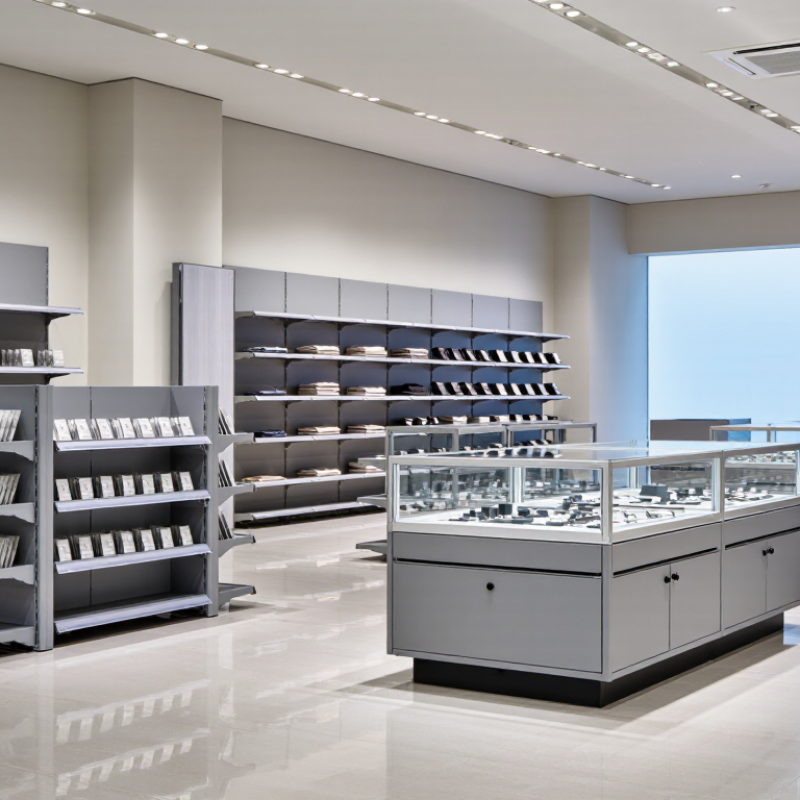
Grey retail shelving refers to store fixtures finished in grey tones, from pale silver to charcoal. The color may come from powder-coated metal, laminate, or painted surfaces, so finish and construction matter as much as appearance. It is not neutral. Under cool lighting, a light grey can look almost white; near warm wood, the same finish may seem darker. Check a sample in the actual store lighting. A small swatch can mislead.
The main fixture types serve different tasks. Gondola shelving stands on the sales floor, often with adjustable shelves on both sides, and suits packaged goods. Wall shelving uses the perimeter efficiently and can keep taller products visible. Endcaps sit at aisle ends, creating a compact spot for seasonal or featured items. Display tables work well for folded goods or products shoppers should handle, while slatwall panels support hooks and small accessories. Match each fixture to product weight, reach, and traffic flow. Confirm shelf load limits and anchoring needs before installation; a crowded aisle or overloaded shelf can undermine an otherwise tidy layout. Grey helps create visual consistency, but it will not hide dust or scuffs equally well across every finish.
| Fixture type | What defines it | Common retail uses | Advantages | Planning considerations |
|---|---|---|---|---|
| Gondola shelving | A freestanding retail unit with a base, uprights, and adjustable shelves; single-sided units often line walls, while double-sided units form aisles. | Groceries, health and beauty products, convenience retail, and general merchandise. | Flexible shelf positions and a familiar layout for organizing a wide range of packaged goods. | Plan aisle width, end displays, base size, and shelf loading; compatible accessories depend on the system. |
| Wall-mounted standards and brackets | Vertical tracks or standards attach to a wall and support adjustable brackets and shelves. | Perimeter displays, book and home-goods sections, and spaces where floor area is limited. | Uses wall space efficiently and allows shelf heights to be changed as assortments shift. | The wall and fixings must suit the expected load. Confirm track, bracket, and shelf compatibility. |
| Slatwall displays | Panels with horizontal grooves accept compatible inserts, shelves, hooks, and other display accessories. | Apparel accessories, packaged items, gifts, and other merchandise displayed on hooks or shelves. | Supports varied merchandising arrangements and makes it easy to reposition compatible accessories. | Panel construction, installation, and accessory ratings affect how much weight can be displayed safely. |
| Gridwall displays | Open wire-grid panels used with compatible hooks, baskets, and shelves; panels may be wall-mounted or supported by a stand. | Small packaged products, accessories, seasonal merchandise, and temporary displays. | Open construction keeps products visible and allows accessories to be rearranged. | Check panel support, stand stability, and accessory fit, especially for heavier items. |
| Wire shelving | A freestanding frame with open wire shelves, commonly adjustable along upright posts. | Back rooms, stock areas, utility zones, and some visible displays requiring open storage. | Open shelves allow airflow and visibility, and the units can be reconfigured for different storage needs. | Small or soft-bottomed products may need shelf liners; verify stability and load limits for each shelf. |
| Freestanding display shelving | A standalone shelf unit designed for placement on the sales floor, often with a distinctive shape or a smaller footprint than aisle gondolas. | Promotional merchandise, feature products, and displays near entrances or checkout areas. | Can create a focused product presentation and be positioned independently of wall fixtures. | Consider footprint, visibility, access, and stability; keep circulation routes clear. |
| Glass display cabinets | Enclosed or partly enclosed cabinets with glass panels and shelves, sometimes with lockable doors. | Fragile, high-value, collectible, or presentation-sensitive merchandise. | Provides product visibility while helping separate merchandise from open-access displays. | Check glass type, door access, cleaning needs, lighting, and suitable placement in the store. |

Single- and double-sided gondola shelves solve different layout needs. A single-sided unit usually sits against a wall, with shelves facing the shopping area. It can turn a bare wall into useful display space while keeping the center aisle open. Grey finishes work well here because they tend to recede visually, letting colorful packaging stand out.
Double-sided gondolas hold products on both faces and are commonly arranged in central aisles. They can create clear shopping routes and display more items in a compact footprint. But extra shelf space is not always better. A row placed too close to a cross-aisle can interrupt movement or block views across the store. Check aisle width, sightlines, and the reach needed to restock products before settling on a layout. The right arrangement depends on the room; measurements on paper can still feel different on a busy day.
Tips: Use single-sided shelving along perimeter walls and double-sided units where shoppers can move around both ends. Keep heavier goods on lower shelves, and test the route with a loaded cart. Leave room for turning. Review the setup after opening; some placements simply do not work as expected.
Grey retail shelving can make a shop feel calm, but the fixture should fit the merchandise and the room. Wall shelving works well for a steady, organized display along a perimeter. It keeps the center floor open and suits folded clothing, boxed goods, or heavier items when the wall and brackets are properly rated. Measure the product depth before installation; a shelf that looks generous when empty can feel cramped once stock is on it.
Gridwall is useful when displays need frequent changes. Hooks, baskets, and small shelves can be moved to suit seasonal products or uneven stock. Its open structure also lets customers see the wall behind it. Not every wall works. Check that the panel is securely mounted, and leave enough space for shoppers to browse without catching bags or sleeves on hooks.
Slatwall offers a neater, more finished look, with accessories that can shift as the assortment changes. It often suits apparel, accessories, and packaged products. Wire shelving is a practical choice for back rooms, stock areas, or displays where airflow and quick visibility matter. It can look less polished, though. Grey wire may help it blend in, but it will not fix a cluttered display. I would test the layout with real products before committing; fixture capacity, wall construction, and customer movement are easy to underestimate.
Grey retail shelving in 2026 may include freestanding gondolas, wall units, end caps, and compact wire displays. Their finish matters, but dimensions and load limits matter more. A narrow aisle can make a deep shelf awkward. Measure the floor space, ceiling height, and product footprint before choosing a unit.
Check shelf width and depth against the items you plan to display. Small packaged goods may fit on shallow shelves, while bulky cartons need greater depth and clearance. Allow room for price labels and customers’ hands. A few centimetres can change whether products sit neatly or overhang. Easy to overlook.
Read the manufacturer’s rated capacity for each shelf and the full bay. These figures may depend on evenly distributed weight and the specified configuration. A stack of dense items creates a different load from light, widely spaced products. Keep heavier stock low, and do not treat a safety margin as extra capacity. I would verify the rating for the exact shelf arrangement, not just a similar-looking unit. It is a bit tedious, but guessing is worse. Recheck after adding accessories, changing shelf spacing, or moving stock; the original rating may no longer apply.
Grey retail shelving often uses RAL codes to describe a finish more clearly than “light grey” or “medium grey.” RAL 7035 is Light Grey, a pale shade that keeps shelves visually quiet and can brighten compact aisles. RAL 7040 is Window Grey, a cooler, deeper grey that gives uprights and shelf edges more definition. Small difference. In a store, it can change the whole impression.
A code identifies a color reference, not a guaranteed visual match. Powder-coat texture, gloss level, metal preparation, and lighting can all affect how the finish appears. Under warm shop lights, RAL 7035 may look creamier; beside a window, RAL 7040 can appear bluer. Check a physical sample against the floor, wall, and packaged goods. Screens are unreliable.
For a practical specification, record the RAL code alongside the coating type, sheen, and any texture requirement. Also confirm that replacement bays can be finished to the same specification. That detail is easy to miss. A sample panel viewed at eye level may not predict how a full run looks under ceiling lights, so assess a larger section when possible. Grey is useful, but not automatically neutral.
Common retail shelving formats include gondola shelving, wall bays, end caps, and wire shelving. The chart compares approximate digital RGB values for two widely used RAL grey references; RGB conversions are indicative and may vary between color libraries and screens.
RAL 7035 is Light Grey; RAL 7040 is Window Grey. Confirm the finish with a physical swatch before specifying shelving, since screen colors are not a reliable paint match.


For those larger-sized parts, or smaller quantity runs, we have 2 independent powder coat booths and ovens. The quality, durability and affordability of today’s powder coating finishes make this the process of choice for world-class companies.
Powder coating advantages over other forms of coating are many. Materials used in the Powder coating process can be metals and non-metals that come in a multitude of thicknesses, textures, colors, etc. Another of Powder coating’s biggest advantages over conventional coatings is its ability to create finishes in many different textures. Powder Coating Booths allow us the ability to apply these advantages to large products.
Tri-State Fabricators runs a full-service conveyor line for painting. Wet painting can provide protection or decoration to many different part styles. From start to finish, every project is easier to undergo random and point-based inspection by our skilled painting team.
Advantages to our Wet Paint Line are these lines start with product prep and ends with a thorough inspection of a high quality finished product. Our ability to complete large and small projects with a superior finish and doing so in a timely and economical fashion. This passes along the savings in production to our customers. When powder coating ins not an option, our Wet Paint Line gets the job done right the first time.
When the parts get big and heavy we roll-out our custom paint racks and oversize booth. By utilizing our partnerships with all the major paint brands, we can match virtually any color with wet paint.
The advantages of having access to a Wet Paint Booth are many. Large projects of many different shapes can be loaded into the booth. The Wet Paint Booth offers an environment that is much more controlled than a typical parts painting operation.
Not only are they used because of their controlled environment, but they’re are also advantageous when it comes to applying paint to parts that are needed in industries that require specialty coatings such as medical, aerospace, etc.
Our military forces have some very high standards when it comes to the finish of their vehicles and equipment. From the first pre-treatment step to final coat, it takes a great deal of knowledge and experience to protect the men and women of our armed forces. They deserve only the best, and Tri-State Fabricators provides it.
All of our processes are closely monitored by our staff and management teams. Both of which are highly trained in the processes of metal fabrication and finishing. Tri-State Fabricators’ goal is to always fully satisfy each and every customer, including the military. We will always put a 110% into what we do.
Abrasive media blasting is an excellent way to remove old paint, rust, and increase the paint/powder adhesion. Glass beads produce a much smoother and brighter finish than angular abrasives; leaving the part clean yet without any dimensional change. Chemically inert and environmentally friendly, we can recycle our beads approximately 30 times; making them a more preferred method of metal cleaning or surface finishing.
Advantages to Glass Bead Blasting are many. Glass bead blast media is used when a project is needing rough surfaces need to become smooth for applications of coatings such as paint. It is typically used to clean paint and rust from a product surface without deforming the surface it is being used on. Overall, compared to many other blasting media, Glass Bead Blasting is a very economical choice and those savings are always passed on to our customers.
Tri-State Fabricators utilize a zinc phosphate wash to clean and etch the material to ensure the best paint adhesion possible. The unique design of our 3-stage wash system does the work like a 5-stage. From Cleaning and rinsing to conversion coating and post-treatment, Our Part Washing process is a complete service and works throughout the fabrication service and the finishing service.
Along with the previously mentioned benefits, Curing is a vital chemical reaction that leaves the product finish hard and relatively safe from mild abrasion and aggressive corrosion. This process can be done in more than one way; ambient air-dry or in curing ovens at temps that exceed 240°.
From fixing paint mistakes (someone else’s of course) to simply cleaning our paint line hooks, our burn-off oven is put to good use. After a quick burn-off, a little clean up, and a fresh coat of paint, your parts will look better than new.
Why does our Burn-Off Oven work so well? Because super heating the air around parts turns the materials into ashes. From paint and powder coatings to rubber and machining oils, high temps do the job without degrading the integrity of the part.
Masking is a vital part of producing high quality products. We have die-cut masking patterns to protect machined surfaces as well as a wide range of plugs and caps to protect threaded holes and bolts. We provide permanent and temporary masking.
Masking allows the selected sections of a product to be protected from a fabrication or finishing service. This can be with both chemicals when etching and tapes, paints when only finishing just a section of the product. Masking is great in aiding the customization process of a project.
Screen printing is a photographic process that transfers artwork onto a porous nylon screen which allows colored ink to flow through the screen and be deposited on an aluminum or plastic component. We can generally have just about any design created onto a screen for your parts.
Some of the advantages of Screen Printing are, brand recognition for your business displaying on your products, assembly instructions, product warnings/hazards, etc. Tri-State Fabricators produces Screen Printing of the highest quality so you know it’s durable.
Metal Finishing is the art of treating the exterior portion of product, often metal but can also be made of other materials, so that the surface is clean and free of any debris. Then the process of applying coats or either paint of powder coat takes place. This coating process improves the quality of the product in both appearance and resistance to wear and corrosion.
Tri-State Fabricators, Inc., understands that a project typically isn’t complete until a high-quality finish has been added to your product. This is why our painting and powder coating teams continuously inspect the products throughout the Metal Finishing process.

