


Choosing a Paper Containers manufacturer involves more than comparing unit prices. Global buyers need packaging that protects products, runs smoothly on filling lines, and arrives consistently across repeat orders. A sample may look sturdy on a desk, yet soften when exposed to condensation or lose shape during stacking. Details matter.
A useful review starts with the container’s intended use. Check material specifications, dimensions, barrier requirements, printing quality, and production tolerances. Ask how the supplier handles prototypes, quality checks, lead times, and order changes. Request samples made with the proposed materials, not just similar stock. Then test them under realistic storage and transport conditions. Small tests reveal problems.
Circular-design expert William McDonough is associated with the principle, “Waste equals food.” It is not a technical rule for paper packaging, but it offers a helpful question: can the container’s materials and end-of-life options fit the buyer’s sustainability goals? Claims should be checked against documented specifications and the facilities available in destination markets. A recyclable label alone does not guarantee practical recycling.
This guide compares manufacturers through product range, customization, manufacturing capabilities, quality practices, and buyer support. The best fit will depend on the application, order volume, and required performance. There is no universal winner. Even a careful shortlist can miss something; buyers should verify current capabilities directly before committing to production.
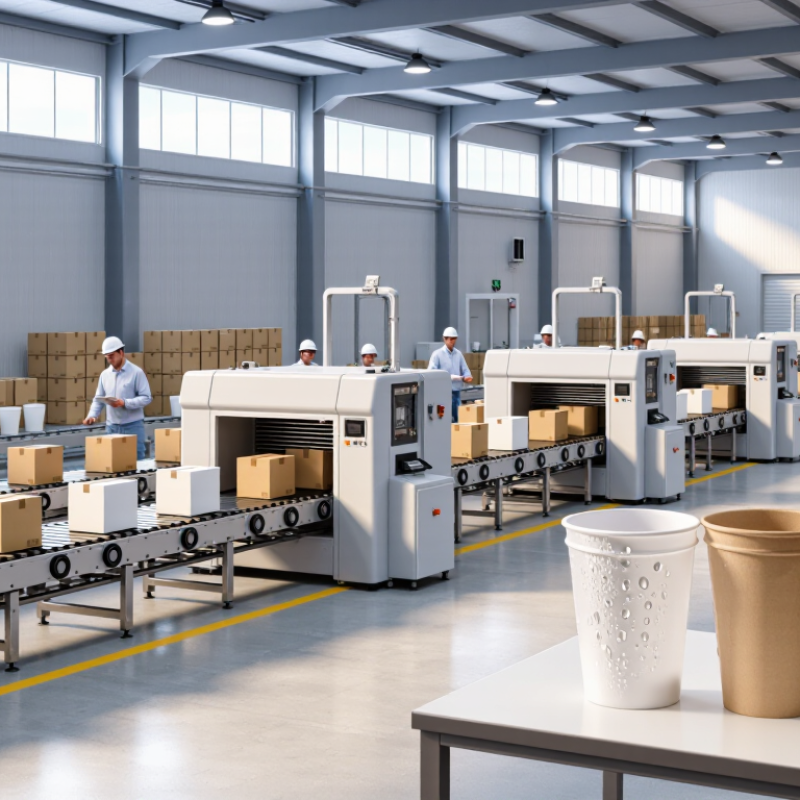
Paper container manufacturers turn paperboard and pulp into practical formats for food, retail, and shipping. Their products include folding cartons, paper cups, bowls, takeaway boxes, trays, and molded-fiber inserts. Production may involve printing, die-cutting, folding, heat sealing, and applying moisture or grease barriers. A cup’s rolled rim and a carton’s glued seam look minor, but both affect leakage and strength. Some formats combine paper with thin barrier layers, so “paper-based” does not always mean paper-only. Small details matter.
Manufacturers also produce protective packaging, such as molded-pulp trays that cushion bottles or electronics. Buyers typically review dimensions, board weight, stacking strength, print quality, and food-contact suitability. The European Commission’s Eurostat reports that 82.5% of paper and cardboard packaging waste was recycled in the EU in 2022. This is useful context, not a guarantee that every container is recyclable; coatings and local collection systems can change the outcome. Not every format fits.
Tips: Request samples and test them with the actual product, filling temperature, and storage conditions. Ask for material specifications and recycling guidance for the target market. A small trial run can reveal weak seals or soggy corners before larger orders. In practice, one test condition is easy to overlook.

Paper containers begin as a performance brief, not a shape. Designers define capacity, filling temperature, stacking load, and expected moisture exposure. A cup for a cold drink needs different barriers from a container holding hot soup. Board grade, wall thickness, rim geometry, and seam placement all affect stiffness and leakage. Small details matter.
Manufacturing usually starts with printed paperboard sheets or rolls. The material is cut, creased, and formed around tooling; seams are sealed with heat, pressure, or adhesive. Coatings can resist grease or water, but they also influence forming and end-of-life processing. The Food and Agriculture Organization’s Global Forest Products Facts and Figures 2022 reports about 401 million tonnes of global paper and paperboard production in 2022. That scale makes consistent specifications essential. Yet a high-volume process can still produce weak rims or uneven seals if moisture and machine settings drift.
Quality checks commonly include dimensional inspection, compression tests, and leak testing. Then comes testing. The U.S. Environmental Protection Agency’s 2018 materials report estimated a 68.2% recycling rate for paper and paperboard in the United States, across all uses. This is useful context, not a guarantee that every coated container is recyclable locally. Designers should verify local collection and mill requirements early. A lighter container may save material, but not if it collapses during transport. Trade-offs are real, and sometimes the first prototype gets them wrong.
The global market includes several kinds of paper container manufacturers. Molded-fiber specialists make trays, bowls, and protective inserts from shaped pulp. Paperboard converters produce folding cartons, tubs, and sleeves, often from purchased board. Integrated producers handle more steps, from papermaking to converting, which can improve coordination but may offer fewer material options. Corrugated specialists focus on sturdy shipping containers rather than small retail packs. Different jobs need different suppliers.
Buyers should compare more than unit price. Ask about container dimensions, stacking strength, print quality, and production tolerances. For food packaging, request material and testing details that match the intended use. Check sample fit with the actual product; a lid that looks right on a drawing may loosen after transport. Also ask how the supplier manages repeat orders and material changes. These details can be hard to assess remotely.
Tips: Send a clear specification and request physical samples. Test them under realistic storage and shipping conditions. Ask for documented material details, lead times, and minimum order quantities. A polished sample is useful, but it cannot reveal every production inconsistency. That part deserves a second look.
A polished catalogue is not proof of consistent quality. Ask for samples from a regular production run, not only hand-finished pieces. Check rim shape, seam strength, coating coverage, and whether lids fit after containers are stacked. Measure several units; small differences can cause trouble on an automated filling line. A sample can still flatter.
Capacity means more than a large monthly figure. Ask how many lines make the product, what minimum order applies, and how seasonal demand affects lead times. Request a production schedule for your likely order size, including setup and delivery time. If capacity depends on one machine, delays may ripple through the schedule. That detail is easy to miss.
For compliance, request current material specifications and test documents relevant to the intended use and destination market. Confirm that documents identify the exact paper, coating, and container construction being quoted. Ask how the manufacturer controls batch changes and handles nonconforming goods. No checklist is perfect; factory conditions can shift between visits. A third-party audit may add useful evidence, but it should not replace clear records and direct questions.
Global buyers should compare paper container suppliers by performance, not price alone. Start with the intended use: hot soup, chilled desserts, or dry takeaway meals place different demands on packaging. Share exact dimensions, expected order volumes, filling temperatures, and storage conditions. Ask for samples made with the proposed paper grade and coating. Check whether lids fit securely, seams stay dry, and containers stack without crushing. A sample can look excellent on a desk and still disappoint after a long delivery route.
Tips: Test samples with the actual food or a close substitute. Record fill temperature, holding time, leakage, and lid fit. Small details matter.
Before placing an order, review product specifications, quality checks, production capacity, and realistic lead times. Request clear answers about material composition and relevant food-contact documentation for the intended market. Compare quotations on the same basis, including printing, tooling, packing, and shipping terms. Ask how defects are handled and whether production batches can be traced. A video call or factory visit may clarify processes, but neither replaces written specifications. Communication is part of supplier quality. It can be uneven, and buyers should allow time to resolve gaps before approving production. Keep a signed sample and agreed tolerances for later reference.
| Supplier / Product Category | Common Materials and Formats | Typical Applications | Key Supplier Evaluation Criteria | Documents and Verifications to Request | Global Sourcing Considerations |
|---|---|---|---|---|---|
| Folding carton and paperboard container manufacturers | Folding boxboard, solid bleached board, recycled paperboard; cartons supplied flat or pre-glued | Dry food, cosmetics, personal care products, household goods, and retail packaging | Board grade and thickness; print quality; cutting and folding accuracy; carton strength; consistency between production runs | Material specifications; print proofs; production samples; applicable food-contact declarations when used for food packaging | Confirm artwork and language requirements for each market. Ask how the supplier controls color variation and protects printed cartons during transit. |
| Corrugated paper container manufacturers | Single-wall, double-wall, or other corrugated board constructions; regular slotted cartons and custom die-cut boxes | Shipping cases, e-commerce parcels, produce distribution, and protective transport packaging | Board construction; box dimensions; compression and stacking performance; moisture exposure; print and converting capability | Board specification; sample cartons; test reports relevant to the intended distribution conditions; quality-control procedures | Specify the packed product weight, stacking pattern, and transport route. Performance depends on box design, board properties, humidity, and handling. |
| Paper cup and food-container manufacturers | Paperboard cups, bowls, tubs, lids, and trays; some formats use barrier coatings or separate lining materials | Hot and cold beverages, takeaway meals, desserts, and food service | Leak resistance; suitability for the intended temperature and contact time; lid fit; seam integrity; coating construction | Food-contact compliance information for the destination market; material and coating details; migration or other test reports where applicable | Food-contact rules differ by jurisdiction and intended use. Confirm whether the product is suitable for hot, cold, fatty, or acidic contents as applicable. |
| Molded-fiber container manufacturers | Formed fiber made from recovered paper or other plant fibers; trays, clamshells, inserts, and protective parts | Food service packaging, produce trays, protective inserts, and product cushioning | Part dimensions; fit and cushioning performance; surface finish; moisture resistance; consistency of molded shapes | Fiber-source information; samples; performance data for the intended application; food-contact documentation where relevant | Ask whether the item includes additives, coatings, or liners. Recyclability and compostability depend on the complete product and local collection or processing facilities. |
| Paper-based protective packaging manufacturers | Honeycomb paper, corrugated pads, paper cushioning, edge protectors, and molded or folded inserts | Furniture, appliances, electronics, industrial goods, and export shipments | Impact protection; load-bearing performance; package fit; ease of assembly; compatibility with existing packing lines | Product samples; packaging drawings; trial-pack results; test data based on the product and shipping environment | Validate packaging with the actual product and shipping configuration. Reduce empty space where practical to improve pallet and container utilization. |
| Custom-printed paper container manufacturers | Printed paperboard, corrugated board, and paper bags; common processes include offset, flexographic, and digital printing | Branded retail packaging, subscription boxes, promotional packs, and point-of-sale displays | Color control; print registration; approved proof matching; finishing options; ability to manage repeat orders | Artwork proofs; color references; print and finishing specifications; confirmation of approved materials and production tolerances | Allow time for artwork approval, sampling, and transit. Confirm who owns printing plates or tooling and how changes to artwork are controlled. |
| Export-oriented paper container manufacturers | Paperboard cartons, corrugated cases, cups, molded-fiber products, or mixed portfolios, depending on facility capability | Import programs requiring repeat orders, multiple pack sizes, or delivery to more than one market | Verified production capacity; quality-management controls; traceability; communication during production; packaging and shipment planning | Facility and quality-system information; product specifications; sample approval records; relevant certificates and declarations for the product and destination | Compare total landed cost, not unit price alone. Include freight, duties, inspection, packaging, lead time, and the effect of order size on inventory. |
| All paper container supplier types | Virgin fiber, recycled fiber, or a specified blend; optional fiber-sourcing or chain-of-custody claims | Buyers seeking material transparency or packaging aligned with procurement policies | Declared recycled content; material traceability; consistency of claims; suitability for the product and local waste system | Written material composition; supporting evidence for environmental claims; valid chain-of-custody documentation when such claims are made | Verify certificates and claims directly with the issuing scheme or certification body. Do not assume that a paper-based item is recyclable in every location. |
| All paper container supplier types | Standard or custom dimensions, board grades, barriers, printing, and finishing | New product launches, ongoing replenishment, and packaging redesigns | Minimum order quantity; sample and tooling charges; production lead time; defect handling; capacity during seasonal peaks | Quotation with specification; approved pre-production sample; inspection criteria; written terms for lead time, payment, and claims | Run a pilot order before scaling. Agree on tolerances, inspection methods, shipment terms, and corrective-action steps in writing. |
Buyer note: Paper packaging performance, regulatory status, and end-of-life options depend on the product design, coatings or other components, intended use, destination-market rules, and local collection infrastructure. Verify specifications and claims for each purchase.


For those larger-sized parts, or smaller quantity runs, we have 2 independent powder coat booths and ovens. The quality, durability and affordability of today’s powder coating finishes make this the process of choice for world-class companies.
Powder coating advantages over other forms of coating are many. Materials used in the Powder coating process can be metals and non-metals that come in a multitude of thicknesses, textures, colors, etc. Another of Powder coating’s biggest advantages over conventional coatings is its ability to create finishes in many different textures. Powder Coating Booths allow us the ability to apply these advantages to large products.
Tri-State Fabricators runs a full-service conveyor line for painting. Wet painting can provide protection or decoration to many different part styles. From start to finish, every project is easier to undergo random and point-based inspection by our skilled painting team.
Advantages to our Wet Paint Line are these lines start with product prep and ends with a thorough inspection of a high quality finished product. Our ability to complete large and small projects with a superior finish and doing so in a timely and economical fashion. This passes along the savings in production to our customers. When powder coating ins not an option, our Wet Paint Line gets the job done right the first time.
When the parts get big and heavy we roll-out our custom paint racks and oversize booth. By utilizing our partnerships with all the major paint brands, we can match virtually any color with wet paint.
The advantages of having access to a Wet Paint Booth are many. Large projects of many different shapes can be loaded into the booth. The Wet Paint Booth offers an environment that is much more controlled than a typical parts painting operation.
Not only are they used because of their controlled environment, but they’re are also advantageous when it comes to applying paint to parts that are needed in industries that require specialty coatings such as medical, aerospace, etc.
Our military forces have some very high standards when it comes to the finish of their vehicles and equipment. From the first pre-treatment step to final coat, it takes a great deal of knowledge and experience to protect the men and women of our armed forces. They deserve only the best, and Tri-State Fabricators provides it.
All of our processes are closely monitored by our staff and management teams. Both of which are highly trained in the processes of metal fabrication and finishing. Tri-State Fabricators’ goal is to always fully satisfy each and every customer, including the military. We will always put a 110% into what we do.
Abrasive media blasting is an excellent way to remove old paint, rust, and increase the paint/powder adhesion. Glass beads produce a much smoother and brighter finish than angular abrasives; leaving the part clean yet without any dimensional change. Chemically inert and environmentally friendly, we can recycle our beads approximately 30 times; making them a more preferred method of metal cleaning or surface finishing.
Advantages to Glass Bead Blasting are many. Glass bead blast media is used when a project is needing rough surfaces need to become smooth for applications of coatings such as paint. It is typically used to clean paint and rust from a product surface without deforming the surface it is being used on. Overall, compared to many other blasting media, Glass Bead Blasting is a very economical choice and those savings are always passed on to our customers.
Tri-State Fabricators utilize a zinc phosphate wash to clean and etch the material to ensure the best paint adhesion possible. The unique design of our 3-stage wash system does the work like a 5-stage. From Cleaning and rinsing to conversion coating and post-treatment, Our Part Washing process is a complete service and works throughout the fabrication service and the finishing service.
Along with the previously mentioned benefits, Curing is a vital chemical reaction that leaves the product finish hard and relatively safe from mild abrasion and aggressive corrosion. This process can be done in more than one way; ambient air-dry or in curing ovens at temps that exceed 240°.
From fixing paint mistakes (someone else’s of course) to simply cleaning our paint line hooks, our burn-off oven is put to good use. After a quick burn-off, a little clean up, and a fresh coat of paint, your parts will look better than new.
Why does our Burn-Off Oven work so well? Because super heating the air around parts turns the materials into ashes. From paint and powder coatings to rubber and machining oils, high temps do the job without degrading the integrity of the part.
Masking is a vital part of producing high quality products. We have die-cut masking patterns to protect machined surfaces as well as a wide range of plugs and caps to protect threaded holes and bolts. We provide permanent and temporary masking.
Masking allows the selected sections of a product to be protected from a fabrication or finishing service. This can be with both chemicals when etching and tapes, paints when only finishing just a section of the product. Masking is great in aiding the customization process of a project.
Screen printing is a photographic process that transfers artwork onto a porous nylon screen which allows colored ink to flow through the screen and be deposited on an aluminum or plastic component. We can generally have just about any design created onto a screen for your parts.
Some of the advantages of Screen Printing are, brand recognition for your business displaying on your products, assembly instructions, product warnings/hazards, etc. Tri-State Fabricators produces Screen Printing of the highest quality so you know it’s durable.
Metal Finishing is the art of treating the exterior portion of product, often metal but can also be made of other materials, so that the surface is clean and free of any debris. Then the process of applying coats or either paint of powder coat takes place. This coating process improves the quality of the product in both appearance and resistance to wear and corrosion.
Tri-State Fabricators, Inc., understands that a project typically isn’t complete until a high-quality finish has been added to your product. This is why our painting and powder coating teams continuously inspect the products throughout the Metal Finishing process.

