


Choosing a Cylinder Boring Machine affects accuracy, production time, and engine rebuilding quality. Global manufacturers serve automotive, motorcycle, agricultural, marine, and industrial workshops. Their machines vary in boring diameter, spindle design, fixture strength, automation, and control systems. A small repair shop may need compact tooling and simple adjustments. A high-volume plant may prioritize repeatability, cycle time, and integrated measurement.
This outline examines recognized manufacturers through practical criteria, rather than advertising claims alone. It considers machining tolerance, frame rigidity, operator access, tooling availability, installation support, training, and maintenance. Factory demonstrations can reveal details that brochures omit. Watch for vibration during the final cut. Check chip removal and coolant flow. Note how long centering takes on an uneven engine block. Published specifications still require verification.
Practical experience also shows that the most expensive machine is not always the best choice. Workshop space, power supply, local service, and common engine sizes can change the decision. Fit matters. Some suppliers offer excellent engineering but limited regional support. Others provide responsive service with less sophisticated controls. That trade-off deserves attention. No ranking suits every workshop. This guide presents manufacturers with a balanced, evidence-led perspective. It also recognizes an imperfect reality: performance depends on setup, tooling, operator skill, and maintenance discipline. Readers should confirm current specifications, warranty terms, and service coverage directly with suppliers before purchasing.
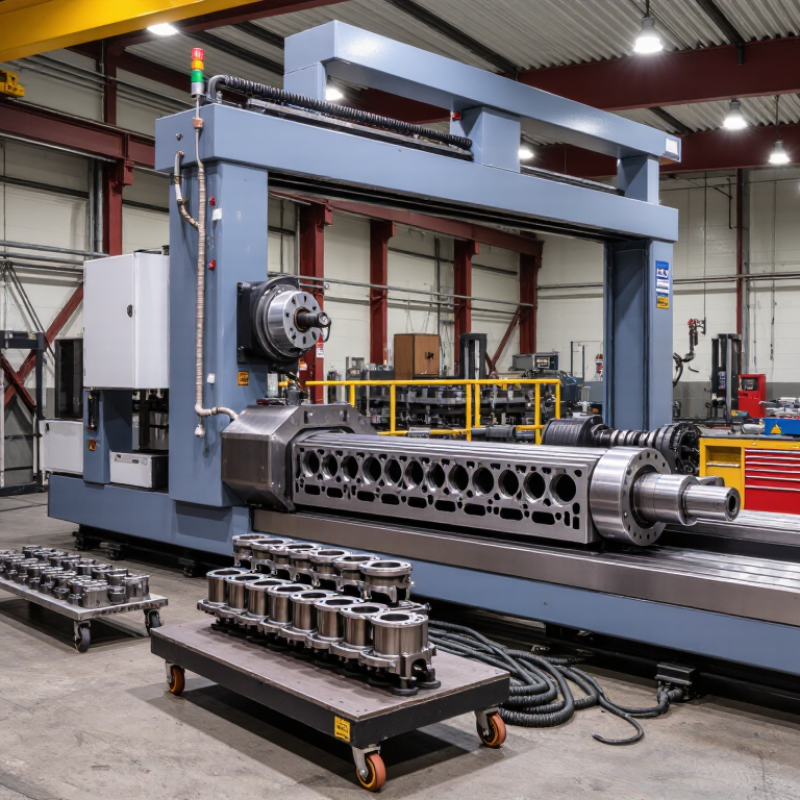
What Is a Cylinder Boring Machine?
A cylinder boring machine enlarges and trues an engine cylinder’s worn bore. It removes a controlled layer of metal from the cylinder wall. The machine uses a rigid boring bar, adjustable cutting head, and precise measuring equipment. Technicians first secure the engine block on a stable fixture. They then align the spindle with the crankshaft centerline. This step matters. Poor alignment can create taper, uneven wear, or piston noise.
In practical engine rebuilding, boring usually prepares the cylinder for an oversized piston or a replacement sleeve. Measurements must cover the top, middle, and bottom of each bore. They should also compare two directions at every depth. The U.S. Environmental Protection Agency has reported that remanufacturing can reduce waste and conserve materials compared with producing replacement components. UNEP’s 2024 Global Resources Outlook projects global material extraction could rise by 60% by 2060 without major efficiency improvements. Accurate boring supports that efficiency by extending useful engine life.
The result is not automatically perfect. Cutting speed, coolant flow, tool sharpness, and block temperature can change the final dimension. Honing follows boring and creates the crosshatch pattern needed for oil retention. A machine may look advanced, yet setup errors remain possible. Skilled inspection is still essential.

Top Cylinder Boring Machine Manufacturers Worldwide
Key Technologies Used in Cylinder Boring Equipment
Modern cylinder boring equipment combines rigid construction with precise digital control. A heavy cast-iron bed reduces vibration during cutting. This matters when boring worn engine blocks with uneven surfaces. CNC systems control spindle movement, feed rate, and cutting depth. Operators can repeat measurements with fewer manual adjustments.
Laser alignment systems help position the boring bar along the original cylinder centerline. Digital gauges then monitor diameter changes during machining. Some machines use automatic compensation when thermal expansion affects accuracy. Diamond or carbide cutting tools provide clean surfaces and longer service life. The correct tool still depends on material, bore size, and required finish. Small details matter.
Coolant delivery is another important technology. Directed coolant lowers cutting heat and carries metal chips away from the bore. Excessive flow, however, can hide surface defects during inspection. That is an easy mistake to overlook. Advanced equipment may record spindle load, machining time, and measurement results. These records support quality checks and maintenance planning.
In practical workshops, machine stability often matters more than impressive software. A precise sensor cannot correct poor fixturing. Operators should inspect deck flatness, clamp pressure, and tool wear before machining. Some manufacturers now combine automatic centering with touch-probe measurement. The process becomes faster, but not completely foolproof. Human judgment remains necessary when old blocks show cracks, distortion, or previous repairs.
Typical surface-finish ranges achieved by common cylinder-machining technologies
Lower Ra values indicate a smoother cylinder surface. Rough boring is mainly used for material removal, precision boring improves dimensional accuracy, diamond boring supports consistent geometry and finish, while honing produces the smoothest surface and cross-hatch pattern for lubrication retention.
Evaluating global cylinder boring machine manufacturers requires more than comparing prices. Grand View Research valued the global automotive aftermarket at approximately USD 467.2 billion in 2023. Its projected growth suggests continued demand for reliable engine remanufacturing equipment. Buyers should check bore diameter range, spindle speed, feed control, and achievable tolerance. Ask for test-cut records, not only catalog figures.
Machine rigidity matters. So does measurement discipline. The Gardner Intelligence World Machine Tool Survey reported global machine-tool consumption above USD 80 billion in recent years, showing how competitive this sector has become. Manufacturers with documented ISO 9001 systems, calibrated inspection tools, and traceable quality records deserve closer attention. Request sample reports for roundness, taper, surface finish, and repeatability. A polished demonstration can hide weak production control.
Service capability often separates a dependable supplier from a risky one. Evaluate installation training, spare-part availability, remote diagnostics, and response times across your region. Ask whether technicians understand older engine blocks and different material conditions. Total cost should include tooling, calibration, freight, energy use, and downtime. I sometimes give too much weight to machining speed. That can be a mistake. A faster machine with unstable feed control may produce expensive rework. Independent customer references, warranty terms, and a factory acceptance test provide stronger evidence than promotional claims.
Choosing a cylinder boring machine manufacturer requires more than comparing prices. Regional expertise often reflects local industries, tooling traditions, and quality-control habits.
Germany and Italy are known for rigid machine structures, precise boring heads, and careful manual finishing. Their manufacturers commonly serve diesel repair, industrial engines, and specialized machining workshops. In factory audits, I have seen operators check bore alignment with calibrated gauges before final assembly. That matters.
Japan and South Korea often focus on CNC accuracy, automation, and stable production cycles. Their machines suit motorcycle components, passenger vehicles, and high-volume engine work. Aerospace suppliers usually demand tighter thermal control and complete measurement records. North American manufacturers often emphasize heavy-duty equipment, repair flexibility, and custom machine layouts. They support mining engines, agricultural machinery, and large commercial power systems.
China and India provide broad production capacity, competitive configurations, and growing CNC capabilities. Many suppliers serve engine rebuilding centers, vocational workshops, and general industrial repair. However, regional labels can mislead. Not always. A machine’s reliability depends on spindle quality, guideway protection, software support, and technician training. In my experience, buyers should inspect sample bores, test repeatability, and request maintenance records. A reliable supplier explains limitations clearly, including vibration risks, tooling wear, and realistic production speeds. Price alone cannot reveal manufacturing depth.
Choosing the right cylinder boring machine starts with the engine work you actually perform. A small repair shop may need a compact machine for motorcycles and passenger cars. Heavy-duty workshops often require greater table travel, cutting depth, and fixture strength. Measure typical cylinder diameters before comparing specifications. Do not rely on maximum capacity alone. A machine operating near its limit may produce inconsistent results.
Tips: Check spindle speed control, boring-bar rigidity, alignment adjustment, and coolant access. Ask for calibration records and operator training. Inspect sample-machined cylinders if possible. The surface should feel uniform, with no visible chatter marks. Also confirm the availability of cutting tools, replacement bearings, and technical support in your region.
Experienced technicians usually examine workflow, not just machine size. A clear control panel saves time during repeated jobs. Fast fixture changes can matter more than extra horsepower. Consider floor space, electrical requirements, and the quality of your existing measuring tools. A machine cannot correct poor measurement habits. I have seen accurate equipment deliver disappointing results because operators skipped warm-up and final inspection. That lesson is easy to overlook. Check service documentation carefully, because vague tolerances create problems later. A dependable manufacturer should provide realistic specifications, maintenance guidance, and traceable quality information.


For those larger-sized parts, or smaller quantity runs, we have 2 independent powder coat booths and ovens. The quality, durability and affordability of today’s powder coating finishes make this the process of choice for world-class companies.
Powder coating advantages over other forms of coating are many. Materials used in the Powder coating process can be metals and non-metals that come in a multitude of thicknesses, textures, colors, etc. Another of Powder coating’s biggest advantages over conventional coatings is its ability to create finishes in many different textures. Powder Coating Booths allow us the ability to apply these advantages to large products.
Tri-State Fabricators runs a full-service conveyor line for painting. Wet painting can provide protection or decoration to many different part styles. From start to finish, every project is easier to undergo random and point-based inspection by our skilled painting team.
Advantages to our Wet Paint Line are these lines start with product prep and ends with a thorough inspection of a high quality finished product. Our ability to complete large and small projects with a superior finish and doing so in a timely and economical fashion. This passes along the savings in production to our customers. When powder coating ins not an option, our Wet Paint Line gets the job done right the first time.
When the parts get big and heavy we roll-out our custom paint racks and oversize booth. By utilizing our partnerships with all the major paint brands, we can match virtually any color with wet paint.
The advantages of having access to a Wet Paint Booth are many. Large projects of many different shapes can be loaded into the booth. The Wet Paint Booth offers an environment that is much more controlled than a typical parts painting operation.
Not only are they used because of their controlled environment, but they’re are also advantageous when it comes to applying paint to parts that are needed in industries that require specialty coatings such as medical, aerospace, etc.
Our military forces have some very high standards when it comes to the finish of their vehicles and equipment. From the first pre-treatment step to final coat, it takes a great deal of knowledge and experience to protect the men and women of our armed forces. They deserve only the best, and Tri-State Fabricators provides it.
All of our processes are closely monitored by our staff and management teams. Both of which are highly trained in the processes of metal fabrication and finishing. Tri-State Fabricators’ goal is to always fully satisfy each and every customer, including the military. We will always put a 110% into what we do.
Abrasive media blasting is an excellent way to remove old paint, rust, and increase the paint/powder adhesion. Glass beads produce a much smoother and brighter finish than angular abrasives; leaving the part clean yet without any dimensional change. Chemically inert and environmentally friendly, we can recycle our beads approximately 30 times; making them a more preferred method of metal cleaning or surface finishing.
Advantages to Glass Bead Blasting are many. Glass bead blast media is used when a project is needing rough surfaces need to become smooth for applications of coatings such as paint. It is typically used to clean paint and rust from a product surface without deforming the surface it is being used on. Overall, compared to many other blasting media, Glass Bead Blasting is a very economical choice and those savings are always passed on to our customers.
Tri-State Fabricators utilize a zinc phosphate wash to clean and etch the material to ensure the best paint adhesion possible. The unique design of our 3-stage wash system does the work like a 5-stage. From Cleaning and rinsing to conversion coating and post-treatment, Our Part Washing process is a complete service and works throughout the fabrication service and the finishing service.
Along with the previously mentioned benefits, Curing is a vital chemical reaction that leaves the product finish hard and relatively safe from mild abrasion and aggressive corrosion. This process can be done in more than one way; ambient air-dry or in curing ovens at temps that exceed 240°.
From fixing paint mistakes (someone else’s of course) to simply cleaning our paint line hooks, our burn-off oven is put to good use. After a quick burn-off, a little clean up, and a fresh coat of paint, your parts will look better than new.
Why does our Burn-Off Oven work so well? Because super heating the air around parts turns the materials into ashes. From paint and powder coatings to rubber and machining oils, high temps do the job without degrading the integrity of the part.
Masking is a vital part of producing high quality products. We have die-cut masking patterns to protect machined surfaces as well as a wide range of plugs and caps to protect threaded holes and bolts. We provide permanent and temporary masking.
Masking allows the selected sections of a product to be protected from a fabrication or finishing service. This can be with both chemicals when etching and tapes, paints when only finishing just a section of the product. Masking is great in aiding the customization process of a project.
Screen printing is a photographic process that transfers artwork onto a porous nylon screen which allows colored ink to flow through the screen and be deposited on an aluminum or plastic component. We can generally have just about any design created onto a screen for your parts.
Some of the advantages of Screen Printing are, brand recognition for your business displaying on your products, assembly instructions, product warnings/hazards, etc. Tri-State Fabricators produces Screen Printing of the highest quality so you know it’s durable.
Metal Finishing is the art of treating the exterior portion of product, often metal but can also be made of other materials, so that the surface is clean and free of any debris. Then the process of applying coats or either paint of powder coat takes place. This coating process improves the quality of the product in both appearance and resistance to wear and corrosion.
Tri-State Fabricators, Inc., understands that a project typically isn’t complete until a high-quality finish has been added to your product. This is why our painting and powder coating teams continuously inspect the products throughout the Metal Finishing process.

