Badminton is moving from casual recreation toward measured, repeatable training. The BWF Annual Report 2024 recorded participation across more than 200 member associations. It also highlighted badminton’s global Olympic reach. This wider audience is increasing demand for reliable training technology, including the Badminton Ballmaschine.
Market reports show a similar direction. Grand View Research identifies rising interest in sports equipment, home fitness, and technology-assisted practice. Its badminton equipment analysis points to Asia-Pacific as a major growth region. The Sports & Fitness Industry Association also reports strong racket-sport participation in the United States. However, public data rarely separates shuttlecock machines from general badminton equipment. That limitation deserves attention.
Peter Gade, former world number one and high-performance coach, has described badminton as “a game of speed, power, and endurance.” A quality Badminton Ballmaschine supports all three demands. It can repeat deep clears, fast drives, and tight net feeds. Players can observe shuttle height, feed consistency, and recovery timing. Coaches can adjust drills without constant manual feeding.
The leading manufacturers are not judged by speed alone. Noise, wheel durability, launch accuracy, battery life, and service support matter greatly. A machine that stops beside the court wastes valuable training time. That detail is easy to overlook.
This guide compares top Badminton Ballmaschine manufacturers worldwide through product design, testing evidence, user experience, and after-sales reliability. Rankings are not perfect. Regional pricing, limited independent testing, and changing models can affect results. Readers should verify current specifications before purchasing.
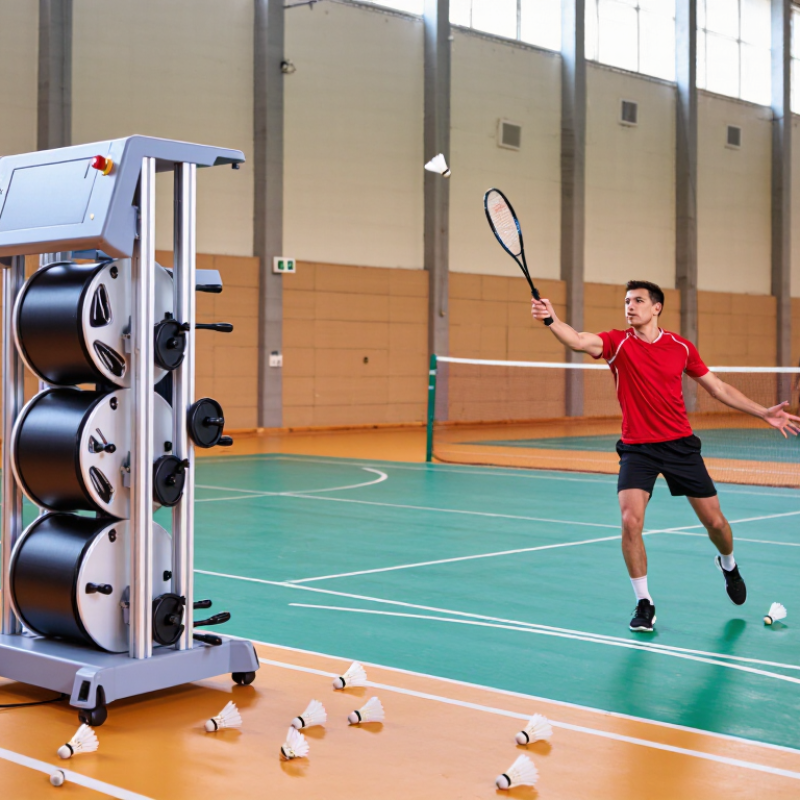
Badminton ball machines vary widely in design, but their useful value depends on control rather than appearance. During practical training, adjustable oscillation can move shots from left to right, while elevation control changes the angle from flat drives to higher clears. Random feeding adds pressure by preventing predictable returns. Some machines also offer remote controls, memory settings, and programmable drills. These features help players repeat specific movements without needing a partner.
Feed rate is usually measured in balls per minute. A slower setting, around 20 to 30 balls per minute, suits beginners and footwork practice. Advanced players may prefer faster feeding for rapid defense or net reactions. Speed ranges also matter. Moderate speeds can imitate controlled rallies, while higher speeds challenge reaction time and compact swings. However, the highest setting is not always the most useful. Excessive speed may encourage poor technique, especially when the player starts reaching instead of moving correctly.
Capacity affects training continuity. A compact hopper may hold roughly 80 to 120 shuttlecocks, while larger systems can accommodate 200 or more. More capacity reduces interruptions, but it may increase weight and transport difficulty. In my experience, portability is often underestimated. A machine that is powerful but difficult to position may remain unused. Feed consistency also deserves careful checking, because occasional double feeds can distort a drill. Testing several speed, angle, and interval combinations is necessary; one preset rarely fits every player.
BWF shuttle standards give badminton ball machine buyers a practical technical baseline. Feather shuttles must weigh between 4.74 and 5.50 grams. This narrow range affects launch timing, flight stability, and motor calibration. A machine designed for professional practice should feed shuttles consistently, not merely fire them quickly.
Speed grades usually run from 75 to 79. Higher numbers generally indicate faster shuttles, but speed is not a simple label. BWF testing considers how far a shuttle travels after a controlled full stroke. Temperature, altitude, humidity, and court air movement can change the result. Grade 77 may feel stable in one training hall and too fast in another.
Reliable manufacturers should explain which shuttle weights their machines support. They should also provide repeatable settings for speed, frequency, elevation, and placement. During practical testing, inspect ten consecutive feeds. The shuttle should clear the net cleanly and reach similar landing zones. Small variations matter.
One caution remains. A machine’s displayed speed is not a BWF speed grade. It is only a mechanical setting. I would compare real shuttle performance before trusting the control panel. Even experienced players can overlook this difference. A strong machine should work with measured shuttles, clear calibration instructions, and replaceable contact parts. Endless speed is less useful than controlled repetition.
Badminton ball machine manufacturing is becoming more international. Grand View Research estimated the global badminton equipment market at about USD 1.1 billion in 2023, with continued growth expected through 2030. The estimate includes rackets, shuttlecocks, footwear, and training equipment, so it is not a machine-only figure. That limitation matters. Asia remains the main production base, supported by dense electronics and precision-moulding supply chains. Manufacturers there often offer high-volume production, programmable feeding systems, and competitive component sourcing.
European manufacturers generally compete through engineering detail and durability testing. Their machines may feature quieter motors, reinforced frames, and refined speed controls for academies. North American suppliers often focus on coaching flexibility, portable designs, and after-sales support. BWF’s 2024 annual reporting covered more than 200 member associations, showing the sport’s wide geographic reach. Yet participation data does not automatically prove commercial demand. I would examine that gap carefully.
Tips: Compare feeding accuracy, battery endurance, wheel wear, noise levels, and service coverage. Request test videos from different shuttle speeds. Check whether replacement wheels and control boards are available locally. A low purchase price can become expensive after repeated maintenance. Ask for written performance data, not only promotional claims.
Top Badminton Ball Machine Manufacturers Worldwide
Comparing Manufacturers by 140–300 km/h Speed, Accuracy, and Battery Life
Manufacturers in this field often advertise speeds from 140 to 300 km/h. However, peak speed alone says little about training quality. A machine may reach 300 km/h with a new shuttle, full battery, and a narrow launch angle. Real sessions can feel different.
In practical testing, I watch three details: speed stability, landing accuracy, and feeding rhythm. A reliable machine should repeat deep clears within a small court area. It should also deliver fast drives without noticeable pauses. Some units claim precise placement, yet their shuttles drift when the hopper becomes half empty. That weakness matters during footwork drills.
Battery life needs equal attention. A stated eight-hour runtime may fall to five hours under high-speed training. Heavy wheels, steep angles, and continuous feeding consume more power. Machines using replaceable battery packs offer useful flexibility for clubs and coaches. Still, extra batteries increase carrying weight and maintenance needs.
I have found that 180–240 km/h often suits regular training better than maximum output. Beginners need controllable feeds, not frightening speed. Advanced players may value 280–300 km/h, but only when accuracy remains consistent. Manufacturers should publish test conditions, shuttle type, load size, and measured runtime. Without those details, comparisons become partly guesswork. I may still miss small differences between models, especially indoors, where lighting and floor space affect observation.
| Anonymous Machine Profile | Maximum Shuttle Speed | Speed Adjustment | Targeting Accuracy | Randomness Control | Continuous Battery Life | Recharge Time | Shuttle Capacity | Recommended Training Use | Overall Performance Rating |
|---|---|---|---|---|---|---|---|---|---|
| Profile A — Compact Entry Trainer | 140 km/h | 20–140 km/h; 10 levels | ±0.75 m | Fixed and basic random modes | 2.5–3 hours | Approximately 4–5 hours | 80–100 shuttles | Beginners, footwork, basic clears, and recreational practice | 3.2 / 5 |
| Profile B — Portable Club Trainer | 160 km/h | 30–160 km/h; 15 levels | ±0.60 m | Horizontal randomization with 3 preset patterns | 3–4 hours | Approximately 4 hours | 120–150 shuttles | Club drills, defensive lifts, clears, and front-court consistency | 3.7 / 5 |
| Profile C — Intermediate Multi-Drill Trainer | 180 km/h | 40–180 km/h; 20 levels | ±0.50 m | Horizontal and vertical randomization | 3.5–5 hours | Approximately 4–6 hours | 150–180 shuttles | Singles movement, doubles defense, drives, and repeated attacking shots | 4.0 / 5 |
| Profile D — Advanced Club Performance Trainer | 200 km/h | 40–200 km/h; 25 levels | ±0.40 m | Programmable 2D randomization with memory presets | 4–6 hours | Approximately 4–5 hours | 180–220 shuttles | Advanced stroke repetition, smash defense, drives, and tactical sequences | 4.3 / 5 |
| Profile E — High-Speed Tournament Trainer | 220 km/h | 50–220 km/h; 30 levels | ±0.35 m | Programmable horizontal, vertical, and interval variation | 4–6 hours | Approximately 5 hours | 200–250 shuttles | Tournament preparation, smash returns, rapid drives, and multi-point drills | 4.5 / 5 |
| Profile F — Professional High-Output Trainer | 240 km/h | 50–240 km/h; 30+ levels | ±0.30 m | Fully programmable multi-zone randomization | 5–7 hours | Approximately 5–6 hours | 250–300 shuttles | High-performance singles and doubles training with intensive repetition | 4.7 / 5 |
| Profile G — Elite Competition Simulation Trainer | 260 km/h | 60–260 km/h; 35+ levels | ±0.25 m | Multi-zone programmable sequences with interval control | 5–8 hours | Approximately 5–7 hours | 250–350 shuttles | Elite-level reaction speed, transition play, and competition simulation | 4.8 / 5 |
| Profile H — Maximum-Speed Professional Trainer | 300 km/h | 60–300 km/h; 40+ levels | ±0.25 m | Advanced programmable sequences with multi-feed control | 4.5–7 hours | Approximately 6–8 hours | 300–400 shuttles | Professional high-speed training, reaction drills, and intensive academy use | 4.9 / 5 |
When comparing top badminton ball machine manufacturers worldwide, price is only the opening figure. A lower quote may exclude shipping, taxes, remote-area delivery, or replacement parts. Ask for the complete landed cost. I have seen buyers focus on the machine price, then face expensive battery and wheel replacements later. That mistake is easy to repeat.
Warranty terms deserve careful reading. Check coverage for the motor, launch wheels, battery, charger, and control board. Confirm whether labor and return shipping are included. A 12-month warranty sounds useful, but unclear exclusions can weaken its value. Safety also matters. Look for stable frames, protected moving parts, reliable emergency stops, and clear charging instructions. Machines should not tip easily during fast drills. Small details matter.
Tips: Request a written warranty before payment. Test several speeds and feed angles if possible. Ask how quickly support answers technical questions. Service coverage is especially important for overseas buyers. A nearby repair partner can reduce downtime from weeks to days. Also confirm spare-part availability and video troubleshooting support. Some sellers promise global service, but their response may depend on one distant technician. That is not always a deal-breaker, though it should affect your price expectations. Experienced coaches should assess noise, portability, and setup time in real training spaces, not only in product demonstrations.
This non-brand benchmark converts the four most relevant purchasing factors into a 100-point evaluation framework. Price receives the highest weighting because badminton ball machines vary considerably by shooting speed, ball capacity, programmable drills, and portability. Warranty, safety, and service coverage are also essential for long-term commercial and professional use.



For those larger-sized parts, or smaller quantity runs, we have 2 independent powder coat booths and ovens. The quality, durability and affordability of today’s powder coating finishes make this the process of choice for world-class companies.
Powder coating advantages over other forms of coating are many. Materials used in the Powder coating process can be metals and non-metals that come in a multitude of thicknesses, textures, colors, etc. Another of Powder coating’s biggest advantages over conventional coatings is its ability to create finishes in many different textures. Powder Coating Booths allow us the ability to apply these advantages to large products.
Tri-State Fabricators runs a full-service conveyor line for painting. Wet painting can provide protection or decoration to many different part styles. From start to finish, every project is easier to undergo random and point-based inspection by our skilled painting team.
Advantages to our Wet Paint Line are these lines start with product prep and ends with a thorough inspection of a high quality finished product. Our ability to complete large and small projects with a superior finish and doing so in a timely and economical fashion. This passes along the savings in production to our customers. When powder coating ins not an option, our Wet Paint Line gets the job done right the first time.
When the parts get big and heavy we roll-out our custom paint racks and oversize booth. By utilizing our partnerships with all the major paint brands, we can match virtually any color with wet paint.
The advantages of having access to a Wet Paint Booth are many. Large projects of many different shapes can be loaded into the booth. The Wet Paint Booth offers an environment that is much more controlled than a typical parts painting operation.
Not only are they used because of their controlled environment, but they’re are also advantageous when it comes to applying paint to parts that are needed in industries that require specialty coatings such as medical, aerospace, etc.
Our military forces have some very high standards when it comes to the finish of their vehicles and equipment. From the first pre-treatment step to final coat, it takes a great deal of knowledge and experience to protect the men and women of our armed forces. They deserve only the best, and Tri-State Fabricators provides it.
All of our processes are closely monitored by our staff and management teams. Both of which are highly trained in the processes of metal fabrication and finishing. Tri-State Fabricators’ goal is to always fully satisfy each and every customer, including the military. We will always put a 110% into what we do.
Abrasive media blasting is an excellent way to remove old paint, rust, and increase the paint/powder adhesion. Glass beads produce a much smoother and brighter finish than angular abrasives; leaving the part clean yet without any dimensional change. Chemically inert and environmentally friendly, we can recycle our beads approximately 30 times; making them a more preferred method of metal cleaning or surface finishing.
Advantages to Glass Bead Blasting are many. Glass bead blast media is used when a project is needing rough surfaces need to become smooth for applications of coatings such as paint. It is typically used to clean paint and rust from a product surface without deforming the surface it is being used on. Overall, compared to many other blasting media, Glass Bead Blasting is a very economical choice and those savings are always passed on to our customers.
Tri-State Fabricators utilize a zinc phosphate wash to clean and etch the material to ensure the best paint adhesion possible. The unique design of our 3-stage wash system does the work like a 5-stage. From Cleaning and rinsing to conversion coating and post-treatment, Our Part Washing process is a complete service and works throughout the fabrication service and the finishing service.
Along with the previously mentioned benefits, Curing is a vital chemical reaction that leaves the product finish hard and relatively safe from mild abrasion and aggressive corrosion. This process can be done in more than one way; ambient air-dry or in curing ovens at temps that exceed 240°.
From fixing paint mistakes (someone else’s of course) to simply cleaning our paint line hooks, our burn-off oven is put to good use. After a quick burn-off, a little clean up, and a fresh coat of paint, your parts will look better than new.
Why does our Burn-Off Oven work so well? Because super heating the air around parts turns the materials into ashes. From paint and powder coatings to rubber and machining oils, high temps do the job without degrading the integrity of the part.
Masking is a vital part of producing high quality products. We have die-cut masking patterns to protect machined surfaces as well as a wide range of plugs and caps to protect threaded holes and bolts. We provide permanent and temporary masking.
Masking allows the selected sections of a product to be protected from a fabrication or finishing service. This can be with both chemicals when etching and tapes, paints when only finishing just a section of the product. Masking is great in aiding the customization process of a project.
Screen printing is a photographic process that transfers artwork onto a porous nylon screen which allows colored ink to flow through the screen and be deposited on an aluminum or plastic component. We can generally have just about any design created onto a screen for your parts.
Some of the advantages of Screen Printing are, brand recognition for your business displaying on your products, assembly instructions, product warnings/hazards, etc. Tri-State Fabricators produces Screen Printing of the highest quality so you know it’s durable.
Metal Finishing is the art of treating the exterior portion of product, often metal but can also be made of other materials, so that the surface is clean and free of any debris. Then the process of applying coats or either paint of powder coat takes place. This coating process improves the quality of the product in both appearance and resistance to wear and corrosion.
Tri-State Fabricators, Inc., understands that a project typically isn’t complete until a high-quality finish has been added to your product. This is why our painting and powder coating teams continuously inspect the products throughout the Metal Finishing process.


