


Top 10 Firefighting Drones for Global Buyers

Firefighting Drone technology is changing how emergency teams observe heat, smoke, and dangerous structures. Aerial visibility can reveal roof hotspots before crews enter. It can also guide water application when visibility becomes poor. The need is substantial. The NFPA report Fire Loss in the United States During 2023 estimated 1,388,500 fires and approximately $22.1 billion in direct property damage. Meanwhile, the United Nations Environment Programme warns that extreme wildfire events could increase by 14% by 2030. These figures give this technology serious operational context.

This guide examines the Top 10 Firefighting Drones for Global Buyers through practical criteria. The comparison considers thermal-camera performance, flight endurance, wind resistance, payload options, obstacle avoidance, communications range, and software reliability. It also considers repair access, operator training, battery logistics, and local aviation requirements. Reports from the European Union Aviation Safety Agency and the Federal Aviation Administration repeatedly stress competent operations and risk management. A capable aircraft still depends on a trained crew. Technology cannot replace judgment.

Some limitations deserve attention. A thermal image may confuse hot metal with active fire. Smoke can weaken visual sensors and wireless links. Battery performance can decline sharply near freezing temperatures. No ranking can fit every department. A compact drone may suit a rural volunteer team, while an industrial brigade may need a tethered platform. Readers should verify manufacturer claims through demonstrations, independent testing, and service records. This is not merely a product list. It is a careful starting point for safer decisions, with a few unanswered questions left deliberately visible.
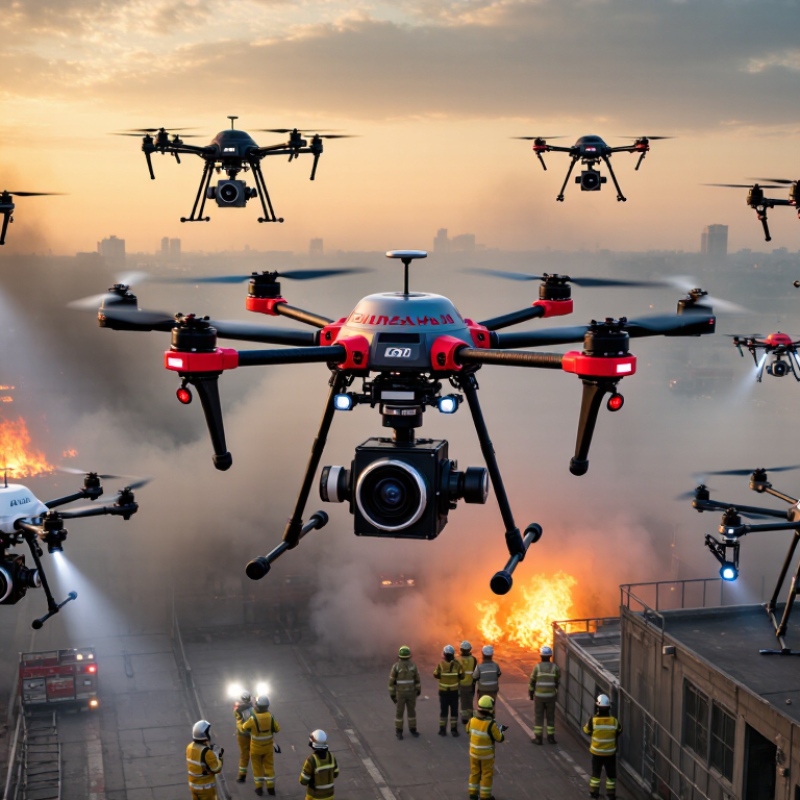
Top 10 Firefighting Drones for Global Buyers

What Firefighting Drones Are and How They Support Emergency Response

Top 10 Firefighting Drones for Global Buyers

Firefighting drones are unmanned aerial systems designed for safer, faster emergency observation. They combine optical cameras, thermal sensors, mapping tools, and secure communications. From above, crews can see roof temperatures, smoke movement, blocked roads, and possible survivors. Some platforms also carry lights, speakers, or small emergency supplies. They should support firefighters, not replace their judgment.

The need is substantial. The National Fire Protection Association reported about 1.39 million fires and nearly 29.8 million fire-department calls in the United States during 2023. In this environment, drones can reach unstable buildings before personnel enter. Thermal imaging may reveal hidden hotspots behind walls or below roofing. Real-time maps can guide water lines and evacuation routes. The National Institute of Standards and Technology also identifies unmanned systems as useful tools for public-safety situational awareness.

A drone is not magic. Heat reflections, dense smoke, rain, and limited battery life can distort information. Operators need practical training, preflight checks, backup batteries, and clear communication with incident commanders. Buyers should examine sensor accuracy, flight endurance, weather resistance, data security, and maintenance support. International teams must also verify local aviation and emergency-response requirements. A confident operator can still miss a victim. That uncomfortable risk deserves honest planning.


Key Technologies Used in Modern Firefighting Drones

Top 10 Firefighting Drones for Global Buyers

Key Technologies Used in Modern Firefighting Drones

Firefighting drones now combine thermal imaging, optical zoom, and edge-based analytics. These systems locate hotspots through smoke, darkness, and unstable structures.

NFPA reported 1,388,500 fires in the United States during 2023. The figure shows why rapid aerial intelligence matters.

Thermal cameras can reveal a warm ceiling cavity before flames appear. Yet reflective metal, heavy rain, and dense smoke can distort readings.

Multispectral sensors help assess vegetation stress and wildfire boundaries. LiDAR maps terrain, power lines, and damaged buildings with useful precision. Real-time kinematic positioning improves flight accuracy near tall structures. Obstacle avoidance uses radar, stereo vision, or both.

Some platforms transmit video through mesh networks when cellular service fails. That sounds dependable. It is not always dependable. Mountain valleys, electromagnetic interference, and battery temperature can reduce coverage and endurance.

The European Environment Agency recorded about 504,000 hectares burned in the European Union during 2023.

This pressure encourages buyers to compare endurance, weather sealing, payload capacity, and software interoperability. Tethered drones can provide persistent overwatch, while compact aircraft support quick interior reconnaissance.

Artificial intelligence may classify smoke or heat patterns, but human confirmation remains essential. A false alarm can divert crews from a real emergency.

Buyers should also examine training records, maintenance plans, encrypted data handling, and compliance with local aviation rules. The best specification is useless if crews cannot deploy it safely.

How to Evaluate Drones for Fire Detection, Suppression, and Rescue

Top 10 Firefighting Drones for Global Buyers

When evaluating drones for fire detection, begin with image quality, not advertised range. A thermal camera should reveal heat behind smoke, while a low-light sensor supports night operations. During testing, inspect roof gaps, window edges, and narrow alleys. These details often expose hidden hotspots. GPS accuracy also matters when teams must return to the same location.

Suppression requires a different checklist. Examine payload capacity, flight stability, water or foam delivery, and wind resistance. A useful drone should maintain position near a burning structure without creating unsafe turbulence. Tethered power can extend working time, but it may restrict movement. Battery-only models offer flexibility, yet their flight periods can shrink quickly in heat. Test both conditions. Marketing figures rarely reflect real fire scenes.

Rescue performance depends on communication and reliability. Look for a clear loudspeaker, bright searchlight, precise location sharing, and stable video transmission. Redundant navigation and automatic return features can reduce risks when smoke blocks visual contact. Every system should be tested by trained operators under local aviation and emergency-response rules. No scorecard is perfect. A drone may detect heat well but struggle with glare, rain, or dense smoke. Record those weaknesses openly. They can matter more than a polished demonstration.

Top 10 Firefighting Drones for Different Global Buyer Needs

Top 10 Firefighting Drones for Different Global Buyer Needs

Global buyers need different firefighting drones, not one universal model. The first three suit rapid scene checks: compact camera drones for municipal crews, thermal-imaging drones for night searches, and long-endurance drones for wide wildfire zones. Aerial views can reveal hot roofs, trapped vehicles, and wind-driven fire lines within minutes. Keep it simple.

The next four target specialized operations. Heavy-lift drones can carry larger water or suppressant payloads for limited spot cooling. Tethered drones can support long observation above industrial sites, ports, or crowded facilities. Indoor drones with obstacle sensing help inspect warehouses and tunnels where satellite navigation fails. Mapping drones create updated fire-perimeter data for command teams. Field trials often show an uncomfortable truth: more payload usually means less flight time. Buyers should compare real payload performance, not brochure figures.

The final three fit communication and resilience needs. Relay drones can extend radio coverage across valleys or damaged urban areas. Rugged, weather-resistant drones support wet, smoky conditions and repeated deployments. Modular systems help agencies replace cameras, batteries, or sensors without buying a complete aircraft. Reliable selection requires checking wind tolerance, thermal accuracy, battery logistics, spare-part access, pilot training, and local aviation approval. A drone that performs well in a calm test may struggle beside a 30-meter building. That gap deserves honest review.

Safety, Regulations, Maintenance, and Deployment Considerations

Firefighting drones can improve situational awareness, but safe deployment requires more than thermal imaging. Buyers should verify aviation approvals, operator certification, radio permissions, and local privacy requirements before purchase. Rules differ between countries and sometimes between regions. A capable pilot must coordinate with incident commanders, not operate independently above emergency crews.

Deployment conditions matter. Strong wind, smoke, rain, and intense heat can reduce flight time and sensor accuracy. Thermal cameras may show hot surfaces, yet they cannot always identify structural weakness or trapped occupants. Keep a safe distance from power lines and aircraft operations. Clear communication prevents duplicated flights and dangerous airspace conflicts. Small details matter.

Maintenance should include battery inspections, firmware checks, propeller replacement, sensor calibration, and documented flight hours. Batteries need controlled storage, temperature monitoring, and approved transport procedures. A damaged battery is not a minor issue. It can become a serious fire risk. Cleaning soot from vents and lenses also protects performance. Some teams overlook this after a difficult incident.

Buyers should request training records, service procedures, spare-part availability, and realistic weather limitations. Test the drone with gloves, masks, and poor visibility. The controls may feel different under pressure. Plans are rarely perfect. A backup communication method and a grounded-drone procedure are essential when systems fail. Safety decisions should remain with trained emergency professionals.

Powder Coat Booths

For those larger-sized parts, or smaller quantity runs, we have 2 independent powder coat booths and ovens. The quality, durability and affordability of today’s powder coating finishes make this the process of choice for world-class companies.

Powder coating advantages over other forms of coating are many. Materials used in the Powder coating process can be metals and non-metals that come in a multitude of thicknesses, textures, colors, etc. Another of Powder coating’s biggest advantages over conventional coatings is its ability to create finishes in many different textures. Powder Coating Booths allow us the ability to apply these advantages to large products.

Wet Paint Line

Tri-State Fabricators runs a full-service conveyor line for painting. Wet painting can provide protection or decoration to many different part styles. From start to finish, every project is easier to undergo random and point-based inspection by our skilled painting team.

Advantages to our Wet Paint Line are these lines start with product prep and ends with a thorough inspection of a high quality finished product. Our ability to complete large and small projects with a superior finish and doing so in a timely and economical fashion. This passes along the savings in production to our customers. When powder coating ins not an option, our Wet Paint Line gets the job done right the first time.

Wet Paint Booths

When the parts get big and heavy we roll-out our custom paint racks and oversize booth. By utilizing our partnerships with all the major paint brands, we can match virtually any color with wet paint.

The advantages of having access to a Wet Paint Booth are many. Large projects of many different shapes can be loaded into the booth. The Wet Paint Booth offers an environment that is much more controlled than a typical parts painting operation.

Not only are they used because of their controlled environment, but they’re are also advantageous when it comes to applying paint to parts that are needed in industries that require specialty coatings such as medical, aerospace, etc.

Military CARC

Our military forces have some very high standards when it comes to the finish of their vehicles and equipment. From the first pre-treatment step to final coat, it takes a great deal of knowledge and experience to protect the men and women of our armed forces. They deserve only the best, and Tri-State Fabricators provides it.

All of our processes are closely monitored by our staff and management teams. Both of which are highly trained in the processes of metal fabrication and finishing. Tri-State Fabricators’ goal is to always fully satisfy each and every customer, including the military. We will always put a 110% into what we do.

Glass-Bead Blasting

Abrasive media blasting is an excellent way to remove old paint, rust, and increase the paint/powder adhesion. Glass beads produce a much smoother and brighter finish than angular abrasives; leaving the part clean yet without any dimensional change. Chemically inert and environmentally friendly, we can recycle our beads approximately 30 times; making them a more preferred method of metal cleaning or surface finishing.

Advantages to Glass Bead Blasting are many. Glass bead blast media is used when a project is needing rough surfaces need to become smooth for applications of coatings such as paint. It is typically used to clean paint and rust from a product surface without deforming the surface it is being used on. Overall, compared to many other blasting media, Glass Bead Blasting is a very economical choice and those savings are always passed on to our customers.

Part Washing

Tri-State Fabricators utilize a zinc phosphate wash to clean and etch the material to ensure the best paint adhesion possible. The unique design of our 3-stage wash system does the work like a 5-stage. From Cleaning and rinsing to conversion coating and post-treatment, Our Part Washing process is a complete service and works throughout the fabrication service and the finishing service.

Along with the previously mentioned benefits, Curing is a vital chemical reaction that leaves the product finish hard and relatively safe from mild abrasion and aggressive corrosion. This process can be done in more than one way; ambient air-dry or in curing ovens at temps that exceed 240°.

Burn-Off Oven

From fixing paint mistakes (someone else’s of course) to simply cleaning our paint line hooks, our burn-off oven is put to good use. After a quick burn-off, a little clean up, and a fresh coat of paint, your parts will look better than new.

Why does our Burn-Off Oven work so well? Because super heating the air around parts turns the materials into ashes. From paint and powder coatings to rubber and machining oils, high temps do the job without degrading the integrity of the part.

Masking

Masking is a vital part of producing high quality products. We have die-cut masking patterns to protect machined surfaces as well as a wide range of plugs and caps to protect threaded holes and bolts. We provide permanent and temporary masking.

Masking allows the selected sections of a product to be protected from a fabrication or finishing service. This can be with both chemicals when etching and tapes, paints when only finishing just a section of the product. Masking is great in aiding the customization process of a project.

Screen Printing

Screen printing is a photographic process that transfers artwork onto a porous nylon screen which allows colored ink to flow through the screen and be deposited on an aluminum or plastic component. We can generally have just about any design created onto a screen for your parts.

Some of the advantages of Screen Printing are, brand recognition for your business displaying on your products, assembly instructions, product warnings/hazards, etc. Tri-State Fabricators produces Screen Printing of the highest quality so you know it’s durable.

Metal Finishing

Metal Finishing is the art of treating the exterior portion of product, often metal but can also be made of other materials, so that the surface is clean and free of any debris. Then the process of applying coats or either paint of powder coat takes place. This coating process improves the quality of the product in both appearance and resistance to wear and corrosion.

Tri-State Fabricators, Inc., understands that a project typically isn’t complete until a high-quality finish has been added to your product. This is why our painting and powder coating teams continuously inspect the products throughout the Metal Finishing process.
