


Finding dependable Desktop Outlet suppliers requires more than comparing catalog prices. Global buyers need products that perform safely on real desks, meeting tables, and shared workstations. A practical review should examine housing materials, socket configurations, USB charging performance, cable quality, installation depth, and heat management. Small details matter. A loose cover or short cable can delay an entire office project.
This guide evaluates leading suppliers through an experienced procurement lens. It considers factory capability, quality-control procedures, product documentation, customization options, minimum order quantities, lead times, and export experience. Buyers should request current test reports, factory photographs, sample units, and clear warranty terms before placing large orders. Independent inspection can also verify dimensions, labeling, packaging, and electrical performance before shipment.
A polished website proves little. Supplier reliability appears in consistent communication, accurate quotations, and honest responses about production limits. No supplier is perfect. Even experienced manufacturers may struggle with peak-season delays or custom tooling costs. That deserves attention. Payment terms, shipping responsibilities, regional plug requirements, and after-sales support should be confirmed in writing. These checks help buyers reduce avoidable risk without relying on attractive promises.
The suppliers discussed here are not presented as universal choices. Their suitability depends on market requirements, project volume, compliance expectations, and installation conditions. A hotel renovation may need discreet pop-up outlets, while an open-plan office may prioritize modular desktop units. Careful comparison creates better purchasing decisions and more dependable results.
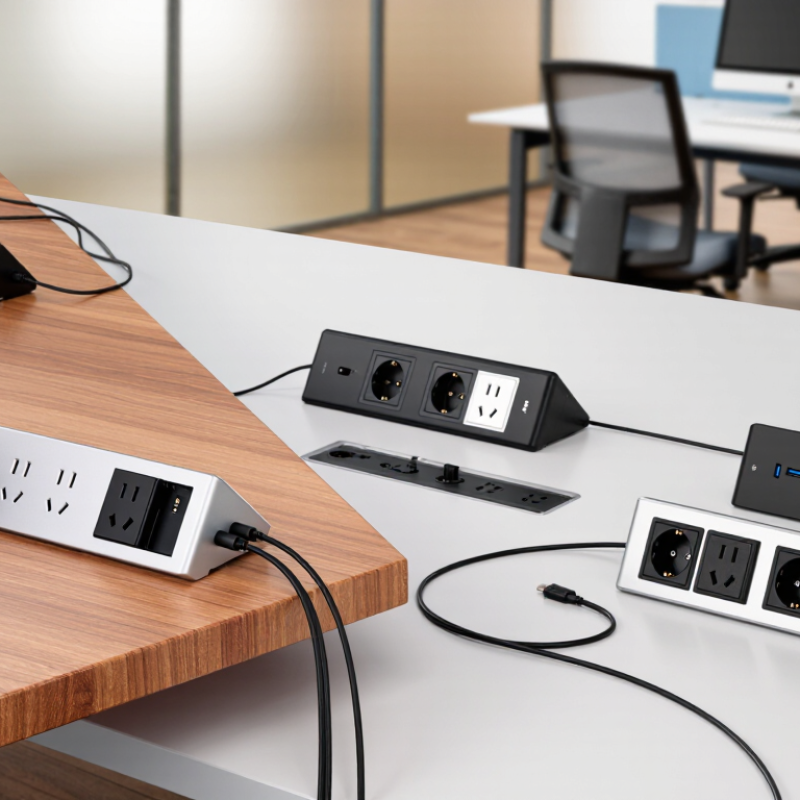
Desktop outlet suppliers manufacture power and data modules fitted into desks, conference tables, and workstations. They serve global buyers by combining product design, factory production, testing, packaging, and export support. A typical supplier may offer pop-up sockets, clamp-mounted units, USB charging ports, network connections, and cable-management parts. Buyers usually provide desk thickness, outlet quantity, plug type, voltage, installation method, and target market.
Their value is practical, not merely commercial. The International Energy Agency’s Electricity 2024 report expects global electricity demand to grow by an average of 3.5% annually from 2024 to 2026. More connected workplaces need organized access to power. However, each market has different electrical requirements. Experienced suppliers should provide test records, material declarations, wiring diagrams, and documentation for applicable national standards. Samples also matter. A socket that fits a 40-millimeter tabletop may fail on a 25-millimeter panel.
Sustainability now affects purchasing decisions. The Global E-waste Monitor 2024 reported 62 million tonnes of electronic waste generated in 2022, with the figure projected to reach 82 million tonnes by 2030. Suppliers can respond through replaceable modules, recyclable metals, durable switches, and reduced packaging. Yet this claim needs verification. “Eco-friendly” is not evidence. Buyers should inspect material data and repair options. My own assumption deserves caution: a lower unit price can hide weaker components, higher return costs, or difficult certification work. Clearance, heat management, and after-sales communication still determine whether a desktop outlet performs reliably across borders.

Global buyers should evaluate desktop outlet suppliers beyond a polished catalog. The International Energy Agency’s Electricity 2024 report forecasts about 4% annual global electricity demand growth in 2024 and 2025. This raises the importance of safe load handling, heat resistance, and reliable internal components. Ask for test records against applicable IEC standards, not only factory declarations. Inspect a sample unit physically. Check socket alignment, cable strain relief, switch response, and surface temperature after continuous use.
Price must include the full landed cost. Compare unit price, tooling, testing, packaging, freight, duties, warranty handling, and expected defect rates. The World Bank’s Logistics Performance Index 2023 shows major gaps in customs, tracking, and delivery reliability across markets. A cheaper supplier may create costly delays at the port. Request a written quotation with Incoterms, lead times, payment terms, and replacement procedures. Small details matter.
Capacity requires evidence, not confident promises. Review monthly output, production lines, staffing, testing equipment, and recent order history. The UNCTAD Review of Maritime Transport 2024 highlights continuing disruption risks in global shipping, so buyers should confirm backup routes and safety stock. A supplier claiming 100,000 units monthly should show records supporting that figure. Capacity can look impressive on paper. It may fail during peak season. A pilot order, independent inspection, and staged payment reduce that risk, although they cannot remove it entirely.
| Supplier Profile | Typical Product Scope | Quality Management | Safety Certifications Available | Material and Construction | Electrical Test Coverage | Indicative FOB Price | Monthly Capacity | Standard Lead Time | Typical MOQ | Customization Capability | Factory Audit Score | Procurement Assessment |
|---|---|---|---|---|---|---|---|---|---|---|---|---|
| Profile A High-volume OEM | Pop-up desktop outlets, clamp-mounted power modules, USB charging units | Documented quality system with incoming, in-process, and final inspection records | CE, RoHS, UKCA, CB documentation commonly available by model | Flame-retardant PC/ABS housing, copper alloy terminals, powder-coated or anodized metal parts | Dielectric strength, insulation resistance, earth continuity, polarity, temperature rise, USB output verification | US$8.50–18.00 per unit | 40,000–80,000 units | 25–40 days after approved samples | 500–1,000 units | High: panel dimensions, socket standards, cable length, logo, color, USB configuration | 92/100 | Best suited to large projects requiring stable output and formal documentation |
| Profile B Mid-sized export manufacturer | Desktop socket boxes, conference-table power modules, data and multimedia panels | Basic ISO 9001-based procedures with batch inspection and corrective-action records | CE, RoHS, FCC or regional test reports depending on product configuration | Aluminum alloy or ABS enclosure, brass contacts, integrated overload protection on selected models | Continuity, insulation resistance, grounding, load test, USB charging test, visual inspection | US$6.20–14.50 per unit | 20,000–45,000 units | 30–45 days | 300–800 units | Medium to high: socket layout, cable assembly, finish, packaging, selected ports | 86/100 | Balanced option for distributors and commercial furniture projects |
| Profile C Cost-focused contract supplier | Basic desktop power strips, under-desk outlets, cable-management power modules | Batch-based inspection; quality records should be reviewed before contract award | Regional compliance documents available for selected standard models | ABS or PC housing, copper alloy conductors, standard PVC or halogen-free cable options | Basic continuity, polarity, insulation, power-on, and appearance checks | US$3.80–9.00 per unit | 15,000–35,000 units | 35–55 days | 1,000–2,000 units | Medium: mainly existing molds and standard socket combinations | 78/100 | Competitive pricing, but buyers should arrange pre-shipment inspection and sample approval |
| Profile D Premium commercial specialist | Architectural desktop outlets, flush-mounted modules, meeting-room connectivity systems | Structured quality management with traceability for critical electrical components | CE, CB, RoHS, UKCA, ETL or other market-specific evidence subject to model verification | Anodized aluminum, reinforced engineering plastics, high-temperature terminals, replaceable modules | Full electrical safety testing, thermal testing, mechanical endurance, grounding, load and abnormal-operation testing | US$18.00–45.00 per unit | 8,000–20,000 units | 45–70 days | 100–300 units | Very high: dimensions, finishes, port combinations, modules, wiring, project packaging | 95/100 | Strong choice for premium offices, hospitality projects, and specification-driven tenders |
| Profile E Flexible private-label supplier | Desktop power hubs, USB-C charging outlets, monitor and workstation power modules | Supplier-controlled inspection with third-party testing arranged for export orders | CE, RoHS, FCC, UKCA and selected national reports depending on destination market | PC/ABS or aluminum body, copper terminals, GaN or conventional charging components depending on model | Electrical safety, USB power delivery, surge protection, temperature, cable pull, and functional testing | US$9.50–24.00 per unit | 12,000–30,000 units | 30–50 days | 200–500 units | High: private label, packaging, cable sets, USB configurations, surface finishes | 88/100 | Suitable for branded distribution programs with moderate order volumes |
| Profile F Small-batch project supplier | Custom desktop sockets, retrofit power modules, low-volume office furniture integrations | Project-based controls; process consistency should be confirmed through an on-site or remote audit | Test reports usually supplied by model, market, and component combination | Mixed aluminum, ABS, steel, and standard copper-contact assemblies | Functional testing and basic safety checks; independent laboratory testing recommended for new designs | US$12.00–32.00 per unit | 3,000–10,000 units | 40–75 days | 50–200 units | Very high: engineering-led customization and small production runs | 82/100 | Appropriate for prototypes, pilot programs, and specialized furniture projects |
| Evaluation note: Before placing an order, confirm the exact socket standard, rated voltage and current, USB output specification, cable requirements, applicable national certifications, tooling ownership, warranty terms, inspection procedure, and after-sales responsibilities. Pricing varies with order volume, materials, certification scope, packaging, destination market, and Incoterms. | ||||||||||||
Reliable desktop outlet sourcing depends on both manufacturing depth and export discipline. East Asia remains a strong option for high-volume production. UN Comtrade data for HS 8536 in 2023 shows substantial electrical-equipment exports from China, Vietnam, and South Korea. The category is broad, however. It includes circuit devices, not only desktop outlets. Buyers should not treat export value as proof of product quality.
Southeast Asia can offer competitive assembly costs and flexible order quantities. Vietnam and Thailand are useful for buyers seeking diversified supply chains. Factory visits should check wiring stations, grounding tests, flame-retardant materials, and carton drop testing. Ask for recent inspection records. Small details matter. A loose USB module can damage an otherwise reliable unit.
Central and Eastern Europe suit buyers needing shorter delivery routes into the European market. Germany, Poland, and the Czech Republic have established electrical manufacturing networks. The World Bank’s 2023 Logistics Performance Index also ranks several European economies strongly for customs and infrastructure performance. Still, regional sourcing can cost more. Labor, certification, and lower production volumes affect quotations. One weakness in common supplier comparisons is the limited attention given to after-sales replacement parts. Buyers should request sample units, production lead times, warranty procedures, and test reports before signing wholesale contracts.大小规律
Regional export values provide a practical indicator of manufacturing scale and wholesale availability for desktop computer equipment. The figures below use rounded 2023 export values for HS 8471, which covers automatic data-processing machines and related units.
Data source: UN Comtrade international merchandise trade statistics, HS 8471, 2023. Values are rounded estimates in billions of U.S. dollars and represent regional export activity rather than individual companies or brands.
When evaluating desktop outlet suppliers, global buyers should verify product-specific certifications before comparing prices. A polished certificate is not enough. Check the exact model, voltage, current rating, plug type, and production site.
For many markets, buyers may review IEC 60884-1 reports, the CB Scheme certificate, and applicable national approvals. Desktop outlets with USB charging ports may require additional safety and electromagnetic compatibility testing. Request RoHS and REACH declarations for restricted substances. WEEE obligations may also apply during distribution. Requirements differ by destination, so local conformity rules still matter.
Look closely at the testing laboratory. It should hold ISO/IEC 17025 accreditation for relevant electrical tests. Confirm the certificate’s validity, scope, issue date, and listed components. Ask for factory inspection records and quality-control procedures, preferably supported by ISO 9001 evidence. Product labels should match the technical file and packaging. A mismatch can delay customs clearance or create safety risks.
I have found that small details reveal supplier reliability. Ask for samples from current production, not old showroom stock. Inspect socket alignment, cable strain relief, heat resistance, and USB output stability. Keep written records of every claim. Some documents may be incomplete. That is a warning, not a minor inconvenience. Even experienced buyers can overlook regional plug standards or updated regulations. Recheck them before placing a large order.
Global buyers should compare desktop outlet suppliers beyond unit price. Request samples with the same load, cable length, socket layout, USB output, and enclosure material. Check test reports against relevant IEC standards, production traceability, and corrective-action records. A supplier that answers quickly is not always reliable.
The World Bank’s 2023 Logistics Performance Index covered 139 economies and highlighted major gaps in shipment reliability. Ask suppliers for realistic lead times, port options, carton dimensions, and shipping documents. Compare quotations on the same Incoterm, payment schedule, tooling ownership, warranty period, and inspection point. A lower price may hide costly rework.
Negotiate carefully.
For imports, calculate landed cost rather than factory cost. Include freight, insurance, duties, destination handling, testing, and possible storage. The WTO reported a 1.2% decline in global merchandise trade volume in 2023, showing why demand forecasts deserve caution. Use a small trial order before committing to annual volume. Specify acceptance limits for socket alignment, grounding continuity, USB charging performance, and cosmetic defects. Independent pre-shipment inspection can expose loose terminals or missing labels before departure. Still, inspections are not perfect. I would keep batch photos, serial records, and retained samples for later claims. A written remedy should define replacement, credit, or rework timelines when goods fail inspection.


For those larger-sized parts, or smaller quantity runs, we have 2 independent powder coat booths and ovens. The quality, durability and affordability of today’s powder coating finishes make this the process of choice for world-class companies.
Powder coating advantages over other forms of coating are many. Materials used in the Powder coating process can be metals and non-metals that come in a multitude of thicknesses, textures, colors, etc. Another of Powder coating’s biggest advantages over conventional coatings is its ability to create finishes in many different textures. Powder Coating Booths allow us the ability to apply these advantages to large products.
Tri-State Fabricators runs a full-service conveyor line for painting. Wet painting can provide protection or decoration to many different part styles. From start to finish, every project is easier to undergo random and point-based inspection by our skilled painting team.
Advantages to our Wet Paint Line are these lines start with product prep and ends with a thorough inspection of a high quality finished product. Our ability to complete large and small projects with a superior finish and doing so in a timely and economical fashion. This passes along the savings in production to our customers. When powder coating ins not an option, our Wet Paint Line gets the job done right the first time.
When the parts get big and heavy we roll-out our custom paint racks and oversize booth. By utilizing our partnerships with all the major paint brands, we can match virtually any color with wet paint.
The advantages of having access to a Wet Paint Booth are many. Large projects of many different shapes can be loaded into the booth. The Wet Paint Booth offers an environment that is much more controlled than a typical parts painting operation.
Not only are they used because of their controlled environment, but they’re are also advantageous when it comes to applying paint to parts that are needed in industries that require specialty coatings such as medical, aerospace, etc.
Our military forces have some very high standards when it comes to the finish of their vehicles and equipment. From the first pre-treatment step to final coat, it takes a great deal of knowledge and experience to protect the men and women of our armed forces. They deserve only the best, and Tri-State Fabricators provides it.
All of our processes are closely monitored by our staff and management teams. Both of which are highly trained in the processes of metal fabrication and finishing. Tri-State Fabricators’ goal is to always fully satisfy each and every customer, including the military. We will always put a 110% into what we do.
Abrasive media blasting is an excellent way to remove old paint, rust, and increase the paint/powder adhesion. Glass beads produce a much smoother and brighter finish than angular abrasives; leaving the part clean yet without any dimensional change. Chemically inert and environmentally friendly, we can recycle our beads approximately 30 times; making them a more preferred method of metal cleaning or surface finishing.
Advantages to Glass Bead Blasting are many. Glass bead blast media is used when a project is needing rough surfaces need to become smooth for applications of coatings such as paint. It is typically used to clean paint and rust from a product surface without deforming the surface it is being used on. Overall, compared to many other blasting media, Glass Bead Blasting is a very economical choice and those savings are always passed on to our customers.
Tri-State Fabricators utilize a zinc phosphate wash to clean and etch the material to ensure the best paint adhesion possible. The unique design of our 3-stage wash system does the work like a 5-stage. From Cleaning and rinsing to conversion coating and post-treatment, Our Part Washing process is a complete service and works throughout the fabrication service and the finishing service.
Along with the previously mentioned benefits, Curing is a vital chemical reaction that leaves the product finish hard and relatively safe from mild abrasion and aggressive corrosion. This process can be done in more than one way; ambient air-dry or in curing ovens at temps that exceed 240°.
From fixing paint mistakes (someone else’s of course) to simply cleaning our paint line hooks, our burn-off oven is put to good use. After a quick burn-off, a little clean up, and a fresh coat of paint, your parts will look better than new.
Why does our Burn-Off Oven work so well? Because super heating the air around parts turns the materials into ashes. From paint and powder coatings to rubber and machining oils, high temps do the job without degrading the integrity of the part.
Masking is a vital part of producing high quality products. We have die-cut masking patterns to protect machined surfaces as well as a wide range of plugs and caps to protect threaded holes and bolts. We provide permanent and temporary masking.
Masking allows the selected sections of a product to be protected from a fabrication or finishing service. This can be with both chemicals when etching and tapes, paints when only finishing just a section of the product. Masking is great in aiding the customization process of a project.
Screen printing is a photographic process that transfers artwork onto a porous nylon screen which allows colored ink to flow through the screen and be deposited on an aluminum or plastic component. We can generally have just about any design created onto a screen for your parts.
Some of the advantages of Screen Printing are, brand recognition for your business displaying on your products, assembly instructions, product warnings/hazards, etc. Tri-State Fabricators produces Screen Printing of the highest quality so you know it’s durable.
Metal Finishing is the art of treating the exterior portion of product, often metal but can also be made of other materials, so that the surface is clean and free of any debris. Then the process of applying coats or either paint of powder coat takes place. This coating process improves the quality of the product in both appearance and resistance to wear and corrosion.
Tri-State Fabricators, Inc., understands that a project typically isn’t complete until a high-quality finish has been added to your product. This is why our painting and powder coating teams continuously inspect the products throughout the Metal Finishing process.

