


Top Commercial Fan Manufacturers Worldwide?

Choosing among the top Commercial Fan manufacturers worldwide requires more than comparing product catalogs. A reliable manufacturer should demonstrate engineering experience, consistent quality control, and clear performance data. Airflow, static pressure, motor efficiency, noise levels, and operating temperature all matter. So does the installation environment.

A fan working inside a warehouse faces different demands than one serving a restaurant, factory, or shopping center. Dust, humidity, grease, and limited ceiling space can quickly expose weak design decisions. Strong manufacturers usually provide detailed specifications, testing information, maintenance guidance, and responsive technical support. Their product ranges may include axial fans, centrifugal fans, HVLS fans, exhaust systems, and specialized industrial models.

This guide examines leading manufacturers through practical and verifiable criteria. It considers production capability, global distribution, certifications, customization options, warranty support, and customer reputation. Independent testing and recent product documentation deserve greater weight than polished marketing claims. Field experience also matters. A quiet fan in a showroom may behave differently after months of dust exposure.

No ranking is perfect. Regional service quality can change the buying decision. Published efficiency figures may also depend on specific operating conditions. That limitation deserves attention. Readers should confirm local standards, installation requirements, replacement parts availability, and after-sales support before choosing a supplier. The strongest manufacturer is not always the largest one. It is often the company that delivers dependable performance, honest documentation, and practical support for the actual project.
Top Commercial Fan Manufacturers Worldwide?

Definition and Role of Commercial Fans in Modern Facilities

Top Commercial Fan Manufacturers Worldwide?

Commercial fans are engineered air-moving systems for workplaces, warehouses, retail buildings, kitchens, and public facilities. They move, circulate, extract, or replace air. Their role goes beyond comfort. Proper airflow can reduce heat buildup, control moisture, dilute odors, and support safer working conditions. In modern facilities, fans often work with ventilation controls, sensors, and heating or cooling equipment. A well-selected unit should match the room volume, operating hours, noise limits, and maintenance access. Bigger is not always better.

Tips: Check airflow, static pressure, sound levels, motor efficiency, and cleaning access before purchase. Ask for tested performance data. Confirm local installation requirements with a qualified professional.

Practical facility assessments show that airflow problems often come from poor placement, not weak equipment. A powerful fan may create uncomfortable drafts near a loading area while leaving distant corners stagnant. Ceiling height, obstructions, door movement, and seasonal conditions all affect performance. A specification can look perfect on paper. Real buildings are less cooperative. Designers should measure conditions after installation and adjust controls when needed. I would also avoid judging equipment by energy ratings alone. Reliability, service support, spare-part availability, and corrosion resistance can matter more over years of daily operation. These details help facility managers choose dependable airflow solutions without treating every building as identical.


Commercial fans support the outdoor-air and air-distribution requirements of modern facilities. This chart compares representative minimum outdoor airflow rates per person for common commercial spaces, based on commonly referenced ASHRAE 62.1 ventilation-rate values. Actual fan selection also depends on occupancy, floor area, system resistance, filtration, and local building codes.

Key Types of Commercial Fans and Their Primary Applications

Top Commercial Fan Manufacturers Worldwide?

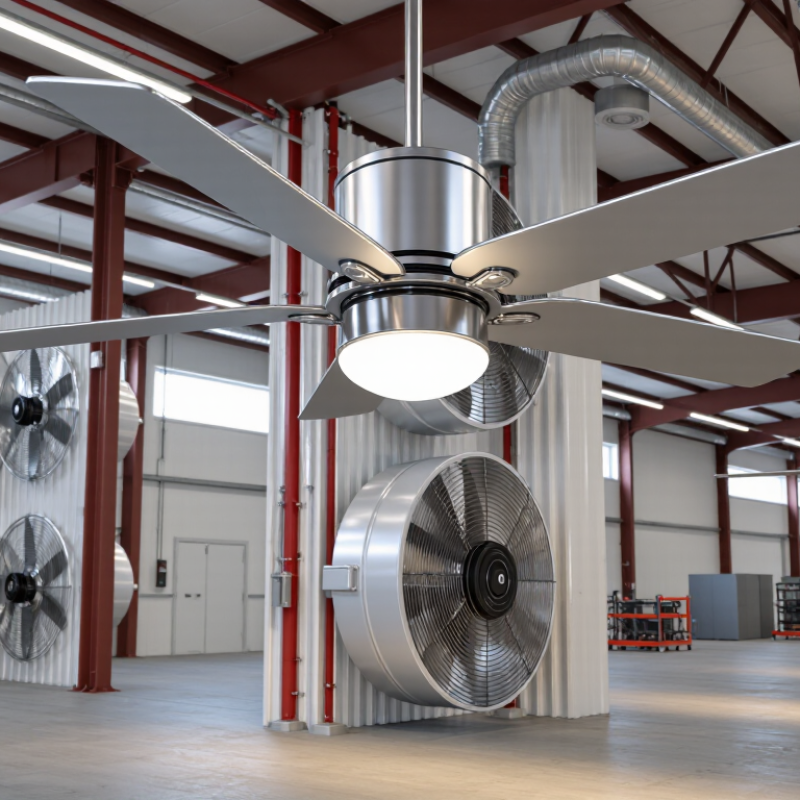
Commercial fans are selected by airflow, pressure, noise, and operating hours, not appearance alone. Axial fans move large air volumes at low pressure. They suit warehouses, parking areas, and agricultural buildings. Centrifugal fans handle higher resistance in ducted ventilation, kitchen extraction, and process systems. Mixed-flow fans balance pressure and airflow in compact HVAC units. Roof exhaust fans remove heat and stale air from factories or retail spaces. HVLS fans create broad, slow air movement across large floors.

The U.S. Department of Energy’s fan-system guidance explains that power demand follows the cube of fan speed. At 80% speed, theoretical power can fall to about 51% of full-speed demand. Real savings vary with system resistance, controls, and maintenance. AMCA 208 also promotes the Fan Energy Index, which compares actual fan efficiency against a reference design. That metric is useful when comparing specifications. Yet, it can be misunderstood without checking duty points. Real buildings are messier.

Tips: Match the fan to the measured airflow and static pressure. Check sound levels near occupied zones. Use variable-speed control where demand changes. Inspect belts, filters, and dampers regularly. A dirty filter can quietly increase resistance and energy use. Also verify local ventilation requirements before installation. A larger fan is not automatically better. Performance may drop when ductwork, grilles, or discharge openings are poorly designed. Industry market reports often show steady commercial ventilation growth, but site conditions still decide practical value.

Leading Commercial Fan Manufacturers Across Global Markets

Commercial fan manufacturers now compete across warehouses, retail sites, airports, farms, and data centers. Their strongest advantage is regional engineering, not simply production volume. Manufacturers serving global markets must adapt motors, controls, noise levels, and safety documentation to local requirements.

MarketsandMarkets estimates that the industrial fans market could grow from about US$7.4 billion in 2023 to US$10.2 billion by 2028. This reflects demand for efficient airflow in manufacturing and logistics. The International Energy Agency also reports rising cooling demand worldwide, especially in emerging economies. That pressure is changing product design. Buyers increasingly request variable-speed drives, sensor integration, corrosion-resistant coatings, and quieter operation. Yet efficiency claims can be difficult to compare. Test conditions are not always identical.

Tips: Compare airflow, power input, sound pressure, warranty support, and replacement-part availability. Ask for certified performance data. Check operation at your real ceiling height and temperature.

Leading manufacturers typically combine engineering centers with production or service networks near major markets. North American projects often emphasize code compliance and controls. European buyers may prioritize lifecycle emissions and acoustic performance. Asian and Middle Eastern projects commonly require high-volume airflow, compact installation, and heat resistance. UL, CE, ISO, and AMCA-related documentation can strengthen procurement confidence, but certification alone does not guarantee suitable field performance. A fan that works well in a factory may disappoint in a humid retail space. That practical gap deserves more attention.

How to Compare Commercial Fan Brands and Product Performance

Comparing Commercial Fan Brands and Product Performance

A strong commercial fan is not defined by airflow alone. In field evaluations, I compare cubic feet per minute, static pressure, motor efficiency, and noise at working distance. A warehouse fan may move impressive air in an open space but perform poorly near shelving or partitions. Check the fan curve, not only the headline airflow figure. Reliable manufacturers publish measured performance under clear test conditions. They also provide motor data, control compatibility, expected service intervals, and accessible replacement parts. These details reveal technical confidence.

I once overvalued a low purchase price. The fan consumed more electricity and needed frequent belt adjustments. That experience changed my comparison method. I now inspect housing quality, balance, vibration, thermal protection, and warranty terms. A good warranty helps, but it cannot replace documented testing. Ask whether performance data comes from independent laboratories or internal testing. Internal results may still be useful, but they deserve careful interpretation. Marketing language can sound precise while remaining incomplete.

Tips: Compare fans under the same airflow and pressure conditions. Listen for rattling after warm-up. Measure power use during normal operation. Review installation clearances and cleaning access. Speak with technicians who maintain similar equipment. Their practical feedback often exposes weaknesses that brochures miss. Do not ignore controls, either. Variable-speed operation can reduce energy use, though poor programming may create unstable airflow. A small trial installation is wiser than trusting one attractive specification sheet.

Top Commercial Fan Manufacturers Worldwide? - How to Compare Commercial Fan Brands and Product Performance
Evaluation Dimension Key Metric or Standard What to Compare Why It Matters Recommended Evidence
Airflow Capacity m³/h or CFM Compare the rated airflow at the same operating point, fan speed, and installation condition. Airflow determines how much air the fan can move through a room, duct, warehouse, or process area. Performance curves tested in accordance with ISO 5801 or AMCA 210.
Static Pressure Pa or in.w.g. Check available pressure at the required airflow, especially for ducted systems, filters, louvers, and grilles. A fan with high free-air flow may deliver substantially less air when system resistance increases. Certified fan curve showing airflow, pressure, speed, and power at multiple operating points.
Fan Efficiency Total or static efficiency (%) Compare efficiency at the actual duty point rather than relying only on the maximum published value. Higher efficiency can reduce electricity consumption and operating cost over the fan's service life. Test data based on ISO 5801, AMCA 210, or the applicable regional testing method.
Energy Consumption Input power in W or kW Compare electrical input at equal airflow and pressure, including motor, controller, and drive losses where applicable. Input power provides a practical basis for estimating annual energy use and total cost of ownership. Measured power data, duty-point calculations, and operating-hours assumptions.
Motor Efficiency IEC efficiency class Confirm the motor rating and efficiency class, such as IE3 or IE4 where applicable. Efficient motors generally reduce losses during continuous commercial operation. Motor nameplate, manufacturer test report, and applicable IEC 60034 documentation.
Speed Control EC motor, VFD, or multi-speed control Assess controllability, minimum stable speed, control signal compatibility, and response to demand. Variable-speed operation can improve comfort, noise control, and energy performance when demand changes. Control wiring diagram, speed range, compatible signals, and commissioning instructions.
Noise Performance Sound power or sound pressure in dB(A) Compare noise values measured at the same distance, speed, airflow, and test environment. Noise affects suitability for offices, retail spaces, hospitality areas, schools, and occupied industrial facilities. Acoustic test conditions, octave-band data where available, and declared measurement distance.
Operating Environment Temperature, humidity, dust, and corrosion resistance Verify suitability for indoor, outdoor, humid, dusty, chemical, washdown, or high-temperature conditions. Environmental compatibility influences reliability, maintenance frequency, and service life. Application rating, material specification, coating details, and installation limitations.
Ingress Protection IP rating under IEC 60529 Compare protection against solid particles and water according to the actual installation environment. The correct IP rating helps protect electrical components from dust and moisture exposure. Declared IP rating and documentation identifying which components the rating covers.
Construction Quality Materials, balance, bearings, and assembly Review housing material, impeller construction, dynamic balancing, bearing type, fasteners, and protective finishes. Mechanical quality affects vibration, durability, service intervals, and long-term operating stability. Technical drawings, material declarations, balancing records, and quality-control procedures.
Safety Features Guards, thermal protection, isolation, and emergency controls Check guarding, motor over-temperature protection, electrical isolation, and access requirements. Proper safety provisions reduce risks during operation, cleaning, inspection, and maintenance. Risk assessment, wiring diagram, safety instructions, and applicable conformity documentation.
Reliability Validation Testing and quality management Compare production testing, vibration checks, electrical testing, endurance validation, and traceability. Documented validation provides stronger evidence than marketing claims alone. Factory test records, inspection plans, quality certifications, and serial-number traceability.
Installation Flexibility Mounting, orientation, and service access Assess ceiling, wall, roof, inline, or floor installation options and the space required for maintenance. Easy installation can reduce labor cost and simplify future servicing or replacement. Dimensional drawings, mounting instructions, clearance requirements, and accessory list.
Maintenance Requirements Inspection and service intervals Review filter cleaning, bearing maintenance, belt inspection, impeller cleaning, and spare-part availability. Predictable maintenance supports uptime and helps control lifecycle expenses. Maintenance schedule, parts catalogue, service manual, and recommended inspection procedures.
Total Cost of Ownership Purchase, installation, energy, and service cost Evaluate the full lifecycle cost rather than comparing purchase price alone. A lower initial price may be offset by higher energy consumption, downtime, or maintenance costs. Five- to ten-year cost model using verified power data, operating hours, tariffs, and service assumptions.
Documentation and Support Technical and after-sales support Compare manuals, selection software, spare-parts support, training, warranty terms, and response time. Clear documentation and responsive support reduce commissioning errors and downtime. Complete technical file, warranty conditions, local service contacts, and documented response procedures.
Comparison principle: Evaluate every fan at the same airflow, static pressure, operating speed, acoustic condition, electrical supply, and installation configuration. Independent test evidence and duty-point data should take priority over headline ratings.

Industry Trends Shaping the Future of Commercial Ventilation

Top Commercial Fan Manufacturers Worldwide?

The better question is how commercial ventilation is evolving. The 2024 Global Status Report for Buildings and Construction reports that buildings consume 32% of global energy. They also produce 34% of global carbon emissions. Ventilation efficiency now affects both operating costs and climate targets. Variable-speed drives, EC motors, heat recovery, and demand-controlled ventilation are becoming standard design priorities. Sensors can adjust airflow when rooms fill, rather than running fans at full speed all day.

Fan laws offer a clear opportunity. AMCA guidance shows that reducing fan speed to 80% can lower theoretical power use to about 51%. Real buildings may achieve less because filters clog and ducts leak. That limitation matters. A highly efficient fan cannot correct poor commissioning. The U.S. Department of Energy also emphasizes regular maintenance, airflow balancing, and controls as practical efficiency measures. Indoor air quality remains equally important, especially in crowded offices, schools, and retail spaces.

Tips: Measure airflow, pressure, noise, and energy together. Check filters before blaming the motor. Use CO2 sensors carefully, because CO2 alone cannot represent every pollutant. Specify accessible service panels and verify performance after installation. IEA analysis continues to link rising cooling demand with stronger efficiency needs, yet ventilation projects often focus too narrowly on equipment prices. The cheapest fan may create expensive comfort problems later.

Powder Coat Booths

For those larger-sized parts, or smaller quantity runs, we have 2 independent powder coat booths and ovens. The quality, durability and affordability of today’s powder coating finishes make this the process of choice for world-class companies.

Powder coating advantages over other forms of coating are many. Materials used in the Powder coating process can be metals and non-metals that come in a multitude of thicknesses, textures, colors, etc. Another of Powder coating’s biggest advantages over conventional coatings is its ability to create finishes in many different textures. Powder Coating Booths allow us the ability to apply these advantages to large products.

Wet Paint Line

Tri-State Fabricators runs a full-service conveyor line for painting. Wet painting can provide protection or decoration to many different part styles. From start to finish, every project is easier to undergo random and point-based inspection by our skilled painting team.

Advantages to our Wet Paint Line are these lines start with product prep and ends with a thorough inspection of a high quality finished product. Our ability to complete large and small projects with a superior finish and doing so in a timely and economical fashion. This passes along the savings in production to our customers. When powder coating ins not an option, our Wet Paint Line gets the job done right the first time.

Wet Paint Booths

When the parts get big and heavy we roll-out our custom paint racks and oversize booth. By utilizing our partnerships with all the major paint brands, we can match virtually any color with wet paint.

The advantages of having access to a Wet Paint Booth are many. Large projects of many different shapes can be loaded into the booth. The Wet Paint Booth offers an environment that is much more controlled than a typical parts painting operation.

Not only are they used because of their controlled environment, but they’re are also advantageous when it comes to applying paint to parts that are needed in industries that require specialty coatings such as medical, aerospace, etc.

Military CARC

Our military forces have some very high standards when it comes to the finish of their vehicles and equipment. From the first pre-treatment step to final coat, it takes a great deal of knowledge and experience to protect the men and women of our armed forces. They deserve only the best, and Tri-State Fabricators provides it.

All of our processes are closely monitored by our staff and management teams. Both of which are highly trained in the processes of metal fabrication and finishing. Tri-State Fabricators’ goal is to always fully satisfy each and every customer, including the military. We will always put a 110% into what we do.

Glass-Bead Blasting

Abrasive media blasting is an excellent way to remove old paint, rust, and increase the paint/powder adhesion. Glass beads produce a much smoother and brighter finish than angular abrasives; leaving the part clean yet without any dimensional change. Chemically inert and environmentally friendly, we can recycle our beads approximately 30 times; making them a more preferred method of metal cleaning or surface finishing.

Advantages to Glass Bead Blasting are many. Glass bead blast media is used when a project is needing rough surfaces need to become smooth for applications of coatings such as paint. It is typically used to clean paint and rust from a product surface without deforming the surface it is being used on. Overall, compared to many other blasting media, Glass Bead Blasting is a very economical choice and those savings are always passed on to our customers.

Part Washing

Tri-State Fabricators utilize a zinc phosphate wash to clean and etch the material to ensure the best paint adhesion possible. The unique design of our 3-stage wash system does the work like a 5-stage. From Cleaning and rinsing to conversion coating and post-treatment, Our Part Washing process is a complete service and works throughout the fabrication service and the finishing service.

Along with the previously mentioned benefits, Curing is a vital chemical reaction that leaves the product finish hard and relatively safe from mild abrasion and aggressive corrosion. This process can be done in more than one way; ambient air-dry or in curing ovens at temps that exceed 240°.

Burn-Off Oven

From fixing paint mistakes (someone else’s of course) to simply cleaning our paint line hooks, our burn-off oven is put to good use. After a quick burn-off, a little clean up, and a fresh coat of paint, your parts will look better than new.

Why does our Burn-Off Oven work so well? Because super heating the air around parts turns the materials into ashes. From paint and powder coatings to rubber and machining oils, high temps do the job without degrading the integrity of the part.

Masking

Masking is a vital part of producing high quality products. We have die-cut masking patterns to protect machined surfaces as well as a wide range of plugs and caps to protect threaded holes and bolts. We provide permanent and temporary masking.

Masking allows the selected sections of a product to be protected from a fabrication or finishing service. This can be with both chemicals when etching and tapes, paints when only finishing just a section of the product. Masking is great in aiding the customization process of a project.

Screen Printing

Screen printing is a photographic process that transfers artwork onto a porous nylon screen which allows colored ink to flow through the screen and be deposited on an aluminum or plastic component. We can generally have just about any design created onto a screen for your parts.

Some of the advantages of Screen Printing are, brand recognition for your business displaying on your products, assembly instructions, product warnings/hazards, etc. Tri-State Fabricators produces Screen Printing of the highest quality so you know it’s durable.

Metal Finishing

Metal Finishing is the art of treating the exterior portion of product, often metal but can also be made of other materials, so that the surface is clean and free of any debris. Then the process of applying coats or either paint of powder coat takes place. This coating process improves the quality of the product in both appearance and resistance to wear and corrosion.

Tri-State Fabricators, Inc., understands that a project typically isn’t complete until a high-quality finish has been added to your product. This is why our painting and powder coating teams continuously inspect the products throughout the Metal Finishing process.
