Top 10 CNC Vertical Turning Lathes for Global Buyers
Choosing among the Top 10 Cnc Vertical Turning Lathes requires more than comparing catalog prices. A Cnc Vertical Turning Lathe must match the buyer’s materials, workpiece dimensions, production volume, and local service conditions. Large steel rings may demand a rigid table, high torque, and stable low-speed cutting. Smaller precision parts may benefit from faster indexing and advanced control functions.
This guide examines ten machines through practical purchasing criteria. Key points include maximum turning diameter, table load capacity, spindle power, cutting accuracy, chip evacuation, and operator accessibility. Energy use and floor space also matter. A machine that performs well in a factory showroom may require different tooling or support after installation.
Real experience often reveals the gaps. A generous swing diameter does not guarantee efficient production. Software quality, commissioning support, spare-parts availability, and technician response can affect uptime more than a single specification. Buyers should verify test-cut results, warranty terms, training, and regional compliance before placing an order. Ask for evidence.
The selected models represent different budgets, industries, and automation levels. Some may suit heavy-duty power generation work, while others fit general engineering or batch production. No ranking can serve every factory. That is worth remembering. Machine performance depends on tooling, workholding, maintenance, and operator skill. This comparison offers a reliable starting point, while encouraging buyers to challenge specifications and request measurable proof.
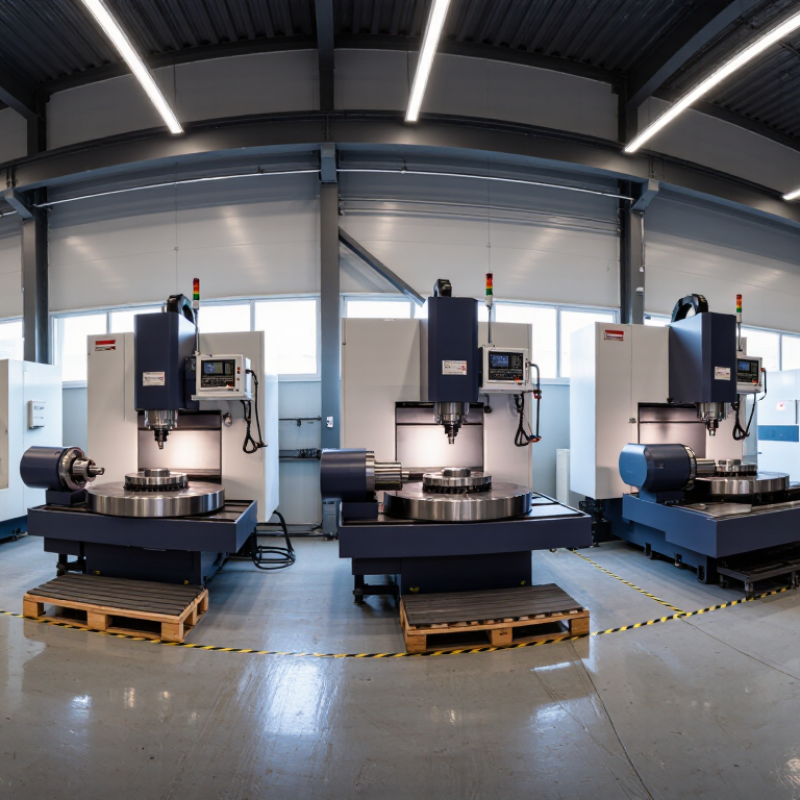
What Is a CNC Vertical Turning Lathe and How Does It Work?
A CNC vertical turning lathe is a computer-controlled machine for cutting round, heavy, or wide workpieces. It grips the part on a horizontal table, called a chuck or faceplate. Unlike a horizontal lathe, the spindle points upward. Gravity helps keep large components seated during machining. Think of a wheel. Heavy work stays stable.
During operation, the operator loads a metal blank and sets its dimensions in the CNC control. The spindle rotates the workpiece while cutting tools move across its surface. A turret holds tools for facing, turning, boring, threading, and grooving. Linear axes guide each movement with programmed accuracy. Encoders monitor position and help correct movement errors. Coolant carries away heat and chips. Correct offsets matter greatly. A small setup error can spoil an expensive component.
In practical workshops, technicians check chuck condition, tool geometry, spindle speed, and workholding pressure before cutting. They also compare the machine’s swing, table capacity, axis travel, and control features with the intended parts. A test pass helps. The first setup is rarely perfect, especially with unfamiliar material or tooling. Tool wear changes dimensions during long cycles, so inspection remains necessary. Operators often measure a finished diameter with a micrometer and adjust the offset by a few microns. That detail is easy to overlook. Reliable production depends on disciplined setup records, clear maintenance procedures, and trained judgment.
Key Specifications for Evaluating CNC Vertical Turning Lathes
Top 10 CNC Vertical Turning Lathes for Global Buyers
Key Specifications for Evaluating CNC Vertical Turning Lathes
Choosing a CNC vertical turning lathe starts with the workpiece, not the brochure. Check maximum turning diameter, turning height, and table capacity against real production parts. A wider swing is not automatically better. It may increase floor space, energy use, and setup time. Leave practical clearance for jaws, tools, coolant, and chip removal.
Spindle specifications deserve close attention. Review rated power, continuous torque, maximum speed, and the speed range used for your materials. Heavy steel rings need stable torque at low speed. Aluminum components may require faster rotation and balanced tooling. Confirm table runout, positioning accuracy, and repeatability through test-cut data. Claimed figures can look excellent, but thermal drift may appear after several hours.
Examine axis travels, rapid-feed rates, tool capacity, and automatic tool-change time. A rigid machine with fewer tools may outperform a faster machine with weak fixtures. Ask about coolant filtration, chip conveyors, enclosure access, and maintenance points. Electrical requirements should match the destination facility, including voltage and frequency. Control software, operator training, spare-part access, and remote technical support also affect ownership cost.
Site acceptance should include sample parts and recorded measurements. Use your own material when possible. Review service response times and reference installations in similar environments. Some evaluation gaps are easy to miss, especially during short demonstrations. A careful buyer should question optimistic cycle-time estimates and verify them under realistic loading.
Top 10 CNC Vertical Turning Lathes for Global Buyers - Key Specifications for Evaluating CNC Vertical Turning Lathes
Comparative reference table based on commonly published specifications for industrial CNC vertical turning lathe configurations.
| Rank | Machine Configuration | Maximum Turning Diameter
(mm) | Maximum Workpiece Height
(mm) | Table Diameter
(mm) | Maximum Workpiece Mass
(kg) | Spindle Speed Range
(rpm) | Main Motor Power
(kW) | X/Z Travel
(mm) | Positioning Accuracy
(mm) | Recommended Applications |
| 1 | Heavy-Duty Single-Column VTL | 1,600 | 1,250 | 1,250 | 8,000 | 2–315 | 55–75 | 900 / 1,000 | 0.020 | Large gears, castings, valve bodies and energy-sector components |
| 2 | Double-Column Production VTL | 2,500 | 1,800 | 2,000 | 20,000 | 1–160 | 90–110 | 1,400 / 1,400 | 0.025 | Wind-power parts, heavy flanges and large-diameter industrial components |
| 3 | Medium-Duty Ram-Type VTL | 1,250 | 1,000 | 1,000 | 5,000 | 3–400 | 45–55 | 800 / 900 | 0.018 | General machining, hydraulic parts, pump housings and bearing seats |
| 4 | High-Speed Precision VTL | 800 | 700 | 630 | 2,000 | 10–1,000 | 30–45 | 600 / 650 | 0.012 | Automotive hubs, brake discs, precision rings and batch production |
| 5 | Compact Two-Axis VTL | 630 | 550 | 500 | 1,500 | 20–1,200 | 18.5–30 | 500 / 500 | 0.015 | Small and medium flanges, wheel components and job-shop work |
| 6 | Live-Tooling Turn-Mill VTL | 1,000 | 800 | 800 | 3,000 | 5–600 | 30–45 | 700 / 800 | 0.015 | Complex valve parts, impellers, flanges and multi-operation machining |
| 7 | Vertical Boring Mill with C-Axis | 1,600 | 1,200 | 1,250 | 10,000 | 2–250 | 55–75 | 1,000 / 1,000 | 0.020 | Keyways, bolt circles, drilling and milling on large rotational parts |
| 8 | Heavy-Ram VTL for Hard Turning | 1,000 | 900 | 800 | 4,000 | 5–500 | 45–60 | 750 / 900 | 0.015 | Bearing rings, hardened steel parts and high-load interrupted cuts |
| 9 | Aerospace Precision VTL | 1,250 | 1,000 | 1,000 | 4,000 | 5–800 | 45–60 | 800 / 900 | 0.010 | Aircraft structural rings, titanium parts and precision alloy components |
| 10 | Flexible Automation-Ready VTL | 800 | 700 | 630 | 2,500 | 10–1,000 | 30–45 | 600 / 650 | 0.012 | Automated pallet loading, repeat production and unmanned shift operation |
Note: Values are representative specification ranges for evaluating CNC vertical turning lathe configurations. Actual capacity, accuracy, tooling, table load, motor rating and automation options vary by machine design and should be verified in the supplier’s official technical documentation.
Top 10 CNC Vertical Turning Lathes for Global Buyers
Top 10 CNC Vertical Turning Lathes for Global Buyers
Choosing among the top 10 CNC vertical turning lathes requires more than comparing spindle diameter. Global buyers should examine rigidity, automation readiness, service access, and documented accuracy. Vertical turning is especially useful for heavy, wide components because gravity supports stable chucking. Fortune Business Insights valued the global CNC machine market at over USD 88 billion in 2022, showing strong investment pressure across manufacturers. Yet a large market does not guarantee a suitable machine.
Look for repeatable positioning, thermal compensation, and a spindle designed for continuous duty. The International Organization for Standardization provides testing principles through ISO 230, which helps buyers compare geometric accuracy. Ask for test-cut records, not only catalog tolerances. A practical trial should include a large steel ring, interrupted cuts, and several hours of thermal operation. Small details matter. Power quality also matters. Poor electrical stability can damage consistency, even when the machine is mechanically sound. I have seen specifications look impressive, while chip evacuation remained weak in real production.
Tips: Build a scoring sheet before contacting suppliers. Give separate weights to accuracy, payload, tooling, energy use, operator training, spare parts, and remote diagnostics. Confirm voltage, guarding, language support, and import documentation early. The International Federation of Robotics reported more than 500,000 industrial robots installed globally in 2023, so automation compatibility deserves serious attention. Still, buyers should question whether robotic loading truly improves their cycle time. It may add complexity instead. A careful factory acceptance test is worth the effort.
How the Leading Models Compare Across Performance and Cost
Comparing the top ten CNC vertical turning lathes requires more than reading list prices. A practical review should examine cutting stability, spindle torque, table size, accuracy, and service access. Larger tables handle heavy rings and flanges, but they often demand higher installation costs. Compact models may deliver faster setup times and lower energy use.
Performance differences become clearer during demanding work. A machine with 45 kW spindle power can maintain speed through tough steel cuts. However, power alone does not guarantee better output. Turret rigidity, chip evacuation, and thermal control also affect surface quality. Rapid traverse rates near 20 m/min can reduce idle time, yet poor programming may erase that advantage. Small details matter.
Purchase price tells only part of the story. Buyers should calculate tooling, coolant, electricity, operator training, maintenance, and expected downtime. A lower-cost lathe may become expensive when replacement parts arrive slowly. A premium configuration can pay back through consistent cycle times, but not in every workshop. Sometimes, the simpler machine wins. That judgment needs real production data, not showroom confidence. Comparing quoted specifications also requires caution, because manufacturers may use different testing conditions. A fair comparison should request sample cuts, accuracy reports, warranty terms, and local technical support. This method gives global buyers a more dependable view of performance versus total ownership cost.
Top 10 CNC Vertical Turning Lathes for Global Buyers - How the Leading Models Compare Across Performance and Cost
This benchmark compares ten anonymous vertical turning configurations by maximum turning diameter, spindle power, and indicative purchase cost. Prices are estimated in USD thousands, excluding tooling, automation, freight, installation, and taxes.
Larger machines generally provide greater workpiece capacity and motor power, but they also require a substantially higher investment. Mid-range configurations often offer the best balance for common heavy-duty turning applications.
How to Select the Right CNC Vertical Turning Lathe for Your Needs
How to Select the Right CNC Vertical Turning Lathe for Your Needs
Choosing among the top ten CNC vertical turning lathes requires more than comparing price and maximum diameter. Measure your largest real workpiece, not an ideal future part. Leave room for chuck jaws, tooling, fixtures, and safe loading. A machine rated for 1,000 millimeters may feel cramped with a 900-millimeter casting. That detail matters.
Match spindle torque to your materials and cutting depths. Steel forgings need different power from aluminum rings or cast iron housings. Check the torque curve, spindle speed range, and continuous duty rating. Review the control system with your operators. A powerful machine can still lose productivity when menus feel confusing or programs require excessive manual edits. Keep it practical. Also inspect chip evacuation, coolant filtration, guarding, and access for routine cleaning.
Evaluate service reliability before signing an order. Ask for documented accuracy tests, installation requirements, training hours, spare-parts availability, and response times. Request a test cut using your own material and tooling. Measure roundness, surface finish, cycle time, and thermal drift after several hours. I have seen buyers focus on table diameter while overlooking foundation strength and crane access. That mistake becomes expensive. Energy use, tool capacity, and automation interfaces deserve attention too. The cheapest quotation may not be the lowest operating cost. Even experienced teams can overestimate future production. Recheck your forecast, part mix, and operator skills before selecting a configuration.





